This site is supported by our readers. We may earn a commission, at no cost to you, if you purchase through links.

Metallic thread breaks at the worst possible moment—mid-design, mid-focus, mid-patience. You’ve rethreaded the machine four times, lowered the tension, slowed down the speed, and it still shreds like paper.
Most sewers blame the thread. The real culprit is usually the needle.
A standard needle’s eye compresses the foil-wrapped filament, generating heat and friction that strips it apart stitch by stitch.
The right needle—specifically designed with an elongated eye, reduced friction coating, and stiff shaft—changes everything. Choosing the best needle for metallic thread, paired with a few machine tweaks, turns a frustrating material into one you’ll actually enjoy working with.
Table Of Contents
- Key Takeaways
- Best Needles for Metallic Thread
- Top 7 Metallic Thread Essentials
- Choosing The Right Needle Size
- Machine Settings for Metallic Thread
- Preventing Metallic Thread Breakage
- Using a Vertical Thread Stand for Smoother Feeding
- Preventing Kinks With Thread Nets
- Applying Thread Lubricant or Beeswax Carefully
- Letting Metallic Thread Relax Before Sewing
- Choosing Cut-away or No-show Mesh Stabilizer
- Replacing Needles After Visible Fuzz or Burrs
- Troubleshooting Shredding, Fraying, and Tension Issues
- Frequently Asked Questions (FAQs)
- Conclusion
Key Takeaways
- The needle is almost always the real problem: a metallic or topstitch needle with an elongated eye and low-friction coating stops foil-wrapped thread from shredding before it starts.
- Match your needle size to your thread weight and fabric: 80/12 for lightweight fabrics with 40 wt thread, 90/14 for medium-weight or 30 wt thread, and 100/16 for heavy denim, canvas, or thick metallic braid.
- A few machine tweaks make a big difference: drop upper tension to 1–3, slow your stitch speed to 350 spm or below, and stretch your stitch length to 3–4 mm to reduce heat and foil stripping.
- How you prep and feed the thread matters just as much as the needle: use a vertical thread stand, slip a thread net over the spool, let it relax 5–10 minutes before sewing, and replace your needle the moment you spot fuzz near the eye.
Best Needles for Metallic Thread
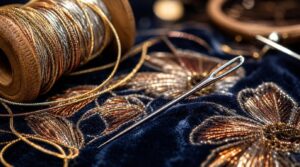
The needle you pick makes or breaks your metallic thread project — literally. Not all needles handle that foil-wrapped thread without shredding it to pieces.
A sewing machine needle guide for costume making can help you match the right needle size and type to your specific metallic thread before you ruin an entire spool finding out the hard way.
Here’s what you need to know before you thread up.
Why Metallic Needles Reduce Shredding and Breakage
Metallic thread shreds when there’s too much friction — and that’s exactly what a standard needle creates. Using larger eye needles helps minimize friction and prevent breakage.
Choosing the right needle for metallic thread means picking one with a Reduced Friction Eye, Enhanced Groove Protection, and a Stiff Shaft Stability that won’t flex mid-stitch. Coated Surface Heat stays lower, too, so the foil wrapping survives.
The result? Consistent Thread Feed, fewer breaks, cleaner stitches.
When to Choose a Topstitch Needle Instead
Sometimes a topstitch needle outperforms even a metallic needle. Here’s when to reach for one instead:
- Heavy Fabric Layers — thick denim or canvas needs the deeper groove to push through cleanly.
- Decorative Edge Stitching — bolder, crisper lines with less thread breakage.
- Hardware Stitching — near zippers or grommets, the reinforced eye manages tension spikes.
- Multi-Thread Assemblies — multiple strands feed more smoothly through a topstitch eye.
- High-Speed Topstitching — reduced friction keeps thread tension stable under pressure.
Best Needle Size for 40 Wt Metallic Thread
For most 40 wt thread on medium-weight fabrics, the 90/14 metallic needle is your go-to. Its needle groove width accommodates the foil-wrapped thread core material without shredding it.
Working with lighter fabric grain alignment? Drop to an 80/12 needle to avoid puckering.
Both sizes handle stitch density effects well, and needle coating benefits keep the eye smooth through long runs.
Best Needle Size for 30 Wt Metallic Thread
Step up to a 30‑wt thread, and thread gauge correlation matters more.
A 90/14 needle manages light-to-medium fabric weave compatibility without issue. On heavier fabric, needle shaft strength becomes the deciding factor — that’s when you reach for a 100/16.
Either way, thread coil relaxation before sewing helps prevent early breakage. Skip the 80/12 needle; it’ll crowd the thread.
When to Use a 100/16 Needle
Reach for the 100/16 when your project involves heavy denim, leather upholstery, thick canvas, or multi-layer quilts. This needle size punches through dense fabric without skipping stitches.
Its reinforced shaft meets industrial stitching demands, and the large eye accommodates bulky metallic braid cleanly.
Selecting the right needle for metallic thread on heavy material means this size—nothing smaller.
Why Elongated Eyes Matter for Metallic Thread
Ever wonder why your metallic thread keeps shredding at the needle? The culprit is usually a standard eye — too small, too tight.
An elongated eye (about 2 mm) changes everything. Here’s what it actually does for you:
- Reduces thread friction reduction at the entry point
- Maintains foil reflection consistency by minimizing stripping
- Improves stability of tension during long stitching runs
- Prevents heat buildup mitigation through smoother passage
- Ensures thread feed smoothness without compression
That wider opening lets metallic thread breathe.
Chrome Vs Titanium-coated Needle Durability
Chrome-plated steel needles cost less upfront, but they wear faster with metallic thread — burrs develop more quickly, and thread friction climbs. For occasional projects, chrome works fine.
Titanium needles cost more, yet their harder coating manages heat dissipation better during long runs. The lifetime under load is considerably longer. For heavy or daily embroidery, the cost‑benefit analysis clearly favors titanium.
Needle durability pays for itself.
Top 7 Metallic Thread Essentials
Getting the right supplies makes metallic thread so much easier to work with.
Beyond the needle, a few key tools — the right thread, a good stand, and a thread net — can save you from constant breakage and frustration.
Here are seven essentials worth having in your setup.
1. ThreadNanny Metallic Embroidery Thread Set
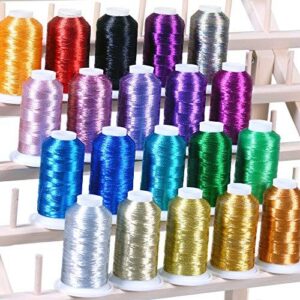
Twenty colors, 1,100 yards each — that’s a serious stash. The ThreadNanny Metallic Embroidery Thread Set gives you 40 wt polyester metallic thread wound on mini-king cones, shrink-wrapped individually to block dust and moisture.
Each spool is azo-dye-free, so it’s safe for kids’ projects and skin-contact items. High tensile strength keeps breakage low even at faster speeds.
Just know — you’ll need to thread it manually. Most auto-threaders won’t cooperate with metallic filament. Position your spool upright and give it room to breathe.
| Best For | Embroiderers who do production-level or detail work and want a reliable metallic thread that holds up through repeated washing without fading or breaking. |
|---|---|
| Material | 100% polyester metallic |
| Primary Use | Machine embroidery |
| Compatibility | Most embroidery machines |
| Pack Quantity | 20 spools |
| Thread Breakage | High tensile strength reduces breakage |
| Price Range | Mid-range bulk set |
| Additional Features |
|
- 20 colors with 1,100 yards each — you’re not running out anytime soon
- High tensile strength means fewer breaks and less frustration at high speeds
- Azo-dye-free and skin-safe, so it works great for kids’ clothing and heirloom pieces
- Auto-threaders won’t work — you’ll need to thread it by hand every time
- Metallic thread is fussy about tension; you’ll likely need to dial it down to around 4
- Some spools have shown up with uneven winding or damaged wire, so it’s worth inspecting before you stitch
2. KingStar Gold Metallic Embroidery Thread
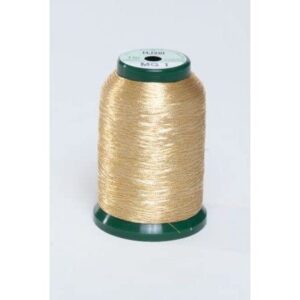
Gold thread that actually behaves — that’s KingStar’s pitch, and it mostly delivers. This 40 wt polyester core thread wraps a rice-paper metallic finish around a stable base, which cuts down on kinking as it unwinds.
It runs through standard pre-tensioners without fuss, so you won’t need to slow your machine or swap needles just to use it.
At $19.95 for 3,000 meters, the value is hard to argue with. Just watch your tension on older machines — some users report occasional fouling.
| Best For | Embroiderers who want reliable metallic thread that works with their existing setup — no needle swaps, no speed adjustments, just plug and stitch. |
|---|---|
| Material | 100% polyester with rice-paper wrap |
| Primary Use | Machine embroidery |
| Compatibility | Standard embroidery machines |
| Pack Quantity | 1 spool |
| Thread Breakage | Reduced breakage via 40wt design |
| Price Range | Mid-range single spool |
| Additional Features |
|
- Runs smoothly through standard pre-tensioners without any machine modifications
- 3,000 meters at $19.95 is genuinely great value for metallic thread
- The polyester core keeps kinking to a minimum, so you’re not stopping to untangle every few minutes
- Older or high-speed machines may experience thread fouling, and tension tweaking can eat up time
- The rice-paper wrap is more fragile than synthetic alternatives — handle the spool carefully
- No brand warranty or support to fall back on if things go sideways
3. SCHMETZ Metallic Sewing Needles
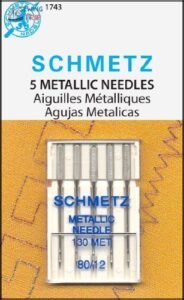
Schmetz built these needles specifically for metallic thread — and the difference shows. Each 80/12 needle (sold in packs of 5 for $6.29) features an elongated, Teflon-coated eye that lets foil-wrapped thread glide through without shredding.
The polished eye is the real win here. Most thread breakage happens right at that pinch point.
The wider groove also keeps tension even across the shaft.
One heads-up: they don’t play well with some needle threaders, like the Baby Lock Destiny.
| Best For | Quilters and embroidery enthusiasts who regularly work with metallic, clear, or nylon specialty threads and want fewer thread breaks and smoother stitching. |
|---|---|
| Material | Steel with Teflon coating |
| Primary Use | Machine embroidery |
| Compatibility | Standard home machines |
| Pack Quantity | 5 needles |
| Thread Breakage | Teflon eye minimizes shredding |
| Price Range | Budget-friendly pack |
| Additional Features |
|
- The Teflon-coated, double-sized eye lets metallic thread glide through without fraying or shredding
- The front groove and scarf keep thread tension steady, which means cleaner, more consistent stitches
- Works great for both machine embroidery and decorative quilting projects that call for specialty threads
- May not work with certain needle threaders, including the popular Baby Lock Destiny
- Packs of only 5 needles means high-volume sewers will need to reorder pretty often
- Overkill if you’re mostly stitching with regular cotton or polyester thread — a standard needle will do just fine
4. Schmetz Topstitch Sewing Machine Needle
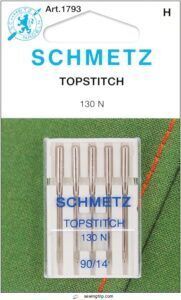
If metallic needles aren’t solving your breakage problem, try stepping sideways instead of up.
The Schmetz Topstitch 90/14 (model 73444) has an elongated eye and a chrome-plated shaft that cuts friction and runs cooler on long seams. That chrome finish makes a real difference with abrasive foil thread.
It fits every major home machine — Brother, Singer, Janome, Baby Lock — and the reinforced shaft resists bending under pressure.
One needle per card, which feels fussy, but the performance justifies it.
| Best For | Sewists working with thick threads, metallic or foil thread, denim, canvas, or leather who need a reliable needle that won’t skip stitches or shred thread on long seams. |
|---|---|
| Material | Steel reinforced shaft |
| Primary Use | Topstitch and quilting |
| Compatibility | All major home machine brands |
| Pack Quantity | 1 needle |
| Thread Breakage | Elongated eye reduces shredding |
| Price Range | Premium single needle |
| Additional Features |
|
- Elongated eye makes threading bulky or metallic thread way easier and cuts down on breakage mid-project
- Reinforced shaft holds up under pressure — great for heavy fabrics like denim and canvas
- Fits all the major home machine brands, so no compatibility headaches
- Sold one needle per card, which gets inconvenient fast if you’re burning through needles on a big project
- Pricier than generic needles, so bulk use adds up quickly
- Optimized for topstitching and quilting — not the best pick for fine embroidery or industrial machines
5. Embroidex Embroidery Thread Stand
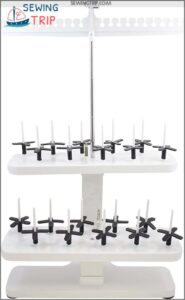
Once you’ve sorted your needle situation, your thread feed becomes the next headache. The Embroidex Thread Stand holds up to 20 spools — King cones, mini‑kings, snap spools — all on one two‑level rack.
A longer thread path means less tension and fewer breaks.
At $27.99, it’s genuinely useful for multi‑color embroidery projects where constant rethreading kills your momentum. The sand‑weighted base keeps things steady, though heavy spools can shift it.
Still, for organized, tangle‑free feeding, it does the job.
| Best For | Embroiderers working on multi-color projects who want their threads organized, accessible, and ready to go without constant rethreading interruptions. |
|---|---|
| Material | Polypropylene plastic |
| Primary Use | Multi-spool embroidery |
| Compatibility | Most spool types and sizes |
| Pack Quantity | 1 stand |
| Thread Breakage | Smooth feeding reduces breakage |
| Price Range | Mid-range accessory |
| Additional Features |
|
- Holds 20 spools of mixed types — King cones, snap spools, mini-kings — so everything you need is right there in one spot
- Thread guide and retainer system keeps feeding smooth and reduces frustrating mid-project breaks
- At $27.99, it’s a low-cost way to seriously speed up your workflow on complex designs
- Assembly instructions are vague, and a handful of the included accessories leave users guessing about what they even do
- The sand-weighted base can still shift when heavier spools are loaded up top
- It’s a big footprint — about 16 inches wide — so smaller sewing tables may not have the depth to accommodate it comfortably
6. Lightweight Thread Stand for Embroidery
If the Embroidex feels like too much real estate on your table, this lightweight stand is worth a look. It holds up to three spools vertically — exactly how metallic thread wants to feed — and tucks neatly into a small workspace.
The built-in bobbin tray stores 12 pre-wound bobbins, which is genuinely handy.
Fair warning: it’s lightweight plastic, so, loaded with heavy spools, it tips. A bean bag underneath fixes that fast.
| Best For | Home sewists and embroiderers who work with metallic or specialty threads and need a compact, budget-friendly way to manage multiple spools without hogging table space. |
|---|---|
| Material | Injection-molded plastic |
| Primary Use | Home embroidery and sewing |
| Compatibility | Small to large domestic spools |
| Pack Quantity | 1 stand |
| Thread Breakage | Snag-free flow reduces breakage |
| Price Range | Budget accessory |
| Additional Features |
|
- Holds three spools at once with vertical hoops that keep thread feeding smoothly — especially great for metallic threads
- Built-in tray holds 12 bobbins, so your whole setup stays in one spot
- Lightweight and collapsible, so it’s easy to pack up and take to a class or retreat
- Thin plastic tips over easily when loaded with heavier spools — you’ll want a bean bag or some weight at the base
- Joints can feel flimsy; some users end up reinforcing them with glue over time
- Plastic hoops only — no metal eyelets, so if you want smoother feed for delicate threads, you’d need to modify it yourself
7. Brothread Thread Net Spool Saver
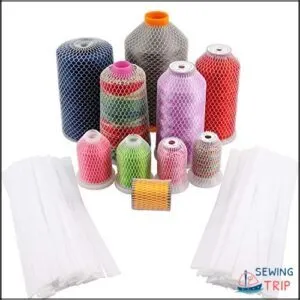
Thread nets might be the smallest fix that makes the biggest difference.
The Brothread Thread Net Spool Saver stretches to fit spools from 2 cm up to 9 cm wide — so it accommodates everything from mini 500‑m spools to standard embroidery cones.
It keeps metallic thread from unwinding mid‑session and feeds it more evenly off the spool. One pack gives you 100 nets. Skip it on heavy 5,000‑m industrial cones, though — too much resistance.
| Best For | Embroiderers, quilters, and sewists who work with slippery threads like metallic, rayon, or silk and want a simple way to keep spools tidy and feeding smoothly. |
|---|---|
| Material | 100% rayon mesh |
| Primary Use | Thread spool management |
| Compatibility | 2cm to 9cm diameter spools |
| Pack Quantity | 100 nets |
| Thread Breakage | Consistent tension reduces breakage |
| Price Range | Budget bulk pack |
| Additional Features |
|
- Stretches to fit a wide range of spool sizes (2 cm to 9 cm), so one pack covers most of your thread collection
- Helps metallic and slippery threads feed more evenly, which means fewer tension headaches mid-project
- 100 nets per pack makes it a genuinely cost-effective alternative to pricier spool huggers
- Not a good fit for heavy 5,000 m industrial cones — the added tension can make thread hard to pull and may cause breakage
- Cutting nets to shorter lengths can leave rough edges that snag thread if you’re not careful about trimming
- Rayon mesh may feel overly snug on heavier spools, which can slow down your workflow
Choosing The Right Needle Size
Needle size is one of those details that looks small but makes a huge difference.
Get it wrong and you’ll be rethreading every five minutes.
Here’s what you need to know to match the right size to your thread and fabric.
80/12 Needles for Lightweight Fabrics
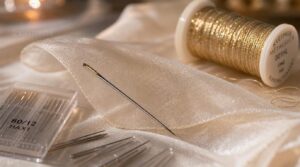
For lightweight fabrics, the 80/12 needle is your starting point. Its slender shaft minimizes fabric pull and keeps stitch quality consistent on silks, voile, and quilting cotton. Eye size compatibility matters here — the smaller eye suits standard threads, but metallic thread needs extra attention to the thread feed.
- Watch for fraying near the eye
- Store needles properly (needle storage prevents tip damage)
- Test on scraps first
- Replace at first sign of fuzz
90/14 Needles for Heavier Metallic Threads
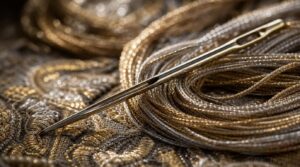
Step up to a 90/14 needle once your metallic thread hits 30–40 wt or your fabric gets heavier. The groove depth advantage here is real — that deeper channel guides metallic thread through cleanly, cutting shredding fast. Coating wear resistance from titanium or chrome means this needle type lasts longer under pressure.
Tension calibration tips: drop your upper tension to 1–1.5. Stitch density effects and fabric compatibility both improve immediately.
100/16 Needles for Thick Metallic Braid
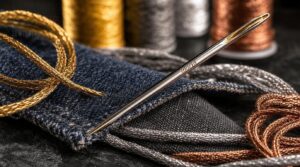
Heavy metallic braid — we’re talking Tex 69 thickness — needs a 100/16 needle, full stop. Shaft stiffness keeps the needle from flexing through denim and canvas, and the eye groove design lets thick braid feed smoothly without shredding.
Coated needle longevity matters here too; titanium or chrome holds up under that abrasion.
Drop your thread tension low, and you’re set.
Matching Needle Size to Fabric Weight
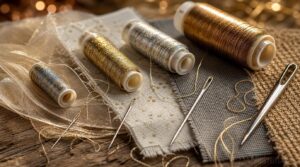
Fabric weight categories aren’t just labels — they’re your roadmap to needle size scaling. Silk and chiffon call for a 70/10; quilting cotton wants an 80/12; canvas demands a 100/16.
- Light fabrics tear with oversized needles
- Layered fabric guidance: add layers, bump up one size
- Weave tightness influence matters as much as weight
Match both, and thread tension balance follows naturally.
Matching Needle Size to Thread Weight
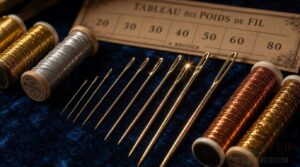
Thread weight drives needle size just as much as fabric does. Weight-driven needle pairing is simple once you see the pattern: 40 wt metallic thread needs an 80/12 or 90/14 needle; 30 wt needs a 90/14 or 100/16.
Think of thread weight charts as your needle gauge correlation guide — heavier thread, bigger eye. These thread thickness guidelines exist because forcing thick thread through a small eye shreds the foil coating quickly.
Why Universal Needles May Damage Metallic Thread
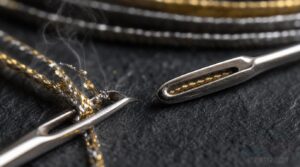
Universal needles seem harmless — until your metallic thread starts shredding mid-project. The problem is structural.
Eye Size Mismatch forces the thread to bend too tightly, while Groove Depth Insufficiency lets it slip and catch. Sharp Tip Nicking scratches the foil coating, Thread Path Deviation causes tension spikes, and Heat Build-up weakens the core fast. That’s real thread breakage and thread fraying waiting to happen.
Why Ballpoint Needles Are Usually Unsuitable
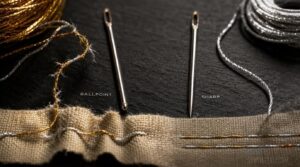
Ballpoint needles aren’t your friend here. Their rounded tip pushes fibers apart instead of piercing cleanly — that’s a recipe for Fabric Skipping on woven fabrics. The result? Puckering Distortion, Inconsistent Tension, and poor Stitch Quality.
Add metallic thread’s foil coating into the mix, and Thread Friction spikes fast. Stick with a sharp needle or topstitch needle to prevent thread breakage.
Machine Settings for Metallic Thread
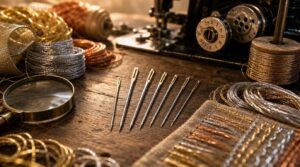
Metallic thread is fussy — and your machine settings are where most sewers lose the battle.
few small adjustments can mean the difference between smooth, shimmering stitches and a pile of frayed thread on your floor.
exactly what to change before you start sewing.
Lowering Upper Thread Tension to Prevent Snapping
Metallic thread snaps when the upper tension grips too tightly — it’s that simple.
Start your tension dial at 1–3, not the mid-range you’d use for cotton.
WonderFil works best around 1; Premium Threads settle nicely between 1.0–1.5.
Upper Dial Tweaking takes patience, so run a Test Stitch Loop on scrap fabric first.
Small adjustments prevent big heartbreaks.
Slowing Stitch Speed to Reduce Foil Stripping
Tension sorted? Now slow down — literally. Set your speed to 350 spm or lower.
Fast needle movement creates heat buildup reduction problems, pulling the foil coating right off its core. Think of it as Foil Adhesion Timing: slower stitching gives the foil wrapped thread micro-moments to resettle between passes.
Use your machine’s Speed Slider Calibration to lock that pace in.
Using Longer Stitch Lengths With Metallic Thread
Speed dialed back? Good. Now stretch your stitch length to 3–4 mm.
Longer stitches are your best tool for Stitch Density Reduction — fewer needle penetrations mean better Heat Dissipation and less stress on the foil coating.
You’ll also notice Edge Shine Enhancement along decorative lines.
For Fabric Stretch Management on knits, stay closer to 3 mm to keep things smooth.
Disabling Automatic Thread Cutters
One overlooked setting can quietly wreck your metallic thread: the automatic thread cutter. That blade dulls fast on metallic wire, nicking your thread before you even notice.
Disable it. Go to Menu → Thread Cutter → Off or Manual — your Cutter Safety Override.
Manual Thread Trimming puts you in control:
- Check that your display confirms "Off" before stitching
- Watch for Pedal Interaction Effects — partial release can still trigger cuts
- Manage Thread Tail Management by trimming floats yourself
- Review Firmware Cutter Settings after updates; they often reset to Auto
- Test on scrap first — always.
Pairing Metallic Thread With Lightweight Bobbin Thread
Your bobbin choice matters more than most people think. Bobbin Weight Matching is simple: use 60–80 wt lightweight bobbin threads. Heavy bobbin thread fights metallic thread from below, causing puckering and thread friction, you’ll spend hours diagnosing.
| Factor | Best Choice | Avoid |
|---|---|---|
| Bobbin Thread Material | Smooth polyester | Cotton |
| Color Coordination | White/gray match | Contrasting colors |
| Weight | 60–80 wt | Heavier than 50 wt |
Adjusting Dense Embroidery Designs for Metallic Thread
Dense designs and metallic thread are a bad combination — the foil coating can’t handle the stress. Simplify by applying Pattern Density Reduction and Negative Space Design so the shimmer actually shows.
- Increase Satin Column Spacing to reduce heat and fraying.
- Use open fill patterns for Thread Path Streamlining.
- Match Stabilizer Weight Matching to your fabric thickness.
- Lower stitch density and check thread tension before starting.
Preventing Metallic Thread Breakage
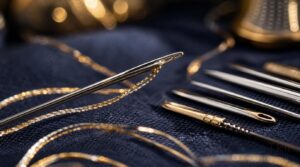
Metallic thread breaks for reasons you can actually fix.
Most of the time, it comes down to you prep and feed the thread before it even reaches the needle. Here’s what to do differently.
Using a Vertical Thread Stand for Smoother Feeding
A vertical thread stand is one of those small upgrades that makes a surprisingly big difference. Feed Angle Optimization is the real win here — the thread drops straight down instead of pulling sideways, which reduces tension spikes that snap metallic thread.
Weighted bases handle Vibration Dampening, while Guide Path Alignment keeps your 80/12 or 90/14 needle from fighting the feed.
A quick weekly Maintenance Routine — wiping lint from the guides — keeps everything running clean.
Preventing Kinks With Thread Nets
Thread nets are a quiet lifesaver for metallic thread. That Elastic Edge Snap grips the cone snugly — that’s your Cone Stabilization Method working.
The Mesh Tightness Control slows the feed just enough for Thread Feed Uniformity, keeping the needle eye size from fighting sudden slack.
Make this your Kink Prevention Routine: net on, thread tension steady, no kinking.
Applying Thread Lubricant or Beeswax Carefully
A little beeswax goes a long way — seriously, Light Wax Application is everything here. Run your thread across the beeswax bar two or three times for an Even Coating, then press it between folded fabric to remove excess.
Quantity Control matters: too much wax gums the needle eye. A silicone-based thread lubricant works better for Machine Compatibility on faster machines.
Letting Metallic Thread Relax Before Sewing
Wax sorted, now give your thread a breather. Relaxation Duration matters more than most sewists realize — let the spool sit on your vertical thread stand for 5–10 minutes before threading.
This simple Thread Conditioning step straightens coiled sections and calms that "squirrely" feed behavior.
After thread unwinding settles, adjust your Post-Relaxation Tension slightly lower. Then do Stitch Consistency Monitoring on a scrap — you’ll notice fewer breaks immediately.
Choosing Cut-away or No-show Mesh Stabilizer
Your stabilizer choice directly affects Fabric Drape Impact and Light Fabric Visibility.
Cut-away stabilizer manages high stitch density well — it’s your go-to for dense metallic fills on cotton or linen. But on delicate knits or silk? No-show mesh stabilizer wins every time. It’s softer, nearly invisible, and preserves drape.
When Weight vs Support feels like a toss-up, layer both.
Replacing Needles After Visible Fuzz or Burrs
Your needle inspection routine matters more than most people realize. Replace the needle the moment you spot fuzz near the eye — that fuzz means burrs are already forming.
Replace your needle the moment you see fuzz near the eye — burrs are already forming
Plan for roughly eight hours of sewing before swapping out, but don’t wait that long if shredding starts earlier. Keep spare needles ready — an 80/12 or 90/14 titanium needle nearby saves your project quickly.
Troubleshooting Shredding, Fraying, and Tension Issues
Shredding usually points to one of three culprits: a Thread Path Obstruction, poor Bobbin Tension Balance, or a needle that’s past its prime.
Rethread completely — every guide, every time.
Check your Feed Mechanism Maintenance and Fabric Grain Alignment, too, since misaligned fabric increases friction quickly.
An 80/12 or 90/14 needle in the right needle material fixes most metallic thread shredding and fraying instantly.
Frequently Asked Questions (FAQs)
What kind of needle do you use for metallic thread?
For metallic thread, reach for a topstitch or metallic needle — think larger eye, reinforced scarf, and chrome or titanium coating. These features together handle the foil-wrapped thread without shredding it.
Can metallic thread be used for hand embroidery?
Yes, you can. Metallic embroidery thread adds gorgeous Color Contrast on dark fabrics.
Use a needle with a larger eye, keep lengths short, and apply light wax for smoother metallic thread handling.
How do you store metallic thread between projects?
Ever wonder why your metallic thread snaps mid-project? Poor storage is often the culprit.
Cool dry storage, smart spool organization, and protective accessories like thread nets keep foil coatings intact between sessions.
Which fabrics should you avoid with metallic thread?
Skip high‑stretch knits, slippery satin, coarse woven fabrics, starch‑treated fibers, and heavy appliqué fabrics. These fabric types shred metallic thread quickly.
Stick with smooth, stable weaves for best results.
Does metallic thread work well for quilting projects?
Quilting cotton is a sweet spot for metallic thread — smooth, stable, and forgiving.
With the right thread tension, stabilizer, and an 80/12 or 90/14 needle, stitch visibility and design complexity both shine beautifully.
How do brand-specific metallic threads differ from each other?
Brand-specific metallic threads differ in core material, coating type, colorfastness level, and foil thickness. Spool winding tension also varies, affecting how smoothly the thread feeds through your machine.
Conclusion
Metallic thread doesn’t forgive careless choices—but it rewards the right ones. Once you match the best needle for metallic thread to your project, dial in your tension, and let the thread feed freely, something shifts.
That glittery, temperamental material stops fighting you. The machine runs smoother. Your stitches land clean.
What once felt like a battle becomes almost easy. Give it the right conditions, and metallic thread stops being the problem—it becomes the point.
- https://www.schmetz.com/en/household-needles/products/single-needles/metallic-needle/
- https://youmakeitsimple.com/2018/07/20/diy-cone-thread-holder/
- https://impactdigitizing.com/
- https://www.hooptalent.com/collections/industrial-magnetic-hoop
- https://www.embroideryhoopstore.com/collections/magnetic-hoops-for-industrial-machines