This site is supported by our readers. We may earn a commission, at no cost to you, if you purchase through links.
Somewhere between your third unpicked seam and a slightly crumpled Drunkard’s Path block, most quilters make a quiet decision: there has to be a better way.
There is. Curved foundation piecing puts a printed paper backbone under your fabric, giving every arc a built-in road map before your needle ever touches the cloth. That single change eliminates the guesswork that makes curved blocks feel so intimidating—no more wrestling with bias stretch on tight curves or hoping your concave and convex edges will behave.
Whether you’re tackling a Double Wedding Ring or a two-inch mini block, the steps ahead will get you there cleanly.
Table Of Contents
- Key Takeaways
- What is Curved Foundation Piecing?
- Essential Tools for Curved Foundation Piecing
- Preparing Fabric and Foundation Templates
- Sewing Curved Foundation Pieces
- Placing Fabric on The Foundation Correctly
- Matching Centers, Ends, and Quarter Points
- Pinning Curved Edges to Prevent Puckers
- Using Glue Basting Instead of Pins
- Setting Stitch Length for Curved Seams
- Sewing Slowly With Needle-down Control
- Maintaining a Consistent Quarter-inch Seam Allowance
- Easing Convex and Concave Curves Together
- Pressing and Troubleshooting Curved Seams
- Frequently Asked Questions (FAQs)
- Conclusion
Key Takeaways
- A printed paper foundation under your fabric gives every curved seam a built-in guide, eliminating the bias stretch and guesswork that make curved blocks so frustrating.
- Matching centers, ends, and quarter points before you sew is the single biggest thing you can do to keep your curves smooth and gap-free, block after block.
- The right tools — a 28mm rotary cutter for tight arcs, the correct presser foot, and fabric-weight foundation paper — do most of the heavy lifting so you don’t have to fight your materials.
- Pressing over a tailor’s ham with a dry iron and clipping only the concave seam allowance are what separate a flat, polished curved block from a lumpy, puckered one.
What is Curved Foundation Piecing?
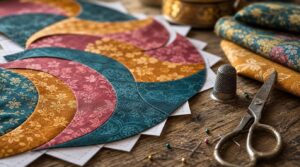
Curved foundation piecing takes the challenge out of sewing tricky, swooping curves by giving your fabric a paper backbone to follow.
It’s a surprisingly forgiving technique, making it a great place to start if you’re just learning how to begin a hand sewing project from scratch.
This technique opens up a whole new world of quilt designs — think Drunkard’s Path, Double Wedding Ring, and beyond.
Here’s what sets it apart: it might just become your new favorite way to sew.
How Curved Foundation Piecing Differs From Standard Curved Piecing
Think of standard curved piecing as freehand cooking — you’re eyeballing everything. Curved foundation piecing flips that completely. You’re working from fixed seam lines printed right on your foundation, so template reliance does the heavy lifting.
Curved foundation piecing trades freehand guesswork for fixed seam lines, letting the template do the heavy lifting
That means distortion control happens naturally, consistent repeatability becomes almost easy, and foundation extraction after stitching leaves you with clean, precise curves every single time.
This method echoes the no‑pins, no‑templates approach celebrated for its improvisational freedom.
When to Use Foundation Paper for Curved Seams
Foundation paper really shines when curves get tricky. If your block is smaller than 4 inches, tiny curve stability becomes a real challenge — that’s where a paper template saves you. It’s also your best friend for bias stretch control, heavy fabric support, and motif alignment.
And when you’re repeating a curved block across a whole quilt? Consistency becomes easy.
Benefits for Accuracy, Stability, and Repeatable Shapes
Foundation paper locks in seamline consistency from the very first stitch, ensuring real curve uniformity block after block. By maintaining starch usage for fabric stability, it effectively controls bias stretch.
Template alignment and seam-allowance management further enhance dimensional precision, resulting in a predictable block fit, every time.
Best Quilting Projects for Curved Foundation Piecing
Once your blocks are accurate and stable, it’s time to put them to work. Start with a Feathered Runner or a simple Quarter-circle block — both are forgiving Beginner curved piecing project ideas.
Ready to level up? Try a Log Cabin Quilt, Spiral Block Quilt, or the stunning Orbit Circle Quilt.
The Cathedral Arch Design and Curved table runner quilting projects are crowd-pleasers too.
Curved Foundation Piecing Vs Paper Piecing
Both methods get you to beautiful curves, but they take different roads. Curved foundation piecing excels in time efficiency — no perforating, no tedious paper removal after every seam. Paper templates shine when edge precision really matters, like intricate mandala designs.
Here’s a quick cost comparison and learning curve breakdown:
- Curved foundation piecing controls fabric stretch better on large, sweeping arcs
- Paper template printing works best for tight, multi-segment curves needing exact alignment
- Both reward practice — this curved seam technique in quilting gets easier with every block
Essential Tools for Curved Foundation Piecing
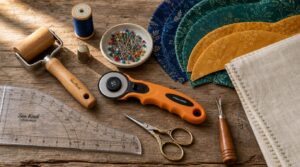
Having the right tools really do make all the difference with curved foundation piecing. You don’t need a huge collection — just a handful of well-chosen ones that work together. Here’s what you’ll want to gather before you start.
Choosing Foundation Paper or Tracing Paper
Your paper choice matters more than you’d think. Lightweight foundation paper (around 20–30 gsm) offers the best peel-away ease after stitching, while tracing paper excels in transparency level—ideal for precise fabric placement.
Ensure ink compatibility with your home printer before purchasing. Both options are cost-effective, so prioritize whichever feels more practical for your project.
Using Acrylic Templates or Printable Templates
Choosing the right template can make or break your curves. Durable acrylic templates offer clear edge precision—you’ll see exactly where you’re cutting every single time—and they hold up through hundreds of cuts. Printable templates win on cost efficiency; just download, scale, and test.
- Acrylic: reusable, grippy, built-in seam guides
- Printable: budget-friendly, custom digital scaling
- Both support adhesive placement for steady, accurate curve cuts
Rotary Cutter Sizes for Gentle and Tight Curves
Blade size selection really does matter. Your 45mm rotary cutter manages gentle curves beautifully, while curve radius matching gets easier when you switch to a 28mm blade for tighter arcs. For small arc precision on tiny pieces, that 28mm blade is your best friend.
Practice blade change technique on scrap fabric first, and always follow basic cutter safety tips.
Self-healing Cutting Mats for Accurate Cutting
A good self-healing cutting mat is a transformative tool for template-based curve cutting in quilting. Its self-resealing surface protects your rotary cutter and enhances blade longevity over time.
Here’s what to look for in a quality mat:
- Grid Alignment: Printed inch and metric lines ensure precise, true cuts.
- Mat Thickness: Opt for 5–7 mm to balance durability and flexibility.
- Edge Reinforcement: Prevents curling under heavy or prolonged use.
- Surface Rotation: Regular rotation spreads wear evenly, extending the mat’s lifespan.
- Cutting Mat Surface: Should resist deflection when using rotary blades for curved cuts, maintaining stability.
Fabric Markers for Light and Dark Fabrics
The right marker makes all the difference. For light fabrics, a fabric-safe pencil or water-soluble pen ensures clean, temporary lines. Dark fabrics require chalk pens or heat-erasable markers for visibility. Always prioritize opacity selection—matching your marker to the fabric is essential.
| Fabric Type | Best Marker |
|---|---|
| Light cotton | Water-soluble pen |
| Dark fabric | Chalk pen |
| Any color | Heat-erasable fabric markers |
| Permanent lines | Fabric-safe pencil |
Heat fixing locks pigment into the fabric, while erasable markers vanish when your project is complete. Prioritizing color longevity and fabric-safe inks ensures your quilt remains vibrant and stain-free, wash after wash.
Pins, Glue Sticks, and Alignment Tools
Once your marks are on, it’s time to hold everything in place. Fine glass-head pins or color-coded pins work beautifully for pinning and aligning curved fabric pieces — use them at the center, ends, and quarter points. If you prefer glue, a clear glue stick lets you pin or glue baste before sewing without shifting.
Micro pegs, magnetic pins, and a bendable ruler round out your alignment game perfectly.
Presser Feet and Seam Guides for Curves
Your presser foot makes or breaks a curved seam. Swap your standard foot for one of these:
- Curve Master foot — short toe reduces bias distortion on tight curves
- Edge guiding foot — built-in guide locks your seam alignment accuracy
- Quarter-inch foot — keeps consistent distance on Drunkard’s Path blocks
- Glass view foot — transparent sole so you see exactly where you’re easing
Specialty piecing feet and presser foot guides do the heavy lifting, so you’re steering, not fighting.
Preparing Fabric and Foundation Templates
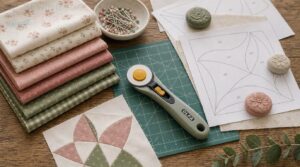
Good prep work is honestly half the battle with curved foundation piecing.
Before you sew a single stitch, there are a few steps that’ll set you up for cleaner cuts, steadier seams, and pieces that actually behave. Here’s what to do before your rotary cutter ever touches the fabric.
Washing and Drying Cotton Before Cutting
Before you cut a single piece, wash your cotton — skipping this step is how warped blocks happen.
Use a cold water wash with a mild detergent (no brighteners) and tumble dry on low heat. Most cotton shrinks 3–5% the first time, so shrinkage control begins here.
| Step | Why It Matters |
|---|---|
| Cold water wash | Minimizes dye loss and shrinkage |
| Low-heat drying | Prevents heat distortion |
| Damp ironing | Eases grain for accurate cutting |
| Fully dry before cutting | Avoids moisture-caused skew |
Applying Starch to Reduce Bias Stretch
Now that your cotton is clean and dry, grab your spray starch. A light mist — think low-residue starch, not a soaking — is all you need for bias edge handling during curved piecing.
Starch concentration matters: too much, and your fabric cracks on curves. Let it dry partially before sewing. That starch drying time keeps edges pliable but controlled.
Printing Foundation Templates at Actual Size
Getting your template printing for quilts right saves you so much headache later. Always set your printer driver settings to 100% — no "fit to page," ever. This ensures accurate scaling from the start.
PDF preparation matters too: Open the file, disable auto-scaling, then print. Avoid default settings that might distort dimensions.
Afterwards, do a quick test square measurement with your ruler. Verify paper size matches and scale is true before cutting any fabric pieces. This final check prevents costly mistakes.
Marking Seam Lines, Notches, and Center Points
Marking your pieces well is where accuracy lives. Use fabric marking pencils—silver or white on dark fabrics, blue or gray on light ones—and draw seam lines parallel to each edge.
Prioritize these three for clean results:
- Seam line consistency along every curve
- Notch visibility for easy edge matching
- Center point accuracy at each midpoint crease
Aligning Templates With The Fabric Grain
Before you trace a single line, check that your template sits on the right grain. Line up the grainline reference with the fabric’s lengthwise threads, using the selvage alignment as your anchor. Pattern grain marks tell you exactly where each piece belongs.
| Fabric Type | Grain Tip |
|---|---|
| Woven cotton | Align lengthwise for minimal stretch |
| Linen | Watch cross-grain positioning carefully |
| Directional print | Rotate for directional print orientation |
| Slippery silk | Use stable backing before placing templates |
Cutting Pieces Oversized for Easier Easing
Cut each piece a little bigger than you think you need—about ¼ to ½ inch beyond the finished size. That extra edge surplus acts as your fabric stretch buffer, giving you room to ease convex or concave curves without pulling or puckering.
Align your template carefully, then trim flush after sewing. These extra millimeters make the whole seam easing margin work beautifully.
Sewing Curved Foundation Pieces
This is where all your prep work pays off — it’s time to sew. Getting curved pieces to lie flat and smooth comes down to a handful of techniques that work together from start to finish.
Here’s exactly what to do, step by step.
Placing Fabric on The Foundation Correctly
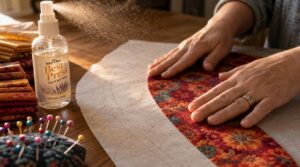
Place your fabric with the wrong side facing down on the foundation paper — that keeps the printed lines visible while you sew. Then smooth from the center outward to chase out any wrinkles.
Before you pin, run through these three quick checks:
- Wrong side orientation confirmed
- Edge-to-line alignment along the seam
- Full coverage check over your section
A light adhesive starch helps everything stay put without stiffness.
Matching Centers, Ends, and Quarter Points
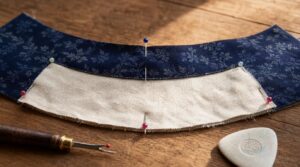
Think of it like a puzzle — every curved piece has three little "handshakes" waiting to happen: the center point, the ends, and the quarter marks. Secure your center alignment precision first, then work outward. End-point matching closes corner gaps, while quarter-point placement smooths the arc between them.
This reference point workflow ensures symmetric curve verification remains consistent across each block. By prioritizing these steps—center, ends, quarters—you maintain accuracy and eliminate gaps, block after block.
Pinning Curved Edges to Prevent Puckers
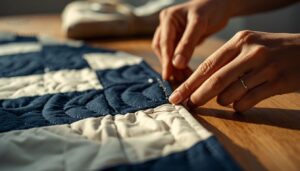
Pinning holds all that careful work in place. Start at the curve’s middle, then work toward each end — this is your pin placement strategy for keeping tension even. Use fine quilting pins spaced every one to two inches, placed perpendicular to the seam.
Remove each pin just before your needle reaches it to avoid puckers.
Using Glue Basting Instead of Pins
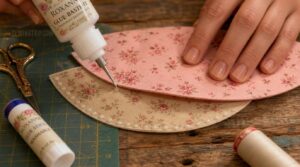
Not a fan of pins? Basting glue works beautifully for curved piecing. A washable glue stick ensures fabric compatibility without leaving residue, and the precision of a fine-tip applicator beats fumbling with pins on tight curves.
To glue baste like a pro:
- Apply tiny dots of basting glue along the concave edge — spacing them every inch keeps things secure without oversaturation.
- Press the convex piece on top, matching centers first, then smooth outward for efficiency along the whole seam.
- Let it tack for 30 seconds before sewing — the washable glue removes in your first machine wash, no fuss.
Whether you pin or glue baste, adhesive selection matters. Always test on scrap fabric first.
Setting Stitch Length for Curved Seams
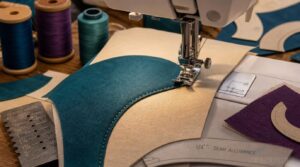
Stitch length ranges matter more than most beginners expect. For sharp curve settings, drop to 1.8–2.0 mm — that tight stitch keeps everything controlled. Gentle curve settings? Try 2.2–2.6 mm.
A quick thread tension tweak helps on very curved edges. Always use the scrap test method first — adjusting sewing machine settings for curves before touching your real fabric saves heartbreak.
Sewing Slowly With Needle-down Control
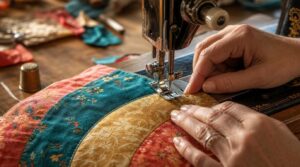
Once your stitch length feels right, slow everything down. Engage needle-down so the needle stays planted whenever you pause—that’s your controlled fabric pivot right there. No shifting, no guessing.
Each needle-down pause gives you a consistent stitch start and keeps your curved piecing method on track.
Take it slow, build that muscle memory training, and the sewing workflow clicks into place naturally.
Maintaining a Consistent Quarter-inch Seam Allowance
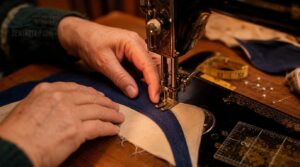
Your quarter-inch seam allowance makes or breaks every curved block. Get your seam guide calibration right first—sew a scrap, measure it, adjust.
- Use a true ¼-inch foot for consistent seam allowance management in curved piecing
- Check thread tension balance so fabric feeds without bunching
- Practice block verification confirms your needle size selection and fabric feeding pressure are spot-on
Easing Convex and Concave Curves Together
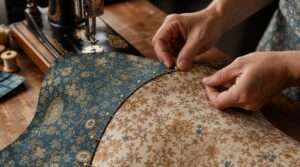
Think of it like fitting a puzzle piece—your convex outer curve is slightly longer than the concave inner curve, and that’s perfectly okay. Match centers first, then ends, working quarter points between.
Use flexible basting to hold everything steady before you sew. Gradual feed keeps tension equilibrium intact, while strategic clip points release any drag.
That’s seam allowance sync in action.
Pressing and Troubleshooting Curved Seams
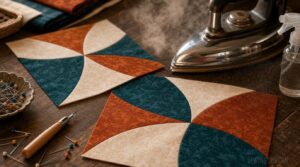
You’ve done the hard part — now it’s time to make those curves look polished and clean. Pressing and troubleshooting are where a good block becomes a great one, and a few simple steps make all the difference.
Here’s what to work through before calling your block done.
Pressing Curved Seams Without Distortion
Press curved seams with a dry iron — steam can stretch bias edges and ruin your shape. Use the tailor ham technique: set the seam over the ham’s curve and press seam allowances flat with steady iron pressure.
Lay a pressing cloth over delicate fabrics. Work in small sections, then allow cooling before handling so your beautiful curves hold their shape.
Clipping Tight Curves Safely
Clipping tight curves doesn’t have to feel scary — it’s really just about working smart. A few clean snips in the right spots make your seam allowance relax and lie flat beautifully.
- Use precision scissors for diagonal notching on the concave seam allowance only
- Practice clip sequencing: outer curve first, then inner
- Blade sharpness matters — dull blades drag and distort
- Use magnifier guidance on tiny, detailed curves
Removing Foundation Paper After Stitching
Start by gently lifting a corner — use tweezers for tiny bits stuck in seam intersections. Work inward toward the edges to protect your curved piecing.
A light mist of water loosens stubborn spots. Remove paper gradually; rushing causes seam distortion.
Sweep away residue with a soft brush before pressing.
Fixing Puckers, Pleats, and Uneven Curves
Puckers and pleats happen to everyone — don’t get discouraged. Most seam puckering stems from tension that’s too tight or fabric shifting mid-stitch.
Address tension issues first: drop your needle tension one to two notches. To prevent fabric movement, use Stabilizer Basting to secure layers before sewing, and employ an Even Feed Foot for consistent fabric feeding.
For smoothing uneven curves, combine Light Pressing with careful Clip Notching. These techniques refine seams and enhance overall finish.
Correcting Stretched or Wavy Fabric Edges
Wavy edges usually mean the bias gets stretched during handling — totally fixable. Start with machine tension adjustment: drop it a notch and re-sew.
Before your next attempt, try temporary adhesive basting to keep layers steady. Fusible stay tape along long edges helps manage fabric stretch effectively.
Use moisture-free pressing, then let pieces rest flat. This post-seam resting time is crucial for preventing fabric distortion.
Improving Accuracy on Small Curved Blocks
Small blocks demand extra care — a 4-inch curved block leaves very little room for drift. Mark your center point clearly, then use transparent ruler checks to verify your arc radius before cutting each piece.
Stitch pause markers help you redistribute ease distribution ratio evenly. With paper tension control and a presser foot with a guide, your curves will land precisely where they belong.
Beginner Project Ideas for Practice Blocks
Now that accuracy is clicking, put it to work. Start with a mini sampler quilt — try four small blocks, each with a different arc radius.
A half-square curve block is great for edge alignment, while a spindle curve block keeps piece count low. The teardrop block and arc wheel block add symmetry and tessellation practice.
Build these beginner tips for curved piecing into your own step-by-step guide.
Frequently Asked Questions (FAQs)
How do you improv curved piecing?
Improv curved piecing is all about trusting your eye. Sketch a freehand curve design, cut loosely with an adaptive seam allowance, and let fabric pairing improv and color block improvisation guide each spontaneous template sketch naturally.
What is improv curved piecing?
Think of improv curved piecing as quilting without a script. You cut free-form curves by eye, trust your instincts, and let spontaneous assembly guide the design.
As creative fabric flow shapes each seam, the process unfolds organically.
What is foundation piecing?
Foundation piecing is like having a map before a road trip — you follow a numbered paper template, sewing fabric pieces directly onto it in order for perfectly precise seams every time.
What is paper piecing?
Paper piecing is a quilting technique where you sew fabric pieces onto a paper template.
This process involves following printed lines in a set stitch sequence order to build shapes.
It can be done by hand or machine, resulting in precise, repeatable shapes.
Can curved foundation piecing work with stretch fabrics?
Yes, it can — but you’ll need a stabilizer selection like lightweight fusible interfacing, careful tension control, and smart interfacing choice. Always use the test swatch method first.
How do you store finished curved foundation blocks?
Stack your finished blocks flat on a dry, level surface using pallet support underneath.
Add spacers for airflow, weatherproof labels for organization, and a breathable seasonal covering to keep moisture out and your work protected.
What thread types work best for curved seams?
Polyester or cotton thread works great for curved seams. Silk thread glides through tight curves with less snagging. Core spun and high twist threads reduce fraying and keep your seam allowances clean and strong.
How do you scale curved blocks up or down?
To scale curved blocks, apply a proportional scale factor to both dimensions equally. Bounding box verification keeps your layout on track.
Always recalculate seam allowances after scaling so everything still fits together cleanly.
Can curved foundation piecing be done entirely by hand?
Oddly enough, slowing down gets you further ahead. Yes, hand stitching curved seams works beautifully — your needle size, thread abrasion resistance, and finger pinning control everything.
Conclusion
Picture a quilter who once abandoned every curved block she started—until she tried the curved foundation piecing technique on a simple Drunkard’s Path. That paper guide changed everything. Your curves stopped fighting back. Your blocks lined up the way they’re supposed to.
That’s what a solid foundation does—it turns frustration into flow. Now you have the tools, the steps, and the confidence.
Go cut that first arc. Your best curved work is just ahead.
- https://quiltsocial.com/sure-fire-method-for-sewing-curves-no-pins-or-clipping-required/
- https://www.allpeoplequilt.com/how-to-quilt/piecing/machine-minute-curved-piecing
- https://piecedbrain.com/2018/10/curved-paper-piecing-tutorial.html
- https://bryanhousequilts.com/2025/05/how-to-use-fabric-cutting-templates-for-foundation-piecing/
- https://blog.wholecirclestudio.com/7-tips-for-piecing-curves/