This site is supported by our readers. We may earn a commission, at no cost to you, if you purchase through links.
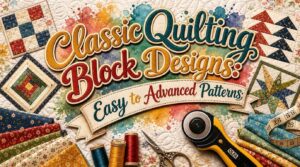
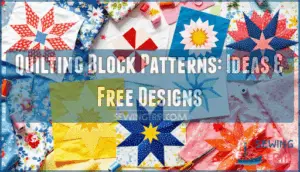
Some quilts made over 150 years ago still hold together—same blocks, same geometry, just different hands. That staying power isn’t luck. Classic quilting block designs were built to last, to teach, and to pass down. A Nine-Patch taught a child to cut straight. A Log Cabin told you which side of the hearth was warm. Every block carried meaning before it carried batting. Whether you’re picking up a rotary cutter for the first time or ready to wrestle diamonds into a Tumbling Blocks pattern, knowing your blocks is where everything starts.
Table Of Contents
Key Takeaways
- Classic quilt blocks like the Nine-Patch and Log Cabin weren’t just pretty — they were built to teach skills, tell stories, and survive generations of use.
- Block size changes everything: smaller blocks (6–8‑inch) demand more precision, while larger ones (12–15‑inch) move faster and suit bold, statement‑making patterns.
- Color contrast does most of the heavy lifting — pair light against dark in almost any block and the design practically builds itself.
- You don’t need to master everything at once; start simple, learn one block at a time, and the more advanced patterns (like Tumbling Blocks or Kaleidoscope) will click when you’re ready.
Easy Classic Quilt Blocks
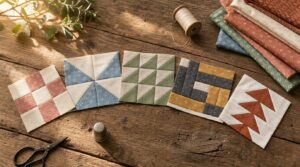
Starting simple is the smartest move any quilter can make. These five beginner-friendly blocks build the core skills you’ll use in every project after this. Pick one that catches your eye and go from there.
If free motion is your next step, these free motion quilting patterns for beginners make a natural follow-on once you’ve got the basics down.
Nine-Patch Block
The Nine-Patch Block is exactly where most quilters start — and for good reason. Nine equal squares in a 3×3 grid, sewn together in three rows. Simple, forgiving, and satisfying. Its Civil War origins show how practical it was: small scraps, big impact. Today, variations like the Double Nine-Patch and Crazy Nine-Patch keep it fresh for modern makers.
- Great teaching tool for seam precision
- Perfect for scrappy fabric leftovers
- Adapts easily into complex block variations
- Foundation for larger Nine Patch Quilt Block Patterns
Plus Sign Block
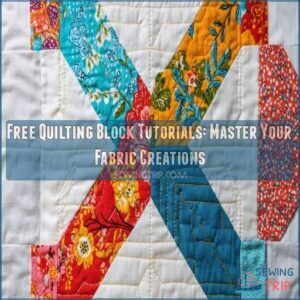
After the Nine-Patch, the Plus Sign block feels like a natural next step. Five equal squares — one center, four arms — form a clean cross. No tricky seams, no partial cuts. Just straightforward piecing that rewards accurate pressing.
Color contrast drives everything here. A dark center against light arms makes the cross pop. Flip it, and the whole mood shifts. The design mirrors the CSS plus sign layout that uses pseudo‑elements for crisp horizontal and vertical lines.
Pinwheel Block
The Pinwheel block is where patchwork starts to feel like magic. Four half-square triangle units spin around a shared center point, creating a blade-in-motion illusion that’s surprisingly easy to achieve. High contrast fabrics — think navy against cream — make the rotation pop. Swap the values, and the whole thing reverses direction.
Square-in-a-Square Block
From spinning blades to something more grounded — the Square-in-a-Square block proves geometry can feel simple. Four triangles wrap a center square, framing it cleanly. Contrast is everything here: dark triangles against a light center make the nested shape sing. Watch your bias edges during trimming, or corners drift. Done right, it’s a satisfying, precise little block.
Bread Basket Block
The Bread Basket block brings warmth to any quilt. Light and dark fabrics mimic woven materials — think cream, tan, and earthy brown. Triangles form the basket handle design, while small rectangles suggest stacked loaves inside. Precision piecing keeps those points sharp. Chain piecing speeds things up nicely. At four or six inches finished, it fits beautifully into sampler layouts.
Traditional Heritage Block Designs
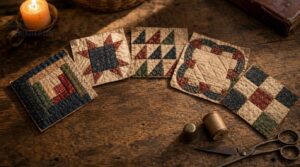
Some quilt blocks carry more than just color and shape — they carry stories. Heritage designs connect you to quilters who worked by candlelight, stitched through hard seasons, and passed their patterns down like heirlooms. Here are five traditional blocks worth knowing.
Each of these patterns has a story behind it, and you’ll find even more traditional quilting block patterns and their histories woven into the craft’s rich heritage.
Heritage quilt blocks carry stories — stitched by candlelight, passed down like heirlooms through hard seasons
Log Cabin Block
Few blocks carry as much history as the Log Cabin quilt block. It starts with a central square — traditionally red, symbolizing the hearth — then builds outward with rectangular strips in light-dark contrast. Alternate sides stay light, two stay dark. That simple rule creates striking diagonal drama. Use scraps freely; this block loves variety.
Ohio Star Block
The Ohio Star quilt block earns its place among the most beloved traditional quilt blocks. Built around a central square, four quarter-square triangle units form the star points, demanding real precision. Strong color contrast makes the star pop. Keep your corners crisp:
- Use 5-inch corner squares for a 12-inch finish
- Pair dark and light fabrics for maximum impact
- Trim every QST unit before assembling
Double Wedding Ring
Few quilt patterns carry as much heart as the Double Wedding Ring. Dating to the early 20th century, it became a symbol of unity — two interlocking rings, two lives joined. Its popularity soared during the Great Depression, when quilters found romance in its hopeful curves.
| Element | Tip |
|---|---|
| Curved piecing | Use templates for smooth, consistent arcs |
| Fabric choice | High contrast makes rings read clearly |
Go modern with multicolor ring sets for a blooming effect.
Grandmother’s Cross
The Grandmother’s Cross block holds a quiet power. It’s one of those heritage patterns that feels like finding an old letter tucked inside a quilt — personal, rooted, and full of meaning. The design arranges fabric pieces into a simple cross shape, and for beginners, paper piecing makes the angles manageable. Display your finished block in a shadow box to honor its story.
Old Maid’s Puzzle
The Old Maid’s Puzzle has roots stretching back to 19th-century America — named after the beloved card game that kept families gathered around parlor tables. It’s built from half-square triangles, pieced together to create a lively, spinning arrangement. Simple to cut, satisfying to sew. Try chain piecing your triangles for speed, and watch a surprisingly vibrant pattern emerge from just two fabrics.
Intermediate Geometric Quilt Blocks
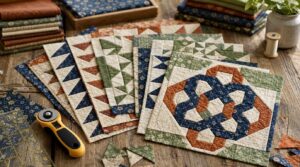
Once you’ve got the basics down, geometric blocks are where things start to get really interesting. These intermediate patterns bring in triangles, angles, and chains that open up a whole new world of design. Here are five blocks worth adding to your repertoire.
Flying Geese Units
The flying geese block is one of those units that looks harder than it is. Each piece is simple: one large triangle pointing up, with two smaller triangles framing it on either side. Together they form a clean, directional shape. Arrange several in a row and you’ve got a chevron layout almost instantly.
Half-Square Triangles
The half-square triangle — or HST — is the building block behind dozens of classic designs, including the Pinwheel Block. You take two squares, sew diagonally, then cut and press. That’s it. Finish sizes usually land at 3½ or 4½ inches. Pair light against dark and you instantly get bold diagonals, chevrons, or checkerboard effects with almost no extra effort.
Quarter-Square Triangles
Step up from the half-square triangle quilt block, and you’ve got the quarter-square triangle — also called the hourglass block. Four triangles join at the center to form one square. It sounds simple, but smart color placement unlocks stars, pinwheels, and rotational symmetry. Use scrap squares to practice precision piecing before cutting into your good fabric.
Diamond in a Square
Diamond in a square takes what you learned with quarter-square triangles and sharpens it. Four triangles wrap a center square, creating a crisp diamond illusion through color contrast — try a light diamond against a dark frame. Precision matters here: align every corner carefully. Foundation piecing keeps those points sharp and clean.
Double Irish Chain
The Double Irish Chain is one of quilting’s most satisfying intermediate patterns. It works by repeating nine-patch blocks alongside larger plain squares, creating bold diagonal chains across your quilt. Use strong color contrast — dark and light fabrics — to make those chains pop. Strip piecing speeds up assembly considerably. Traditionally, quilters used two coordinating fabrics to guide the eye diagonally.
Advanced Classic Block Patterns
Expert-level blocks are where quilting really starts to test your skills — and reward your patience. These patterns demand precision, careful fabric placement, and a willingness to slow down. Here’s what you’ll be working with at this level.
Kaleidoscope Block
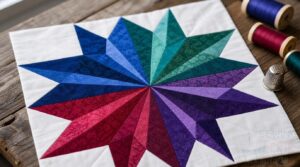
The Kaleidoscope block is where geometric patchwork becomes pure optical illusion. Four-patch rotation is the core trick — spin each unit and the whole block seems to shimmer. Use high-contrast fabrics and a color wheel palette with light-to-dark value shifts to mimic gemstone facets. Add background triangles to deepen the effect. Paper piecing keeps your points crisp.
Tumbling Blocks
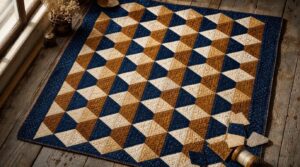
Tumbling Blocks is one of those classic quilt patterns that stops people mid-scroll. It creates a convincing 3D cube illusion using simple diamond units — no tricks beyond smart color placement.
- Dark, medium, and light diamonds form each cube face
- Strip piecing beats Y-seams every time
- High color contrast makes cubes pop boldly
- Dates back to 19th-century American quilting
Radiating Wedge Pieces
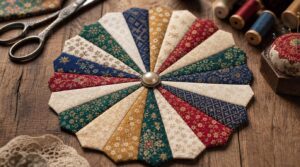
Radiating wedge pieces bring serious drama to any quilt. Think of blocks like Dresden Plate or Mariner’s Compass — both use wedge ring assembly to build a full circle from identical angled units. Bias edge control matters here. Those angled cuts stretch easily, so starch your fabric first. Scrappy wedge designs look stunning when you alternate light and dark pieces throughout.
Fussy Cutting Tips
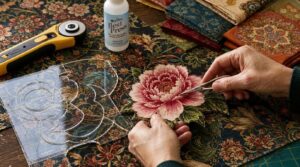
Fussy cutting is all about intention. You’re not just cutting fabric — you’re framing a focal motif so it lands exactly where you want it in the block.
- Plan motif placement before any blade touches the fabric
- Use micro-tip scissors for tight corners and small details
- Apply a light fabric stabilizer on the back to prevent fraying
- Replace rotary blades often to keep clean, precise edges
Secondary Pattern Effects
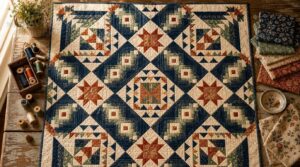
Here’s something quilters often miss: the blocks you sew aren’t the only patterns your quilt makes. Secondary pattern effects appear where blocks meet — shapes your design never planned, but color and geometry create together. High contrast between light and dark fabrics makes these effects sharp and bold. Softer midtones keep things subtle. Watch your block arrangement closely — it changes everything.
Choosing Quilt Block Sizes
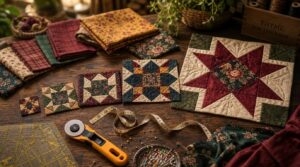
Block size shapes everything — how long your project takes, how detailed it looks, and how it all fits together in the end. Before you pick a pattern, it helps to know what each size brings to the table. Here’s a quick rundown of the five most common quilt block sizes to help you decide.
Six-Inch Blocks
Six-inch blocks are the smallest standard block size, and they’re worth knowing well. They produce a high seam count, so precision piecing matters every step. That said, they’re perfect for high-detail designs — think miniature Ohio Star or Log Cabin variations. They’re also ideal for mini quilt uses like samplers or wall hangings.
Eight-Inch Blocks
Step up from six-inch blocks, and eight-inch blocks feel like a welcome relief. Fewer seams, faster progress. They work beautifully with classic layouts like the Nine-Patch, Log Cabin, and Flying Geese — enough room for clean detail without the fuss. Lap and twin quilts are their sweet spot, making them a reliable go-to for quilters ready to build real projects.
Ten-Inch Blocks
Ten-inch blocks hit a sweet spot that most quilters quietly love. Adaptable across project dimensions, they fit lap quilts, throws, and bed-size projects without forcing awkward math. Here’s why quilters keep reaching for them:
- They suit complex designs like the Ohio Star without cramping the detail.
- Fabric selection feels easier — fat quarters cut cleanly.
- Fewer seams mean faster, more satisfying progress.
- Layout combinations stay flexible with minimal adjustments.
Twelve-Inch Blocks
Twelve-inch blocks are the most popular commercial size for good reason. You’ll need fewer of them to finish a bed-size quilt, which means less time piecing and more time enjoying the process. Classic designs like the Ohio Star, Log Cabin, and Pinwheel all shine at this size — plenty of room for detail without feeling overwhelming.
Fifteen-Inch Blocks
Fifteen-inch blocks are the big guns of your quilt block library. They finish fast, demand less piecing, and give bold patterns room to breathe. Three reasons quilters love this size:
- Fewer seams mean quicker assembly
- Fabric efficiency improves with fewer cuts
- Pattern scaling works beautifully for statement designs
Use a precise 0.5-inch seam allowance to hit that clean 15-inch finish every time.
Frequently Asked Questions (FAQs)
How do I choose fabrics for classic quilt blocks?
Pick fabrics with high contrast values first. Then check that prints don’t clash in scale. Prewash everything to avoid shrinkage surprises. A tight 3-to-5 color palette keeps your quilt looking intentional, not chaotic.
What tools do beginners need for quilting projects?
You don’t need much to start — but the right tools make all the difference. A rotary cutter, self-healing mat, clear ruler, sewing machine, and iron cover the basics beautifully.
How do I join finished quilt blocks together neatly?
Use a ¼-inch seam allowance, pin corners carefully, and press seams flat after each join. Sashing strips between blocks keep everything aligned and tidy.
Can classic quilt blocks be machine washed safely?
Yes, classic quilt blocks can be machine washed safely. Use cold water on gentle cycle with mild detergent, dry flat or on low heat, and always check seams afterward.
How do I fix mistakes in completed quilt blocks?
Mistakes happen. Seam rip carefully, replace the piece with a correctly measured patch, and rejoin using a ¼-inch seam allowance. For sizing gaps, add coping strips. Conceal minor flaws with strategic quilting or appliqué.
Conclusion
Old quilters called it "making do"—stretching scraps into something whole. That mindset still fits. Classic quilting block designs connect you to every hand that ever squared a corner or matched a seam. Start with a Nine-Patch. Graduate to Flying Geese. When Tumbling Blocks finally clicks, you’ll feel it. Each pattern you master becomes yours to teach, yours to hand down. The blocks don’t change. What you bring to them does.
- https://threadbarecreations.blogspot.com/2020/02/classic-quilt-blocks-nine-patch.html
- https://www.tehistory.org/hqda/html/v23/v23n3p099.html
- https://www.nps.gov/home/planyourvisit/quilt-discovery-experience.htm
- https://tortoisecrafts.co.uk/about-me/my-quilt-stories/nine-patch-stories
- https://www.huntington.org/digital-classroom-resources/object-story-log-cabin-light-and-dark-quilt