This site is supported by our readers. We may earn a commission, at no cost to you, if you purchase through links.
Fabric shifting ruins more quilts than most sewists care to admit. You line up your layers perfectly, start stitching, and somewhere around the third row, everything has crept a quarter inch off course. That creep is the enemy—and a modern quilting walking foot is the tool that stops it cold.
A walking foot synchronizes your machine’s top and bottom feed dogs, moving all three quilt layers at exactly the same pace. Studies show this cuts fabric shifting by up to 85% and drops puckering rates from 63% to under 12%. Those aren’t small improvements—they’re the difference between a quilt you’re proud of and one you hide in a drawer.
Getting consistent, beautiful results comes down to choosing the right foot, setting up your machine properly, and knowing which modern designs actually shine with this technique.
Table Of Contents
Key Takeaways
- A walking foot syncs your machine’s top and bottom feed dogs, cutting fabric shifting by up to 85% and dropping puckering rates from 63% to under 12%.
- Choosing the right foot matters—check your machine’s shank height, and consider an open-toe version for clearer sightlines and real-time fabric monitoring.
- Your setup makes or breaks results: raise the feed dogs, set stitch length to 3.0–4.0 mm, and adjust top tension slightly upward before touching your actual quilt.
- The walking foot isn’t just for straight lines—it handles chevrons, crosshatch grids, matchstick quilting, and even gentle curves when you slow down and guide steadily.
Why Use a Walking Foot?
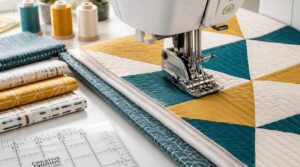
The walking foot is one of those tools that genuinely changes how your quilts turn out. It works by adding a second set of feed dogs that move your quilt layers together, keeping everything in sync from start to finish. Here’s why it belongs on your machine for every modern quilt project.
If you’re just getting started, these sewing machine quilting tutorials for beginners walk you through exactly how to get the most out of your walking foot.
The walking foot transforms your quilts by syncing every layer, keeping your quilt sandwich moving in perfect harmony
Even Layer Feeding
Keeping every layer moving together is the whole point of even layer feeding. Your walking foot adds a second set of feed dogs on top, syncing perfectly with the ones below. This feed dog sync locks your quilt sandwich into balanced, steady motion.
- Top fabric glides without pulling ahead
- Batting stays flat, not bunched
- Backing feeds evenly from edge to edge
Less Shifting and Puckering
Even with layers moving together, shifting and puckering can still sneak in. That’s where fabric tension balance really matters. Your walking foot syncs with the feed dogs below, reducing fabric shifting by up to 85% and dropping puckering rates from 63% to under 12%. Additionally, utilizing the stable lengthwise grain can help maintain structural shape.
Quilt sandwich prep matters too — pre-wash your fabrics and choose a stable batting to keep everything flat and calm under the needle.
Best Modern Quilt Styles
Now that puckering is under control, you’re ready to think about style.
The walking foot shines brightest with minimalist geometric quilts — think bold color blocks, clean lines, and generous negative space. It manages straight line quilting, matchstick quilting designs, and asymmetrical layouts beautifully. Modern motifs like chevrons and checkerboard grids stay crisp and sharp, and geometric modern quilts with high-contrast color schemes come alive stitch by stitch.
Walking Foot Versus Free-motion
So where does the walking foot end and free motion begin?
Walking foot quilting locks in layer feeding, keeping all three sandwich layers moving at the same rate. Free motion gives you fluid curves and freehand motifs, but your hands control everything.
Here’s a quick comparison:
- Straight line quilting: walking foot wins every time
- Organic swirls: free motion takes over
- Modern quilting hybrids: use both
Choose The Right Walking Foot
Not every walking foot works with every machine, and picking the wrong one can cost you time and frustration. The good news is that once you know what to look for, the choice gets a lot easier. Here’s what to evaluate before you buy.
Low-shank Machine Compatibility
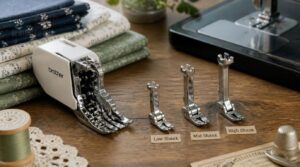
Most home sewing machines are low-shank compatible, meaning the presser foot sits close to the needle plate. That matters because foot adapter options vary widely, and the wrong fit causes skipped stitches or poor feeding. Before buying a walking foot, confirm your machine model matching by checking your manual or the manufacturer’s brand compatibility lists.
| Machine Type | Shank Height | Walking Foot Fit |
|---|---|---|
| Standard domestic | Low shank | Direct snap-on |
| Older/vintage models | High shank | Adapter required |
| Industrial machines | High shank | Not compatible |
Brand-specific Walking Feet
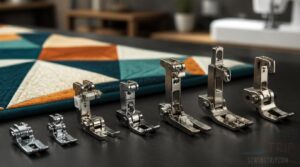
Not every walking foot fits every machine — and that gap matters more than most beginners expect. Brand compatibility charts help you match your exact model before buying. A precision-ground toe and metal construction quality guarantee smooth, even feeding across your modern quilt design.
- Model-specific alignment reduces skipped stitches
- Accessory kit features include spare screws and alignment tools
- Manufacturer feet outperform universal adapters in quilting techniques
Open-toe Visibility Benefits
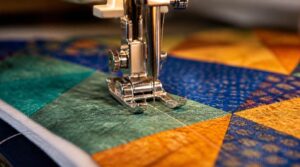
A small design change can completely transform your quilting accuracy. The open-toe walking foot gives you Clear Needle View directly onto your quilt surface, so you can see exactly where each stitch lands. That visibility enhances Precision Stitch Alignment when following marked lines, seam edges, or channel guides — no guesswork involved.
Fabric Layer Monitoring becomes simple too. You can watch your fabric handling in real time, spotting grain shifts or puckering before the stitch engages. That’s Real-time Adjustment Capability working in your favor. The Reduced Shadowing Effect on light fabrics keeps your sight lines clean throughout.
Understanding how feed dogs control fabric movement helps you make the most of these real-time monitoring features.
| Feature | Standard Walking Foot | Open-toe Walking Foot |
|---|---|---|
| Needle visibility | Partially blocked | Fully exposed |
| Line-following ease | Moderate | High |
| Fabric monitoring | Limited | Real-time |
Guide Bar Attachments
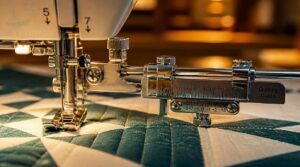
A guide attachment clips onto your walking foot and keeps every quilting row perfectly parallel — zero marking needed.
- Adjustable guide bars let you control spacing for straight line quilting
- Seam guide bar tracks existing seams completely hands-free
- Mounting hole alignment locks the bar securely in place
- Quick release mechanism swaps guide bars in seconds
- Bar vibration reduction and depth gauge integration keep stitches smooth and precise
Built-in Dual Feed Systems
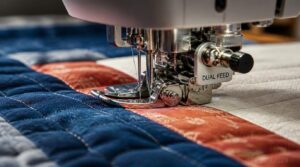
Some machines don’t need a separate walking foot at all. Integrated Dual Feed technology — like Pfaff’s IDT or Janome’s AcuFeed Flex — is built right into the machine.
| Feature | Benefit |
|---|---|
| Top Bottom Synchronization | Prevents layer shifting |
| Even Fabric Transport | Reduces puckering on thick quilts |
| Dual Feed Mechanism | Works across stitch lengths |
| Integrated Feed Technology | No extra foot required |
Gather Quilting Tools and Supplies
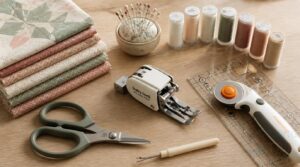
Before you sew a single stitch, having the right tools in your corner makes all the difference. The good news is you don’t need a huge collection — just a focused set of supplies that work together. Here’s exactly what to gather before you begin.
Quilting Needles and Thread
Your quilting needle and thread pairing can make or break a project. A size 14 topstitch needle works beautifully with a walking foot, preventing skipped stitches through thick layers. For cotton thread benefits, Aurifil 50wt is a personal favorite — it creates clean perforations and a natural matte finish.
Keep these pairings in mind:
- 50wt cotton thread pairs with 80/12 needles for midweight fabrics
- 40wt thread needs a 90/14 needle for heavier quilt tops
- Thread tension balance keeps stitches even on both sides
Change your needle every project.
Marking Pens and Rulers
Good marking tools are just as important as a sharp needle.
Water soluble ink disappears with a quick rinse, so your lines stay clean without ghosting. Dual tip markers let you switch between fine and chisel widths in one tool — perfect for both detail work and broader channel lines.
Ruler grid accuracy matters more than people realize. Clear acrylic rulers with 1/8-inch increments help you align perfectly with your walking foot’s edge or guide attachment.
| Tool | Best Use |
|---|---|
| Fine-tip marker | Precise seam lines |
| Chisel-tip marker | Broad spacing guides |
| Acrylic quilting ruler | Grid and crosshatch alignment |
| Adjustable guide bars | Parallel line spacing |
Precision alignment guides on rulers work beautifully alongside adjustable guide bars, eliminating the need to mark every single line.
Quilt Sandwich Materials
Once your marking tools are set aside, it’s time to think about what you’re actually stitching through.
Your quilt sandwich has three fabric layers: the quilt top, batting, and backing. Each choice affects how your walking foot feeds the sandwich.
- Pre-wash your fabrics to prevent shrinkage after quilting
- Cut your backing fabric 4–6 inches larger than your quilt top
- Choose cotton or wool batting for natural drape and even compression
Stencil Templates
Now that your sandwich layers are sorted, think about how you’ll mark your quilting design before the walking foot ever touches fabric.
Stencil templates let you trace repeatable motifs directly onto your quilt top. Mylar options are a personal favorite — transparent and flexible, they sit flat and show the fabric beneath for accurate alignment. Pair them with quilting rulers for clean, consistent repeats every time.
Quilting Gloves
Once your design is marked, your hands become the next tool that matters.
Quilting gloves give you control the walking foot can’t provide alone. Their silicone-tipped fingers grip fabric without dragging, keeping layers steady as you guide the quilt through.
- Grip material in silicone or rubber prevents slipping
- Breathable knit fabrics reduce hand fatigue on long sessions
- Three-finger designs focus traction where you need it most
- Sizes from XS to XL provide a snug, precise fit
- Machine washable options make care simple — skip the fabric softener
Set Up Your Sewing Machine
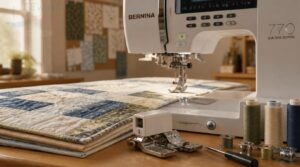
Getting your machine ready is where good quilting actually begins. A few quick adjustments make the difference between smooth, even stitches and a frustrating afternoon of fixes. Here’s exactly what to do before you sew your first line.
Install The Walking Foot
Getting your walking foot seated correctly takes about two minutes — and it saves you from a lot of frustration later. Start with Mounting Shank Identification: check whether your sewing machine uses a low-shank or high-shank mount to confirm machine compatibility. Raise the presser foot, loosen the shank screw, then slide the even feed foot into position so its forked arms wrap around the needle clamp bar.
Foot Alignment Check is the step most people skip. Make sure the guide attachment sits flush and that nothing wobbles. Complete the Screw Tightening Procedure firmly, then do a quick Test Stitch Verification on scrap fabric before touching your quilt.
Keep Feed Dogs Raised
Once your walking foot is attached, check that your feed dogs are raised before sewing a single stitch. These small metal teeth grip your fabric from below, working in sync with the even feed foot to control movement through every layer.
Dog height settings matter here. Low feed dogs mean poor grip, skipped stitches, and fabric that wanders.
Set Longer Stitch Length
Dial your sewing machine to a stitch length of 3.0–4.0 mm before quilting through multiple layers. This longer setting reduces fabric perforation, eases your needle through thick batting, and keeps straight line quilting designs clean and visible.
- Prevents batting from bunching between stitches
- Creates clear, bold quilting lines
- Reduces stress on thread and needle
- Maintains consistent bobbin thread supply
- Works beautifully with a size 14 topstitch needle
Always test on scrap fabric first.
Adjust Top Thread Tension
Top thread tension is the quiet variable that can make or break your walking foot results.
Increase tension by 0.5 to 1 point above your regular piecing setting when quilting through a full quilt sandwich. Extra layers demand more pull to keep the thread balance midpoint between fabrics.
| Situation | Tension Adjustment | Result |
|---|---|---|
| Standard quilt sandwich | +0.5 above piecing | Balanced stitches |
| Thick batting layers | +1.0 above piecing | Prevents looping |
| Fine 50wt cotton thread | Slight decrease | Avoids perforation |
| Heavier fabric layers | Moderate increase | Locks thread cleanly |
| Bobbin tension misaligned | Recalibrate both | Restores stitch balance |
Your needle size impact matters too — a size 14 topstitch needle may need slight fabric tension tweaks for smooth stitches. Always rethread with the presser foot raised to prevent thread shredding before adjusting anything.
Test on Quilt Scraps
Before sewing a single stitch on your actual quilt, build a test sandwich with scraps. Run a sewability test first — checking how fabric feeds under your walking foot, noting any skipping or snagging. Confirm stitch precision with a block accuracy check, keeping measurements within ⅛ inch.
Also run a colorfastness test, fiber content check, and stiffness evaluation to catch surprises early.
Master Straight Line Quilting
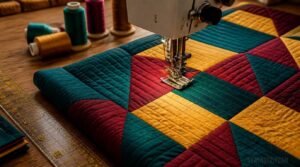
Straight line quilting is where precision meets confidence, and your walking foot makes it surprisingly achievable.
Once you understand a few key approaches, your quilting lines will stay sharp, even, and intentional every single time. Here are the essential techniques that will take your straight line quilting from guesswork to second nature.
Marking Straight Quilting Lines
Straight lines start with smart marking habits. Use a ruler and Hera marker to crease clean lines that disappear after quilting — no ink, no residue. For multi-line setups, painter tape along your ruler edge keeps everything aligned consistently.
- Mark from the center outward to reduce drift
- Test on scrap fabric first to verify pressure and visibility
- Re-mark lines after repositioning your quilt
- Keep erasable marking tools separate to avoid color transfer
Using Seams as Guides
Once your lines are marked, your existing seams become your most reliable guides. Aligning the walking foot’s edge with a sewn seam keeps your stitching straight without measuring again. This works especially well for seam-based spacing across quilt blocks.
For added precision, a magnetic seam guide attaches quickly to your machine bed and locks your reference point in place.
Channel Quilting Technique
Channel quilting is one of my favorite ways to add length and movement to a quilt. You stitch parallel straight lines from one edge to the other, letting the walking foot do the heavy lifting.
Channel width selection matters here — most quilters work between ¼ and ½ inch. Pair that with uniform channel spacing and your design stays visually balanced across the whole quilt.
Crosshatch Quilting Lines
Crosshatch quilting builds naturally on channel quilting by adding a second pass of lines over the first. Those intersecting lines create a clean grid that adds real texture and structure to your quilt top.
Spacing guidelines matter here. Most quilters work between ¼ and ½ inch apart. For a diamond grid variation, simply stitch your lines diagonally across the fabric grain.
Keep needle position consistent and let the walking foot guide your grid alignment — your crosshatch detailing will land perfectly every time.
Matchstick Quilting Basics
Crosshatch gives you structure — matchstick gives you texture. Matchstick quilting packs straight lines just 1/8 to 1/4 inch apart, creating dense, shaded depth across your quilt surface.
Prep your fabric with a tight-weave cotton and load a size 80/12 needle. Use 50wt cotton thread — tonal for subtlety, contrasting for drama. Let your walking foot feed every layer evenly. Practice spacing on scrap first.
Try Modern Quilting Designs
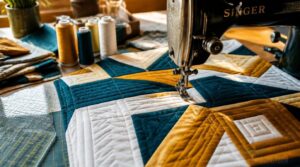
Straight lines are a great foundation, but the walking foot can do so much more. Once you’re comfortable with the basics, it’s the perfect time to push your creativity and explore designs that make a quilt truly yours. Here are five modern patterns worth adding to your repertoire.
Diagonal Line Quilting
Diagonal lines might be the boldest move in your walking foot toolkit. Running at 45 degrees to the grain, they create a sharp, striking energy across your quilt top. Use a clear acrylic ruler and washable marker to mark consistent spacing — anywhere from 1/4 inch to 1 inch apart changes the whole mood.
Want something even more dramatic? Try radiating from a center point for a sunburst effect, or cross two diagonal sets to build a diamond grid.
Chevron Quilting Patterns
Chevron designs bring a bold, rhythmic energy that few other quilting patterns can match. Your walking foot excels here, keeping layers locked in sync as you stitch those satisfying V-shapes.
- Use strip piecing technique for fast, accurate chevron rows
- Half square triangles create crisp, sharp points
- Try chevron orientation variations — flipping rows creates motion
- Echo a binding color coordination from your dominant chevron hue
A color gradient chevron adds gorgeous depth across the quilt.
Checkerboard Grid Designs
Switching to a checkerboard grid design instantly transforms a quilt with bold visual rhythm. Alternating light and dark squares create sharp contrast that looks striking yet stays structured.
Your walking foot feeds every layer evenly, keeping those grid lines crisp and consistent. Try varying square sizes to fit borders naturally, or shift to a diagonal orientation for unexpected energy.
Echo Quilting Shapes
Echo quilting builds layers of meaning right on your quilt’s surface. The idea is simple: you stitch lines that radiate outward from a central shape, each one echoing the last. Echo hook designs follow curved half-circle motifs, spacing lines 1/8 to 1/4 inch apart for tight or airy texture.
Your walking foot guide attachment keeps every echo line parallel without marking each one by hand.
Gentle Curve Quilting
Gentle curves bring a soft, flowing energy that straight lines simply can’t match. Unlike rigid quilting patterns, smooth arcs create a rhythmic, almost meditative surface across your quilt.
- Curve spacing techniques keep arcs evenly rhythmic
- Batting density adds plush, dimensional texture
- Open-toe walking foot improves arc visibility
- Smooth arc guidance uses light finger pressure
Your walking foot holds every layer steady through each turn.
Fix Common Walking Foot Problems
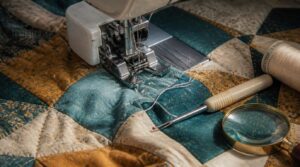
Even the best setup hits a snag sometimes, and that’s completely normal. Knowing what to look for makes troubleshooting fast and frustration-free. Here are the most common walking foot problems and exactly how to fix them.
Skipped Stitches
Skipped stitches can stop a project cold. Most of the time, the fix is simpler than you think. Needle-thread tension mismatch is the most common culprit — try increasing your top tension by half a point. Also check that your quilting needle (size 80/12 or 90/14) isn’t dull or bent, since a damaged needle won’t catch the bobbin thread reliably.
Fabric layer density matters too. Thick sandwiches slow your feed dogs down, so reduce your machine speed to around 50–75% for even feeding and better quilting accuracy.
Thread Shredding
Thread shredding is frustrating, but it’s almost always fixable once you know where to look. Unlike skipped stitches, this problem usually points to friction — somewhere along the thread path, something is cutting or wearing the fiber down.
Start with these three quick checks:
- Hook tip damage — run your fingernail along the hook; any snag means it needs replacing
- Needle eye mismatch — a needle too small for your thread creates constant rubbing and fraying
- Thread guide wear — grooved or rough guides weaken thread silently with every stitch
Re-threading with your presser foot raised also helps reset thread tension and removes hidden kinks inside the tension discs.
Uneven Stitch Length
Uneven stitch length often sneaks up after you’ve sorted tension issues. The fix usually comes down to a few key adjustments working together.
Thread Tension Balance between your top and bobbin threads keeps stitches uniform. Presser foot pressure set too high or low causes layers to feed unevenly. Pair that with proper Needle Size Selection and controlled Machine Speed Control, and your walking foot delivers consistent stitch spacing every time.
Fabric Bunching
Bunching usually means something’s off with how your layers feed through together.
Start by checking presser foot pressure — if it’s too high or too low, one layer creeps ahead of the other. Also review your Thread Tension Balance and make sure your needle suits your fabric weight, because a mismatched needle pushes fibers instead of piercing cleanly.
Walking Foot Maintenance
Once you’ve sorted bunching, make maintenance your next habit.
Clean the walking foot with a soft brush after every project. Wipe metal surfaces dry to prevent rust, then apply light sewing machine oil to moving joints every two to four weeks. Store it in a protective case, and do a quick monthly alignment check — your feed dogs and needle bar will thank you.
Frequently Asked Questions (FAQs)
Can a walking foot work with thick batting layers?
Yes, a walking foot manages thick batting layers well. Its dual feed system moves all quilting layers at the same pace. Use a 90/14 needle and adjust tension to keep stitches even.
How do you quilt curves using a walking foot?
The walking foot manages gentle curves surprisingly well. Move slowly, pivot at natural points, and use consistent hand guidance to steer fabric smoothly. Practice first on scraps to build confidence before tackling your actual quilt.
What speed settings work best for dense quilts?
For dense quilt speed, start around 60 percent. This gives your dual feed dogs time to grip each layer of the quilt sandwich evenly, keeping stitch length control steady and preventing thread breaks.
How often should walking foot pivot points be lubricated?
Neglect those pivot points for even a week too long, and your walking foot will scream at you. Lubricate every 1–3 months for heavy use, or every 6–12 months for light quilting.
Conclusion
It’s no coincidence that skilled quilters who switch to a modern quilting walking foot rarely go back. That quarter-inch creep that once ruined your rows? Gone. The puckering that buried your best work? Solved.
Every technique in this guide—straight lines, chevrons, gentle curves—works because your layers finally move as one. Master your setup, trust the process, and the quilts you’ve always been imagining will finally start looking exactly like the ones you make.
- https://sewingmachineman.substack.com/p/all-about-walking-feet-and-dual-feed/comments
- https://weallsew.com/difference-between-walking-foot-and-dual-feed
- https://sherriquiltsalot.com/2020/09/30/almost-everything-you-need-to-know-about-a-walking-foot
- https://freemotionproject.com/2018/01/walking-foot-quilting-basics
- https://quiltforlovers.com/index.php/2020/05/17/postcard-from-sweden/