
This site is supported by our readers. We may earn a commission, at no cost to you, if you purchase through links.

Symmetry is a rule quilters learn early—and the best ones break it on purpose. An asymmetric layout pulls the eye across the surface unpredictably, creating tension and movement that a perfectly balanced grid never achieves.
The challenge isn’t choosing asymmetry; it’s controlling it so the design feels intentional rather than accidental. Focal points, visual weight, negative space, and block rotation all work together to hold an irregular composition together. Once you understand how these elements interact, asymmetric quilt layout techniques stop feeling risky and start feeling like your most reliable creative tool.
Table Of Contents
Key Takeaways
- Placing your focal point off-center and backing it with strong value contrast is what gives an asymmetric quilt its tension — everything else in the layout exists to support that one anchor.
- Negative space isn’t empty; reserving at least forty percent of your surface as breathing room is what keeps bold blocks from drowning each other out.
- Breaking the grid through intentional moves — rotating blocks, offsetting seams, and mixing sizes — turns a rigid layout into something that actually pulls the eye across the quilt.
- Before you sew anything, test your layout on a design wall, photograph it from a distance, and label every row and section so your composition stays exactly where you planned it.
Plan Your Asymmetric Quilt Layout

A strong asymmetric layout doesn’t happen by accident — it starts with a clear plan before you touch a single piece of fabric. Getting a few key decisions locked in early saves you from frustrating do-overs later. Here’s where to begin.
Before anything else, brushing up on broderie perse appliqué layout fundamentals helps you make smarter decisions about motif placement and fabric prep from the start.
Define The Quilt’s Focal Point
Every great asymmetric quilt starts with one question: where does the eye land first? That spot is your focal point — the block or motif that anchors everything else.
Place it off-center to create natural tension and movement. Use strong value contrast or a standout color to make it unmistakable. Everything around it should support, not compete.
Sketch Grids Before Cutting
Once you’ve locked in your focal point, grab graph paper before you touch a single piece of fabric. Sketch a proportional grid that mirrors your quilt’s finished dimensions.
A 1-to-2-inch square works well for most large quilts. This gives you a clear map for block placement and helps you see the full visual composition before committing.
Choose Negative Space Areas
With your grid sketched out, it’s time to decide where the quiet zones live.
Think of negative space as breathing room — not empty, but intentional. Reserve at least forty percent of your surface for it. This keeps asymmetric quilt blocks from competing with each other. This creates a visual resting place for the eye.
- Wider gaps around smaller blocks stop them from disappearing
- Edge space balance frames your focal point naturally
- Calm areas guide the eye without adding clutter
Mark Block Placement Order
Once your quiet zones are mapped, it’s time to decide what goes where — and in what order.
Mark block sequence before you touch a single pin. Start with your focal point block, then work outward. Place high-impact blocks first, then fill supporting areas.
This block alignment guide keeps your asymmetric quilt blocks from wandering into chaos.
Balance Visual Weight Effectively
Asymmetric quilts live and die by visual weight — get it wrong, and one corner pulls all the attention while the rest fades out. The good news is that balancing a layout isn’t guesswork; it comes down to a few clear principles you can apply every time. Here’s what to focus on.
Compare Dark and Light Values
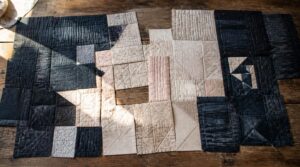
Think of value as your quilt’s invisible backbone. Dark values absorb light and feel heavy, while light values feel open and airy.
Just as dark values create visual weight in a quilt, strong hand-sewn stitching techniques give those deeper sections the structural backbone they need to hold their shape over time.
When you place them side by side in asymmetric quilt blocks, the difference in visual weight becomes instantly clear. A simple grayscale photo of your layout reveals this balance — or imbalance — without color distracting you.
Separate High-contrast Blocks
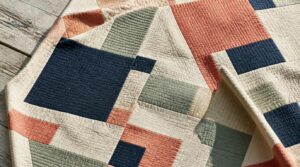
High-contrast blocks need room to breathe. When a deep navy sits beside bright coral, the tension between them creates an instant focal point — but stack too many together and they start competing instead of popping.
Alternate high-contrast pairs with calmer, mid-value blocks to build a deliberate visual rhythm. That spacing lets each bold block land with full impact.
Avoid Heavy Color Clusters
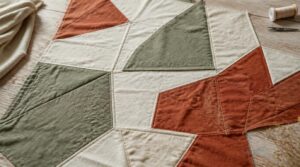
Clustering too many saturated hues in one zone is like turning up every speaker at once — everything gets loud, nothing stands out.
When every color shouts at once, nothing stands out
Stick to two or three dominant colors and scatter them across your layout. Leave generous negative space between bold blocks so each color gets room to register. That restraint is what makes your asymmetric blocks truly pop.
Use Photos to Check Balance
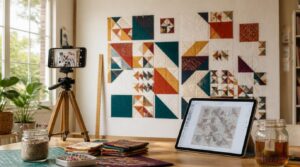
A photo doesn’t lie. Once your asymmetric quilt blocks are arranged on the design wall, step back and snap a shot — use consistent lighting and a neutral background to keep colors true.
Add a ruler for scale reference, then overlay your digital mockup to spot any drift in visual balance. Mark key spots with photo annotation markers so you can adjust block placement without starting over.
Break The Grid With Blocks
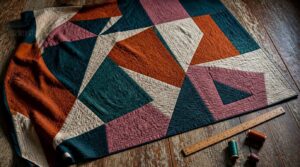
A straight grid can quietly kill the energy of an otherwise bold quilt. The good news is that a few deliberate structural moves can break that rigid pattern and open up something far more interesting. Here are the techniques that’ll help you do exactly that.
Offset Seams Intentionally
Offsetting seams means moving stitch lines inward by a quarter to half inch, creating a staggered finish instead of a flat grid.
- Reduces edge bulk for cleaner binding
- Creates a subtle staggered seam rhythm across rows
- Strengthens asymmetric quilt blocks and compositional balance
- Adds natural seam drift effects that guide the eye
- Mark reference points for consistent offset alignment
Rotate Asymmetrical Blocks
Rotating your asymmetric quilt blocks is like turning a kaleidoscope — one small shift unlocks a completely different image. Block orientation variation drives energetic angular flow across your layout, guiding the eye without repeating the same pattern. Try rotating each block so no two share the exact same angle, preserving the asymmetry that makes your design breathe.
Check seam alignment after every rotation. Angles shift, and small misalignments snowball fast. Rotations also reveal unexpected bonuses — chevron motif creation and diagonal lines can emerge naturally from negative space rotation, adding depth you didn’t plan but won’t want to lose.
Mix Block Sizes Carefully
Once you’ve experimented with rotation, size becomes your next lever. Block size rhythm shapes how the eye moves — large blocks anchor, small blocks accent.
Try a 1-2-3-2-1 proportion pattern across rows to keep things flowing without chaos. Pair bold prints in smaller blocks and solids in larger ones to maintain scale contrast balance throughout your asymmetric layout.
Handle Odd Block Counts
An odd block count isn’t a problem — it’s an opportunity. Start with a central focal block, then build outward unevenly. Use a stray single block as a deliberate counterweight.
- Track your quadrant block count to keep no side too heavy.
- Apply the color triangle approach to balance warm and cool tones.
- Use negative space placement to frame the lone block as a visual pause.
Create Secondary Patchwork Patterns
Once you’ve handled odd block counts, look at what forms between your blocks. Secondary patchwork patterns emerge naturally when you plan seam intersections carefully. Offset your seams so they meet at diagonal points, creating chevron echoes across the quilt.
Layer small patches atop larger ones for depth. Add micro patches inside bigger blocks to build a quiet, repeating motif underneath the main design.
Use Color and Negative Space
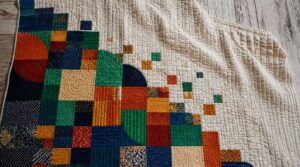
Color does more work in an asymmetric quilt than most people realize. The way you use it — alongside the spaces you deliberately leave empty — can make your layout feel vibrant or flat. Here are five techniques that put both to work for you.
Reserve Forty Percent Breathing Room
Think of negative space as your quilt’s breath. Reserve at least forty percent of your layout as open, unoccupied area — this isn’t wasted space, it’s working space.
That breathing room frames your focal point, giving the eye a place to land and rest. It also simplifies seam alignment and keeps dense blocks from crowding each other.
Pair Solids With Low-volume Prints
Pairing solids with low-volume prints is one of the smartest moves you can make in an asymmetric layout. Your focal solid placement sets the anchor — it’s where the eye lands first, so choose a matte, mid-tone fabric that holds steady without competing.
Here’s what to keep in mind:
- Value contrast pairing works best when your solid sits 2–4 shades away from the print
- Match texture — soft prints need smooth, calm solids beside them
- Use neutral color harmony (cream, taupe, ivory) for adaptable, cohesive pairings
- Apply scale balance strategies by placing larger solid blocks near busier print clusters
- Avoid bright white solids next to near-white prints — the glare breaks visual balance
Your fabric placement decisions shape how the whole quilt breathes.
Build Monochrome Movement
Working with a single color might sound limiting, but it’s where Diagonal Value Flow really shines.
Arrange your asymmetric quilt blocks from light to dark along a diagonal swath. This Monochrome Gradient creates depth and a sense of motion. Keep midtones dominant at the center so your Active Focal Shift stays controlled, letting rhythm variation guide the eye naturally outward.
Guide Eyes With Contrast
Contrast is your most direct tool for guiding attention. Luminance differences between adjacent blocks tell the eye exactly where to look first. Place a bright block against a deep background, and that spot becomes an instant focal point.
A value jump within a single row anchors attention before pulling it forward along a natural contrast path across your asymmetric layout.
Try Ombre Value Shifts
An ombre value shift moves color gradually from light to dark across your layout, creating natural depth. Plan your light-to-dark ladder in at least five tonal steps:
- Start with your lightest anchor near the quilt’s edge
- Step through midtones toward your focal point
- Place your darkest values to balance heavy asymmetric blocks
This builds depth through shadows and keeps composition flowing.
Test, Label, and Sew Sections
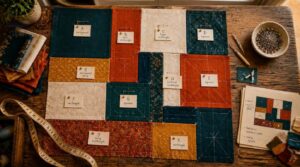
Before you sew a single seam, your layout needs a reality check. A few simple steps can save you from costly mistakes and keep your asymmetric design exactly where you want it. Here’s how to lock everything in place before the needle hits the fabric.
Arrange Blocks on Design Walls
A design wall is your quilt’s staging ground — a place to think before you commit.
Pin your blocks in rough position first, then step back. Try rotating every few blocks to shift color flow and break repetitive lines. Use washi tape to maintain consistent spacing between blocks, simulating sashing.
Rearrange freely until the asymmetrical layout feels intentional, not accidental.
Photograph Layouts From Distance
Your phone camera is more powerful than you think. Step back — far back — and photograph your layout from distance.
A wide view reveals visual imbalances your close-up eye misses entirely. Distant framing naturally exposes whether your asymmetric blocks feel intentional or scattered. Check if leading lines pull the eye toward your focal point naturally, or if heavy color clusters throw the composition off balance.
Make Quick Fabric Mockups
Once you’ve snapped your distance shots, grab your scraps. Scrap mockup creation is one of the fastest ways to test an asymmetric layout without committing a single seam.
Cut small six-by-six inch squares and arrange them on a cork board or wall using painter’s tape for temporary mounting solutions. Swap pieces freely until your visual balance feels right.
Label Rows and Sections
Once your mockup feels right, lock it in with labels. Row Label Placement matters more than most quilters expect — number each horizontal row from top to bottom along the left edge. Then apply a Section Tagging System for vertical groupings, placing tags at the top of each column. This keeps your asymmetric quilt blocks exactly where you intended them.
Descriptive Naming beats vague markers every time. Instead of "Row 1," try "FocalRow" or "NeutralSection" — names that actually tell you something. Pair labels with a simple Legend on Wall so anyone helping you can follow along without guessing.
Sew in Manageable Units
With your blocks labeled and ready, it’s time to sew — but don’t rush into one giant assembly. Work in manageable units of 6 to 12 inches each. This keeps your asymmetric quilt blocks easy to handle and your seam allowance consistency locked at ¼ inch throughout.
Here’s a simple order to follow:
- Group units by color family first
- Chain piece units to save time without shifting layout
- Mark unit boundaries clearly before joining sections
- Test each unit on your design wall
- Join units using a stair-step assembly pattern
Frequently Asked Questions (FAQs)
Can asymmetric quilts work with traditional block patterns?
Yes — and that’s the paradox. Traditional block patterns can anchor an asymmetric quilt beautifully. Rotating or offsetting familiar shapes like log cabins disrupts the grid while keeping color harmony balanced and the overall design grounded.
How do seasonal themes influence asymmetric quilt designs?
Seasonal themes shape your quilt’s color palette and texture. Winter calls for cool blues, spring brings soft pastels, and autumn adds warm flannel weight — each season naturally guiding visual balance and block placement.
What fabrics work best for improvisational asymmetric piecing?
Cotton is your best bet — it won’t let you down. Stable midweight cottons resist distortion, while linen-cotton blends hold irregular seams beautifully, making both ideal for improvisational asymmetric piecing with scraps.
How do you handle asymmetric layouts in smaller quilts?
Smaller quilts demand tighter composition. With less space, every block placement matters more. Keep quiet zones simple and let one bold element lead. Scale down patterns, but hold your visual balance firm.
Conclusion
Think of asymmetric quilt layout techniques as a controlled storm—wild on the surface, but driven by invisible forces working quietly underneath. Every focal point you set, every block you rotate, and every pocket of negative space you leave open works together to hold your design firmly steady.
You’re not abandoning order; you’re rewriting it on your own terms. Once you trust the process, asymmetry stops being a gamble and becomes your sharpest creative edge.
- https://www.simplesimonandco.com/2017/07/modern-quilt-along-2017-asymmetry.html
- https://www.quiltingboard.com/main-f1/quilting-designs-highlight-well-matched-points-t293141.html
- https://www.missouriquiltco.com/blogs/missouri-star-blog/modern-quilt-patterns-guide
- https://www.quiltingdaily.com/traditional-made-modern-fresh-take-traditional-quilt-patterns
- https://quiltingbookspatternsandnotions.com/collections/modern-quilt-patterns