This site is supported by our readers. We may earn a commission, at no cost to you, if you purchase through links.
Most quilts try to say too much. Twelve fabrics, four border prints, a dozen competing shapes—and somehow the whole thing ends up looking like a yard sale.
Minimalist quilting flips that logic. Strip everything back to clean lines, open space, and a tight color story, and something interesting happens: the quilt gets louder by going quieter.
A single geometric block on a wide ivory background commands a room. One bold seam across soft linen stops you mid-step. These minimalist quilting design ideas aren’t about doing less—they’re about making every choice count, so nothing you add is wasted.
Table Of Contents
- Key Takeaways
- Minimalist Quilt Design Essentials
- Negative Space Quilting Ideas
- Simple Geometric Quilt Patterns
- Minimalist Color Palette Ideas
- Beginner-Friendly Minimalist Quilt Ideas
- Modern Quilting Stitch Techniques
- Textured Minimalist Fabric Ideas
- Top 4 Minimalist Quilting Picks
- Frequently Asked Questions (FAQs)
- Conclusion
Key Takeaways
- Negative space isn’t empty — it’s the design doing its quietest, most powerful work by pulling focus to exactly where you want it.
- Fewer seams, bigger blocks, and a tight color story will always hit harder than a quilt trying to do everything at once.
- Your thread, fabric texture, and stitch choice carry just as much visual weight as the pattern itself — don’t treat them like afterthoughts.
- One bold, intentional decision beats a dozen safe ones every time.
Minimalist Quilt Design Essentials
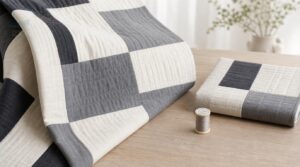
Minimalist quilting isn’t about doing less — it’s about making every choice count. The best modern quilts share a handful of core design principles that keep things clean, intentional, and visually striking. Here’s what you actually need to know.
Understanding the design principles behind negative space quilts is what separates quilts that feel intentional from ones that just feel sparse.
Clean Lines and Simple Shapes
Clean lines are the backbone of any minimalist aesthetic. In a geometric quilt, straight edges and precise angles do all the talking.
Your cuts need to be true, your seams flat, and your simple designs consistent. When shapes align cleanly, the whole quilt reads as intentional — calm, confident, and sharp. That’s the power of Clean Edge Geometry.
Balanced Negative Space
Once your lines are sharp, the next move is knowing what not to fill. Balanced Negative Space is your secret weapon.
Let empty fabric breathe around your focal block. That void isn’t wasted — it’s doing work. It guides the eye, builds Focal Isolation, and gives your geometric forms the room they need to actually land.
This approach helps you achieve an ideal compositional balance in your quilt.
Low Seam Density
Negative space sets the stage, but low seam density keeps the surface clean enough to let it shine. Fewer stitch lines mean less visual noise — your geometric forms read clearly, without busy joins breaking the calm.
Use a longer stitch length and a neutral thread choice, and those seams quietly disappear into the fabric instead of competing with your design.
Large-scale Quilt Blocks
Big blocks are a bold move. When your finished blocks hit 12 inches or larger, the whole quilt shifts — fewer seams, cleaner geometry, more breathing room. That’s the block scale benefit right there.
Solid colors and dramatic fabric prints shine without heavy piecing getting in the way. Pair that with generous sashing between blocks, and each shape floats.
Accurate cutting is non-negotiable. Precise rotary cuts keep block edges crisp and corners aligned. Then press every seam flat — horizontal pressing mat, firm pressure. That flatness is what makes those bold geometric forms actually pop.
Calm Visual Movement
Rhythm is everything in a minimalist quilt. Soft transitions between blocks guide the eye gently — no jarring jumps, just a slow, steady drift.
- Use subtle horizontal flow across the quilt surface
- Let negative space anchor the visual resting points
- Keep motion curved, not sharp
- Layer slow movement behind a near-static foreground
- Let diffused, even tones carry the rhythm forward
Negative Space Quilting Ideas
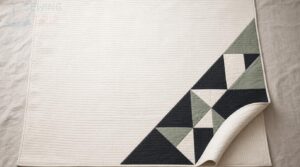
Negative space is one of the most powerful tools in minimalist quilting — and one of the most underused. It’s not just empty fabric; it’s a design choice that gives your focal elements room to breathe and shine. Here are some smart ways to put that open space to work.
Off-center Focal Blocks
Strategic offsetting is quiet power. Place your focal block near the one-third mark, and the whole minimalist quilt design shifts. That single move builds asymmetrical design tension without clutter. Solid fabrics boost this effect — no pattern fighting for attention.
| Technique | Why It Works |
|---|---|
| Strategic Offsetting | Anchors focus away from dead center |
| Visual Weight Distribution | Balances large blocks with negative space |
| Sashing Integration | Frames the focal block without crowding |
| Thread Accent Choices | Subtly outlines emphasis |
| Pressing Precision | Keeps edges crisp and flat |
Floating Geometric Shapes
Geometric shapes that seem to hover — that’s the quiet magic of floating shape placement. Circles from 2 to 6 inches drift upward visually when spaced with intentional gaps. Polygon clusters of 3 to 7 irregular shapes add depth without noise.
Run them along a diagonal drift path, and your quilt gains calm, smooth movement.
Wide Solid Background Areas
A solid background isn’t empty — it’s doing the heaviest lifting on your quilt. Flat color fields pull every eye straight to your focal shape, no competition.
Here’s what makes them work:
- High contrast backdrops like deep charcoal or warm white sharpen focal shapes instantly
- A background proportion ratio of 60 percent or more keeps the composition calm and grounded
- Solid fabric selection — matte cotton or linen — keeps the surface even and quiet
- Sparse quilting lines preserve that clean, uninterrupted feel across wide panels
Pick one background tone and commit to it.
Rule of Thirds Layouts
Think of your quilt top as a photograph. Photographers don’t center everything — and neither should you.
Rule of thirds splits your design into a 3×3 grid with four intersection points. Place your focal block near one of those intersections. That single move creates natural tension and pull without feeling chaotic. Negative space does the rest, framing your shape with calm, intentional breathing room.
Sparse Asymmetrical Composition
Symmetry is overrated. Sparse asymmetrical composition places one dominant block off-axis, then lets negative space carry the rest.
A large shape sitting one-third across the surface creates instant visual pull. Smaller elements counter that weight from a distance, guiding your eye along a diagonal sweep path — calm, deliberate, never crowded.
Simple Geometric Quilt Patterns
Geometry is where minimalist quilting really clicks into place. A few clean shapes, repeated with intention, can carry a whole quilt without needing anything extra. Here are some simple geometric patterns worth adding to your rotation.
Grid-based Square Layouts
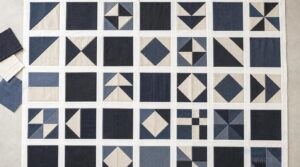
Working with a Uniform Square Grid is one of the simplest ways to get clean, confident results.
Each square acts as a modular block unit, holding its place in a repeating matrix. Gutters between squares set the rhythm. An even column layout keeps everything balanced. Scale it up or down — the grid holds.
Plus Sign Quilt Blocks
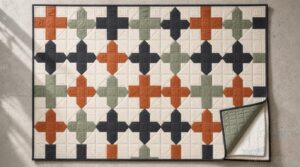
The plus sign block is grid logic with attitude. A central square extends into four equal arms — simple, deliberate, geometric. Blocks usually finish at 6 or 12 inches. Nail your seam allowances and the cross stays crisp.
Try a rotated plus layout to reveal secondary patterns across the quilt. Or go bold with a multi-color lattice — each arm in a different hue.
Square in Square Designs
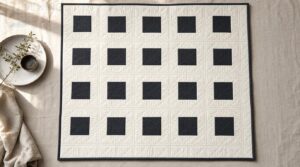
From the bold arms of the plus block, pull inward. Square in square designs strip geometry down to its core — one square cradling another, perfectly centered.
Precision piecing keeps those edges true. A standard 1⅓ to 1 outer-to-inner ratio gives the layout natural balance. Pair a dark inner square against a neutral field, and the contrast does all the talking.
Modern Flying Geese Rows
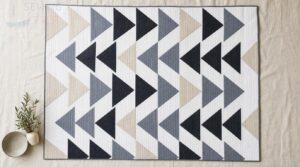
From one square cradling another, shift your eye outward — to rows that actually move.
Modern flying geese rows do something no static block can. They pull the eye diagonally, creating uniform spacing and rhythm in one clean sweep. Stack them with a chevron offset and the whole quilt breathes. That’s the hidden grid working quietly beneath every crisp, pointed tip.
Scattered Window Blocks
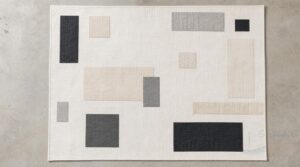
Scattered windows break every rule about centering — and that’s the point. Irregular window placement scatters rectangle and square blocks across the surface, creating dispersed focal points instead of one obvious anchor. Here’s what makes it work:
- Generous gap spacing lets negative space breathe between blocks
- Solid fabric blocks keep the composition calm and clean
- Crisp edge pressing makes each piece float like architectural window panes
Minimalist Color Palette Ideas
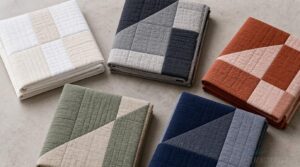
Color is where minimalist quilting really gets to flex. Your palette shapes the whole mood — it’s the difference between a quilt that hushes a room and one that stops people in their tracks. Here are five palette directions worth keeping in your back pocket.
Monochrome Fabric Combinations
Monochrome doesn’t mean boring — it means intentional. A monochromatic palette gives your quilt a quiet authority that busy prints simply can’t match. Pick three to five shades of one hue, and let the value scale harmony do the heavy lifting. The eye moves naturally from light to dark without any jarring jumps, keeping your design calm and cohesive.
Textural Monochrome Blend is where things get interesting. Pair a matte cotton with a slightly slubbed fabric in the same tone — you get depth without introducing a single new color. That contrast in surface finish reads beautifully against negative space, especially when your solids are given room to breathe across clean-lined blocks.
Black and White Contrast
Black and white is the definitive power move in minimalist quilting. Pure contrast does something no other palette can — it turns simple geometric shapes into graphic statements. White reflects light outward while black pulls it in, and that tension creates real visual depth.
Edge definition sharpens automatically. Clean, solid fabrics keep boundaries crisp without any extra effort.
Beige, Grey, and White
Beige, grey, and white don’t compete — they collaborate. This palette is built on neutral tonal shifts that create quiet depth without a drop of color. Warm undertones in beige fabrics keep things from feeling cold, while dove grey bridges the gap beautifully.
- Warm ivory base — anchors the palette
- Dove grey midtone — adds structure
- Crisp cotton-white — sharpens edges
- Cotton-linen blend — brings soft weave texture
- Low-volume prints — add movement without noise
Light reflectivity effects matter more than you’d think. White fabrics shift how nearby beige or grey reads depending on your lighting. Test swatches in natural light before committing — always.
Tonal Ombre Gradients
A tonal ombre gradient is quiet confidence in fabric form. You’re working within a monochromatic palette, letting value do the heavy lifting instead of color contrast.
| Gradient Zone | Fabric Value | Effect |
|---|---|---|
| Top | Light | Airy, open |
| Middle | Mid-tone | Anchoring |
| Bottom | Deep shade | Grounded weight |
Use 4 to 7 light-to-dark strips for an uninterrupted color flow. Match your thread to the mid-tone — it disappears beautifully.
Solid Fabric Color Blocking
Solid color blocking is basically architecture in fabric form. Each section owns its space — no gradients, no excuses. To nail it, focus on three things:
- Block size contrast — pair large focal panels with smaller accent blocks
- High contrast pairing — push colors apart for a bold, graphic punch
- Grid alignment precision — clean edges only work when your cuts are exact
Solid fabrics and neutral base blocks keep the minimalist aesthetic sharp.
Beginner-Friendly Minimalist Quilt Ideas
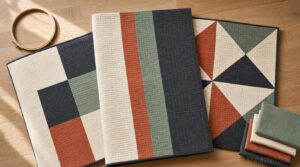
Starting simple doesn’t mean settling for boring. Minimalist quilting is honestly one of the best places to begin because the designs are forgiving, the fabric choices are straightforward, and the results still look intentional.
Here are a few beginner-friendly ideas that prove you don’t need complexity to make something worth hanging on a wall.
Large Block Throw Quilts
Large block throw quilts are where minimalism really earns its name. Blocks measuring 12 to 24 inches do the heavy lifting — bold, confident, and fast to piece. You spend less time at the machine and more time stepping back to admire the work. That’s the whole point.
Keep the quilt dimensions between 55 and 70 inches wide. That hits the sweet spot for couch throws and wall displays alike. Pair your dominant block with a coordinated backing fabric and finish with a clean 2 to 3-inch binding — nothing fussy, just a crisp modern frame that respects the design.
The real secret? Negative space does the talking. One strong block surrounded by open solid ground reads as a statement piece, not a beginner project.
One bold block, open ground all around it, and the negative space speaks louder than the design itself
Fat Quarter Layouts
Fat quarters are practically made for minimalist modern quilt patterns. Each piece measures 18 by 22 inches — big enough for bold focal blocks, small enough to stay manageable. That’s your sweet spot for quarter block arrangement without waste.
Pair a dark fat quarter against a light neutral for value contrast pairing that does all the dramatic work. Modular grid design keeps everything clean and intentional.
Simple Strip Piecing
Strip piecing is where minimalist quilting really clicks. Cut your strips to a uniform width — 2.5 inches works well for most beginners — then chain them through your machine without stopping. You’ll move faster and keep your seam allowances consistent.
Here’s what makes it work:
- Press seams to one side to reduce bulk
- Stagger your joins so seams don’t stack at intersections
- Rotary cut subcuts from finished strip sets for perfectly matched edges
The rhythm of repeating strips creates calm visual movement — no heavy motifs needed.
Half-square Triangle Designs
From strips to triangles — same logic, bigger visual payoff. Half-square triangle units are two right triangles joined at the hypotenuse to form one square. Common finished sizes hit 2.5 and 3.5 inches. Rotate them and you reveal diagonal grid patterns, a chevron HST layout, or value gradient blocks. Precision trimming tips: use a square ruler and press seams open for flat, clean joins.
| Layout | Arrangement | Effect |
|---|---|---|
| Chevron HST Layout | Mirror pairs in rows | Bold zigzag |
| Rotated Checkerboard | 90° alternating turns | Diagonal motion |
| Value Gradient Blocks | Light-to-dark sequence | Soft ombre shift |
Easy Scrap Fabric Blocks
Turning leftover fabric into something intentional — that’s the quiet power of scrap block assembly. You’re not matching perfectly. You’re building something honest.
- Use the crumb piecing method to sew narrow strips randomly onto a foundation
- Apply seam nesting tips to reduce bulk at block intersections
- Press seams outward from center using pressing center outward technique
- Repeat one color cue across blocks for cohesion
- Keep backgrounds solid for clean lines
Modern Quilting Stitch Techniques
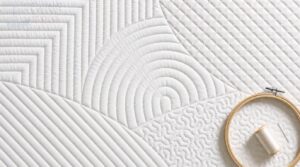
The stitching you choose can completely change how a quilt feels — even when the fabric stays simple. It’s one of the quietest decisions in the process, but it does a lot of heavy lifting. Here are five techniques worth adding to your practice.
Echo Quilting Lines
Echo quilting is basically a ripple effect stitched around a shape. You sew parallel lines at even intervals — usually 1/8 to 1/4 inch apart — that follow the contour of a block or motif.
Each pass mirrors the last, building quiet depth without adding visual noise. Match your thread to blend in, or contrast it to let every echo stand out.
Straight-line Quilting
Straight-line quilting is the backbone of minimalist modern quilt patterns. Simple, deliberate, and surprisingly powerful.
- Parallel stitch lines spaced 1/4 to 1 inch apart create clean, even texture
- A walking foot technique feeds all layers smoothly, preventing shifting
- Radiating center lines draw the eye inward for quiet drama
- Thread color choices — matched or contrasting — control how much the stitching speaks
Even line spacing keeps your geometric patterns crisp and intentional.
Contour Quilting Details
Contour quilting is where your quilt stops being flat and starts feeling alive. Unlike straight-line quilting, contour line flow traces the actual edges of your shapes — following their natural outline rather than cutting across them. The result? Depth without density.
Ruler guided curves keep your arcs smooth and confident. Free motion works too, but consistency is everything.
Use a 70/10 or 80/12 needle with neutral thread — dove gray or ivory — to keep your minimalist modern quilt patterns clean and intentional.
Contrasting Thread Accents
Thread color is a quiet decision that carries a lot of weight. Dark navy on light linen sharpens every seam line. White on charcoal keeps things precise but restrained. Even bright red on muted gray can act as a single focal punch.
- Navy on linen — crisp and deliberate
- White on charcoal — clean, minimal contrast
- Red on gray — one bold accent
- Gold on black — shimmer reads as texture
Raw-edge Appliqué Shapes
Raw-edge appliqué is refreshingly simple. Cut your shape, fuse it down, stitch close to the edge — done.
Botanical silhouettes and geometric forms work beautifully here, letting negative space do the heavy lifting. Edge fraying isn’t a mistake; it’s the point. It adds quiet texture without breaking your minimalist aesthetic. Even a single leaf shape can anchor an entire quilt.
Textured Minimalist Fabric Ideas
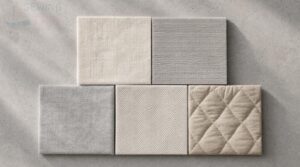
Minimalism isn’t just about what you leave out — it’s also about what your fabric brings to the table. Texture does the quiet work of adding depth without noise, giving your quilt something to say without shouting. Here are five fabric choices that do exactly that.
Linen Quilt Backgrounds
Linen is quietly one of the best backgrounds you can choose for a minimalist quilt. Its natural slub texture adds subtle visual interest without competing with your design. Weights between 90 and 150 gsm keep things lightweight, while heavier options around 180–260 gsm add real drape to larger throws.
The natural tone palette — ecru, ivory, flax — pairs beautifully with monochromatic or geometric designs. That matte finish genuinely helps seams disappear, keeping your clean lines front and center.
Key things to know about linen backgrounds:
- Pre-wash before cutting — linen shrinks, and you don’t want surprises after piecing
- Plain or herringbone weave choices both complement solid color blocking
- Matte finish reduces glare, making negative space feel intentional
- Softens beautifully with every wash, gaining that lived-in warmth
- Works especially well with large-scale blocks and sparse layouts
Care is simple: cold gentle wash, air dry, then iron while slightly damp. That’s it.
Slubbed Cotton Details
Slubbed cotton brings something linen can’t — visible yarn irregularities that create raised nubs across the surface. That uneven texture catches light differently at every angle, adding depth to solid colors without prints or embellishment.
For minimalist modern quilt patterns, slub texture does the visual work quietly. It reinforces clean lines and geometric shapes while keeping your monochromatic color palette feeling warm and intentional, never flat.
Low-volume Prints
Low-volume prints sit right in that sweet spot between solid fabric and busy pattern. They bring subtle print pairing without competing for attention. Think tiny dots, soft crosshatching, or faint geometric marks — barely there, but doing real work.
That tonal harmony keeps your minimalist modern quilt patterns feeling cohesive. The eye moves quietly across the surface, never snagged by contrast or clutter.
Neutral Woven Textures
Neutral woven textures take fabric hand softness to another level. Linen and cotton blends develop character over time — starting crisp, then softening beautifully with each wash.
Weave grain highlights catch light quietly, adding dimension without bold contrast. Those natural slub texture nuances and slight thread irregularities give your minimalist modern quilt patterns a calm, tactile richness that no print can replicate.
Subtle Fabric Scraps
Scrap blending might be the quietest power move in minimalist quilting. Small pieces in soft tones and neutrals — ivory, taupe, warm grey — tuck into your design without demanding attention. Micro texture layers from cotton-linen or voile scraps add depth you feel more than see.
Keep prints low-volume and geometric, arrange with generous negative space, and let subtle edge fraying do the rest.
Top 4 Minimalist Quilting Picks
Some resources just cut through the noise and give you exactly what you need. These four picks are the ones worth keeping on your shelf — whether you’re just starting out or looking to sharpen your style. Here’s what made the cut.
1. Simply Modern Patchwork Quilts
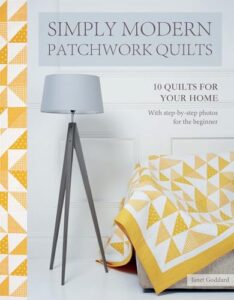
If you want one book that actually gets minimalist quilting right, this is it. Simply Modern Patchwork Quilts from Search Press packs 10 step-by-step projects into 96 clean, well-photographed pages. It’s built for both beginners and seasoned quilters, covering materials, techniques, and yardage in plain language.
The designs lean on bold geometric shapes, solid fabrics, and restrained palettes — exactly the kind of quiet confidence minimalist quilting demands. At just under a pound, it’s a practical workbench companion, not a coffee table showpiece.
| Best For | Anyone who loves clean, modern design — whether you’re picking up a needle for the first time or looking for fresh project ideas to break out of traditional patterns. |
|---|---|
| Skill Level | Beginner to Advanced |
| Primary Use | Quilt Projects |
| Design Style | Contemporary Modern |
| Item Count | Multiple Projects |
| Physical Format | Instructional Book |
| Intended For | Home Decor Quilts |
| Additional Features |
|
- Clear, step-by-step instructions make it easy to follow along without getting lost
- Beautiful photography shows the finished quilts in real home settings, which really helps you picture the end result
- Covers yardage and sizing so you can actually plan your fabric before you buy
- Skips traditional quilt block styles entirely, so it won’t satisfy that itch if that’s what you’re after
- Tools and fabric aren’t included — you’re on your own for sourcing materials
- At 96 pages, it’s a focused collection, not an exhaustive reference you’ll pull from forever
2. Modern Quilts Block by Block Pattern Book
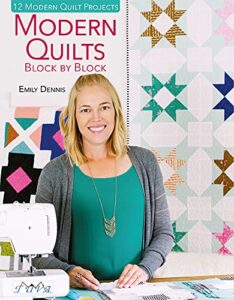
Modern Quilts Block by Block gives you 12 repeating-block projects that actually make sense from the first cut. Each pattern comes with clear graphics, step-by-step instructions, and detailed cutting diagrams — including precut-friendly options. At $19.10, it’s a solid pick for confident beginners ready to move beyond the basics.
The spiral binding stays flat on your work table, and the cover flaps hold your page. Fair warning: the grey text can be hard on the eyes in low light.
| Best For | Beginner and novice quilters who want modern takes on traditional blocks and are ready to tackle their first real projects. |
|---|---|
| Skill Level | Beginner & Novice |
| Primary Use | Quilt Projects |
| Design Style | Modern Traditional |
| Item Count | 12 Projects |
| Physical Format | Spiral-Bound Book |
| Intended For | Versatile Quilting |
| Additional Features |
|
- 12 varied projects with clear cutting diagrams, including precut-friendly options
- Spiral binding lies flat and cover flaps keep your place — genuinely handy at the cutting table
- Versatile enough for baby quilts, table runners, or mix-and-match sampler quilts
- Gray text can be tough to read, especially in low light
- A few patterns reportedly have instructional errors, so double-check before cutting
- At $19.10 it’s reasonable, but experienced quilters may find the skill level too basic
3. Zen Chic Inspired Modern Quilt Design
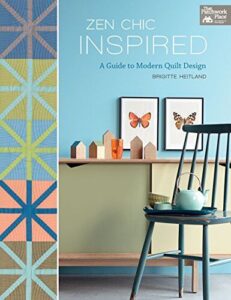
Zen Chic Inspired Modern Quilt Design is the book for quilters who want their work to feel intentional — not just finished. Published by That Patchwork Place, its 12 patterns lean hard into clean lines, negative space, and bold geometry.
Think interior design logic applied to fabric. Color palettes stay restrained — neutrals, high contrast, tonal gradients — so the shapes do the talking.
It’s built for confident beginners who already grasp the basics and want to level up their design eye.
| Best For | Quilters who already know the basics and want to develop a sharper, more modern design sensibility — especially those who love clean, intentional aesthetics. |
|---|---|
| Skill Level | Confident Beginners |
| Primary Use | Quilt Projects |
| Design Style | Minimalist Modern |
| Item Count | 12 Patterns |
| Physical Format | Design Book |
| Intended For | Interior Design Quilts |
| Additional Features |
|
- 12 fresh patterns built around negative space, bold geometry, and graphic shapes — great for breaking out of traditional quilt ruts.
- Uses interior design logic for color, so your finished quilt actually works with your space, not just in a vacuum.
- Styled room photography makes it easy to visualize how each quilt fits into a real home.
- Not the right starting point if you’re still learning basic quilting terms or techniques — assumes you’ve got that covered.
- Lighter on full-size templates and traditional blocks than pattern-heavy books.
- More focused on design thinking than step-by-step written instructions, which may frustrate detail-oriented learners.
4. Victorian Needlework Embroidery Scissors Kit
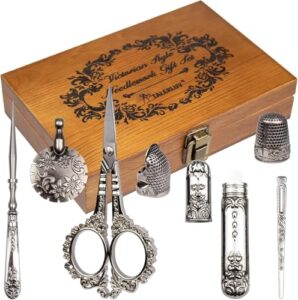
Good tools don’t just help — they make every cut feel deliberate. The TALERLUV Victorian Needlework Scissors Kit brings that intention in a 30-piece set built for precision work like quilting, embroidery, and cross stitch. The stainless steel blades resist rust, and the engraved floral grips add a quiet elegance that feels right at home in a minimalist sewing space.
Everything stores in a custom wooden box with dedicated slots — no digging, no chaos. Just reach in and work.
| Best For | Hobbyists and crafters who love detail-oriented needlework like embroidery, cross stitch, or quilting — and want their tools to look as good as the projects they make. |
|---|---|
| Skill Level | Adults & Children |
| Primary Use | Quilting & Sewing |
| Design Style | Antique Victorian |
| Item Count | 30 Pieces |
| Physical Format | Tool Kit |
| Intended For | Sewing & Crafts |
| Additional Features |
|
- Stainless steel blades with a rust-resistant finish that holds up over time
- Gorgeous antique Victorian design with engraved floral handles — functional and beautiful
- Custom wooden storage box keeps everything organized and easy to grab
- Small scissors are great for precision but won’t handle larger cutting tasks
- No measuring tape included, so you’ll need to source that separately
- Better suited for small-scale projects — not the right fit for heavy-duty sewing work
Frequently Asked Questions (FAQs)
How do I care for a finished minimalist quilt?
Treat your finished quilt with care. Wash in cold water using a gentle detergent, skip bleach, and dry flat. Store it in a breathable cotton bag away from direct sunlight.
What quilt sizes work best for minimalist designs?
Queen and king sizes shine brightest here. A 90×108-inch queen gives your design room to breathe. Large negative space needs surface area to land. Smaller? A 50×60-inch throw still works clean.
Can minimalist quilts work for wall hangings?
Absolutely. Minimalist quilts are made for walls. Simple shapes and restrained color read clearly from across a room, and negative space does the heavy lifting — no busy pattern needed.
How long does a minimalist quilt typically take?
Baby quilts wrap up in 6–14 hours. A lap quilt? Around 12–24 hours. Throw sizes push 20–40 hours. Your timeline depends on quilt size, seam count, and whether you’re machine or hand quilting.
Are minimalist quilts suitable as handmade gifts?
Yes, minimalist quilts make excellent handmade gifts. Their clean designs suit almost any home, simple palettes won’t clash with existing decor, and fewer seams mean faster finishing — so you spend less time sewing, more time giving.
Conclusion
The quilt sitting in your head right now isn’t quite finished—but you already know exactly what it needs. That instinct? That’s the whole point.
Minimalist quilting design ideas don’t hand you a formula. They sharpen your eye until you can walk into a fabric store, pick three solids, and build something that stops people cold.
Less chaos. More intention. One bold choice, made with confidence, always outlasts a quilt that tried to say everything.