This site is supported by our readers. We may earn a commission, at no cost to you, if you purchase through links.
One snapped needle can stop your whole line. Ten minutes later, your deadline looks shaky. Small shops feel this fast.
A wrong needle costs more than money. It costs trust with clients.
Sewing machine needles for small businesses aren’t just supplies. They’re the backbone of every stitch you ship.
Pick the wrong size, and seams pucker. Pick the wrong shank, and machines jam.
The right needle keeps your line moving and your reputation intact. Below, you’ll find nine needles built for real production work. You’ll also get the storage rules that keep your shop running strong.
Table Of Contents
- Key Takeaways
- Top 9 Sewing Machine Needles for Small Businesses
- 1. Universal Heavy Duty Sewing Needles
- 2. Universal Sewing Machine Needle Set
- 3. Organ Industrial Needle Assortment 16×257
- 4. Organ Sewing Machine Needle Assortment
- 5. Industrial Heavy Duty Sewing Needles
- 6. Industrial DB1 Sewing Needle 14 90
- 7. Singer Heavy Duty Needle Set
- 8. Universal Heavy Duty Sewing Needles 90/14
- 9. Universal Sewing Needle Assortment Set
- Home Vs Industrial Needle Compatibility
- Best Needles by Fabric Type
- Needle Sizes for Production Sewing
- Buying Needles in Bulk
- Frequently Asked Questions (FAQs)
- Conclusion
Key Takeaways
- Your needle has to match your machine’s shank style first—flat shank for home machines, round shank for industrial—or you’ll jam the works.
- Picking the right needle size for your fabric weight matters more than anything else, since the wrong size causes puckered seams or skipped stitches.
- Swap out your needles every 4 to 8 hours of sewing (or after each project) because dull or bent needles wreck stitch quality fast.
- Buying needles in bulk and storing them dry and labeled saves you money and keeps your production line running without unexpected downtime.
Top 9 Sewing Machine Needles for Small Businesses
The right needle makes or breaks your production line. These nine options cover the range from everyday stitching to heavy-duty industrial work. Here’s what belongs in your supply cabinet.
Pair your needle choice with a heavy duty sewing machine built to push through thick layers without skipping a stitch.
1. Universal Heavy Duty Sewing Needles
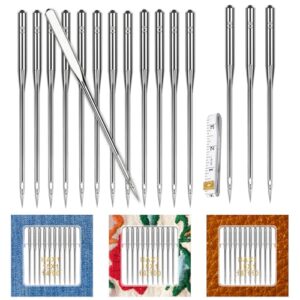
Universal Heavy Duty Sewing Needles are built for the jobs that eat ordinary needles alive. You get 30 needles across three sizes — 90/14, 100/16, and 110/18 — so you’re covered from mid-weight shirts to canvas and denim.
The high-carbon iron-alloy construction resists bending under pressure. Your flat-shank design seats firmly in most home machines. No skipped stitches. No guessing.
One limitation: the plastic tubes crush easily. Handle them with care.
| Best For | Hobbyists and small-shop sewers who regularly work with a range of fabrics — from everyday shirts to canvas, denim, and leather. |
|---|---|
| Material | Iron alloy |
| Needle Count | 30 |
| Size Range | 90/14-110/18 |
| Shank Type | Flat-side |
| Machine Compatibility | Domestic |
| Fabric Range | Light to heavy |
| Additional Features |
|
- 30 needles across three sizes means you’re set for most projects without buying multiple packs
- Heavy-duty iron-alloy build holds up under pressure and keeps stitch quality consistent
- Flat-shank design fits most home sewing machines right out of the box
- The plastic tubes are flimsy — one wrong squeeze and they’re crushed
- Not specialized, so delicate fabrics like silk or knits might need a different needle type
- Won’t fit industrial machines, so it’s strictly a home-use option
2. Universal Sewing Machine Needle Set
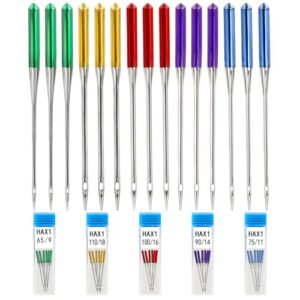
If the heavy-duty set covers your thick layers, this one covers everything else. The Universal Sewing Machine Needle Set gives you 30 needles across five sizes — 65/9, 75/11, 90/14, 100/16, and 110/18. Light silk to heavy canvas. One package covers it all.
Color-coded shanks make size identification instant. No squinting at tiny numbers mid-project. The flat-shank design fits Singer, Brother, and Janome without adapters.
One note: check your machine tension before starting. A few models don’t seat these perfectly.
| Best For | Sewers of all skill levels who work across a range of fabrics and want one needle set that handles everything from delicate silk to heavier materials. |
|---|---|
| Material | Iron alloy + titanium |
| Needle Count | 30 |
| Size Range | 65/9-110/18 |
| Shank Type | Flat-side |
| Machine Compatibility | Domestic |
| Fabric Range | Silk to leather |
| Additional Features |
|
- Five sizes in one pack means you’re covered no matter what fabric hits your machine
- Color-coded shanks make grabbing the right needle fast — no guessing mid-project
- Fits Singer, Brother, and Janome right out of the box, no adapters needed
- Some needles have broken on first use, so durability isn’t guaranteed across the board
- A handful of machine models may still have fit issues despite the broad compatibility claim
- Packaging isn’t always clear, making it tricky to confirm your machine is a match before you buy
3. Organ Industrial Needle Assortment 16×257
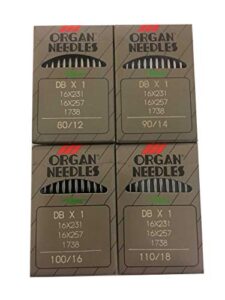
Switch to industrial and everything changes. The Organ 16×257 Assortment gives you 40 needles across four sizes — 12, 14, 16, and 18 — with 10 per size. Built for DBx1 industrial machines only. Not home machines.
At 33.9 mm, these handle denim, leather, and canvas without skipping. One pack covers your size range. No separate orders.
Can’t use them on a Cowboy 3200 or non-DBx1 setup. Check your machine first.
| Best For | Industrial sewers who work with heavy fabrics like denim, leather, or canvas and need a reliable range of DBx1 needle sizes without buying separate packs. |
|---|---|
| Material | Industrial steel |
| Needle Count | 40 |
| Size Range | 12-18 |
| Shank Type | DBx1 industrial |
| Machine Compatibility | Industrial only |
| Fabric Range | Heavy-duty only |
| Additional Features |
|
- Four sizes in one pack — no hunting down individual size packs
- Handles tough, heavy-duty materials without skipping stitches
- Built for high-speed production, so they hold up under real workload
- Won’t work on home machines or anything that isn’t a DBx1 setup
- Size labeling can trip up sewers who are new to industrial needles
- No flexibility for other shank types — you’re locked into DBx1
4. Organ Sewing Machine Needle Assortment
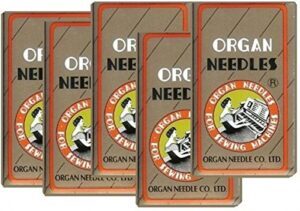
For home machines, the Organ Sewing Machine Needle Assortment is your all-in-one answer. Five sizes — 65/9 through 120/20 — cover light to heavy fabrics. Universal, jeans, and stretch variants included. Color-coded shanks make quick identification easy in a busy workroom.
Each needle features a hardened tip and centered eye for clean stitching and smooth thread flow. Compatible with Janome, Brother, and Singer machines. One box. Every fabric type. No guessing.
| Best For | Home sewers who want one pack that handles most everyday projects without hunting down multiple needle sizes. |
|---|---|
| Material | Steel |
| Needle Count | 50 |
| Size Range | 9-18 |
| Shank Type | Flat-back HAx1 |
| Machine Compatibility | Domestic |
| Fabric Range | Light to medium |
| Additional Features |
|
- Five sizes in one box — from lightweight to medium fabrics, you’re covered without buying separate packs.
- Each needle is engraved with its size, so there’s no guessing when you grab one out of the drawer.
- Works with popular machines like Janome, Brother, and Singer right out of the box.
- The fabric glue stick shown in the listing isn’t actually included, which is a bit misleading.
- Only universal flat-back needles here — if your project needs ballpoint or quilting needles, you’ll need to shop elsewhere.
- Needles can snap if your machine isn’t threaded right or you push the fabric too hard, so a little care goes a long way.
5. Industrial Heavy Duty Sewing Needles
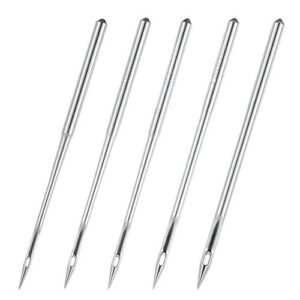
Stainless steel construction. That’s what separates these from the rest. The Industrial Heavy Duty Sewing Needles come in five sizes — 14/90 through 22/140 — with 10 needles each. Built for leather, denim, and carpet work.
If you’re unsure which size to grab first, this guide on sewing machine needle repair and selection can help you match the right needle to your fabric and avoid common mistakes.
Sharp points cut clean. No fraying. No snagging. Your older home machines and modern electric models can both handle them. 50 needles per pack keeps your workroom running without constant restocking.
| Best For | Hobbyists and professional sewers who regularly work with heavy materials like leather, denim, or carpet and need a reliable, versatile needle supply. |
|---|---|
| Material | Stainless steel |
| Needle Count | 50 |
| Size Range | 14/90-22/140 |
| Shank Type | Flat-surface push-in |
| Machine Compatibility | Domestic and older models |
| Fabric Range | Heavy-duty |
| Additional Features |
|
- Five sizes in one pack means you’re covered for almost any heavy-duty project without hunting down individual needles.
- Stainless steel construction holds up to tough fabrics without bending or dulling quickly.
- Works with a wide range of machines — old and new — so you’re not locked into one setup.
- Not a fit for specialized machines that need proprietary needle types.
- You’ll need a screwdriver handy to swap needles, which adds a small extra step.
- Humid storage conditions can lead to rust, so you’ll want to keep them somewhere dry.
6. Industrial DB1 Sewing Needle 14 90
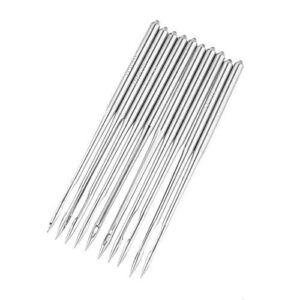
Industrial DB1 needles are built for one job: industrial lockstitch machines. That’s it. No domestic use. No crossover.
Size 14/90 accommodates lightweight fabrics, nylon webbing, and zippers cleanly. Compatible with JUKI DDL-555, Singer, and Brother industrial models. One needle fits multiple machines — your overhead stays lean.
Each pack holds 10 needles at 37 mm length. Durable enough for long production runs. Small packs mean fresh needles stay in rotation without excess waste.
| Best For | Garment manufacturers and industrial sewers who need reliable, cross-compatible needles for lockstitch machines working with lightweight fabrics, nylon webbing, or zippers. |
|---|---|
| Material | Industrial steel |
| Needle Count | 10 |
| Size Range | 14/90 only |
| Shank Type | DB1 industrial |
| Machine Compatibility | Industrial only |
| Fabric Range | Lightweight only |
| Additional Features |
|
- Works across multiple major industrial brands (JUKI DDL-555, Singer, Brother), so you’re not stocking separate needle sets for each machine
- Handles lightweight fabrics, nylon webbing, and zippers cleanly without skipped stitches or snags
- Durable build holds up through long production runs without bending or breaking
- Only comes in size 14/90, so if your work requires different needle sizes, you’ll need to look elsewhere
- Not compatible with domestic machines — strictly industrial lockstitch use only
- Ten needles per pack goes fast in high-volume shops, meaning you’ll be reordering more often than you’d probably like
7. Singer Heavy Duty Needle Set
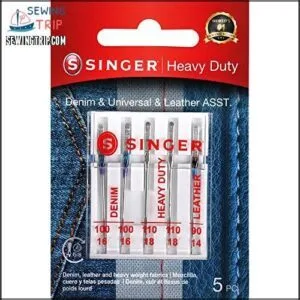
The Singer Heavy Duty Needle Set gives your domestic machine real muscle. Five needles. Three sizes — 90/14, 100/16, and 110/18. That range accommodates denim, canvas, corduroy, and leather without skipping a beat.
Each needle fits a flat-shank domestic machine — Singer, Brother, Kenmore, and more. No adapters. No guesswork. The color-coded case keeps sizes sorted fast.
At 0.01 lb total, it’s light to store. Heavy on results.
| Best For | Home sewers who regularly work with heavy fabrics like denim, canvas, or leather and want one reliable set that works across multiple machine brands. |
|---|---|
| Material | Standard steel |
| Needle Count | 5 |
| Size Range | 90/14-110/18 |
| Shank Type | Universal |
| Machine Compatibility | Domestic |
| Fabric Range | Heavy-duty |
| Additional Features |
|
- Three sizes in one pack means you’re covered for most heavyweight fabrics without buying multiple sets
- Works with all the major domestic brands — Singer, Brother, Kenmore — so no hunting for brand-specific needles
- The color-coded case makes grabbing the right size quick and painless
- Only three size options, so very fine or extremely heavy fabrics might leave you needing something extra
- Not built for thick upholstery or industrial materials — standard needle length has its limits
- Vintage or specialty machines with non-standard shanks may not accept these needles
8. Universal Heavy Duty Sewing Needles 90/14
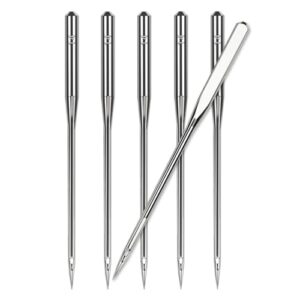
These universal heavy duty needles come packed 50 to a box — five packs of ten. You won’t run out mid-project. The flat-shank design fits most domestic machines without adapters.
Built from hardened iron alloy, they push through denim, canvas, and layered quilting without bending. The polished eye reduces thread friction. The reinforced scarf keeps stitches clean on thick seams.
Reliable. Affordable. A steady workhorse for your production floor.
| Best For | Home sewers and hobbyists who regularly work with heavy fabrics like denim, canvas, or leather and need a reliable, budget-friendly needle supply that won’t run out fast. |
|---|---|
| Material | Iron alloy |
| Needle Count | 50 |
| Size Range | 90/14 only |
| Shank Type | Flat-side |
| Machine Compatibility | Domestic |
| Fabric Range | Heavy-duty |
| Additional Features |
|
- Comes in a bulk pack of 50, so you’re always stocked up and ready for back-to-back projects
- Hardened iron alloy construction holds up well against thick, tough fabrics without bending
- Flat-shank design fits most standard home sewing machines right out of the box
- Only available in size 90/14, so if your project calls for a different size, these won’t cut it
- A few users have reported needle breakage under really heavy stress or high-speed sewing
- Won’t work with machines that need a round shank needle instead of a flat one
9. Universal Sewing Needle Assortment Set
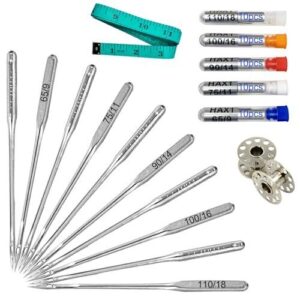
One set. Five sizes. Everything you need to move from silk to denim without stopping.
The Universal Sewing Needle Assortment Set covers sizes 65/9 through 110/18 — fifty needles total, ten per size. Each one is cold-forged steel with a slightly rounded tip. Works on Singer, Brother, Janome, and most flat-shank domestic machines.
Five labeled storage tubes keep your needles sorted. No guessing. No digging. Just grab the right size and sew.
| Best For | Home sewists — hobbyists and pros alike — who work across a range of fabrics and want a reliable, affordable needle set without constantly running out of the right size. |
|---|---|
| Material | Cold-forged steel |
| Needle Count | 50 |
| Size Range | 65/9-110/18 |
| Shank Type | Universal |
| Machine Compatibility | Domestic |
| Fabric Range | Silk to denim |
| Additional Features |
|
- Fifty needles across five sizes means you’re covered from delicate silks all the way up to heavy denim or leather
- Labeled storage tubes keep everything organized so you’re not hunting for the right needle mid-project
- Cold-forged steel construction holds a sharp edge and works with most flat-shank domestic machines like Singer, Brother, and Janome
- Not built for industrial machines, so heavy-duty commercial sewists will need to look elsewhere
- No color-coded shanks — you’re relying on the tube labels to tell sizes apart
- Beginners might need a little extra help figuring out which needle size plays nicely with which fabric
Home Vs Industrial Needle Compatibility
Grabbing the wrong needle for your machine is an easy mistake — and a costly one. Home and industrial systems don’t play by the same rules, so knowing the difference keeps your projects running smoothly. Here’s what you need to know before you buy.
Domestic Flat-shank Systems
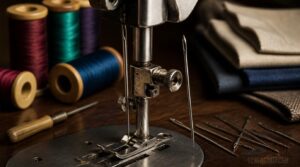
Most home machines run on a flat-shank system. The needle has a flat back that locks into the clamp screw. No guessing required.
A proper flat shank alignment guide helps prevent needle breakage.
| Feature | Detail |
|---|---|
| Shank thickness | 0.9–1.0 mm |
| Size range | 60/8 to 110/18 |
| System standard | 130/705 H (HAx1) |
| Point types | Sharp, rounded, ball |
| Maintenance tip | Replace every 8–12 hours |
Industrial Round-shank Systems
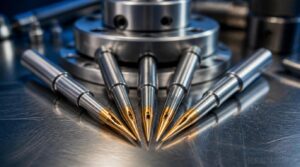
Industrial machines use a round shank system — cylindrical, locked in tight. No flat back. The chuck grips it securely, even at high speeds.
Carbon steel forging gives the shank rigidity. Stress spreads evenly. Bending stays rare.
| Feature | Round Shank Detail | Why It Matters |
|---|---|---|
| Shank shape | Cylindrical | Secure chuck fit |
| Material | High-carbon steel | Resists bending |
| Speed rating | High-speed alignment | Reduces misalignment |
| Coating options | Titanium nitride | Lower friction |
| Maintenance | Stitch-count replacement | Consistent quality |
Replace needles on schedule. Inspect for burrs regularly.
Brand Compatibility Checks
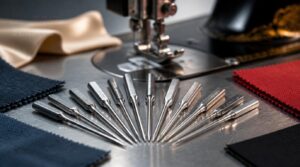
Round shanks lock tight. Flat shanks need proper orientation. Shank style verification comes first — always.
Check your machine manual alignment before buying. It lists approved needle systems by brand and model.
| Check | Flat Shank | Round Shank |
|---|---|---|
| Orientation | Flat back required | Any rotation |
| System code | 130/705 H | 135×17 |
| Brand risk | Misfit damages driver | Chuck misalignment |
Needle plate inspection confirms groove width. Wrong needle types cause thread breakage and skipped stitches. Test fabric tension before full runs.
Heavy-duty Machine Requirements
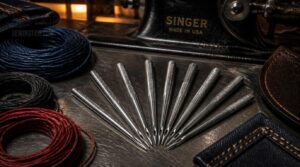
Heavy-duty machines hit differently. High torque at low speeds keeps fabric moving without stalling. Frames built from high-strength steel alloys absorb constant vibration without warping. Thermal sensors protect motors during long production runs. Redundant safety sensors catch failures before damage spreads.
Your industrial sewing needles must match this power — bulk purchasing round-shank types sized for the job keeps textile manufacturing moving.
Avoiding Wrong Needle Purchases
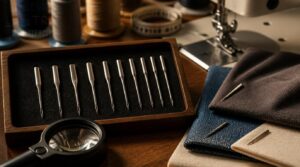
Wrong needles waste money. Check shank style first — flat or round determine fit. Match needle size to fabric weight using a needle size chart.
Verify brand compatibility before bulk purchasing. Avoid generic brands; vague specs mean breakage risk.
Choose fabric-specific needles — ball-point for knits, denim for canvas. Your sewing machine compatibility check saves every order.
Best Needles by Fabric Type
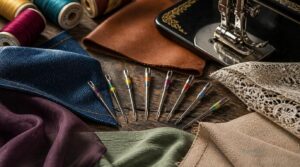
The right needle depends entirely on what’s under your presser foot. Match your needle to your fabric and you’ll avoid skipped stitches, broken thread, and wasted material. Here’s what works best for each fabric category you’re likely running through your machine.
Wovens and Everyday Fabrics
Woven fabrics are your everyday workhorses. Plain weave — think cotton poplin and broadcloth — holds equal strength in both directions. It’s tight and smooth.
Universal Bulk Needles handle these fabrics well. Their slightly rounded tip glides without damage.
For microfiber blends, reach for Microtex Bulk Needles instead. That fine point keeps stitch lines clean and precise.
Denim and Canvas Projects
Denim and canvas hit different. Both are tough — but they’re built differently.
Denim uses a twill weave. Canvas runs plain weave. That changes how your needle moves through each one.
Use Jeans/Denim Bulk Needles for both:
- Sharp point cuts through diagonal twill ribs
- Supports 8–14 oz denim without skipped stitches
- Penetrates tight canvas plain weave cleanly
- Built for layers and heavy abrasion
Knits and Stretch Fabrics
Knits don’t behave like wovens. They stretch. That changes everything.
Use ball-point needles for knit fabrics. The tip slides between looped threads instead of piercing them. No snags. No skipped stitches.
For elastane blends — anything with 3–20% spandex — try a stretch needle. It accommodates recovery and movement without breaking the stitch.
Leather, Vinyl, and Suede
Leather, vinyl, and suede each need a wedge-point needle. That sharp, blade-like tip cuts cleanly through the surface without tearing. Regular needles drag and rip.
For suede and leather, size up. A 90/14 or larger supports the resistance. Vinyl stays cleaner with consistent stitch tension. Keep your needle fresh — dull tips shred material fast.
Quilting and Embroidery Work
Quilting and embroidery demand precision from your needle. HLx5 High-Speed Quilting Needles cut through quilt sandwiches cleanly. Machine Embroidery Needles feature a larger eye to protect thread.
- Match your stabilizer selection to your fabric weight
- Balance thread tension to prevent loops
- Use hoop alignment techniques for consistent results
Needle Sizes for Production Sewing
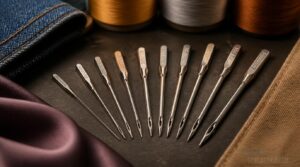
Getting needle sizes right is the difference between clean production runs and a pile of ruined fabric.
Both European and American sizing systems are in play here, and knowing which size fits your material keeps your machines running smoothly. Here’s what you need to know across five key sizing categories.
European and American Sizing
Two sizing systems run side by side: European metric and American numerical. A size 100/16 means a 1.0 mm blade diameter — the number tells you exactly what you’re working with. American sizing doesn’t. That’s where conversion errors creep in.
SCHMETZ and Groz-Beckert both follow dual-system labeling. Trust the paired number. Always.
Fine Fabric Needle Sizes
Fine fabrics demand precision. Size 60/8 starts at 0.60 mm — built for chiffon and silk. Size 70/10 suits organza and voile. Step up to 75/11 for fine cottons.
Microtex Sharp needles are your best tool here. They minimize fabric snagging and keep stitch balance clean. Pair them with 60-weight thread. Small needle, small hole, better result.
Medium-weight Fabric Sizes
Medium-weight fabrics run 5 to 10 oz/yd² — roughly 170 to 340 GSM. That covers twill, poplin, linen blends, and cotton canvas.
Your go-to needle range here is 70/10 to 90/14. Size 80/12 accommodates most mid-weights cleanly. It pierces without distorting. Size 90/14 suits denser weaves like chino or canvas.
Bulk wholesale needles in these sizes keep your production steady.
Heavy Fabric Needle Sizes
Heavy fabrics demand bigger needles. Think 100/16 to 110/18 for denim and canvas. Lighter needles bend and break fast.
Here’s a quick denim thickness guide:
- 6–8 oz denim — 90/14
- 10 oz denim — 100/16
- 12–14 oz denim — 110/18
- Upholstery weight — 120/20
- Multi-layer seams — bump up one size
Reducing Skipped Stitches
Bigger needles solve half the problem. Skipped stitches often come down to the wrong needle for the job.
A bigger needle only fixes half the problem; skipped stitches usually mean the wrong needle for the fabric
Match needle type to fabric first — ballpoint for knits, sharp for wovens. Check needle installation: flat side back, fully seated.
Balance your thread tension. Stabilize slippery layers.
Replace needles every 6–8 hours of operation. Consistent seam quality starts there.
Buying Needles in Bulk
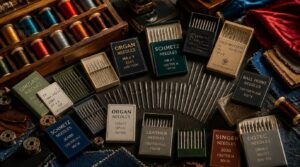
Buying needles one box at a time adds up fast. Bulk purchasing keeps your costs predictable and your production moving without interruption. Here’s what to know before you stock up.
Bulk Pricing Considerations
Bulk pricing on sewing machine needles rewards smart planning. Orders over 50 units grant 5% per-unit savings. Hit 100 units and that jumps to 10%. At 250 units, you’re saving 15% — plus suppliers often bundle or waive shipping entirely.
Always calculate total landed cost: price, shipping, duties combined. That’s the real number that matters.
Coated Needle Value
Coated needles cost more upfront — but they earn that gap back fast. Titanium-nitride coatings extend needle life three to five times longer than standard chrome. That’s fewer replacements, less downtime, less waste.
SCHMETZneedles and NonStick bulk needles reduce friction by up to 25 percent. Your fabrics stay cleaner. Your stitches stay consistent.
For production sewing, that’s real ROI.
Needle Storage Systems
When needles pile up, production slows down. Needle storage solutions keep your workflow steady.
Drawer organizer benefits are real: labeled slots let you grab the right needle fast. Clear trays show your stock at a glance. Wall cabinet efficiency adds more — mounted at eye level, slim profiles fit tight spaces.
The myPad Needle Organizer organizes craftroom organization cleanly. Portable pouches travel well.
Cost Control for Businesses
Smart cost control starts with your needle inventory management. Target 6–8 inventory turns yearly. That keeps cash moving.
Buy bulk needle packaging at wholesale prices — universal needles start at $51.50. Track supplier performance and centralize procurement to cut maverick spending.
Run monthly budget variance checks. Even small overruns add up fast.
Frequently Asked Questions (FAQs)
What is the difference between industrial and home sewing machine needles?
Shank shape is the key difference. Home needles have a flat back. Industrial needles use a round shank. That single design choice determines speed, power, and machine fit.
How often should small businesses replace sewing needles?
Six hours of steady stitching dulls a point fast. Replace every 4 to 6 hours of high-volume sewing, after each project, or when switching fabrics. Inspect for burrs or bends—damage means swap it now.
What needle brands do professional seamstresses trust most?
Schmetz German engineering earns top trust for industrial sewing consistency. Organ embroidery precision wins specialty stitching.
Singer durability holds mid-weight production. Professional brand loyalty stays strong with these top needle brands for quality sewing and tailoring.
How do damaged needles affect stitch quality and output?
A dull blade tears more than it cuts. Fabric puckering causes weak seams. Thread breakage risks climb with needle heat damage. Stitch tension issues and production rework costs follow. Stick to your needle replacement schedule for stitch stability.
Should small businesses stock multiple needle sizes at once?
Yes. Five sizes cover most jobs.
That’s smart stocking strategy, not waste. Bulk needles cut downtime and boost fabric versatility.
Good inventory optimization plus core size selection keeps your needle inventory management tight and your sewing supplies ready for any order.
Conclusion
One broken needle once stalled a 200-piece order for an hour. That’s the real cost of skipping the right pick.
Sewing machine needles for small businesses aren’t a minor detail. They’re the quiet engine behind every shipment.
Match the needle to the fabric. Store them dry and labeled. Keep spares stocked before you need them.
Do this and your line runs smoothly. stitches hold. clients stay. That’s the whole game.
- https://www.sailrite.com/Selecting-a-Sewing-Machine-Needle
- https://weallsew.com/five-basic-sewing-needles-you-need-and-why
- https://help.singer.com/en-US/choosing-the-right-singer-machine-needles-389061
- https://blog.wawak.com/post/sewing-machine-needle-and-thread-size-chart
- https://theshelfpotato.com/2019/01/05/business-as-usual-marketing-fails-another-innovative-product-titanium-coated-sewing-needles