This site is supported by our readers. We may earn a commission, at no cost to you, if you purchase through links.
Curved seams separate a polished garment from one that looks homemade.
A sleeve cap that puckers, a neckline that ripples, a rounded hem that waves—these problems almost always trace back to a single cut gone slightly wrong.
The blade drifted, the fabric shifted, or the scissors took short choppy bites instead of one long, confident stroke.
Knowing how to cut curves in fabric cleanly changes everything downstream: your seams lie flatter, your notches clip without stress, and the finished piece holds its shape.
Get the cut right, and the rest follows.
Table Of Contents
- Key Takeaways
- Gather Tools for Clean Curves
- Prepare Fabric Before Cutting
- Stabilize Fabric on Your Table
- Mark Curves Accurately
- Choose The Right Cutting Method
- Cut Curves With Scissors
- Cut Curves With Rotary Cutters
- Handle Tricky Fabric Types
- Fix Jagged or Uneven Curves
- Finish Curved Edges Cleanly
- Frequently Asked Questions (FAQs)
- Conclusion
Key Takeaways
- Sharp tools aren’t optional — dull scissors and worn rotary blades are the #1 cause of jagged, uneven curves before you even start sewing.
- Prep your fabric before you cut: pre-wash to prevent shrinkage, press it completely flat, and stabilize it with weights instead of pins, so nothing shifts mid-cut.
- Match your cutting tool to the curve — a 45mm rotary blade glides through gentle arcs, while sharp scissors give you the hands-on control that tight curves demand.
- Finishing matters as much as cutting — clip inward curves, notch outward ones, and finish raw edges with a zigzag or serger, so your seams actually lie flat.
Gather Tools for Clean Curves
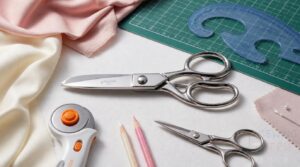
Before you make a single cut, your tools will make or break the outcome. The right ones give you control; the wrong ones leave you with frayed edges and frustration. Here’s what you need to have on hand.
Precision matters just as much when planning your design—a solid geometric quilting pattern guide helps you map out cuts before the scissors ever touch the fabric.
Sharp Fabric Scissors
Good scissors aren’t optional — they’re your most important curved-cutting ally. Look for blades made from high-carbon stainless steel; they stay sharp longer and resist rust in humid sewing rooms. An ergonomic cushioned handle reduces hand fatigue during long sessions. Research highlights ergonomic handles fatigue reduction with a 25% decrease in user fatigue. Here’s what to prioritize when choosing a pair:
- Blade geometry: a fine bevel grind produces smooth, clean curves without snagging
- Tension screw: lets you fine-tune blade pressure for precise control
- Serrated edge option: grips slippery fabrics so they don’t shift mid-cut
- Slim nose profile: improves visibility around tight inner corners
Rotary Cutter Sizes
Scissors get you far, but a rotary cutter takes curved cutting to another level — especially on longer, gentler arcs.
The 45mm blade is your everyday workhorse, handling cotton, linen, and most quilting fabrics smoothly. For tighter curves, switch to a 28mm blade. The 18mm blade manages the tiniest details.
Match the blade to the curve, and your edges almost cut themselves.
Match your rotary blade size to the curve, and clean edges follow naturally
Self-healing Cutting Mat
A good blade means nothing without a solid surface under your fabric. That’s where a self-healing cutting mat earns its place at your table.
Its polymer layer recovery seals each cut automatically, keeping the surface smooth for your next pass. The printed grid lines help you align curves fast and check seam allowances without guesswork.
Fabric Weights
Pins can shift or distort fabric, especially lightweight materials under 4 oz per square yard. Fabric weights solve that problem without leaving holes or pulling the grain.
Set them down flat and let them hold your fabric in place while you cut.
They’re especially handy with slippery or airy fabrics that move the moment your hand lifts.
Curve Rulers and Templates
Curve rulers and templates take the guesswork out of curved cutting. A French curve accommodates necklines and armholes beautifully, while quilting rulers keep longer arcs consistent. For garment work, a multi-radius set covers most shapes you’ll encounter.
- Rigid acrylic rulers hold steady under pressure
- Flexible templates bend to match custom radius curves
- Digital drafting tools export precise vector curves for pattern software
Prepare Fabric Before Cutting
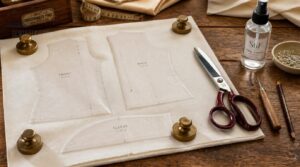
Before your scissors ever touch the fabric, a little prep work makes all the difference between a clean curve and a frustrating one. Think of it as setting the stage — when your fabric is smooth, stable, and ready, cutting becomes so much easier. Here’s what you need to do first.
Pre-wash to Prevent Shrinkage
Before you cut a single curve, your fabric needs a bath. Pre-wash your fabric first — skipping this step means your finished piece could shrink and distort after the first launder. Cotton can shrink 3 to 5 percent, and linen up to 6 percent. That’s enough to throw off your entire pattern.
Use warm water for natural fibers like cotton and linen, since it removes sizing and finishing treatments more effectively than cold. Keep wool on a gentle, cool cycle to avoid felting. Synthetics like polyester barely shrink, but a quick wash still clears any residue.
Always test a small swatch before cutting the full yardage. Wash it, dry it the same way you plan to dry the finished piece, then measure. This confirms your actual shrinkage and saves you from costly surprises. Add a dye fixative during prewash to protect colorfastness, especially with deep or bright shades. A little fabric conditioner also helps soften stiffness that builds up after washing.
Press Fabric Completely Flat
Once your fabric comes out of the wash, don’t let it sit in a crumpled heap — press it completely flat before you do anything else. Wrinkles locked into fabric before cutting will follow every curve you make.
Set your iron to the right heat for your fabric type, use short, even strokes, and let it cool fully before you touch it again.
Add Starch for Stability
Starch is your secret weapon for cleaner cuts. It firms up fibers just enough to stop shifting while you work.
Spray starch is the easiest option — mist it from 6–12 inches for even coverage.
If you’re working with light-colored fabric, rice starch leaves less white residue. Always test on a scrap first, then iron it in before cutting.
Smooth Wrinkles and Ripples
Wrinkles aren’t just ugly — they’re a trap. Even a small ripple under your pattern line can throw a curve off by several millimeters.
Before you mark anything, press the fabric flat using a medium-high steam setting. That heat activates natural fibers, reduces fabric memory, and releases built‑up tension across the weave.
Let it cool completely before touching it.
Check Grain Line Alignment
Grain line is your silent guide — get it wrong, and your curves will twist before you’ve even picked up the scissors.
Run your finger along the selvage edge and confirm your warp threads run perfectly parallel to it. Then check the cross grain sits at a true right angle. A quick T-square confirms both.
Do this before anything else.
Stabilize Fabric on Your Table
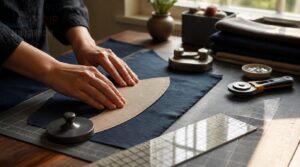
Before your blade ever touches the fabric, the way it sits on your table can make or break your curves. A few simple tricks will lock everything in place so nothing shifts mid-cut. Here’s what to do.
Use a Large Flat Surface
Before you cut a single curve, your cutting table needs to set you up for success. A surface 40 to 60 inches wide gives you room to spread fabric fully without folding the edges — and that matters more than most beginners realize.
Good lighting over your workspace keeps your marked curve lines sharp and easy to follow.
Place Fabric on Cutting Mat
Now that your table is set, it’s time to lay your fabric on the self-healing cutting mat. Place the fabric pretty side down and align one edge with a mat grid line. This keeps your curves true. Make sure no fabric hangs off the edge — blade drift loves an overhang. Quick tip: wipe the mat surface first to clear lint.
- Feel the grid lines click into place under your fabric
- Notice how a clean mat surface keeps your blade gliding smoothly
- Enjoy the confidence of knowing your fabric isn’t going anywhere
- See your curve lines stand out clearly against a stable surface
- Trust that every aligned edge brings you one step closer to clean results
Add Butcher Paper Backing
Your cutting mat is set — now slide a sheet of butcher paper underneath the fabric. This simple layer does a lot.
It stabilizes delicate fibers, absorbs blade pressure, and keeps the fabric from creeping during long curve cuts.
Choose uncoated kraft paper (40–60 gsm) to avoid dye transfer onto light fabrics.
Make sure it lies flat, with no wrinkles.
Avoid Stretching The Fabric
Butcher paper helps, but it can only do so much if you’re tugging the fabric around. Fabric distortion sneaks in fast when you stretch or drag curves into place.
Instead, lift and reposition the fabric gently. Keep it flat, relaxed, and aligned with the grainline at all times. Even slight tension can warp a curve before your blade ever touches it.
Use Weights Instead of Pins
Swap out your pins and reach for fabric weights instead. Pins puncture fibers, leave marks on delicate fabrics, and slow you down.
Weights sit flat, hold steady, and never snag a single thread. On slippery fabrics like silk or satin, they’re a real advantage — no shifting, no pinholes, just clean, confident cuts every time.
Mark Curves Accurately
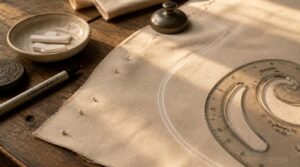
Getting your curves marked right is half the battle. A wobbly or faded line will throw off your entire cut, so it’s worth taking a few extra minutes here. Here’s what you need to know to mark cleanly and confidently.
Use Washable Fabric Markers
A washable fabric marker is one of the cleanest ways to trace pattern pieces before cutting curves. Pick a fine-tip marker for tight arcs and a bold tip for busy fabrics.
Always do a color contrast test on a scrap first — dye-based ink can ghost on dark fabrics. Most marks wash out fully in a cold-water cycle.
Try Tailor’s Chalk
Tailor’s chalk is one of the oldest fabric marking methods — and still one of the best. White chalk works on dark fabrics; blue or pink shows up clearly on light ones. Keep marks crisp by rubbing the chalk edge on a hard surface to sharpen it before marking curves.
| Chalk Color | Best Fabric | Why It Works |
|---|---|---|
| White | Dark denim, navy | High contrast on deep tones |
| Pink | Light cotton, linen | Soft visibility without bleeding |
| Blue | White or cream fabric | Clear lines, easy removal |
| Yellow | Medium-toned fabric | Stands out on muted shades |
| Dual-color | Mixed fabric projects | Flexible for varied surfaces |
Chalk brushes away cleanly — no washing needed on most wovens. On slippery silks or chiffon, test a small area first to check residue.
Trace With French Curves
A French curve is your secret weapon for smooth, repeatable arcs. Choose the right curve radius by matching the template’s edge to the arc you’ve plotted — don’t force a tight section over a gentle sweep.
Hold it flat with light pressure and trace in one continuous motion, lifting only between segments to keep lines clean and consistent.
Mark Seam Allowances Clearly
Getting seam allowances right is what separates a clean project from a frustrating one. Mark ¼ inch from the seam edge for standard garment work, or ½ inch for quilting. Use a water-soluble pen on delicate fabric and tailor’s chalk on heavier material. Always align marks with pattern notches and grain lines for accuracy.
- Use contrasting color markers so lines stay visible after handling
- Place marks evenly along each edge — gaps cause misalignment
- Don’t mark on fold lines or inside fold allowances
- Double-check each mark matches its correct pattern piece
Keep Lines Smooth and Visible
A shaky or faint line can throw off even the sharpest rotary cutter.
Always choose high-contrast marker colors — light ink on dark fabric, dark ink on light.
Keep line thickness consistent by using a fine-tip washable marker and applying even, light pressure to avoid indentations.
Test your marker on a scrap first to confirm it washes out cleanly.
Choose The Right Cutting Method
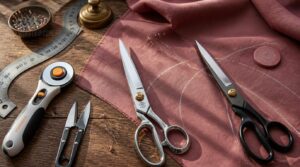
Not every curve gets cut the same way, and that’s where a lot of people go wrong. Your tool choice can make or break the cleanness of that edge. Here’s what works best depending on the curve you’re dealing with.
Rotary Cutter for Gentle Curves
A rotary cutter is your best friend for gentle curves. The 45 mm blade glides smoothly along wider arcs without overcutting. Keep the blade upright, maintain steady forward pressure, and let the cutter do the work:
- Guide along a ruler or template
- Keep blade exposure minimal
- Replace dull blades immediately
- Use consistent, forward-only strokes
Small Blade for Tight Curves
When a curve gets too tight for your rotary cutter, reach for a small craft blade. A compact tang gives you real control on radii as small as 1/8 inch.
Titanium nitride coatings keep the edge sharp longer, and micro-serrated segments grip slippery fibers so the blade doesn’t skid off your marked line.
Scissors for Detailed Shapes
When blades get too small to manage, scissors take over. Sharp fabric scissors give you hands-on control that no rotary tool can match. Think of them as your precision instrument for detailed shapes.
- Curved blade design follows tight arcs naturally
- Serrated edges grip slippery fabrics during precision cutting
- Ergonomic grips reduce fatigue on long sessions
- Micro detail scissors handle ultra-tight applique work cleanly
Single-layer Cutting Accuracy
Scissors give you precision—but precision only holds when you cut one layer at a time. Single-layer cutting keeps your fabric from shifting, drifting, or misaligning mid-cut. Stack two layers and you’re gambling with symmetry.
| Factor | Single Layer | Multiple Layers |
|---|---|---|
| Pattern alignment | Consistent | Prone to drift |
| Cutting accuracy | High | Reduced |
| Layering risks | None | Significant |
Avoid Dull Blades
A dull blade is the fastest way to ruin a clean curve. It drags, skips, and frays edges instead of slicing through them.
Replace your rotary blade every 10–15 meters of fabric, or sooner if cuts feel rough. Store blades in a protective sheath, and keep a spare ready.
Sharp blades equal cutting accuracy—every time.
Cut Curves With Scissors
Scissors give you something a rotary cutter can’t — real feel and control over every inch of that curve. The trick is in how you move, not just how sharp your blade is. A few simple habits make all the difference.
Use Long Smooth Strokes
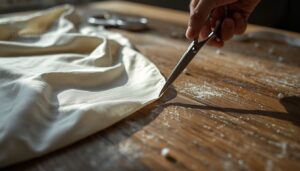
Think of your scissors as a paintbrush — long, sweeping strokes create the smoothest curved edge. Open the blades fully and glide them through the fabric in one continuous motion. This keeps blade alignment consistent, reduces edge jag, and gives you real tactile feedback as you follow the curve.
Short, choppy snips break that rhythm and invite jagged results.
Keep Fabric Flat
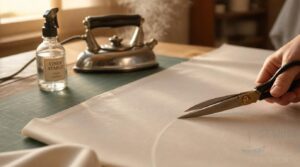
Flat fabric is your foundation. Before you even pick up the scissors, pre-wash and iron your fabric completely — shrinkage or wrinkles will throw off your curve line the moment you start cutting.
A light coat of starch keeps fibers stable, so the fabric doesn’t ripple or drift.
Keep the grainline aligned with your mat and let the fabric rest naturally flat.
Hold Fabric Gently Taut
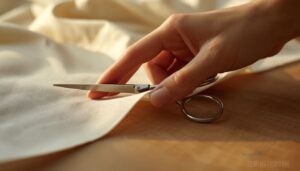
Your non-dominant hand does more than just hold the fabric in place — it controls the cut. Rest your hand flat, fingers spread wide, just ahead of the scissors.
Apply gentle, even tension across the fabric using your fingertips, not a pinch. This distributes pressure evenly, keeps the weave from slacking, and holds the grain line true throughout the curve.
Turn Fabric, Not Scissors
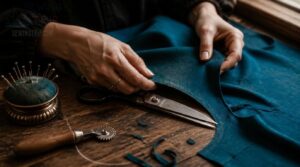
Most sewists twist their scissors around the curve — that’s the wrong move. Instead, turn the fabric toward you while keeping your scissors steady. This keeps your cutting angle consistent and your motion fluid.
Rotating the fabric lets the blade follow the curve naturally, giving you a continuous cutting motion with far better precision and edge integrity.
Avoid Short Choppy Snips
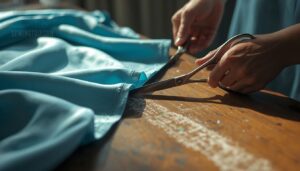
Short, choppy snips are the enemy of a clean curve. Each time you stop and restart, you create a tiny flat spot that breaks the arc.
Instead, use long steady strokes across 8 to 12 inches whenever possible. Keep consistent pressure, let your wrist guide the motion fluidly, and let the blade do the work without interruption.
Cut Curves With Rotary Cutters
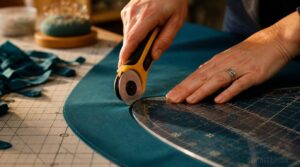
A rotary cutter can glide through curves faster than scissors — but only if you use it right. The way you hold and guide the blade makes all the difference between a clean arc and a ragged mess. Here’s what to keep in mind each time you cut.
Keep Blade Upright
Think of your rotary cutter like a wheel — it only works right when it rolls straight. Keep the blade upright, perfectly perpendicular to the mat, as you guide it through the curve.
Vertical blade alignment prevents edge drift and reduces mat friction, giving you cleaner, smoother cuts. Tipping it even slightly causes the blade to wander off your marked line.
Cut Away From Body
Once your blade stays upright, the next thing to lock in is direction. Always cut away from your body.
Push the rotary cutter forward — never pull it toward you. This one habit protects your hands and keeps your cutting motion smooth and controlled, which matters a lot when you’re following a curved line.
Follow Ruler Edges Carefully
With direction sorted, now your ruler does the real guiding work. Keep the ruler flat against the fabric — no gaps, no rocking. Use a non-slip acrylic ruler or place a grippy mat underneath to prevent ruler creep mid-cut.
| Ruler Mistake | Better Habit |
|---|---|
| Ruler lifts at edges | Press down evenly |
| Ruler shifts during cut | Use non-slip backing |
| Nicked ruler edge snags fabric | Inspect ruler before cutting |
| Loose curve templates drift | Weight or tape them down |
Run your blade right along the ruler’s edge for precision cutting. Your curved lines stay clean when the ruler stays still.
Use Steady Forward Pressure
Your ruler is locked in — now your pressure needs to match it. Steady forward pressure is what separates a clean curve from a wobbly one. Push the rotary cutter at a uniform speed, letting the blade do the work without forcing it.
- Slow down at tight curves
- Listen for a crisp, consistent cutting sound
- Ease pressure when fabric feels denser
- Keep your elbow close to reduce hand fatigue
Retract Blade After Cutting
Once the cut is done, retract the blade immediately — every single time. This one habit protects both you and your fabric. A blade left exposed can snag the edge of your curve or nick your fingers during repositioning.
| Action | Why It Matters |
|---|---|
| Retract after each cut | Prevents accidental nicks |
| Check retraction click | Confirms blade is secured |
| Maintain spring mechanism | Keeps retraction smooth |
Handle Tricky Fabric Types
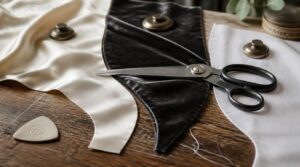
Not all fabrics play by the same rules, and curves make that even more obvious. The way you handle cotton is completely different from how you’d approach silk or velvet. Here’s what to keep in mind for each fabric type you’re likely to meet.
Cotton and Linen Curves
Cotton and linen behave surprisingly well under a rotary cutter — until you skip the prep. Always prewash first. This removes factory starch and shrinks the fabric by roughly 2 to 5 percent, so your curves won’t distort after the first wash.
Keep water temperature consistent, since higher heat can shift edge accuracy by a few millimeters. Align cuts to the grain to prevent bias stretching along curved seams.
Knit Fabric Shifting
When you work with knit fabrics, pay close attention to stitch displacement—that’s the sideways shift of yarns as you handle or cut. High yarn elasticity makes this even trickier.
Always stabilize with weights, not pins, and line up the wale direction. Keep your tension even.
If you notice lateral migration, adjust your curve to compensate for stitch drift.
Slippery Silk and Chiffon
Silk and chiffon are beautiful but frustrating — they slide around the moment you look away.
Lay a sheet of parchment paper underneath to reduce friction and keep edges true. Use pattern weights instead of pins to avoid distortion. Cut single layers only, with a sharp rotary cutter and replace blades often. Dull blades snag delicate fibers fast.
Denim and Canvas Thickness
Denim and canvas don’t forgive a dull blade. Denim commonly runs 14 to 16 oz, and canvas can hit 20 oz — that thickness fights back when you’re cutting curves.
- Use a 45 mm rotary cutter with a fresh blade
- Cut single layers only to control the twill grain
- Slow down on curves; dense weaves dull blades fast
- Apply fray check immediately after cutting
Velvet Nap Direction
Velvet is beautiful but unforgiving. Its fabric nap runs in one direction, and cutting curves without checking that first means mismatched color shading at every seam.
| Step | What To Do | Why It Matters |
|---|---|---|
| 1 | Run your hand along the pile | Identifies nap direction by feel |
| 2 | Use a low-angle light test | Reveals shadows against the nap |
| 3 | Mark nap direction on each piece | Prevents misaligned panels |
| 4 | Align all pieces before cutting | Ensures consistent fabric grain direction |
| 5 | Steam gently after cutting curves | Relaxes pile without crushing it |
Consistent nap alignment across every cut piece keeps your velvet looking rich and even throughout the finished work.
Fix Jagged or Uneven Curves
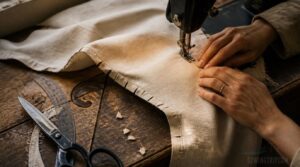
Even the most careful cuts sometimes come out a little off — and that’s completely normal. The good news is a jagged or uneven curve is almost always fixable without starting over. Here are a few simple ways to get it back on track.
Trim Only Small Amounts
When a curve comes out jagged, the instinct is to fix it fast — but that’s where overcutting happens. Instead, trim no more than 1/8 inch at a time.
Use light, incremental blade taps rather than full slicing motions. This keeps smooth contour transitions intact and protects your seam allowance on curved seams.
Re-mark The Curve Line
Once you’ve trimmed, redraw the line before cutting again. Align your curved ruler or template exactly over the original shape. Use a washable fabric marker or tailor’s chalk — both give clean, thin lines without staining.
Trace slowly to avoid ghost lines. Then verify symmetry by comparing both sides. Keep the fabric flat the whole time to prevent distortion.
Smooth Bumps Gradually
Once your line is redrawn, it’s time to work out any remaining bumps. Trim in tiny increments along the outer edge — never take a big cut. Small snips give you control. After each trim, test the curve against your pattern to check the fit. You’re easing the shape gradually, not rushing it.
Once it lies flat, press lightly with low heat steam to set the edge.
Avoid Overcutting Seam Allowance
Once the bumps are smoothed, watch where your blade drifts. Overcutting seam allowance is an easy mistake — one extra millimeter changes everything. Stress builds at those cut edges, causing puckering along curved seams.
Cut slowly, check often, and keep your blade aligned with the marked line. Seam drift prevention starts with patience, not speed.
Recute Using a Template
When a curve still looks off after trimming, reach for your template before cutting more. Reset the template on the fabric, align it to the grain, and retrace. Then recut along the fresh line.
- Inspect template edges for burrs
- Realign to grain before tracing
- Mark a clean reference line
- Recut in one smooth pass
Finish Curved Edges Cleanly
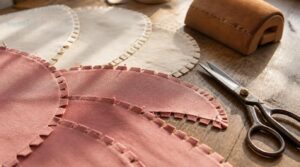
Cutting the curve is only half the job — finishing those edges is what separates a polished piece from one that unravels in the wash. A few smart steps will keep your curved seams smooth, flat, and ready to sew. Here’s exactly what to do after your scissors hit the table.
Clip Inward Curves
Inward curves don’t lie flat on their own — they need a little help. After sewing your curved seams, clip into the seam allowance every 3 to 6 mm, stopping 1 to 2 mm from the stitch line. This releases tension along the concave edge and lets it splay open smoothly when pressed.
| Curve Type | Clip Spacing | Clip Depth |
|---|---|---|
| Gentle arc | Every 6 mm | 1–2 mm |
| Moderate curve | Every 4 mm | 1–2 mm |
| Tight curve | Every 3 mm | 1–2 mm |
Use sharp embroidery scissors for clean, controlled cuts. Always clip at right angles to the seam — never at an angle — to prevent stitch damage. Once clipped, press with steam to set the curve flat.
Notch Outward Curves
Outward curves need notches — small V-shaped cuts in the seam allowance — to release bulk and lie flat. Cut them at regular intervals, spacing them more densely near the peak where fullness concentrates most.
Keep each notch shallow and well clear of your stitch line to protect seamline integrity. Press finished notches over a tailor pillow with light steam to settle the curve cleanly.
Press Seams With Steam
Steam is the secret weapon for beautiful curved seams. Once your notches are done, set your iron to a medium steam setting and press from the center of the curve outward.
- Use a tailor’s ham to support rounded shapes
- Apply short, even steam passes — don’t drag
- Use a pressing cloth to prevent fabric shine
- Let the heat setting cool fully before moving
- Repress lightly if any edge lifts after cooling
Use Zigzag or Serger
Raw edges on curves fray fast — and that undoes all your careful cutting work. A zigzag stitch is your easiest fix. Set your machine to a medium width and short-to-medium length, then stitch just inside the edge. For knits, the zigzag stretches slightly with the fabric, keeping the edge stable without cracking.
A serger works even better if you have one. It trims and overlocks in a single pass, producing a clean, tight finish that resists unraveling — especially on slippery fabrics. Match your thread weight to the fabric: polyester for most, nylon for sheers.
Store Pieces Flat
Once your curved pieces are cut and finished, store them flat — never folded. Folding distorts the grain and undoes your careful work.
Lay each piece in a labeled envelope or flat folder with acid-free tissue between layers to prevent color transfer.
Keep storage between 65–75°F with controlled humidity, and never stack heavy items on top.
Frequently Asked Questions (FAQs)
How to cut fabric straight?
Funny enough, cutting straight is harder than it looks. Use a quilting ruler on a self-healing mat, align your grainline carefully, and guide your rotary cutter forward with steady, even pressure to avoid jagged edges.
How do you cut fabric?
To cut fabric, you mark your line, secure the fabric flat, then cut with sharp scissors or a rotary cutter using smooth, steady strokes. Always keep blades sharp and cut away from your body.
What tools do you need to cut fabric straight?
You need sharp fabric scissors, a rotary cutter, a self-healing cutting mat, and quilting rulers. These tools work together to give you clean, controlled cuts every time.
Do you wash fabric before cutting?
Yes, always pre-wash your fabric before cutting. It prevents shrinkage, removes sizing agents, and reveals any color bleed. Once dry, press it flat to restore the grainline.
Do you clip inward or outward curves?
Both, actually — but for different reasons. Clip inward curves to release tension and let the seam lie flat. Notch outward curves to remove excess fabric and prevent puckering.
Can I cut curves on patterned or plaid fabric?
Patterned and plaid fabric can absolutely work with curved cuts — the trick is planning around the motifs. Align your curves along dominant plaid lines, not across them, to keep the pattern’s rhythm intact.
How do I cut curves through multiple fabric layers?
Stack no more than two layers at a time. Use fabric weights to prevent shifting, and keep steady forward pressure on your rotary cutter for consistent, clean results across every layer.
What seam allowance width works best for curves?
Start with ⅜ inch (1 cm) for most curves. Trim to ¼ inch (6 mm) after stitching on tight curves. Knits and necklines need that smaller allowance to stay smooth and bulk-free.
Should I cut curves before or after interfacing?
Cut curves after fusing interfacing. It stabilizes slippery edges, preserves fabric grain, and gives you a clean line to follow. For tight curves, fuse first, then trim — it reduces bulk and keeps everything accurate.
How do I transfer curved cuts onto dark fabric?
On dark fabric, light tailor’s chalk or a water-soluble pen works best. You can also use carbon transfer paper for precision. Always test on a scrap first.
Conclusion
Once you get the hang of how to cut curves in fabric cleanly, everything downstream starts to fall right into place. Your seams lie flat, your notches clip without stress, and the finished garment holds its shape exactly the way it should.
Sharp tools, smooth long strokes, and a steady, confident hand aren’t secrets—they’re just good habits. Build them, and every curved hem, sleeve cap, and neckline you ever cut will speak for itself.
- https://mellysews.com/how-to-cut-fabric
- https://www.guiltyquiltystudio.com/post/curved-piecing-101
- https://tillyandthebuttons.com/blogs/sewing/how-to-cut-fabric-without-cutting-your
- https://www.threadsmagazine.com/project-guides/learn-to-sew/tips-to-lay-out-a-pattern-and-cut-fabric-accurately
- https://zelouffabrics.com/blogs/news/how-to-use-proper-fabric-cutting-technique