This site is supported by our readers. We may earn a commission, at no cost to you, if you purchase through links.
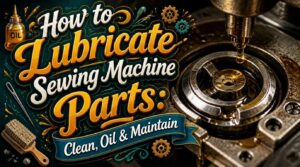
A sewing machine running at full speed completes roughly 1,000 stitches per minute, with its hook race, needle bar, and feed dogs cycling through metal-on-metal contact the entire time. Without a proper lubricating film in place, that contact turns into friction, friction turns into heat, and heat quietly degrades your machine months before any visible damage shows up. Most people oil a machine only when something goes wrong — by then, wear has already occurred.
Knowing how to lubricate sewing machine parts correctly, and on schedule, is what separates a machine that lasts decades from one that needs constant repairs. The right oil at the right points keeps everything running smooth, quiet, and precise — starting with the steps below.
Table Of Contents
Key Takeaways
- Lubrication prevents the chain reaction of friction, heat, and wear that quietly degrades your machine long before any visible damage appears.
- Using the wrong lubricant — such as WD-40, cooking oils, or automotive grease — causes more damage than running the machine dry.
- Cleaning lint from the hook race, needle bar joints, and feed dogs before oiling is non‑negotiable, since oil traps debris and makes it abrasive.
- A two‑minute maintenance log tracking oil type, parts serviced, and oiling date is the single most reliable way to stay on schedule and extend machine life.
Why Lubricate Sewing Machine Parts?
Most sewing machine problems trace back to one overlooked habit — skipping lubrication. When metal parts run dry, friction builds, performance drops, and repair costs follow. Here’s exactly what proper oiling does for your machine.
Using the wrong oil can quietly wreck your machine, so check these sewing machine cleaning and lubrication tips before you start.
Reduce Friction and Heat
Running a sewing machine without oil is like driving a car without engine coolant — heat builds fast and damage follows. Every metal-on-metal contact point generates friction, and that friction becomes thermal load on your motor and moving parts.
Skip the oil and your sewing machine consumes itself — friction becomes heat, and heat becomes damage
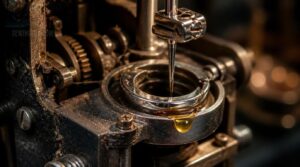
A light application of clear sewing machine oil forms a thin lubricating film that reduces resistance, lowers operating temperature, and keeps your hook race and needle-bar joints rotating smoothly at any speed.
Prevent Rust and Corrosion
Heat damage gets the headlines, but rust and corrosion quietly destroy machines that sit unused in humid workshops or garages.
A thin oil film acts as a corrosion inhibitor, blocking moisture from reaching bare metal surfaces. Store your machine in a dry, enclosed space and consider these protective measures:
- Control humidity with a small dehumidifier
- Apply clear sewing machine oil regularly
- Wipe metal parts with a lint-free cloth after each session
Choosing the use corrosion‑resistant metals such as stainless steel can further safeguard parts.
Quiet Squeaks and Grinding
That grinding sound mid-project isn’t random — it’s your machine telling you something is dry and rubbing where it shouldn’t.
Shuttle race friction, gear train squeals, and belt tension issues all trace back to the same cause: insufficient lubrication at key contact points. A drop of appropriate oil on the needle-bar joints and rotary hook quiets most noise within minutes of sewing.
Improve Stitch Consistency
Silencing the noise is satisfying, but lubrication also directly affects how your stitches look and hold.
When feed dog grip and needle-bar movement are smooth, your machine keeps a steady rhythm — and steady rhythm means even stitches. Friction-related drag disrupts that rhythm fast. Keep these in check:
- Balance thread tension for your fabric type
- Match needle size to fabric thickness
- Maintain consistent sewing pace throughout each seam
Extend Machine Lifespan
Every hour of unlubricated sewing accelerates wear on gears, hooks, and needle-bar joints — often invisibly, until something fails.
Regular oiling prevents micro-welding between metal surfaces and dissipates heat before it damages components. A maintenance log keeps you on schedule and even protects resale value.
| Maintenance Action | Benefit |
|---|---|
| Oil hook race | Reduces heat buildup |
| Lubricate needle-bar | Prevents joint wear |
| Clean feed dogs | Stops abrasive debris |
| Log oiling dates | Tracks service history |
| Replace dull needles | Protects needle-bar alignment |
Signs Your Machine Needs Oiling
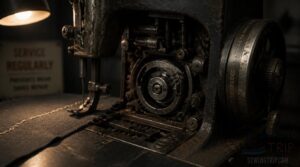
Your machine can’t speak up, but it will show you when it needs attention. A few telltale signs appear long before a breakdown actually happens. Here’s what to watch for.
Noisy Moving Parts
Your machine is talking — the question is whether you’re listening.
Squeaking, grinding, and drive belt whine are early warnings, not background noise. Loose component detection matters here: check the needle bar collar and presser foot screw for play.
Thread path burrs catch thread and create clicking sounds. Rail wear on feed dog tracks produces scraping. Each noise points to a specific lubrication point.
Stiff Handwheel Movement
When the handwheel feels like it’s fighting you, that’s mechanical friction asking for attention.
If stiffness keeps returning, check your long-term sewing machine storage habits — improper storage is often the root cause of recurring handwheel resistance.
Lint buildup around the shaft is the most common culprit, but worn timing gears and gear backlash effects add resistance too. A shaft alignment issue creates binding you’ll feel as a tight spot mid-rotation.
Apply one or two drops of oil at the handwheel mechanism, then turn it through a full cycle to confirm smooth movement.
Uneven or Skipped Stitches
Skipped stitches rarely happen for just one reason.
A dull needle fails to penetrate consistently, while a needle size mismatch adds irregular resistance through the fabric.
Thread tension issues and thread compatibility errors compound the problem fast.
Dry lubrication points — particularly the needle bar and bobbin case — reduce feed precision, which shows up directly as uneven gaps in your seam line.
Frequent Needle Breakage
Breaking a needle once is bad luck. Breaking them regularly is a warning sign.
Needle clamp alignment slipping even slightly lets the needle strike the hook or bobbin case, and that’s an immediate snap.
Wrong needle type selection for fabric density compounds the stress.
Thread path tension spikes, from poor lubrication at the needle bar, also force the needle beyond its flex limit.
Lint Around Metal Joints
Lint is quiet, but it’s one of the fastest ways to degrade your machine’s performance. Mixed with oil, it turns abrasive and causes micro-scratch formation on metal moving parts — accelerating wear you won’t see until damage is done.
Watch for these signs:
- Dense lint nests near the hook race or needle bar
- Synthetic fiber shedding after long sessions with polyester fabrics
- Lubricant absorption leaving joints visibly dry between oiling cycles
- Intermittent binding or humming during operation
Choose The Right Sewing Oil
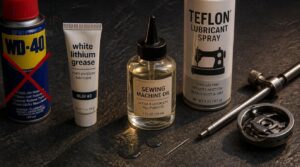
Not all lubricants are created equal, and the wrong one can do more damage than no oil at all. Your machine’s seals, plastics, and moving joints each respond differently depending on what you apply. Here’s what’s actually worth using — and what to stay away from.
Clear Sewing Machine Oil
For most household machines, clear non-detergent oil is the right starting point — and for good reason. Its low viscosity lets it flow into tight spots like the hook race and needle bar without pooling or attracting lint.
It’s odorless and non-toxic, which matters in a home studio. Because it dries transparent, fabric staining prevention is built in, and material compatibility with metal, plastic, and rubber components is reliable across common machine types.
Synthetic Sewing Machine Oil
Clear oil works well for most machines, but synthetic oil is worth the upgrade if you sew heavily or in variable temperatures.
Synthetic sewing machine oil — usually PAO-based — holds its viscosity under heat, resists oxidation, and won’t leave the gummy sludge that clogs fine mechanisms over time. Anti-wear additives protect high-load joints like the hook race, making it a smart choice for preventive maintenance on machines that work hard.
White Lithium Grease Uses
Where synthetic oil manages precision joints, white lithium grease steps in for heavier-duty components — motor bearings and drive gears that take real mechanical stress. It stays put under load and resists moisture, which matters for long-term wear prevention.
Use it sparingly on:
- Motor bearings prone to friction under sustained high-speed use
- Heavy-duty gears where oil would fling off under torque
- External pivot points exposed to humidity or vibration
Teflon-Based Lubricant Uses
Where grease manages bulk stress, Teflon-based lubricants handle precision — PTFE particles form a boundary film that reduces galling between metal and plastic components without attracting lint.
| Application | Form | Benefit |
|---|---|---|
| Needle-bar bushings | Spray | Reduces friction at start-up |
| Plastic gear trains | Paste | Prevents sticking under load |
| Tension assembly pivots | Spray | Metal-plastic compatibility |
Tri-Flow is a reliable option — temperature-resistant and safe across most machine materials.
Oils You Should Avoid
Just because something says "lubricant" doesn’t mean it belongs in your machine. WD-40, cooking oils, and automotive oils all cause more damage than dry friction — they leave sticky residue, attract lint, and gum up fine mechanisms fast.
Vegetable oils go rancid and coat the hook race with deposits. Silicone sprays degrade felt washers and plastic components. Stick to manufacturer-specified oil only.
Prepare Before Lubricating Parts
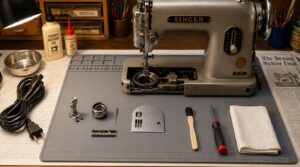
Before you touch a single drop of oil, the machine needs to be safe, disassembled, and ready. Skipping prep steps is how oil ends up in the wrong place — or on your fabric. Work through each of these before you start.
Unplug The Machine
Every maintenance session starts the same way — disconnect the power at the wall, not just the foot pedal.
Follow these before touching anything inside:
- Unplug directly from the wall outlet, not a power strip
- Wait two minutes for residual capacitors to discharge
- Confirm the control panel lights are dark before proceeding
Remove Needle and Foot
With the power off, the next step is clearing the needle and presser foot before anything else gets touched.
Loosen the needle clamp screw counterclockwise, remove the needle carefully, and set it on a soft cloth — flat side facing back for easy reinsertion. Raise the presser foot lever fully, then detach the foot and inspect the socket for wear or lint buildup.
Remove Bobbin Case
The bobbin case sits closer to the hook race than most people realize — and removing it carefully protects that alignment.
Open the bobbin compartment, press the latch release mechanism, and lift the case straight out. Don’t angle it. If it feels stuck, lint is likely the culprit — wiggle gently rather than forcing it. Inspect the case edge for nicks or thread buildup before setting it aside.
Take Off Stitch Plate
The stitch plate hides more lint than most people expect — removing it reveals the feed dogs and shuttle race underneath.
Use the correct screwdriver to avoid stripping the plate screws, then lift carefully along the alignment notches. Here’s what to check once it’s off:
- Lint packed around the feed dogs
- Thread caught near the needle hole
- Debris in the shuttle race channel
- Signs of fabric snagging on plate edges
- Screw condition before reinstalling
Protect Your Work Surface
One stray drop of oil on your table can transfer straight to your next project fabric — so surface prep isn’t optional.
Lay a silicone mat down first, then place a sheet of newspaper underneath it to catch any bleed-through. Keep a lint-free cloth within reach to wipe oil residue off tools and your hands before touching anything else.
Clean Parts Before Oiling
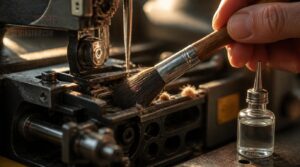
Oiling a dirty machine traps lint and debris under the lubricant, which speeds up wear rather than preventing it. Clean parts accept oil properly and let it do its job. Work through each of these areas before you apply a single drop.
Brush The Bobbin Area
Start here — the bobbin area collects more lint than anywhere else in the machine.
With the case removed, use a small lint brush to sweep debris out of the bobbin housing and shuttle channel. Work in one direction to avoid pushing lint deeper. Check under a light for hidden thread wraps around the shuttle that can quietly cause tension problems and jams.
Clean Feed Dogs Carefully
With the shuttle clean, move up to the feed dogs — those small serrated teeth that grip and advance your fabric.
Use a nylon-bristle brush to clear lint from between the teeth without bending them. A wooden or plastic pick works well for packed debris. Avoid metal tools entirely — they scratch the surface and can throw off feed dog alignment over time.
Remove Compacted Lint
Once the feed dogs are clear, check deeper — compacted lint hides in spots a quick brush won’t reach. The needle bar joints and hook race corners are common traps. Never oil over lint; the lint-oil interaction turns abrasive and accelerates wear.
Target these areas first:
- Needle bar channels where lint packs between metal surfaces
- Hook race corners after every few projects
- Tension disc edges where thread drag deposits fine fibers
Use Vacuum Crevice Tools
After loosening compacted lint with a brush, a vacuum crevice tool pulls it out cleanly without pushing debris further in. The narrow nozzle concentrates suction into tight gap areas, like the bobbin housing seam and needle plate channels — spots a brush can’t fully clear.
Keep the tool’s tip clean between uses; a clogged nozzle loses suction and just redistributes debris rather than removing it.
Wipe Exposed Metal Parts
Grab a microfiber cloth for the final pass on exposed metal, since it lifts oil residue without scratching surfaces.
- Wipe away excess oil
- Use a soft cloth, single direction
- Apply degreaser sparingly, never sprayed directly
- Dry fully to limit solvent residue
- Note hand-oil corrosion risk
This habit keeps machine maintenance simple and surfaces scratch-free.
Lubricate Key Machine Parts
With your machine clean and debris-free, it’s time to put the oil exactly where it counts. Not every part needs lubrication — only the metal-on-metal contact points that generate friction during operation. Here are the key spots to target and how to reach each one correctly.
Oil The Hook Race
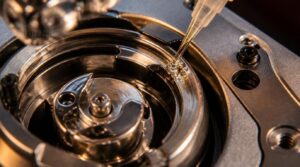
The hook race is the single most important lubrication point on most machines — it’s where the rotary hook meets thread under load with every stitch.
Remove the bobbin case first, then wipe away any old residue before applying one to two drops of clear sewing machine oil directly to the race surface. Turn the handwheel slowly afterward to distribute the oil, then check rotation smoothness for any remaining grinding resistance.
Lubricate Rotary Hook
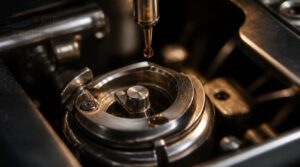
With the race oiled, turn your attention to the rotary hook itself — the part that actually catches the thread loop on every cycle.
Before applying oil, inspect the hook point for burrs or nicks; a damaged tip causes skipped stitches; no amount of lubrication will fix.
Use a precision nozzle to apply one drop at the contact surfaces, keeping oil away from the bobbin area to prevent pooling.
Oil Needle-Bar Joints
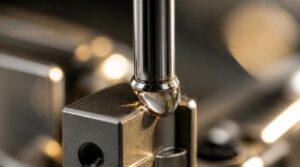
Your needle bar moves up and down hundreds of times a minute, so needle bar friction builds fast without attention.
Wipe old residue from the joint surfaces first, then apply one drop of clear or synthetic oil where the shaft meets its guide block.
This oil application technique assists smooth needle motion, while a light touch prevents lubricant seepage onto your fabric below.
Check Feed-Dog Pivots
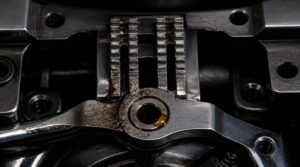
Feed-dog pivots are easy to overlook, but pivot surface wear here causes uneven fabric advancement that no tension adjustment will fix. Apply a drop of oil to the pivot bore where the feed dog arm rotates, then turn the handwheel to work it through.
Watch for these warning signs before oiling:
- Loose chatter during sewing without fabric resistance
- Feed dog play when pressed manually
- Darkened or gummy lubricant near pivot points
- Inconsistent stitch length across test seams
- Pitted or scored surfaces visible on the pivot arm
Use a Zoom Spout Oiler
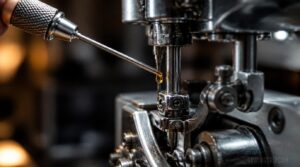
Getting oil into tight lubrication points without dripping is where most people struggle — the Zoom Spout Oiler solves that. Its telescoping spout extends to reach deep into the machine, and the non-clogging nozzle delivers precise droplet control without overspray.
| Feature | Benefit |
|---|---|
| Spout extension reach | Accesses deep joints without disassembly |
| Telescoping spout | Locks at chosen length for steady aim |
| Precision droplet control | Prevents over-oiling sensitive parts |
| Non-clogging nozzle design | Maintains consistent flow with thin sewing oils |
Test and Schedule Maintenance
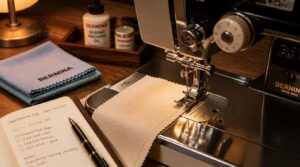
Oiling is only complete once you’ve confirmed the machine runs clean and smooth. Skipping the test phase is where most people leave residue on fabric or miss a part that still needs attention. Work through these final steps in order to close out the maintenance session properly.
Turn Handwheel Slowly
Before running any fabric through, always turn the handwheel slowly through one full rotation by hand. This distributes oil across contact surfaces and lets you feel for any remaining resistance or binding in the needle bar travel.
A smooth, consistent rotation confirms your lubrication points are well‑covered. Any stiff spot or scraping sound at this stage means something still needs attention before you sew.
Wipe Excess Oil
Once the handwheel turns smoothly, wipe off any excess oil drip from exposed surfaces before it migrates somewhere it shouldn’t.
A lint‑free microfiber cloth works best — sweep outward from moving parts toward the machine exterior, not across the needle area or stitch plate.
Leftover oil attracts lint quickly and creates sticky buildup that undoes the maintenance you just completed, so wipe until the cloth comes up clean.
Sew Scrap Fabric
With the cloth coming up clean, grab some scrap fabric to put your oil application techniques to the real test. Pick a piece matching your project’s weight, thread a compatible spool, and check your needle type before stitching.
- Match thread weight to fabric
- Confirm correct needle selection
- Adjust stitch settings as needed
A clean test run on test fabric confirms you’re preventing stitch issues before tackling your actual project.
Check for Oil Stains
After your test seam, flip the scrap fabric over and inspect both sides under good lighting. Shiny slicks or wet patches on the fabric surface mean too much oil reached a contact zone. Check the needle bar area and bobbin housing for oil spillage on fabric transfer points.
If staining shows up, wipe the affected joints again and run another test swatch before moving to your actual project.
Record Oiling Dates
After every session, jot down the date, oil type, and parts serviced — it takes two minutes and saves real headaches later. A maintenance log turns guesswork into a reliable lubrication schedule you can actually trust.
Track these four things every time:
- Date and sewing hours since last oiling
- Specific parts lubricated
- Oil type and grade used
- Any performance changes noticed during the test run
Frequently Asked Questions (FAQs)
Can I use WD40 to lubricate my sewing machine?
No — WD-40 is a solvent, not a lubricant. It strips existing oil, attracts lint, and leaves residue that clogs fine mechanisms. Always use light sewing machine oil designed for low-viscosity, tight-tolerance applications.
What oils are suitable to lubricate a sewing machine?
Think of oil viscosity like water versus honey — your machine needs the thinner kind. Use clear non-detergent mineral oil or synthetic sewing machine oil. Both flow into tight joints without leaving damaging residue behind.
Can I over-oil my sewing machine parts?
Yes — over-oiling is a real risk. Excess oil attracts lint, gums up moving parts, and seeps into the bobbin area, staining your fabric. Apply only 1–2 drops per joint, then wipe away any runoff immediately.
Does machine brand affect which oil to use?
It does, more than most people expect. Brand-specific viscosity requirements vary, and using a generic oil can degrade seals or void your warranty. Always check your manual for the manufacturer’s approved oil specification first.
How do I oil a vintage or antique machine?
Vintage machines need extra care — old seals are fragile, and heavy oils can accelerate oxidation.
Use clear sewing machine oil only; apply one drop per joint, and work the handwheel slowly to restore mechanical smoothness without stressing aged components.
Should I oil a brand-new sewing machine first?
Most new machines ship with factory-applied lubrication already in place — adding oil immediately can cause over-saturation. Check your manual first; if it identifies oil points, apply just one drop each and rotate the handwheel before stitching.
Can oiling fix a machine that already skips stitches?
Sometimes — but not always. If dry hook race joints are causing drag, oiling the needle bar and hook race can restore stitch consistency. However, persistent skipping often points to timing drift or a worn needle, not lubrication.
Conclusion
A machine that runs quietly for decades and one that fails within a year often share the same design — the only difference is what happens between sessions.
When you lubricate sewing machine parts on schedule, clean before you oil, and test before you sew, you’re not just preventing noise or staining. You’re protecting every stitch that follows.
Two drops of oil, applied correctly, can outlast a hundred hours of neglect.