This site is supported by our readers. We may earn a commission, at no cost to you, if you purchase through links.

A sewing machine that ran perfectly last week shouldn’t start skipping stitches without warning—but it does, and lint is almost always the reason.
After four to six hours of sewing, compacted fibers settle into the bobbin area like sediment, quietly disrupting the hook race, throwing off thread tension, and grinding metal parts that should glide silently.
Most sewists blame their thread or needle first. The real culprit sits a few centimeters below.
Knowing how to remove bobbin case lint—and doing it the right way—keeps your machine running clean, quiet, and stitch‑perfect every time you sit down.
Table Of Contents
Key Takeaways
- Lint builds up in the bobbin area after just 4–6 hours of sewing and is the most common cause of skipped stitches, thread jams, and tension problems—not your thread or needle.
- Clean the bobbin case, tension spring, and hook race after every project using a soft lint brush, lint‑free cloth, and fine tweezers—never compressed air, which pushes debris deeper into the machine.
- One drop of lightweight sewing machine oil on the hook race is enough; over‑oiling attracts lint and throws off thread tension just as badly as skipping lubrication entirely.
- Beyond regular self‑cleaning, get your machine professionally serviced once a year to catch hidden lint, timing drift, and worn parts that a brush simply can’t reach.
Why Remove Bobbin Case Lint?
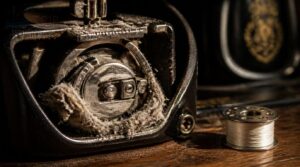
Lint is quiet trouble — it builds up slowly, then causes real problems before you even notice. A little buildup in the bobbin area can throw off your whole machine in more ways than one. Here’s why keeping it clean actually matters.
Even small stitching issues often trace back to lint, so brushing out the bobbin area regularly pairs well with knowing your sewing machine needle repair solutions before problems compound.
Prevent Skipped Stitches
Lint buildup in the bobbin area is one of the sneakiest causes of skipped stitches. After just 4–6 hours of sewing, accumulated lint disrupts the hook’s rhythm, breaking the connection between upper thread and bobbin thread.
Make sure your needle size matches your thread weight, keep the bobbin area clean, and that timing stays reliable. Additionally, you should replace needle regularly to prevent skips.
Stop Thread Jams
Skipped stitches are frustrating, but thread jams stop you cold. When lint clogs the bobbin case and hook race, tension goes uneven — and uneven tension means threads bind and tangle under the needle plate, stalling your fabric completely.
Here’s what commonly triggers jams:
- Lint around the tension spring seizes the thread path
- A worn or burred needle catches and snags thread
- Wrong needle size creates friction that bunches thread beneath the plate
- Skipping thread guides during setup throws upper and lower tension off balance
Clean your bobbin area regularly, inspect your needle for damage, and rethread carefully after every fabric change.
Reduce Hook Noise
That grinding or clicking you hear mid-project? That’s often lint forcing the hook to work harder than it should.
Lint buildup amplifies contact vibrations in the hook race, and once debris settles between moving parts, every needle cycle adds friction and noise.
Regular bobbin area cleaning keeps the hook race surface smooth, restoring the quiet, steady rhythm your machine was built for.
Protect Stitch Tension
Smooth hook operation goes hand in hand with stable stitch quality.
Lint in the bobbin area disrupts the balance between your upper and lower thread, causing irregular tension that shows up as puckering, loops, or skipped stitches. Even small debris near the tension spring is enough to throw things off, especially when you’re working with delicate fabrics or thinner threads.
Prevent Needle Strikes
A loose or dirty bobbin case is one of the sneakiest causes of needle strikes. When lint builds up beneath the case, it can shift the case out of alignment — and a misaligned case puts the needle directly in harm’s way.
Keep your bobbin area clear, and you keep your needle where it belongs: moving safely through every stitch.
Tools for Bobbin Case Cleaning
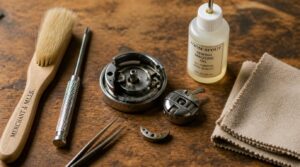
Before you touch a single screw, make sure you’ve got the right tools within reach — it makes the whole job faster and safer. Nothing fancy here; just a handful of items you probably already own or can grab for a few dollars. Here’s what you’ll need.
Soft Lint Brush
Your soft lint brush is the unsung hero of bobbin area cleaning. Natural rubber bristles are especially effective here — they’re soft enough not to scratch the bobbin case, yet clingy enough to lift compacted lint in one pass.
Use one-directional strokes to sweep debris out cleanly. A wooden or bamboo handle gives you the firm control you need in tight spaces.
Lint-free Microfiber Cloth
A lint-free microfiber cloth covers what your brush can’t — wiping metal surfaces clean without leaving a single fiber behind. That matters because stray fibers in the bobbin area behave just like lint: they disrupt tension and clog the hook race.
Here’s what makes microfiber worth keeping in your kit:
- Fiber absorption capacity — it holds liquids up to seven times its weight, so one wipe lifts oil residue cleanly.
- Surface scratch prevention — ultrafine synthetic fibers are gentle enough for polished metal bobbin cases.
- Synthetic fiber durability — with proper microfiber laundry care (no fabric softener, air dry), cloths last hundreds of washes.
Choose a cloth with a GSM density above 300 for better performance in tight spaces.
A heavier fabric also pairs well with breathable coatings—check out these sewing machine covers built for daily use to see how GSM and ventilation work together.
Correct Screwdriver
Most sewists grab the nearest screwdriver without thinking — and strip a screw before they even get started. For bobbin case cleaning, you need a Phillips-head screwdriver that actually fits the needle plate screws.
Too large or too small, and you’ll chew up the head. Look for a handle with a non-slip ergonomic grip so you can tighten firmly without slipping.
Thin Tweezers
Fine-tipped tweezers might be the most underestimated tool in your cleaning kit. When a brush can’t reach it, long skinny tweezers can. They’re built for exactly this kind of work — tight gaps, compacted thread, stubborn debris wedged deep in the bobbin area.
Here’s what makes a good pair worth keeping:
- Stainless steel grades 300–400 resist corrosion and hold their shape after repeated use
- Tip precision under 0.5 mm lets you grip tiny lint fibers without tearing surrounding parts
- Angled or bent tips improve access when removing the bobbin case or reaching the hook race
- Tip parallelism within 0.02 mm ensures an even grip so threads don’t slip free mid-pull
- Knurled or grooved grips give you steady control, even during extended bobbin case cleaning sessions
After each use, wipe the tips with alcohol and check that they still close evenly. Misaligned tips won’t grip properly, and that’s when you’ll start leaving lint behind instead of pulling it out.
Sewing Machine Oil
Good sewing machine oil does one job quietly: it keeps metal parts gliding instead of grinding. Light mineral or synthetic oil is what you want — thin enough to coat the hook race without leaving sticky residue.
Skip 3-in-1 oil entirely; it’s too thick, attracts lint, and can gum up tension discs fast. One drop is always enough.
Prepare Your Machine Safely

Before you touch anything inside your machine, a few quick steps will keep you and your machine safe. Skipping even one of them can lead to bent parts, broken needles, or worse. Here’s exactly what to do first.
Unplug Before Cleaning
Before touching anything inside your machine, unplug the power cord. This isn’t just a precaution — it’s the rule.
Unplugging cuts power to the motor completely, so there’s no risk of an accidental start while your fingers are near the hook assembly. It also protects the machine’s microcontroller from static shocks that can quietly damage sensitive electronics during cleaning.
Raise The Needle
With the power cord unplugged, your next move is to raise the needle to its highest position. Turn the handwheel slowly toward you until the needle bar lifts completely clear of the bobbin area.
This moves the needle out of the hook timing zone, giving you safe, unobstructed access to the bobbin case for lint removal.
Remove Presser Foot
With the needle safely out of the way, now remove the presser foot. Lift the presser foot lever to its highest position first.
On snap-on machines, press the release lever on the foot holder — the foot drops free without any tools. For screw-on feet, loosen the small holder screw.
Either way, clean around the foot holder before moving on.
Take Out Bobbin
With the foot out of the way, you’re ready to remove the bobbin. Reach into the bobbin area and lift the bobbin spindle straight up.
Manage any thread tails carefully — don’t let them snag on the hook race.
For drop-in systems, this is simple. Side-loading cases may need a gentle forward pull to release the bobbin cleanly.
Check Your Manual
Before you touch anything else, check your manual. Every machine operates bobbin case access differently — your manual spells out the exact removal steps, safety precautions, and model-specific differences you need to know.
It also covers maintenance intervals tied to your warranty.
Skipping this step is where most mistakes begin.
Remove Lint From Bobbin Case
How you remove lint depends on the type of bobbin system your machine uses. Each setup has its own access points and a slightly different process, so it helps to know which one you’re working with before you start. Here’s what to tackle, step by step.
Side-loading Bobbin Cases
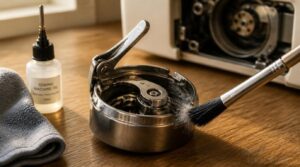
Side-loading bobbin cases sit at the machine’s side or front edge, making lint access surprisingly straightforward. Lift the metal latch finger first — never yank the case out cold, or you’ll bend it.
- Brush lint from the tension leaf spring
- Clear the interior case walls
- Inspect case alignment marks
- Check latch engagement firmly
- Wipe the exterior clean
Drop-in Bobbin Systems
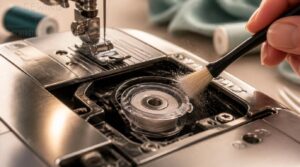
Drop-in bobbin systems make lint removal refreshingly simple. Lift the needle plate cover to expose the open chamber, then use a soft brush to sweep lint away from the rotating hook and surrounding area.
The transparent cover lets you spot buildup before it becomes a problem. These systems use Class 15 bobbins, so cleaning and reloading stay quick — perfect for fast color changes mid-project.
Brush Tension Spring
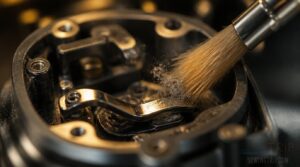
The tension leaf spring is easy to overlook, but it keeps your bobbin thread feeding at consistent pressure. Use a soft brush to sweep lint away from it in short, gentle strokes.
Lint here throws off tension fast. If the spring looks bent or corroded, replace it — a worn spring causes uneven thread pull and skipped stitches every time.
Clean Hook Race
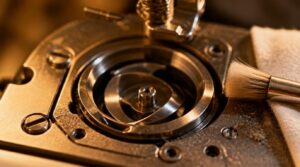
The hook race is the unsung hero of clean stitching — a precision-machined circular track that guides your thread loop around the bobbin with every stitch.
- Lint in the race causes skipped stitches and stitch inconsistency
- Burrs or nicks snag thread and create frustrating tension problems
- A dirty race surface throws off shuttle timing alignment entirely
After you remove the bobbin case, take your soft brush and sweep the race surface using short, controlled strokes. Work around the full circle of the channel. Then wipe it clean with your lint-free cloth.
Inspect the race closely. Even a tiny scratch can fray thread or disrupt the shuttle’s rhythm. If it looks worn, call a technician.
Remove Trapped Threads
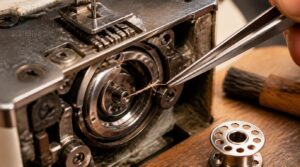
Even after brushing the hook race, trapped threads can hide in places your brush can’t reach — tucked between the bobbin case and the hook race wall.
Use thin tweezers to gently pull any tangled thread free. Work slowly. Forcing it snaps the tension spring. Once clear, check that thread flows freely through every pathway before reinserting the bobbin case.
Reinstall The Bobbin Case Correctly
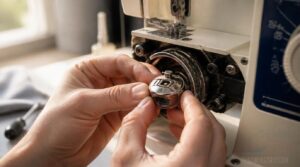
Getting the bobbin case back in correctly is just as important as cleaning it. A misaligned case can undo all your hard work in seconds. Here’s exactly how to reinstall it right, step by step.
Align Case Marks
Getting the bobbin case back in correctly starts with visual alignment accuracy. Look for the small marks on the case and match them to the housing indicator on your machine — these should line up parallel to the needle plate edge.
- Clear any lint blocking the marks before placing the case
- Rotate slowly until the top notch meets the reference line
- Check that the side mark aligns with the screw hole
Misaligned marks cause skewed seating and stitch drift.
Seat Latch Securely
Once the marks line up, it’s time to lock the case in place. Slide the latch lever firmly until you hear or feel a small snap — that click means the spring inside has engaged the locking toe.
No snap? Remove the bobbin case and reseat it.
A properly locked latch prevents case movement, which keeps your stitches consistent and protects the shuttle hook from misfeeds.
Replace Needle Plate
With the bobbin case locked in, slide the needle plate back into position. Align the needle slot carefully with the needle’s path — even a slight offset can cause skipped stitches or needle strikes. Press the plate flat until it sits flush against the machine bed, with no gaps along the edges.
Before securing anything, check the plate type matches your current stitch pattern.
Tighten Screws Gently
Now that the plate is flush, grab your screwdriver — the right one matters here. Most machines use small Phillips or slotted screws, commonly M1.6 to M2.0.
Finger-tight plus a quarter turn is your target. That’s roughly 0.5–1.0 Nm — enough to prevent lateral movement without stripping the threads. If the screw head starts showing indentations, you’ve gone too far.
Test on Scrap Fabric
Before you call the job done, run a test stitch on scrap fabric — this is where you find out if everything is working together.
- Use fabric density variation: test on lightweight, medium, and knit scraps.
- Check stitch consistency across straight and zigzag passes.
- Confirm thread tension baselines hold from start to finish.
Any skipping or puckering? Recheck your bobbin seating.
Avoid Bobbin Cleaning Mistakes
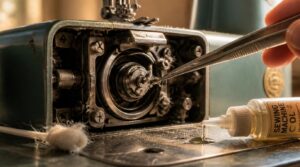
Even a clean machine can run into trouble if the cleaning itself goes wrong. A few small missteps — things most people don’t even realize they’re doing — can cause more damage than the lint ever would. Watch out for these common mistakes before they cost you a repair bill.
Never Force The Case
The bobbin case isn’t a push-and-pray situation. If it resists, stop immediately — forcing it risks bending the latch finger, which throws the case out of alignment and can cause your needle to strike metal mid-stitch.
Instead, gently guide the case with one finger and try a slight wobble. That’s usually enough to seat it correctly without stressing the metal.
| Forcing Behavior | What Gets Damaged | Result |
|---|---|---|
| Jamming case in hard | Latch finger bends | Needle strikes metal |
| Ignoring resistance | Case lip wears down | Harder future reinsertion |
| Skipping alignment | Case misaligns | Tension loss mid-sew |
| Pushing off-angle | Case housing cracks | Machine needs servicing |
| Repeated forcing | Metal fatigue builds | Full case replacement |
Detecting resistance early is the real skill here. A case that won’t seat smoothly is telling you something — usually that alignment is off. Recheck the reference marks, adjust, and try again.
Avoid Compressed Air
Compressed air might seem like a quick fix, but it’s one of the worst things you can do near the bobbin case area. Instead of removing lint, it blasts debris deeper into the hook race and tension assemblies — exactly where you don’t want it. Worse, tiny particles can become airborne projectiles, posing a real hazard to your eyes.
Compressed air doesn’t clean your bobbin case — it just buries the problem deeper
Reach for a soft lint brush instead.
Do Not Over-oil
Think of oil like seasoning — a little goes a long way, and too much ruins everything. A single drop is genuinely enough for most machines.
Excess oil attracts lint, migrates into the hook race, and alters thread grip on the bobbin case, causing slipped stitches.
Always use lightweight sewing machine oil, never WD-40 or household oils.
Check for Scratches
A scratched bobbin case is easy to overlook — until your thread keeps snagging for no obvious reason.
After cleaning, hold the case under a bright light and run a fingertip across the interior. You’re feeling for burrs or rough edges.
Even micro-scratches can trap lint and nick thread paths. Severe scratches mean replacement — don’t wait for your stitches to suffer.
Remove Metallic Thread Lint
Metallic threads are sneaky. Unlike cotton or polyester, they shed tiny metallic fibers that cling to the hook race through metallic fiber static — making shiny lint buildup harder to spot and remove.
After decorative thread maintenance, brush the bobbin case thoroughly and use tweezers to lift any trapped debris. Skipping this step is one of the fastest routes to metallic thread breakage.
Bobbin Area Maintenance Schedule
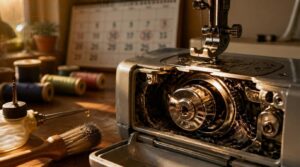
Cleaning once and calling it done won’t cut it — your machine needs consistent attention to stay in top shape. A simple schedule takes the guesswork out of when to clean, oil, and service everything. Here’s what that routine looks like.
Clean Every Project
Make it a rule to clean after every project — not just when problems appear. Lint from one session builds on the last, and suddenly your bobbin area is a mess.
Here’s your end-of-project routine:
- Brush lint from the bobbin case and hook race
- Wipe surfaces with a lint-free microfiber cloth
- Return your cleaning kit to its spot nearby
This keeps fabric residue from transferring to your next project and protects stitch quality over time.
Check After Heavy Sewing
Heavy sewing sessions push your machine harder than usual.
Afterward, inspect the bobbin area before putting anything away. Check that the bobbin case seats snugly — loose seating can throw off tension fast.
Run your finger along the hook race; it should move smoothly, with no grinding. Uneven stitches or fabric puckering? That’s lint interference, and it needs clearing now.
Oil Hook Race Properly
Once your bobbin area is clean, lubricate the hook race — that circular track where the hook spins.
One drop of sewing machine oil on the contact lip is enough. More than that attracts lint fast.
Use a fine-tip applicator for lubrication application precision, then slowly turn the handwheel to spread it evenly.
Always wipe away excess oil to prevent residue buildup.
Service Machine Annually
Keeping your hook race oiled matters — but once a year, hand the machine to a professional technician.
They check timing calibration, balance thread tension, inspect component wear, and clear hidden lint, no brush can reach.
That service protects warranty eligibility, extends your machine’s life, and even enhances resale value if you ever sell.
Store Machine Covered
Covering your machine between sessions is one of the simplest habits that pays off long-term.
A breathable dust cover blocks lint, dust, and stray fibers from settling into vents and moving parts — without trapping moisture inside. It also shields the machine from accidental bumps during storage.
Think of it as a quiet guardian keeping everything clean until your next project.
Frequently Asked Questions (FAQs)
Can I clean the bobbin area without tools?
Yes, you can. A quick visual check and gentle finger sweep along the bobbin case edge reveal lint. Wipe surfaces with a lint-free cloth to clear surface dust safely.
Does bobbin lint affect embroidery thread differently?
Embroidery threads are more sensitive to lint than standard threads. Metallic threads snag on debris, rayon loses its gloss, and cotton absorbs moisture that mixes with lint, quietly disrupting tension before you notice any stitch problems.
How do I know my bobbin case needs replacing?
Think of your bobbin case like a small engine part — when it starts failing, your whole machine feels it. Replace it if you spot cracks, rust, wobble, bent latch, or persistent tension issues.
What fabrics produce the most bobbin lint?
Cotton, wool, fleece, and terry cloth produce the most bobbin lint. Textured or brushed fabrics shed heavily, while loose weaves and unfinished cotton release the most fibers during stitching.
Can a dirty bobbin cause fabric puckering?
Absolutely — a dirty bobbin case can pull your fabric into puckered seams. Lint disrupts thread tension balance, causing uneven stitch formation. Clean the bobbin area regularly to keep feeding smooth and seams flat.
Conclusion
A stitch in time saves nine—and the same holds true for your bobbin area.
When you remove bobbin case lint after every few projects, you’re not just tidying up; you’re protecting the precision your machine was built to deliver.
Clean hooks glide. Tension holds. Stitches land exactly where they should.
Your machine works hard for you every single day—a quick brush and a drop of oil are the least you can give back.
- https://weallsew.com/sewing-machine-cleaning-tip
- https://sewingmachineman.substack.com/p/compacted-lint
- https://help.brother-usa.com/app/answers/detail/a_id/183107/~/how-to-clean-the-bobbin-area-%28race%29---video-included
- https://faithandfabricdesign.com/2021/03/tutorial-how-to-clean-bobbin-case.html
- http://shesasewingmachinemechanic.blogspot.com/p/how-to-clean-and-oil-bobbin-and-feed-dog.html