This site is supported by our readers. We may earn a commission, at no cost to you, if you purchase through links.
Thread tension problems wreck more projects than dull needles ever will. One session you’re sailing through a clean seam, and the next you flip the fabric to find loops, tangles, or a puckered mess staring back at you.
Most sewers assume tension issues mean something’s broken. Usually it’s not. A single misthreaded guide, a worn needle, or a bobbin wound slightly off can throw the whole system out of balance.
The good news: you can fix loose thread tension in your sewing machine without guesswork. Knowing exactly where to look — and what order to check — puts you back in control fast.
Table Of Contents
- Key Takeaways
- Signs of Loose Thread Tension
- Check Threading Before Adjusting Tension
- Match Needle, Thread, and Fabric
- Fix Loose Upper Thread Tension
- Adjust Bobbin Tension Correctly
- Clean Tension Discs and Bobbin Area
- Test Stitches After Every Change
- Set Tension for Different Fabrics
- Top 3 Tension-Fixing Sewing Tools
- Frequently Asked Questions (FAQs)
- Conclusion
Key Takeaways
- Before touching the tension dial, rethread your machine completely — one missed guide is enough to cause loops, bird-nesting, or skipped stitches, no dial adjustment will fix.
- needle, thread weight, and fabric must match: a size mismatch quietly breaks tension balance before you’ve changed a single setting.
- Adjust one increment at a time — upper dial or bobbin screw — and test on a matching scrap after every change so you know exactly what’s working.
- Lint between the tension discs and in the bobbin area throws off stitch balance just as much as a wrong setting, so clean both regularly and oil moving parts as directed.
Signs of Loose Thread Tension

Your sewing machine is telling you something — you just need to know how to listen. Loose thread tension shows up in specific, recognizable ways before a project goes completely sideways. Here are the signs to watch for.
Loops Underneath Fabric
Flip your fabric over after a test seam.
If you see small rounded arches lining up along the stitch, upper thread tension is too high — or your thread path has a snag. Those loops form when the top thread pulls too hard and drags bobbin thread up.
Rethread both upper and bobbin, then test on scrap fabric.
Bird-nesting Near Needle Plate
Thread tangles under the needle plate signal loose top-thread tension. That dense knot of loops — called bird-nesting — forms when the upper thread releases too freely and the bobbin catches it in bunches.
Three things you’ll notice:
- A tangled thread cluster jammed beneath the fabric
- Irregular thread loops caught around the needle plate
- The machine snagging or stopping mid-seam
Rethread both upper and bobbin threads completely before adjusting anything.
improper top threading is a frequent cause of bird nesting.
Irregular Stitch Spacing
Stitches that bunch together or drift apart along a seam are a direct tension signal.
Uneven stitch spacing happens when upper or bobbin tension shifts mid-seam — pulling stitches tight in one spot, loose in another.
Feed dog wear, shuttle hook timing, or mismatched thread weight can all push spacing out of rhythm without any obvious warning.
Skipped or Weak Stitches
When spacing goes wrong, weak stitches usually follow. A skipped stitch means the hook missed the thread loop entirely — often because needle-hook timing is off or the needle is dull.
Loose upper tension lets the needle move without forming a proper lock. Worn feed dogs or slippery fabric shifting under the foot makes the problem worse.
Puckered Seam Lines
Puckering is often the first visible sign that thread tension is off. When bobbin tension is too tight — or upper thread tension is too loose — the seam pulls inward and gathers.
High stitch density compresses fibers further. Tightly woven fabrics and selvage edges are especially vulnerable.
Apply a seam stabilizer before stitching to reduce shifting on delicate materials.
Check Threading Before Adjusting Tension

Before you touch the tension dial, your threading deserves a second look — it’s the most common culprit behind loose stitches. A single missed guide or an incorrectly seated thread can throw everything off, no matter how well you adjust the settings. Here’s what to check, step by step.
Before adjusting tension, rethread first — one missed guide quietly breaks everything
Raise The Presser Foot
Before you touch the tension dial, raise the presser foot. This opens the tension discs and lets the top thread seat correctly — skip this, and no adjustment will hold.
Lifting the foot also clears the needle plate by 3–5 mm, so fabric layers slide under without catching or shifting. It prevents needle strikes on thick seams too.
Follow Every Thread Guide
Every thread guide exists for a reason — skip one, and the upper thread path breaks down fast. Your machine’s manual threading path isn’t a suggestion; it’s the sequence that keeps tension balanced from spool to needle.
Run your finger along each guide groove to confirm the thread sits flat, not bent or riding high.
Check The Take-up Lever
The take-up lever is the unsung control point of your upper thread path. If you skipped it during threading, loose stitches are almost guaranteed.
Check these signs of a problematic lever:
- Lever sits too low due to a weak or stretched spring
- Visible lever clearance gaps causing inconsistent thread feed
- Lever alignment issues pulling thread off its correct path
- Uneven timing between needle rise and lever movement
With the presser foot raised and needle up, verify the lever moves freely without binding.
Thread Needle Correctly
The needle eye must be perfectly centered in the hole — even a slight tilt causes thread path friction and skipped stitches. Hold your work under good light and confirm the thread exits the eye straight, with no loops or bends.
A perpendicular needle angle keeps tension even and prevents snags before you sew a single stitch.
Rethread From Scratch
When tension problems persist after partial fixes, rethread from scratch — don’t guess where the mistake is.
Raise the presser foot first so the tension discs open fully, then pull all thread clear.
Run it back through every guide in order, from spool pin to needle eye, confirming it advances freely at each point.
Match Needle, Thread, and Fabric
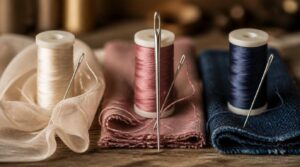
Threading alone won’t save your stitches if your needle, thread, and fabric aren’t working together. A mismatch anywhere in that trio quietly undermines tension no matter how carefully you’ve set the dial. Here’s what to check and align before touching anything else.
Choose Correct Needle Size
The size you pick matters more than most sewists realize. Needle size and fabric weight must align — lightweight fabrics like cotton lawn need a 70/10 needle, while denim demands 100/16 or 110/18. A mismatch causes thread shredding, skipped stitches, and loose tension.
For knits, use a ballpoint 75/11 or 80/12 to avoid snagging the weave.
Replace Dull Needles
You matched the right size — now check what that needle has been through. A dull needle tears fabric fibers instead of slicing cleanly, throwing tension off immediately.
- Replace after 8–10 sewing hours
- Inspect the tip under light for micro chips
- Choose titanium or chrome-coated needles for synthetic fabrics
- Store needles away from humidity
- Never reuse a bent or burred needle
Use Quality Sewing Thread
The needle’s condition sets the stage — but what you feed through it matters just as much. Poor-quality thread frays, breaks unevenly, and throws tension off in ways no dial can fix.
Reach for polyester or inner spun thread. Both deliver consistent tensile strength and uniform diameter, which keeps stitches forming cleanly without skipped loops or irregular pull.
Avoid Damp Thread Storage
Humidity is the quiet enemy of consistent stitching. When thread absorbs moisture, it swells slightly, disrupting its diameter and weakening tensile strength — your machine’s tension dial can’t compensate for that.
Keep storage humidity below 50 percent and use airtight containers with desiccant packets inside. Rotate older spools first so no spool sits long enough to develop mildew.
Match Thread Weight
Thread weight is a length-based unit — 40-weight thread means 40 kilometers equals one kilogram.
Lighter fabrics need 50–60 weight; heavy fabrics, like denim or canvas, need 30–40 weight for stronger seams.
Mismatched thread density strains tension balance before you’ve touched the dial. Match weight to fabric first, then fine‑tune from there.
Fix Loose Upper Thread Tension

The upper tension dial is usually the quickest place to start when your stitches look off. A few small, deliberate adjustments — done in the right order — make all the difference between a balanced stitch and a tangled mess. Here’s what to work through to get your upper tension dialed in.
Start Between 4 and 6
Your upper thread tension dial is the first control to set before anything else. On most domestic machines, dial between 4 and 6 gives you a balanced baseline — enough grip to prevent loose loops underneath without straining the thread to breaking point.
For medium-weight fabrics like cotton or polyester blends, start at 4–5. That range keeps fabric feeding smoothly, with minimal drag under the presser foot.
Here’s what getting this baseline right actually protects:
- Clean, even stitches on both fabric sides
- No thread snapping mid-seam from over-tightening
- Consistent fabric feed without drag or resistance
- A reliable starting point for every new project
- Less time troubleshooting, more time sewing
Fine-tuning within that range still depends on your needle type and thread weight, so always confirm on scrap first.
Tighten One Click Gradually
One click at a time — that’s the discipline that separates controlled sewing machine troubleshooting from guesswork. When top tension feels off, move the tension dial settings by a single increment only. That small shift is enough to close loose loops without overcorrecting into puckering.
Adjusting tension in small increments protects delicate fabrics and keeps thread visibility balanced on both sides.
Test on Scrap Fabric
Every dial change you make deserves a test run before it touches your real project.
Cut a 4-inch scrap square from the same fabric, then sew a straight line. Flip it over and check both sides.
Balanced stitches sit evenly on top and underneath — no loops, no pulls. Record the tension setting that passes.
Avoid Over-tightening Tension
Tightening too far is just as damaging as leaving tension loose. When you push the dial past 6, thread tension strain pulls stitches tight enough to snap the needle thread or pucker lightweight fabric badly.
- Stop at half-number increments
- Check presser foot pressure first
- Watch for fabric pucker signs
- Rest thread to prevent needle thread fatigue
Check Tension Discs
The discs themselves might be the real culprit. If lint buildup has crept between them, the thread won’t seat correctly — meaning your top thread tension is off before you even touch the dial.
Brush the gap clean. Then check for disc surface wear: grooves or scratches prevent even pressure.
Damaged discs need replacement, not adjustment.
Adjust Bobbin Tension Correctly
The bobbin is half the tension equation, and it’s often the half people forget to check. Getting it right takes a little patience, but the process is straightforward once you know what to look for. Here’s how to work through it step by step.
Inspect Bobbin Winding
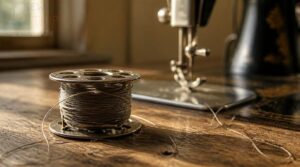
Before adjusting your bobbin’s tension screw, check the bobbin itself. Uneven winding is a hidden cause of loose stitches that gets overlooked.
Look for these warning signs:
- Thread layered in spirals or ridges instead of flat, uniform rows
- Visible gaps between layers or loose outer edges that come apart easily
- A wobbling bobbin when spun by hand
Steady, moderate winding speed keeps layers even and prevents thread deformation.
Check Bobbin Direction

Wrong bobbin direction is a quiet troublemaker. Once your winding checks out, verify the rotation direction before touching any tension screw.
For front-loading machines, the bobbin unwinds clockwise when viewed from above. For drop-in machines, it runs counterclockwise. Insert it backward, and the thread won’t feed smoothly — expect bunching or skipped stitches immediately.
When in doubt, check your manufacturer’s diagram.
Try The Drop Test
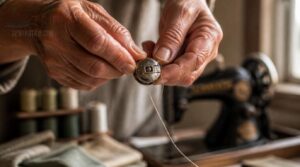
Now you know the bobbin is seated and spinning correctly. But does it actually hold the right tension?
The bobbin drop test tells you fast. Hold the thread tail, lift the case a few inches, then release slightly. A correctly tensioned bobbin drops just a few inches — not freely, not stuck.
Turn Screw Quarter-turns

The drop test gave you a pass — now it’s time for the hands‑on fix.
Use a small jeweler’s screwdriver on the bobbin case tension screw. Turn clockwise in ¼-turn increments to tighten.
Each quarter turn makes a precise, controlled change without overshooting. Don’t force past the end stops — stripping the threads means starting over.
Test After Each Adjustment

After each quarter‑turn, test stitch on scrap fabric before touching that screw again. Sew a straight four‑inch test line and check both sides.
Balanced tension means neither thread dominates. If stitches still loop or pucker, note the setting in your tension log and adjust again — one quarter‑turn at a time.
Clean Tension Discs and Bobbin Area

Dirt and lint are quiet saboteurs — they sneak into your tension discs and bobbin area and throw everything off without a single warning sign. A clean machine holds tension far more reliably than one you’ve adjusted a dozen times over. Here’s exactly where to focus your cleaning efforts.
Remove Lint Buildup
Lint is the silent saboteur of smooth stitching. Even a small buildup clogs the gaps between tension discs, limiting their movement and throwing off stitch balance.
Clean the bobbin area after every project. Use a small brush — never compressed air directly — to sweep fibers clear without pushing debris deeper into the mechanism.
Brush Tension Discs Gently
The tension discs deserve careful attention. Hold a soft bristle brush at a shallow angle and sweep along the disc edges — never jab into the gap.
- Use only soft, non-metal tools
- Brush along disc edges, not into gaps
- Remove loose lint with light strokes
- Check that discs stay aligned afterward
- Clean with the needle plate removed
Clean discs let your upper thread glide without snagging.
Clean Under Needle Plate
The needle plate hides more trouble than most sewists expect.
Remove the screws, lift the plate, and sweep out lint and debris with a soft brush. Check the needle hole for burrs — any roughness there cuts thread and wreaks tension. Clear the thread path completely, then confirm the feed dogs move freely before replacing the plate flush against the machine bed.
Inspect Bobbin Case
Pull the bobbin case out and hold it under good light. Run your fingernail around the rim — burrs or cracks here damage the thread on every pass.
Check that the tension spring sits flat and moves without binding. Confirm the latch engages fully and the case seats flush in the shuttle race.
Replace any damaged case with an OEM-compatible part.
Oil as Directed
A clean machine runs true — but cleaning alone won’t protect moving metal from friction. After brushing out lint, apply two drops of sewing machine oil to the hook race, needle bar, and take-up lever.
Unplug first. Stick to lightweight, manufacturer-approved oil; motor oil gums fast.
Run scrap fabric afterward to absorb excess.
Test Stitches After Every Change

Every tension change you make is a guess until you sew a test line and see the result. Skipping this step means you might ruin your actual project chasing a fix that wasn’t quite right. Here’s how to test smart after each adjustment.
Use Matching Scrap Fabric
Grab a piece of scrap fabric that matches your project’s weight and fiber before touching the tension dial. Testing on mismatched material gives you false results.
- Group scraps by color temperature to keep patches visually consistent
- Prewash scraps at the same temperature to prevent shrinkage misalignment
- Match fabric weight and stretch levels so tension reads accurately
Your test reflects reality only when the scrap mirrors the real thing.
Sew Four-inch Test Lines
Once your scrap fabric is ready, sew a four-inch test line at your current tension setting. That short run is enough to reveal skipped stitches, uneven feed, or thread imbalance across a standard seam length.
Inspect the line before changing anything. What you see there tells you exactly which direction to adjust.
Check Both Fabric Sides
Flip the fabric over and look at both faces. The top should show a clean, straight stitch line with no visible loops. The underside should match — evenly spaced, no thread nests.
If bobbin tension is off, loops appear below. If top tension runs high, stitches pucker above. Both sides together tell the full story.
Compare Top and Bobbin Threads
Now that both sides are in view, look at what the threads are doing relative to each other. Top thread runs heavier — usually 40 to 50 weight — while bobbin thread sits lighter beneath. A balanced stitch locks both threads at the fabric’s midpoint. If one dominates either surface, your tension is off.
Record Successful Settings
Every setting you dial in is only useful if you can repeat it. Keep a tension log — a small notebook or digital sewing journal — listing your fabric type, needle size, upper tension number, and bobbin adjustment for each project.
Three things worth recording every time:
- Upper tension dial position
- Needle type and size
- Fabric weight and type
Set Tension for Different Fabrics
Not every fabric plays by the same rules, and your tension dial shouldn’t either. Getting the balance right comes down to knowing what each material needs before you sew a single stitch. Here’s how to set your tension for five common fabric types.
Lightweight Cotton Tension
Lightweight cotton — usually 60 to 120 gsm — demands a gentler touch than most fabrics.
Set your upper tension between 4 and 5 to keep the stitch interlock flat on both sides.
Use a size 70/10 needle and a 2.0 to 2.5 mm stitch length to avoid perforation.
Always prewash first; shrinkage shifts how tension sits against the grain.
Knit Fabric Tension
Knit and stretch fabrics behave differently from wovens — they need room to move.
Set upper tension to 3–4 and always use a ball-point or stretch needle to prevent skipped stitches and thread loops.
Key settings to control:
- Yarn feed balance for consistent loop size
- Stitch density to preserve elasticity
- Avoid tightening past 4 — it kills stretch
- Check both fabric sides after each test
Denim and Canvas Tension
Denim and canvas don’t forgive weak tension. Set upper tension to 5–6 and pair it with a size 90/14 to 110/18 needle — anything lighter won’t penetrate the dense weave cleanly.
Align fabric along the grain to prevent diagonal puckering.
A walking foot keeps thick layers feeding evenly, which protects stitch balance across the entire seam.
Leather Tension Settings
Leather is unforgiving — tension mistakes leave permanent holes you can’t undo.
Set upper tension between 5 and 6, using a 90/14 or 100/16 leather needle. Use bonded polyester or waxed thread so it glides cleanly through dense hides. A longer stitch length, around 3–4 mm, prevents over-perforation. A walking foot keeps feed steady and even.
Bulky Seam Adjustments
Stack three or more layers, and your machine starts fighting back. Set upper tension to 5–6 and increase stitch length slightly to prevent thread nesting.
- Use a walking foot for even layer feed
- Choose heavier polyester thread to resist breakage
- Press each seam open before stitching the next
A Teflon foot works with coated or sticky materials well.
Top 3 Tension-Fixing Sewing Tools
The right tools make tension fixes faster and more consistent. Having a few key items on hand saves you from guessing and reworking seams. Here are three worth keeping in your sewing kit.
1. Singer Universal Sewing Machine Needles Assorted
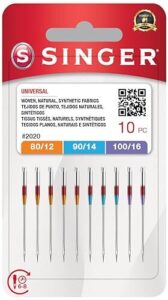
Three needle sizes do most of the heavy lifting in everyday sewing. The Singer Universal Needle Assortment gives you an 80/12 for lightweight fabrics, a 90/14 for medium weights, and a 100/16 for denim and canvas — all in one pack. That range alone covers most tension problems caused by a mismatched needle.
Each needle has a chrome-finished shaft that resists friction and corrosion. Replace yours every 6–8 hours of sewing to keep stitches clean and tension consistent.
| Best For | Hobbyists and casual sewers who work with a variety of everyday fabrics and want a versatile needle assortment without buying multiple size-specific packs. |
|---|---|
| Compatibility | Singer sewing machines |
| Material | Steel |
| Primary Function | Needle supply |
| Package Quantity | 15 needles |
| Portability | Lightweight bulk pack |
| Skill Level | Beginner to intermediate |
| Additional Features |
|
- Covers lightweight to medium-weight fabrics with three sizes (80/12, 90/14, 100/16) in a single purchase
- Universal Singer compatibility makes it easy to grab and go without second-guessing fit
- A cost-effective way to keep a range of needle sizes on hand for mixed projects
- Only 15 needles total — significantly fewer than the 50-needle count some listings suggest
- Needles arrive loosely in a plastic bag rather than organized or individually packaged
- Limited to three standard sizes, so specialty or larger needles aren’t included
2. Dritz Needle Inserter With Brush
Swapping needles mid-project is easier when you’re not fumbling one into the clamp by feel alone. The Dritz Needle Inserter With Brush solves that precisely — its push-in tip holds the needle shank steady while you tighten the clamp screw, no pinched fingers required.
Flip it around and the built-in lint brush clears debris from the needle plate area in seconds. At 16.67 inches, it reaches tight spots without disassembly.
| Best For | Sewists and serger users who want a safer, more convenient way to change needles and do quick machine cleanups without a separate toolkit. |
|---|---|
| Compatibility | Sewing machines & sergers |
| Material | Plastic |
| Primary Function | Needle changing & lint removal |
| Package Quantity | 1 dual-ended tool |
| Portability | Slim, travel-ready body |
| Skill Level | All skill levels |
| Additional Features |
|
- The push-in tip keeps the needle aligned and steady so you can tighten the clamp screw without risking a poke or dropped needle
- The flip side doubles as a lint brush, clearing debris from the needle plate in seconds — two tools in one
- At 16.67 inches, it’s slim enough to slip into tight machine spaces and small enough to toss in a travel sewing kit
- The plastic body can crack if you drop it or apply too much force during needle insertion
- The built-in brush is handy for quick cleanups but won’t replace a dedicated machine cleaning tool for deeper maintenance
- It’s a single-piece design, so if you want one at multiple machines or workstations, you’ll need to buy extras
3. Madam Sew Seam Guide Ruler
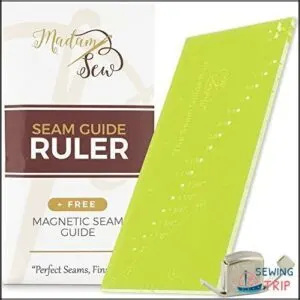
Once the needle’s in place and the area is clean, accurate stitching still depends on one more factor: where you guide the fabric. The Madam Sew Seam Guide Ruler clips magnetically to any metal needle plate and gives you 16 measured holes spanning 1/8" to 2", so you’re always sewing at the exact allowance you need.
Its fluorescent-green body stays visible against any fabric. The built-in 1/4" pivot point guides binding corners cleanly.
| Best For | Quilters and sewists who need fast, repeatable seam accuracy and work on projects like quilts, binding, or half-square triangles. |
|---|---|
| Compatibility | Most metal-plate machines |
| Material | Fluorescent-green plastic |
| Primary Function | Seam allowance guiding |
| Package Quantity | 1 magnetic ruler |
| Portability | Small, magnetic design |
| Skill Level | Intermediate to advanced |
| Additional Features |
|
- 16 hole increments from 1/8" to 2" let you dial in any seam allowance quickly and consistently
- The magnetic base snaps onto any metal needle plate in seconds, so setup is nearly instant
- Built-in 1/4" pivot point and 45° line handle corner binding and triangle trimming without extra tools
- Won’t stick to machines with plastic or non-magnetic needle plates, which limits compatibility
- The magnet can be hard to pull off the needle plate once it’s on
- At 2.5" × 5.5", it’s only useful for seam guidance — you’ll still need a full-size ruler for cutting and layout
Frequently Asked Questions (FAQs)
Does sewing speed affect thread tension consistency?
Yes, sewing speed does affect thread tension. Faster stitch cycles create variable load shifts on the needle thread, causing momentary tension drift. Moderate speeds produce far more consistent stitch formation.
How does presser foot pressure impact stitch quality?
Presser foot pressure directly controls how firmly fabric stays against the feed dogs. Too much crushes delicate material; too little lets it drift, causing skipped stitches and uneven seam lines.
Can machine timing issues mimic tension problems?
Timing trouble? Call it a tension impersonator. When your machine’s timing drifts, the needle and hook miss their cue — producing loops, skipped stitches, and bird-nesting that look exactly like a tension problem but aren’t.
Does thread color or dye affect tension behavior?
Thread color does affect tension. Darker, pigment-heavy threads are stiffer and can alter disc grip. Dye coatings change how thread feeds. Always recheck tension on scrap when switching dye lots.
Conclusion
Most sewers spend years fighting tension problems that could’ve been solved in ten minutes. Knowing how to fix loose thread tension sewing projects correctly isn’t a minor skill—it’s what separates endless frustration from clean, confident work every single time.
Start with threading. Match your materials. Test on scraps. Adjust one variable at a time.
Your machine hasn’t betrayed you; it’s just waiting on the right setup. Give it that, and it delivers.
- https://www.sewschool.co.uk/sewing-machine-thread-tension
- https://www.maggieframes.com/blogs/embroidery-blogs/mastering-singer-bobbin-tension-troubleshooting-and-adjustment-guide
- https://www.fortheloveofthread.com/blog/solving-tension-issues-on-your-sewing-machine
- http://ohyoucraftygal.blogspot.com/2013/10/sewing-lesson-10-how-to-fix-tension-on.html
- https://www.threadsmagazine.com/2008/11/02/understanding-thread-tension