This site is supported by our readers. We may earn a commission, at no cost to you, if you purchase through links.
A skipped stitch seems minor—until it unravels a seam halfway through a project you’ve spent hours on.
Nine times out of ten, that frustrating little skip traces back to one thing: a needle that’s bent, dull, or seated wrong in its clamp.
Most sewists check their thread tension, swap their presser foot, even retime their machine before they think to question the needle itself.
The needle does the most mechanical work of any part on your machine, and proper needle insertion technique is what determines whether it does that work cleanly.
Get this right, and almost everything else follows.
Table Of Contents
Key Takeaways
- The needle is the most mechanically demanding part of your sewing machine, and most stitch problems — skipped stitches, thread breakage, fabric snags — trace back to a needle that’s bent, dull, inserted backward, or not fully seated.
- Matching your needle to your fabric type and weight isn’t optional: ballpoint for knits, sharp for wovens, denim needles for heavy layers — using the wrong one quietly ruins your work before you’ve sewn a single clean seam.
- flat side facing back, needle pushed fully upward until it stops, and the clamp screw tightened snugly — any shortcut here causes wobble that throws off tension and stitch consistency.
- Always test on scrap fabric after inserting a new needle, listening for crisp, even tapping, and watching for complete stitches — your machine tells you immediately whether everything’s right.
Choose The Right Sewing Needle
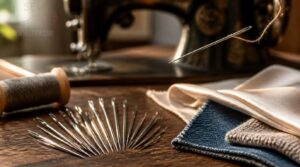
Choosing the right sewing needle is the foundation of clean, consistent stitches — get this wrong and everything else becomes a struggle. The good news is that it comes down to just a few straightforward decisions you can make before you even thread the machine. Here’s what to look at first.
Once you’ve nailed needle selection, pairing it with solid beginner hand sewing techniques for quilts will keep your tension balanced and your stitches looking consistent from the very first seam.
Match Needle to Fabric
Think of your needle as a specialized tool — each fabric demands its own match.
Ballpoint needles glide between knit fibers without cutting threads, preventing frustrated runs. Sharp needles pierce woven fabrics cleanly for precise seams. Denim needles penetrate heavy layers with a reinforced shaft, while leather needles use a wedge tip for clean perforations.
For polyester, choose a needle that minimizes snagging.
Always make sure correct needle orientation so that the scarf faces the hook for proper stitch formation.
Check Needle Size
Once you’ve matched your needle to the fabric type, the next question is: how big should it be? Needle size is measured in millimeter gauge numbers — the higher the number, the finer the needle.
Delicate fabrics need sizes 60–70; medium-weight cotton suits 80–90; heavy denim requires 90–110. When in doubt, test on a fabric scrap first.
Pick Correct Needle Type
Size tells you how big; type tells you how it enters the fabric.
Ball point needles push knit fibers apart rather than piercing them, preventing snags and runs.
For silks, a Microtex needle’s ultra-fine tip glides cleanly through delicate weaves.
Dense denim needs a sturdier denim needle to muscle through without skipping stitches or deflecting mid-seam.
Inspect for Bends
A bent needle is a silent troublemaker. Even a slight curve changes how the tip meets fabric, causing skipped stitches or breakage mid-seam.
Before inserting any needle, roll it across a flat surface — a straight needle stays flush; a bent one wobbles visibly. That quick check takes seconds and saves your entire project.
Avoid Dull Needles
A dull needle doesn’t announce itself — it just quietly ruins your work. Tip integrity matters more than most sewists realize.
- Store needles cushioned, away from moisture to prevent corrosion
- Replace after heavy sessions on thick fabrics like denim
- Inspect the tip before every project for invisible burrs
A compromised tip drags instead of pierces, creating uneven, skipped stitches.
Prepare Your Sewing Machine
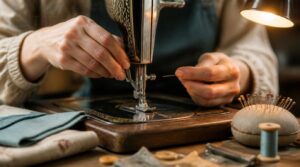
Before you insert a new needle, your sewing machine needs to be ready — and that starts with a few simple setup steps. Skipping this prep is one of the most common reasons needles break or stitches go wrong. Here’s exactly what to do before the needle ever touches the machine.
Turn Power Off
Before you touch a single needle, turn the power off completely. This one step stops all motor movement and prevents unexpected machine activity — no sudden bobbin jolts, no accidental starts if you graze the foot pedal. Think of it like following electrical safety protocols before any maintenance: the machine must be fully still.
| Risk | Cause | Prevention |
|---|---|---|
| Needle driving unexpectedly | Power left on | Switch off before inserting |
| Accidental motor start | Foot pedal contact | Disconnect power source |
| Bobbin movement | Active electrical current | Full power-off confirmed |
| Finger injury | Shifting internal parts | Wait until machine is still |
| Loose needle ejection | Vibration during insertion | Power down completely first |
Raise The Needle Bar
With the machine off, turn the handwheel toward you until the needle bar reaches its highest position. This clears the needle plate area completely, giving you unobstructed access to the clamp.
Before raising, make sure the needle plate is free of fabric or debris. If the bar feels stiff, the guides may need lubrication — don’t force it.
Lower The Presser Foot
Lower the presser foot slowly until it rests flush against the fabric with gentle, even resistance. This small step controls fabric pressure adjustment and keeps your material stable during needle insertion.
- Position fabric carefully under the foot
- Lower until contact feels firm but not forced
- Confirm stitch uniformity control by checking for gaps
- Watch for fabric bunching underneath
- Prevent seam rippling by coordinating foot pressure evenly
Remove Old Needle Safely
Before removing the old needle, power off the machine completely — a stray pedal press can cause serious injury. Raise the needle bar to its highest position, then loosen the clamp screw fully.
Grasp the needle by its shaft and pull straight downward without bending. Inspect the shaft for burrs, then dispose of it properly in a designated sharps container.
Keep Tools Nearby
Think of your workspace as an extension of your hands — everything within reach means nothing breaks your focus. A magnetic pin cup corrals loose needles instantly.
Keep a portable LED lamp clipped nearby for clear visibility. Store your compact needle kit in a labeled drawer, and set a clean, wipeable mat down to maintain a tidy surface throughout.
Insert The Needle Correctly
Getting the needle seated correctly is where everything either comes together or falls apart. It’s a small step, but done wrong, it throws off your stitches before you’ve even started sewing. Here’s exactly what to do, one step at a time.
Identify The Flat Side
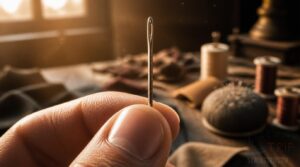
Hold the needle up to a light source and look closely at the shaft. One side is flat—smooth and featureless—while the opposite side shows a slight groove running its length.
That flat face is your orientation anchor. Run your fingertip along both sides; the flat surface feels noticeably different from the rounded, grooved side opposite it.
Face Needle Properly
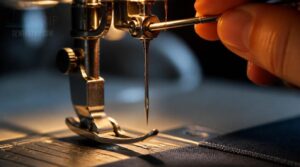
Once you’ve identified the flat side, orient the needle so the flat face points away from you — toward the back of the machine. This sets the bevel upward, meaning the angled, sharp tip faces the fabric correctly.
Proper needle bevel positioning ensures smooth thread delivery, minimizes tissue trauma to your fabric, and prevents skipped stitches during sewing.
Push Needle Fully Upward
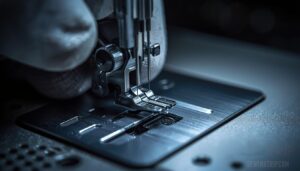
With the flat side facing back and the bevel properly oriented, slide the needle fully upward into the needle bar clamp until it can’t go any higher. This ensures the tip sits correctly above the needle plate opening, supporting consistent stitch depth and smooth fabric penetration across every pass.
- Full upward travel aligns the needle with presser foot clearance
- The needle shaft becomes visible through the needle plate for quick inspection
- Proper height maintains needle bar synchronization for even stitches
Tighten The Clamp Screw
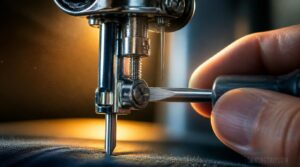
Once the needle is fully seated, use a small flathead screwdriver to tighten the clamp screw firmly — snug, not strained. Aim for a snug, controlled turn that secures the needle without stressing the threads. Overtightening risks thread galling inside the housing, weakening your hold over time.
| Screw Condition | Risk | Correct Action |
|---|---|---|
| Too loose | Needle wobble | Re-tighten carefully |
| Overtightened | Thread galling | Back off slightly |
| Properly torqued | Stable needle | Proceed confidently |
Check Needle Alignment
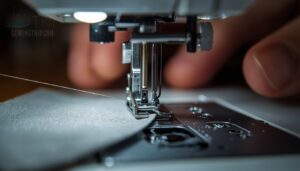
Once the needle is seated and secured, confirm eye perpendicularity before sewing a single stitch. The needle eye must sit perfectly parallel to the fabric surface — any tilt disrupts your thread path and causes fraying or skipped stitches.
Slowly turn the hand wheel by hand and watch the needle travel straight down through the needle plate hole without drifting sideways.
Test Stitch Before Sewing
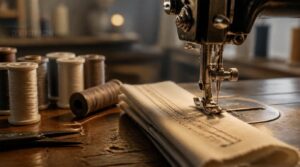
Before you sew a single seam on your actual project, running a test stitch is the smartest move you can make. It takes just a minute, but it tells you everything you need to know about whether your needle is seated correctly and your machine is ready. Here’s what to check during that test run.
Rethread The Machine
Before you sew a single stitch, rethreading correctly is everything. Start with the take-up lever at its highest position, then guide your thread through each guide point, fully seating it into the tension discs for proper engagement.
Confirm the thread passes cleanly through the needle eye without twists. Poor thread path alignment causes bunching, skipped stitches, and unnecessary frustration.
Use Scrap Fabric
Once you’ve rethreaded, grab a scrap fabric swatch before touching your actual project.
Scraps let you test needle angle and orientation under real conditions — checking that the needle seats correctly and drives cleanly through layers. Fabric swatch testing also reveals tension issues instantly.
Think of it as your safety net: small sacrifice, big protection.
Watch for Skipped Stitches
A skipped stitch is your machine’s quiet warning sign. It usually points to tension imbalance, a bobbin thread issue, or inconsistent fabric feed — all directly tied to how your needle sits in the clamp.
Watch your scrap fabric carefully. If stitches appear incomplete or gapped, suspect timing misalignment or lint buildup in the bobbin area before assuming anything else is wrong.
Listen for Needle Hits
Your machine talks — you just need to listen. A crisp, regular tapping as the needle moves through fabric means insertion is correct and penetration is clean. Here’s what each sound tells you:
- Rhythmic, even hits — proper needle alignment and smooth fabric feeding
- Dull or muffled thuds — needle may be hitting the presser foot or throat plate
- Sudden pops or crackling — uneven layers or a seam allowance catching the needle
- Faint, vanishing hits — needle may be too large or misaligned for the fabric
- Grinding or buzzing — stop immediately; inspect for needle damage or timing issues
Sound is your most honest diagnostic tool.
Adjust if Needed
Sometimes a single tweak is all it takes. If your test stitches show skipping or irregular tension, change one variable at a time — needle position, clamp tightness, or thread path — then stitch again on scrap fabric.
Note what triggered the issue and what you changed. Reassess immediately after each adjustment to confirm the fix held before moving forward.
Avoid Needle Insertion Mistakes
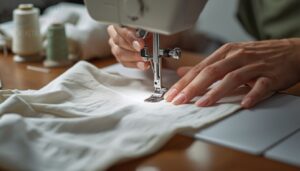
Even small missteps during needle insertion can throw off your entire project. Knowing what to watch for makes all the difference between clean, consistent stitches and a frustrating sewing session. Here are the most common needle insertion mistakes you’ll want to avoid.
Backward Needle Placement
Inserting your needle backward is one of the most common — and easily overlooked — mistakes you can make. When the flat side faces forward instead of toward the back of your machine, the bevel orientation throws off thread alignment entirely, causing skipped stitches and fabric snags.
Always confirm your needle faces the correct direction before tightening anything.
Loose Clamp Screw
A backward needle is bad enough — but a loose clamp screw is sneakier. Vibration from fast sewing gradually loosens it, causing needle wobble mid-stitch.
- Check tightness before every session
- Use the correct screwdriver to avoid screw head damage
- Apply manufacturer-specified torque
- Replace worn screws with OEM parts
- Never over-tighten — thread stripping weakens the housing permanently
Wrong Needle Size
Picture a clinical injection: wrong gauge raises tissue trauma risk, hematoma formation, and patient pain levels, even medication delivery errors.
Sewing needles fail the same way. Heavy fabric needs larger gauges to dodge skipped stitches; delicate fabric tears under excess penetration force.
Base needle selection and length criteria on fabric weight, choosing the smallest appropriate gauge for strong, pucker-free seams.
Partially Inserted Needle
A partially inserted needle sits just shy of fully seated — and that small gap creates big problems. Needle bar wobble at high speed throws off stitch consistency, causing skipped stitches and fabric puckering.
Thread tension becomes unbalanced, leading to uneven loops. Lightweight fabrics snag; dense layers stall.
Always push the needle firmly upward until it stops, then tighten the clamp screw securely.
Reusing Damaged Needles
Think of a damaged needle like a blunted scalpel — it doesn’t cut cleanly, it tears.
A damaged needle, like a blunted scalpel, doesn’t cut cleanly — it tears
Needle tip burrs from reuse snag fabric threads and transfer micro-contaminants between projects, raising real infection risk.
Structural deformation throws off alignment, producing skipped stitches. Replace any bent or dull needle immediately — safe practice means never compromising on a tool that costs almost nothing to swap.
Frequently Asked Questions (FAQs)
How often should sewing machine needles be replaced?
Replace your sewing machine needle every 8 hours of sewing or after each project. On dense fabrics like denim, swap sooner. Skipped stitches or thread breakage are clear signs it’s time.
Can needle position affect thread tension settings?
Yes — needle position directly affects thread tension balance. A misaligned needle disrupts hook path alignment and thread take-up, shifting tension between bobbin and upper thread, causing uneven stitches across your seam.
What causes needle breakage during regular sewing?
Needle breakage often comes down to a few common culprits: thread tension issues, fabric mismatch, a damaged needle plate, improper needle alignment, or lint buildup creating resistance around the eye.
Does needle brand affect stitch quality significantly?
Brand matters more than you’d think. Needle tip sharpness, surface finish, and material plating quality vary noticeably between manufacturers — directly affecting thread flow consistency and stitch uniformity across your seam.
How do specialty needles differ from standard ones?
Specialty needles feature sophisticated tip geometries, friction-reducing coatings, and echogenic markers that standard needles lack.
These purpose-built designs improve tissue sampling yield, reduce insertion trauma, and offer specialized configurations across a wider gauge and length range.
Conclusion
A thousand seams could unravel before you’d ever suspect the needle—yet now you know exactly where to look first. Proper needle insertion technique isn’t a small detail buried deep in your machine’s manual; it’s the very foundation every clean, confident stitch is built on.
these three checkpoints take thirty seconds and save hours of frustration.
Trust the process, and your machine will trust you back.
- https://leveluprn.com/blogs/clinical-nursing-skills/26-intradermal-subcutaneous-intramuscular-injections
- https://www.immunize.org/news/updates/website/how-to-administer-intramuscular-and-subcutaneous-vaccine-injections-6
- https://www.gosh.nhs.uk/conditions-and-treatments/procedures-and-treatments/giving-subcutaneous-injections
- https://opentextbc.ca/clinicalskills/chapter/6-7-intradermal-subcutaneous-and-intramuscular-injections
- https://www.rch.org.au/rchcpg/hospital_clinical_guideline_index/Subcutaneous_injections_and_device_management