This site is supported by our readers. We may earn a commission, at no cost to you, if you purchase through links.
Your fabric stalls mid-seam, bunching up under the needle like it’s stuck on glue. You check the tension, swap the needle, even rethread the whole machine. Nothing fixes it. The real culprit hides below the needle plate, buried in lint you can’t see.
Feed dogs do the heavy lifting in every stitch, gripping and pulling fabric forward in tiny, precise bites. Skip a few cleanings, and dust, thread fragments, and oil residue pack into those teeth until they can’t grab anything. A sluggish feed dog turns a simple project into a frustrating mess of skipped stitches and crooked seams.
Cleaning feed dogs takes ten minutes and a few household tools. Here’s the exact process that gets your machine gripping fabric like new again.
Table Of Contents
Key Takeaways
- Lint and thread packed into feed dog teeth are the hidden cause behind most fabric feeding problems like skipped stitches and bunched seams.
- Removing the needle plate and cleaning with a soft brush, tweezers, and a small vacuum takes about ten minutes and restores your machine’s grip completely.
- A single drop of low-viscosity sewing machine oil at each designated point — never randomly — keeps feed dogs moving smoothly without attracting new lint buildup.
- Brushing feed dogs after every project and doing a full deep clean weekly prevents the slow buildup that turns a quick fix into a frustrating repair session.
What Are Sewing Machine Feed Dogs?
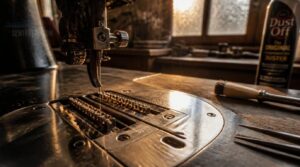
Feed dogs are those small toothed bars under your needle plate that grab fabric and pull it through your machine. They work quietly in the background, but when they’re dirty or jammed, you’ll feel it in every stitch. Here’s what you need to know about how they’re built and how they move before you start cleaning them.
If you’ve noticed skipped stitches or uneven feeding lately, this guide to common feed dog problems and fixes walks through the usual culprits.
Feed Dog Location
Tucked beneath the needle plate, the feed dogs sit in a horizontal row, their toothed tips extending up through narrow slots to grip your fabric directly. They’re positioned right alongside the bobbin zone, which is why lint migrates so easily between the two areas.
You can’t see the full feed dog mechanism without removing the needle plate first.
The synchronized motion of feed dogs ensures consistent stitch length.
How Feed Dogs Move
Each feed dog follows an elliptical motion cycle — rising above the needle plate, gripping the fabric, pulling it forward, then dropping back down to reset. That four-part loop repeats with every stitch.
Key mechanics working together:
- Feed dogs raise and lower in sync with the needle
- Forward travel matches your set stitch length exactly
- Needle timing synchronization prevents skipped or uneven stitches
- Differential feed mechanics let front and back sections move independently for stretch fabrics
Why Feeding Matters
That four-part cycle isn’t just mechanical choreography — it’s what keeps your stitches honest. When feed dogs grip the fabric evenly, you get consistent stitch length, accurate seam allowances, and clean needle penetration every time.
When feed dogs grip evenly, every stitch stays honest—consistent length, accurate seams, clean penetration
Without reliable fabric feeding, material slips, puckers, or drifts sideways — and your seam allowance accuracy disappears fast.
Signs They Need Cleaning
Your feed dogs will tell you when they’re struggling.
Fabric bunching or sluggish movement is usually the first sign — the material drags instead of gliding.
You might also notice skipped stitches or uneven feeding on test fabric, thread nesting under the seam, or a gritty clicking noise during stitching. Any one of these means it’s time to clean.
Tools Needed to Clean Feed Dogs
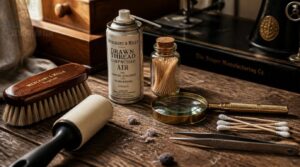
You don’t need a repair shop full of gadgets to get this job done right. Most of what you need is probably already sitting in a kitchen drawer or your sewing kit. Here’s exactly what to grab before you start.
Lint Brush
A lint brush is your first line of defense against feed dog buildup. Reach for one with natural rubber bristles—they grip fuzz without scratching the metal teeth.
Dual‑sided designs work great here: coarse bristles tackle stubborn lint, while the softer side cares for delicate sweeps.
Rinse it clean and let it dry fully after each use. No disposables needed; just a sustainable tool that keeps lint removal simple.
Small Toothbrush
A small toothbrush earns its place in your cleaning kit fast. Its compact brush head slips into the narrow slots around the feed dog teeth where a standard brush simply can’t reach.
Medium-soft bristles scrub out packed lint without scratching the metal.
Use short back-and-forth strokes to dislodge debris precisely.
Replace it once the bristles splay — bent bristles miss more than they clean.
Tweezers
Tweezers are your go-to tool when lint buildup turns stubborn. A good pair of pointed or needle-nose tweezers lets you reach thread fragments wedged deep inside feed dog slots.
- Use slant-tip tweezers for angled access
- Choose stainless steel to resist corrosion
- Grip tip alignment should be within 0.1 mm
- Textured grips improve control
- Inspect tips regularly for wear
Mini Vacuum
A mini vacuum is perhaps the most satisfying tool for this job. Where a brush loosens lint, the vacuum removes it completely.
Just be careful not to over-oil afterward, since applying lubricant to sewing machine gears the right way helps keep dust and lint from building back up.
Look for a cordless model weighing under 2.5 pounds with a crevice nozzle attachment — that slim 4-to-8-inch tip reaches directly into feed dog slots. Battery-powered units offer 10–25 minutes of runtime, which is plenty for a full cleaning session.
Sewing Machine Oil
Not all oils are created equal — and using the wrong one can do more harm than good. Always reach for clear sewing machine oil with low viscosity, as it forms a thin protective film without pooling around tight mechanisms.
Synthetic oil outperforms mineral oil in modern machines, resisting heat and staying clean longer.
One drop per point is enough.
Prepare Your Machine Safely
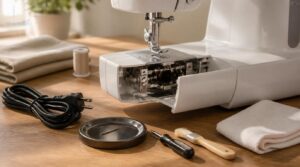
Before you touch the feed dogs, you need to set your machine up the right way. Skipping prep steps is how accidents happen — and how parts get damaged before the real work even begins. Here’s what to do first:
Unplug The Machine
Skip this step and you’re risking a real shock. Before you touch anything near those feed dogs, unplug it completely—pull the cord from the wall outlet, not just the machine’s switch. This stops accidental motor engagement, protects circuit boards from static discharge, and keeps fingers safe.
- Unplug from the wall outlet
- Inspect the power cord for damage
- Confirm the indicator light is off
- Check for frayed insulation before storing
Remove The Needle
With the machine unplugged, loosen the needle clamp screw by turning it counterclockwise. Hold the needle steady and slide it down gently—don’t force it.
Check it for burrs or bending; a damaged needle causes skipped stitches later. Confirm proper needle orientation (flat side back) before storing. This quick check protects your feed dogs and needle plate from unnecessary wear during cleaning.
Remove Presser Foot
With the needle out of the way, your presser foot is next. Most modern feet are snap-on, so look for the release button at the back of the foot holder and press it—the foot pops free. Screw‑fix models need a tiny screwdriver to loosen the holder screw first.
Either way, check shank compatibility before reinstalling later.
Take Off Needle Plate
Now grab a screwdriver and find the two screws holding the needle plate in place, usually at opposite edges. Loosen them evenly to avoid plate warping, then lift straight up—no twisting or prying.
Before setting it aside, note the alignment notch and check the needle hole clearance. This step exposes the feed dogs and any hidden lint buildup underneath.
Check Your Manual
With the plate off, take thirty seconds to check your manual before going further. Every model has quirks—Singer, Brother, Janome, Kenmore—and your manual confirms safe feed dog cleaning steps, accessory compatibility, and maintenance intervals specific to your machine.
It’ll also explain any dashboard error codes tied to feeding issues. This quick manual check prevents costly mistakes and keeps your sewing machine maintenance on track.
Clean Lint From Feed Dogs
With your machine open and the needle plate off, you’ve got a clear view of the feed dogs and the grooves around them. This is where the real cleaning happens, and it goes faster if you work through it in order. Here’s how to get every bit of lint and thread out of there.
Brush Visible Lint
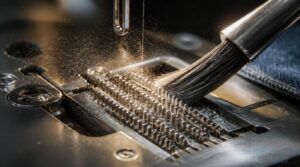
That thin gray film coating your feed dogs isn’t harmless dust—it’s friction in disguise. Grab a soft-bristled brush and sweep along the teeth, working in the direction of fabric travel.
Check narrow gaps between each tooth; lint hides there fast. Good lighting reveals what your eyes might miss.
Brushing now stops lint buildup before it hardens into clumps that wreck your feed dog mechanism’s grip entirely.
Clear Needle Plate Slots
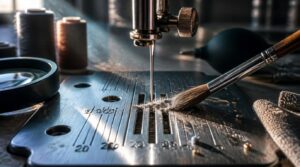
The needle plate slots trap lint just as fast as the feed dogs. Left unchecked, that buildup causes fabric snagging and weakens your machine maintenance routine.
- Run a fingernail along each edge to catch slot edge burrs
- Confirm needle alignment is centered over the slot
- Brush lint buildup clear from slot walls
- Clear loose debris with compressed air
- Verify smooth slot edges for proper slot width compatibility
Remove Trapped Threads
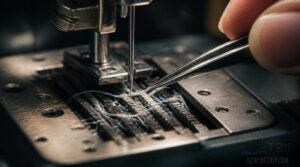
Threads wrap around feed dogs like a tangle you can’t undo with bare hands — that’s where tweezers precision becomes essential. Work slowly.
| Tool | Use Case | Key Tip |
|---|---|---|
| Tweezers | Unwinding thread nests | Pull parallel to teeth |
| Bent needle | Clearing tight crevices | Hook, don’t scrape |
| Fingers | Loose thread ends | Start before tools |
Never force anything — avoiding tooth damage keeps feed dogs gripping properly.
Vacuum Loose Debris
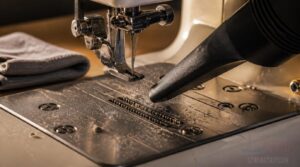
A small vacuum does what brushes can’t — it pulls remaining debris out instead of pushing it around. Fit a crevice tool attachment to reach between the feed dogs and needle plate slots.
Keep suction at a moderate level to avoid disturbing small screws nearby. A HEPA-filtered vacuum prevents fine lint from recirculating.
Finish by wiping surrounding surfaces with a microfiber cloth.
Avoid Forcing Parts
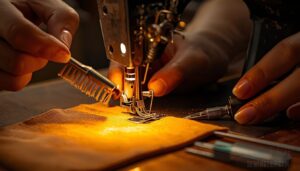
Forcing anything during machine maintenance is how small problems become expensive ones. If a part resists, stop.
- Forcing the needle plate can crack the metal or cause bobbin misalignment.
- Prying near the hinge pins risks bending them.
- Yanking threads strains thread guides, causing wear and fraying.
Let the tools do the work — never your strength.
Clean Around The Bobbin Area
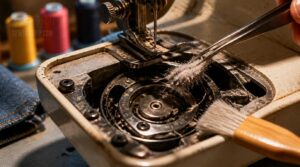
Your feed dogs aren’t the only spot collecting lint. Thread and dust love to settle around the bobbin case too, often without you noticing. Here’s how to clear that area out properly.
Remove Bobbin Case
Your bobbin case hides a surprising amount of lint buildup, even when everything looks fine from the outside. With the machine still unplugged, open the needle plate area and find the latch mechanism holding the case in the shuttle.
Gently disengage it and pull the case straight out—no twisting. Check shuttle alignment before removal and watch for thread tangling around the case edges.
Brush Hook Area
With the bobbin case out, your hook area sits exposed—this is where lint loves to hide.
Grab your lint brush and sweep around the metal hook using slow, even strokes. This small mechanical part controls thread tension, so thorough dust and lint removal here matters. Skip the compressed air blast; gentle brushing protects delicate parts better.
Use Pipe Cleaners
Your lint brush cleans the open spaces, but pipe cleaners reach the tight curves a brush can’t touch.
Make sure yours is dry and fluffy—any moisture invites rust. Twist the tip into a stiff little brush, then use light tapping rather than hard rubbing to loosen compacted lint around the hook race.
Switch to a fresh section for each spot, so you’re not just redistributing lint between areas.
Check for Thread Nests
Once the hook race looks clear, take a second to check for thread nests—those tangled clumps love to hide right where you’ve been brushing.
Look for:
- A spiral or clumped tangle near the bobbin
- Frayed threads bunching behind the plate
- A faint linty, almost burnt smell
- Loose looping on the fabric’s underside
Spotting nesting signs early prevents bigger jams down the road.
Reinstall Parts Correctly
Once you’ve cleared out any nests, putting things back is just as important as the cleaning itself.
Drop the bobbin case seating fully into the hook race, making sure notches align with the pins. Check that the safety notch faces the right way.
Then reinstall the needle plate, lining up the finger and confirming needle plate alignment before tightening screws to spec.
Oil and Reassemble Correctly
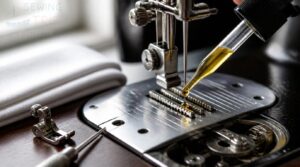
Once the lint is gone, your feed dogs need a little moisture to move smoothly again. This step isn’t complicated, but it does need to be done in the right order. Here’s exactly how to oil and put everything back together.
Use Sewing Machine Oil
Once your feed dogs are clean, they need a little lubrication to keep moving smoothly. Grab a low-viscosity sewing machine oil—synthetic blends resist heat and oxidation better than mineral oils, so they last longer between applications. Oxidation inhibitors stop that gummy buildup that attracts lint.
Use a light touch; oil viscosity matters more than quantity. Too much causes stains, so a thin film is all you need.
Oil Approved Points
Not every spot on your machine needs a drop. Stick to the designated lubrication points—usually the hook race, the center post, and the pivot joints of your manual flags.
Manufacturers test these locations against strict OEM specifications, checking additive compatibility and viscosity performance across temperature swings. That testing protects emissions systems and keeps your machine running smoothly between services.
Oiling randomly skips that protection entirely.
Wipe Excess Oil
Don’t skip this step—it matters more than it looks. Grab a microfiber cloth and wipe each oiled point until no residue remains.
- Wipe the needle plate top
- Clean around feed dog slots
- Check the thread path
- Dab the bobbin housing
- Wipe the presser foot shank
Leftover oil attracts lint and risks fabric stains. A quick, dry pass keeps your machine’s lubrication doing its job without overapplication problems.
Turn Handwheel Slowly
Now turn the handwheel toward you, slow and steady, always rotating in the same direction your machine calls for.
This isn’t just a formality. Slow rotation reveals stiff spots caused by lint buildup or debris before you sew a single stitch. You’ll also feel any mechanical resistance, catch threading alignment issues, and keep needle breakage off the table. It’s a simple, hands-on safety check that confirms your machine maintenance actually worked.
Replace Needle Plate
Here’s where everything comes back together. Set the needle plate back over the feed dogs, lining up the holes with the screw posts—screw alignment matters more than people think, since a crooked plate causes snagging and skipped stitches down the road.
Tighten evenly, not too hard.
- That moment fabric glides smoothly again
- No more snagged threads ruining your work
- The satisfaction of a machine that just runs right
Confirm model verification and plate compatibility before you sew.
Test Feed Dog Performance
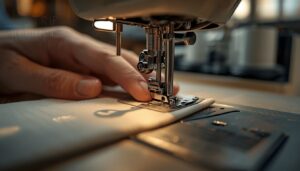
Cleaning and oiling won’t mean much if you skip this part. A quick test run tells you whether the feed dogs are actually doing their job again. Run through these five checks before you trust your machine with a real project.
Raise Feed Dogs
Before you test anything, make sure your feed dogs are actually up. If you used a drop feed lever for free-motion quilting earlier, those teeth are sitting flat and won’t grip fabric at all.
Check your feed dog position switch—Singer, Brother, and Kenmore all place it differently. Newer Janome models use digital height settings instead of a manual lever.
Set Stitch Length
Once your feed dogs are up, dial in your stitch length—zero disables feed dog movement completely, so don’t leave it there.
For most fabric weight, 2.0 to 3.0 mm works well; go shorter for lightweight fabrics to prevent seam puckering, longer for heavier materials.
Stitch density and tension length affect each other, so customizing stitch settings now saves headaches and lint buildup later.
Test on Scrap Fabric
Grab a scrap of medium-weight woven fabric, around 4 by 6 inches, and make sure it’s clean and lint-free. Stretchy or delicate fabrics will skew your results, so skip those for now.
Run a straight stitch test and watch how the fabric feeds. A clean, even stitch line means your feed dog adjustment worked and grip is back to normal.
Check Fabric Movement
Watch the fabric edge as it moves past the needle line on your throat plate. Fabric drift patterns show up fast—if one side pulls ahead, you’re looking at uneven feeding or worn feed dogs.
Check stitch length uniformity too. Consistent spacing means smooth fabric movement and good slippage prevention. Uneven seam allowances usually point to feed dog troubleshooting territory, especially with layered fabric binding on thicker stacks.
Watch for Skipped Stitches
Skipped stitches on your test scrap mean something’s off beyond just feed dog cleaning. Check needle size matching first—a mismatched needle and fabric weave creates gaps.
Then look at tension balance, bobbin thread consistency, and presser foot pressure.
If lint buildup near the needle plate caused the original problem, skips should disappear once feeding runs smooth again.
Prevent Future Feed Dog Problems
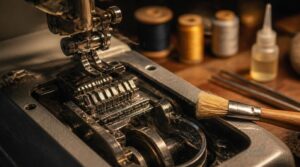
Cleaning your feed dogs once won’t keep them working right forever. Lint builds back up, oil dries out, and parts wear down with regular use. A few simple habits will keep your machine feeding smoothly for years to come.
Brush After Projects
A two-minute habit can save you a whole afternoon of deep cleaning. Once you finish a project, brush the feed dogs before you walk away. Loose lint and thread fragments sit right on the surface, and a soft-bristled brush clears them before they pack into the teeth.
This prevents lint buildup and stops thread nests from forming:
- Pick a sewing-machine lint brush, not a household one
- Sweep across the feed dog area, not just around it
- Check the presser foot for stray lint too
- Make it routine after every single project
Deep Clean Weekly
Once a week, give your machine real attention, not just a quick brush-off. Remove the needle plate and look behind it, since lint hides there even when the surface looks clean.
This weekly deep clean keeps stitch tension stable, improves fabric grip, and prevents thread nests from forming under the bobbin area. Skipping it shortens feed dog life and invites buildup that a quick sweep won’t catch.
Adjust Presser Foot Pressure
Getting presser foot pressure right does as much for clean feeding as a tidy feed dog. Fabric weight matching is the key: light for silk, medium for cotton, heavy for denim.
- Check your dial or lever
- Test on scrap fabric first
- Watch for puckering or dragging
- Readjust gradually
Correct pressure prevents fabric puckering and keeps stitch tension balanced, easing troubleshooting later.
Avoid Over-oiling
More oil doesn’t mean better lubrication. Excess oil attracts lint and dust, turning into sticky residue right on your feed dog teeth.
Stick to approved oiling points only, using a light sewing machine oil—never household substitutes. Too little causes friction and wear; too much breaks down from heat and gums up the mechanism. Wipe away any excess immediately to keep your machine running clean.
Replace Worn Feed Dogs
Even good cleaning habits can’t fix teeth that have worn smooth. Identifying worn teeth is simple: run a finger across them, and if they feel flat instead of sharp, it’s time to replace them.
Choose a model specific feed dog matched to your machine’s brand. Mount it with even screw tension, verify alignment against the needle plate, then test fabric advancement on scrap before sewing your real project.
Frequently Asked Questions (FAQs)
Why are sewing machine feed dogs called dogs?
Diligent little teeth do the dirty work: feed dogs grip and bite fabric like a mechanical biting action. The name comes from 19th-century engineering jargon, where component naming traditions borrowed animal metaphors for parts that "engage" material.
What if feed dogs wont rise back up?
Stuck rise usually points to jammed rise levers, weak lift springs, or stuck feeding cams. Check feed dog height and adjustment settings first.
Clear debris-clogged housings, then test alignment—if mechanical troubleshooting doesn’t fix it, a technician should inspect the spring or cam.
Wheres the feed dog switch on Brother machines?
Think of it like a hidden light switch — easy to miss until you know where to look. On most Brother models, including the SE600 series, the feed dog switch sits near the back base, sometimes as a recessed slider behind the needle area.
Why do feed dogs fail with thick fabric?
Thick fabric exceeds your feed dog’s grip capacity, causing slippage.
Fabric thickness limits, low feed dog height, and steady presser foot pressure all factor in—plus stitch timing drift when resistance changes, needle penetration, leading to skipped or uneven stitches.
How often should feed dog pivots get oiled?
Pivot points need oiling every 6 to 12 months. Climate and usage both drive that range. Apply 1–2 drops of mineral oil, work the movement, then wipe any excess to prevent buildup.
Conclusion
Clean feed dogs, clean fabric movement, clean results—it really is that straightforward.
When you take ten minutes to clean feed dogs on your sewing machine, you’re not just removing lint.
You’re restoring the machine’s grip, its rhythm, its reliability.
Skipped stitches and bunched seams don’t happen to machines that get regular attention.
Keep the brush close, make cleaning part of your routine, and your machine will pull fabric through exactly the way it should.
- https://mypacklove.com/blogs/patches/what-is-feed-dog-on-sewing-machine-easy-beginner-guide
- https://sewcanshe.com/diy-sewing-machine-maintenance-guide
- https://scissortailquilting.com/tutorials-instruction/clean-maintain-sewing-machine-maintenance
- https://thesewistdiary.substack.com/p/why-you-should-clean-your-sewing
- https://en.wikipedia.org/wiki/Dog_(engineering)