This site is supported by our readers. We may earn a commission, at no cost to you, if you purchase through links.
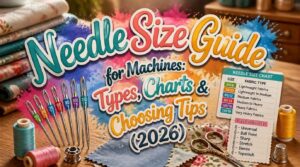
A wrong needle doesn’t just make bad stitches—it can shred delicate silk, snap thread every few inches, or punch holes through fabric that no amount of pressing will fix. Most sewists blame their machine or their thread when the real culprit sits in the needle clamp.
The numbering system doesn’t help: two different sizing scales, cryptic dual labels like 80/12, and dozens of needle types all competing for your attention.
Once you understand what those numbers actually measure and how needle anatomy connects to fabric behavior, choosing the right one stops feeling like guesswork.
This needle size guide for machines breaks it all down—sizes, charts, fabric matching, and the warning signs telling you a change is overdue.
Table Of Contents
- Key Takeaways
- Sewing Machine Needle Sizes Explained
- Sewing Needle Anatomy Basics
- Needle Size Chart by Fabric
- Choosing Needles by Fabric Type
- Matching Needle Size to Thread
- Common Sewing Machine Needle Types
- Specialty Needles for Specific Projects
- Top 9 Sewing Machine Needles
- 1. Singer Universal Sewing Machine Needles
- 2. Schmetz Microtex Sharp Needle 80/12
- 3. Schmetz Jersey Ballpoint Needle Set
- 4. Titanium Coated Topstitch Needle
- 5. Schmetz Universal Needle 80 12
- 6. Organ Ballpoint Sewing Needle Set
- 7. Schmetz Stretch Sewing Needle
- 8. Schmidt Heavy Denim Sewing Needle
- 9. Schmetz Heavy Duty Leather Needle
- When to Change Machine Needles
- Sewing Needle Troubleshooting Guide
- Frequently Asked Questions (FAQs)
- Conclusion
Key Takeaways
- The European sizing system makes needle selection almost foolproof — the number is the shaft diameter in hundredths of a millimeter, so an 80/12 needle is exactly 0.80mm wide and works best on everyday cottons and medium-weight fabrics.
- Needle type matters just as much as size — ballpoint for knits, sharp/Microtex for silk and dense weaves, leather needles for hides, and denim needles for heavy twill, since using the wrong point damages fabric in ways no amount of pressing fixes.
- Your needle should match your thread, not just your fabric — a fine 60/8–75/11 suits delicate thread, an 80/12 handles most all‑purpose thread, and thick topstitching or metallic threads need a 90/14 or larger with an elongated eye to prevent breakage.
- Don’t wait for a snap or a skip to change your needle — clicking sounds, visible holes, thread fraying, or puckered seams are all early warnings that a fresh needle (every 6–8 hours on tough fabrics) will fix faster than any tension adjustment.
Sewing Machine Needle Sizes Explained
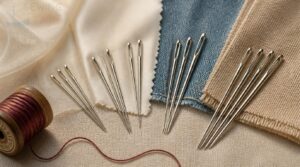
Needle size numbers can look confusing at first — two numbers separated by a slash, and most people have no idea what either one means. Once you understand the system, though, picking the right needle becomes almost automatic. Here’s what those numbers actually tell you.
Once you get the hang of it, this complete guide to choosing the right sewing needle and thread makes the whole system click into place.
European Size Numbers
The European metric system established in 1942 turns needle sizing into something refreshingly straightforward — the number IS the measurement. Specifically, the European number tells you the shaft diameter in hundredths of a millimeter. So a size 80 needle measures exactly 0.80 mm across. Many brands also provide a dual-number labeling system that pairs the metric size with its imperial equivalent for easy cross‑reference.
Think of it like a needle size conversion chart you never have to look up — the math is built right into the label:
- Size 60 = 0.60 mm — whisper-thin, made for silk and chiffon
- Size 80 = 0.80 mm — the everyday workhorse for cotton and linen
- Size 100 = 1.00 mm — steps up confidently for denim and canvas
- Size 120 = 1.20 mm — built tough for upholstery and heavy layers
Each size step up changes the diameter by exactly 0.1 mm — no guessing, no regional fit variations to account for. That’s what makes the European metric system so reliable across brands like Schmetz, Organ, and Klasse, which all follow the same international sizing standard.
American Size Numbers
While the European system is pure math, the American system works more like a gauge scale — the numbers run roughly from 8 to 21, with smaller numbers meaning finer needles and larger ones meaning thicker shafts.
It’s not metric-based, but American size numbers still track diameter closely enough that pairing them with your fabric weight stays simple and reliable.
80/12 Sizing Example
The label 80/12 means one thing: the shaft is 0.80 mm wide, and 12 is its American equivalent.
That single measurement tells you this needle works with lightweight to medium-weight fabrics — think quilting cotton or a light poplin — without punching oversized holes.
Match it with standard all-purpose thread, and your stitches land clean and tight every time.
Needle Diameter Meaning
The shaft diameter — that 0.80 mm measurement from the 80/12 example — is what needle diameter actually means. A wider shaft punches a bigger hole; a narrower one leaves almost no mark. Think of it like a drinking straw: the outer diameter controls fit, the inner bore controls flow.
- Larger diameter = heavier fabric compatibility
- Smaller diameter = cleaner holes in delicate material
- Higher gauge = thinner needle overall
- Wider bore = less flow resistance for thick thread
- Puncture size directly affects fabric recovery
Common Home-machine Sizes
Most home machines ship with a universal 80/12 needle already installed — and honestly, that covers a surprising range of projects. For chiffon needle selection, drop to a 60 or 70. Cotton blend sizing and polyester needle compatibility both land comfortably at 80 or 90. Hit denim or canvas, and you’ll need 100 or 110.
Sewing Needle Anatomy Basics
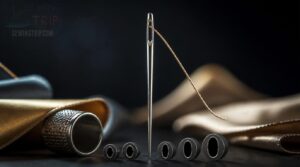
Every sewing machine needle has a unique structure, with each part playing a key role in how stitches form. If you know what to look for, you can spot the details that make one needle work better for certain fabrics.
Let’s break down the main parts so you can see exactly how each piece matters.
Shank and Shaft
Think of the needle shank as the needle’s handshake with your machine — it’s the thick upper section that locks into the clamp.
- Shank flatness keeps orientation correct; the flat side always faces away from you
- The needle shaft diameter defines the needle’s size number
- A straight needle shaft prevents deflection during stitching
- Proper needle alignment protects both fabric and hook timing
Groove and Eye
Running the shaft down to where the thread actually does its job — the groove and eye — is where needle geometry gets really interesting.
The long front groove runs down the shaft and cradles the thread as it punches through fabric, shielding it from friction. A groove too narrow for your thread causes it to ride up the shaft and snap. Too wide, and tension goes uneven.
| Groove Width | Best Thread Match |
|---|---|
| Narrow | Fine cotton or silk |
| Wide | Topstitching or quilting thread |
The eye of the needle sits just above the point. Its size scales with the shaft — bigger needle, bigger eye. A good rule: your thread should fill roughly 40–50% of the eye opening. Gold-plated or polished eyes reduce wear noticeably during long sessions.
Eye design variations matter too. Round eyes suit standard threads; elongated eyes handle slippery synthetics smoothly. A correctly placed eye also reduces fabric puckering by controlling exactly where the thread enters the stitch zone.
Scarf Function
Just above the eye sits a tiny indentation called the needle scarf — and it quietly controls whether your stitch forms at all.
That small groove creates just enough clearance for the machine’s hook to swing in, catch the needle thread, and loop it around the bobbin thread. Without it, stitch formation fails completely, giving you skipped stitches every time.
Point Shapes
The needle’s tip does more work than most people realize — it’s your first line of defense against fabric damage.
Here are the four main point shapes in this needle selection guide:
- Sharp tip precision — pierces dense wovens cleanly, with a fine 0.15–0.20 mm radius
- Ballpoint fiber separation — rounds between knit loops instead of cutting them
- Microtex weave penetration — ultra-thin tip for microfiber and tight weaves
- Leather chisel cutting — wedge-shaped for clean perforations without tearing
Stitch Formation Role
Every stitch your machine makes is a small miracle of timing — and the needle is at the center of it.
As the needle rises, it creates a tiny thread loop beneath the fabric. The hook catches that loop at a precise moment — that’s looper timing precision — and pulls it around the bobbin thread to lock the stitch.
Needle Size Chart by Fabric
Picking the right needle size starts with knowing your fabric — get that wrong and you’ll fight skipped stitches or torn threads the whole way through. The chart below breaks things down by fabric weight so you can make a confident call before you even thread your machine.
Here’s what each category looks like and which needle sizes work best.
Lightweight Fabrics
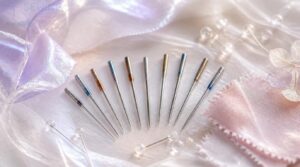
When you’re working with fabrics that range from 30 to 150 gsm — think chiffon, organza, silk, and voile — the needle size you pick can make or break the finished look.
For these delicate materials, stay in the 60/8 to 75/11 range. That small shaft diameter slips through fine yarns without tearing them apart or leaving ugly holes.
| Fabric | Recommended Needle Size |
|---|---|
| Silk chiffon, organza, voile | 60/8 – 70/10 |
| Silk, satin, lightweight lawn | 70/10 – 75/11 |
A Microtex sharp needle is your best friend here — its acute point pierces dense, sheer weaves cleanly, which matters a lot for sheer fabric layering where every puncture shows. Lightweight fiber performance depends heavily on this — silk chiffon, often under 40 gsm, tears easily with an oversized needle.
These fabrics also rely on fabric breathability and summer garment drape for their appeal, so distorting the weave with a needle that’s too thick undermines the whole purpose. Their moisture wicking properties stay intact only when the fabric structure remains undamaged after sewing.
Medium-weight Fabrics
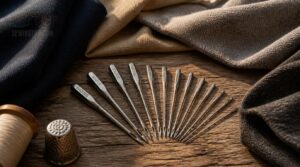
Moving up from delicate sheers, medium-weight fabrics sit in the 170 to 340 GSM range — think cotton twill, chambray, ponte knits, and linen blends.
| Fabric | Needle Size | Stitch Length |
|---|---|---|
| Cotton twill, chambray | 80/12 – 90/14 | 2.5–3.0 mm |
| Ponte knit, jersey | 80/12 – 90/14 | 2.5 mm |
| Linen blend, Oxford cloth | 80/12 – 90/14 | 2.5–3.0 mm |
Always prewash before cutting — it reduces stiffness and prevents future shrinkage.
Heavyweight Fabrics
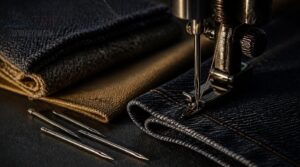
Heavy fabrics — denim, canvas, thick wool, and heavy cotton duck — usually weigh between 340 to 540 GSM and demand a needle that won’t buckle under pressure.
| Fabric | Needle Size |
|---|---|
| Heavy denim, canvas, twill | 100/16 – 110/18 |
| Thick wool, coating, heavy cotton | 100/16 – 110/18 |
For these materials, reach for a denim needle or heavy-duty needle type from your needle size chart — their reinforced shafts push through dense weaves without deflecting. A tight weave also means better abrasion resistance and silhouette control, so the right needle size protects that structure rather than distorting it.
Leather and Upholstery
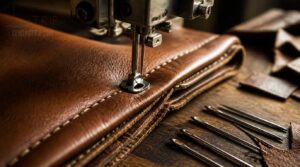
Leather and upholstery sit at the far end of the fabric weight scale — and they play by completely different rules than even the heaviest denim.
| Material | Needle Size |
|---|---|
| Soft nappa, thin suede | 90/14 – 100/16 |
| Full grain, top grain leather | 100/16 – 110/18 |
| Vinyl, faux leather | 100/16 – 110/18 |
| Heavy upholstery, thick hides | 120/19 – 130/21 |
| Aniline, chrome-tanned leather | 100/16 |
Always pair these sizes with a leather needle — its wedge-shaped, chisel point cuts clean holes rather than pushing fibers aside. Stitch holes in leather are permanent, so the right needle type matters immediately.
Full grain and top grain leather demand sizes 100/16 to 110/18, while softer chrome-tanned hides can sometimes work at 90/14. For thick upholstery fabric with protective pigmented coatings or UV-resistant finishes, go up to 120/19 or larger to avoid needle deflection.
Layered Sewing Projects
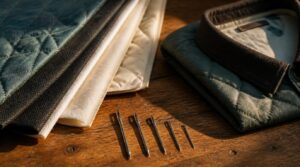
Stacking multiple fabric layers — think bag panels, quilted jackets, or padded collars — demands a larger needle size than any single layer would.
| Project Type | Needle Size |
|---|---|
| Quilted cotton panels | 80/12 – 90/14 |
| Padded bags with foam | 90/14 – 100/16 |
| Interfaced collars/cuffs | 80/12 – 90/14 |
| Heavy batting + canvas | 100/16 – 110/18 |
Grade seam allowances and press thick seams flat before stitching to reduce bulk and prevent needle deflection.
Choosing Needles by Fabric Type
The fabric sitting under your presser foot tells you almost everything you need to know about which needle belongs in your machine. Getting that match right is what separates clean, professional stitches from puckered, skipped‑stitch frustration.
The fabric under your presser foot tells you exactly which needle belongs in your machine
Here’s how to choose the right needle for five common fabric types you’ll likely encounter.
Woven Cottons
Woven cotton is one of those fabrics that looks simple but rewards you for paying close attention to your needle choice. The grid-like warp-and-weft structure holds its shape well — no stretch, no drama — but the wrong needle will still leave you with puckered seams or visible holes you can’t press away.
For most plain weave cottons like poplin, quilting cotton, and shirting, an 80/12 universal needle is your go-to starting point. It manages the fabric’s tight weave without punching oversized holes, and it pairs cleanly with standard all-purpose thread. Drop to a 70/10 for lighter weights like cotton lawn or voile, where a larger needle would leave marks the fabric just doesn’t need.
Heavier weaves — think cotton canvas or a sturdy twill — call for a 90/14 or 100/16, especially when you’re sewing multiple layers. Cotton’s dimensional stability works in your favor here; it won’t shift under the presser foot, so the needle can do its job cleanly.
If your cotton has been mercerized — treated for extra luster and better dye uptake — it’s often woven more tightly, so a Microtex sharp needle gives you cleaner penetration than a universal . That acute point slices through dense fibers instead of nudging them aside.
Stretch Knits
Sewing stretch knits without skipped stitches comes down to one decision: ballpoint or stretch needle.
A ballpoint needle slides between knit loops instead of piercing them — perfect for jersey and interlock. For elastane fiber blends with serious four-way stretch mobility, upgrade to a stretch needle (75/11 or 90/14). Its scarf design prevents skipped stitches that elastic fabrics trigger constantly.
Denim and Twill
Denim fights back — its tight 2/1 or 3/1 twill weave resists needles that aren’t built for the job.
For denim stitching, reach for a denim/jeans needle in sizes 100/16 to 110/18. The hardened shaft punches through indigo-dyed warp threads and dense cotton fibers without deflecting.
Heavier 14 oz denim? Go straight to 110/18.
Silk and Microfiber
Silk is the fabric that punishes the wrong needle fast — you’ll hear it pop, and your seam will pucker almost immediately.
For silk and microfiber, use a Microtex sharp needle sized 60/8 to 75/11. Its fine, acute point pierces tightly woven fibers cleanly, protecting silk’s natural luster and microfiber’s dense surface. Silk microfiber blends — common in luxury apparel — respond especially well to this combination.
Vinyl and Leather
Leather and vinyl will eat through the wrong needle like paper — leather needles use a wedge-shaped point to cut cleanly through hides, suede, and vinyl without tearing.
- Leather: size 100/16 to 110/18
- Vinyl: size 90/14 to 100/16
- Fabric-backed vinyl: size 80/12 to 90/14
- Thick upholstery layers: size 110/18 to 120/19
Matching Needle Size to Thread
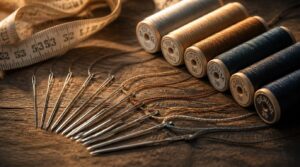
Getting the needle size right for your thread makes a bigger difference than most people expect.
The wrong pairing causes everything from skipped stitches to snapped thread mid‑seam — and it’s usually an easy fix once you know what to look for.
Here’s how each thread type matches up with the right needle size.
Fine Thread Pairing
When your thread is ultra-fine, your needle size matters most — a mismatch here causes more problems than almost anything else at the machine.
For fine threads, stay in the 60/8 to 75/11 range. That slim shaft keeps the needle hole small, which is key to minimizing grain visibility on delicate fabrics like chiffon or silk. Also, slightly loosen your tension — fine thread snaps easily under standard settings. Add a stabilizer under sheer fabrics to prevent puckering.
All-purpose Thread
Moving up from fine thread pairing, all-purpose thread sits right in the sweet spot for most everyday sewing — and getting the needle match right here is simpler than you might think.
Most all-purpose spools run at 40 to 50 weight, which pairs directly with a size 80/12 needle. That’s your reliable default — a universal needle at 80/12 works with cotton, polyester blends, linen, and most medium-weight wovens without complaint.
- Polyester or polyester-cotton blend all-purpose thread resists UV fade, holds color wash after wash, and shrinks minimally — making it the go-to for garments and home textiles alike
- 40-weight thread on an 80/12 is the standard pairing; drop to a 70/10 for 50-weight thread on lighter fabric weights
- Store spools in a cool, dry place away from direct light to prevent brittleness and color bleed over time
The matte or subtle sheen finish on most all-purpose thread flows smoothly through the shaft groove, keeping friction low and tension consistent. That smooth feed is partly why spun polyester all-purpose thread rarely needs tension adjustments on standard settings.
One thing I always tell people — don’t force a 50-weight thread through an 80/12 on sheer or lightweight fabric. Drop to a 75/11 instead to avoid puckering.
Heavy Topstitching Thread
When your project calls for bold, raised seam lines on denim or canvas, heavy topstitching thread changes the needle equation completely.
Topstitching thread usually runs Tex 30 to Tex 40 — noticeably thicker than all-purpose — and needs a dedicated topstitch needle sized 90/14 to 100/16 to handle it without fraying or skipping. That larger eye and deeper shaft groove let the thread feed smoothly, which directly protects against thread breakage issues on heavyweight fabric.
Polyester blend topstitching thread resists abrasion and repeated washing — a real advantage on jeans or outerwear seams that take daily stress. Set your stitch length to 3.5–4 mm for clean, visible decorative lines that hold their definition wash after wash.
Metallic Thread Needs
Metallic thread is its own category — it doesn’t follow the same rules as all-purpose or topstitching thread.
A dedicated metallic needle sized 90/14 is your go-to here. Its elongated eye reduces friction on the fragile metallic film, and the deeper shaft groove protects the thread during stitch formation. Skip universal needles entirely — their standard eye shreds metallic thread fast.
Four things to dial in before you stitch:
- Slow your sewing speed — heat buildup at the needle tip is what snaps metallic thread mid-seam.
- Ease top tension slightly to prevent looping or puckering on your fabric surface.
- Add a stabilizer — tear-away works well on most wovens — to keep stitches crisp and aligned.
- Use a thread conditioner on the spool to improve smooth feeding through the needle path.
For finer metallic threads, an 80/12 metallic needle manages detail work without oversizing the hole. Just don’t go smaller than that — a narrow eye causes constant breakage.
Thread Breakage Issues
Thread breakage is almost always a signal — your machine is telling you something’s off.
| Cause | Fix |
|---|---|
| Needle mismatch | Match needle size to thread weight |
| Tension disc wear | Service or replace tension assembly |
| Guide alignment errors | Rethread completely from scratch |
| Fabric friction impact | Slow speed on dense materials |
| Spool storage quality | Use fresh, sealed thread spools |
Common Sewing Machine Needle Types
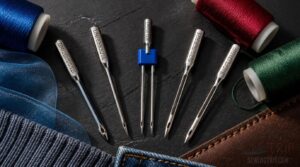
Picking the right needle type matters just as much as picking the right size — the wrong tip can snag knits, skip stitches, or leave ugly holes in your fabric. Each needle type is built for a specific job, so knowing what’s in your toolkit saves you a lot of frustration.
Here are the five most common sewing machine needle types and what each one does best.
Universal Needles
Think of the universal needle as your sewing kit’s Swiss Army knife — dependable, ready for most jobs, and a smart starting point for beginners.
Universal needles use the 130/705H shank system, fitting virtually any home machine. Their slightly rounded tip pierces woven fibers cleanly while reducing snags on light knits. Pair an 80/12 size with standard all-purpose thread for everyday cotton, poplin, or stable blends — that combo manages most beginner projects without fuss.
Ballpoint Needles
When you sew knits—like jersey or interlock—ballpoint needles are your best friend. Their rounded tip slides between fabric loops, not through them, so you avoid snags and runs.
That also keeps seam elasticity intact, making sure your stitches stretch with the fabric.
If you want fewer skipped stitches and cleaner seams on knits, reach for ballpoints every time.
Stretch Needles
Stretch needles take knit fabric sewing one step further than ballpoints. The medium ballpoint tip still parts fibers gently, but the deeper scarf pulls thread closer to the hook — so you get far fewer skipped stitches on spandex stretch and high-elasticity knits.
- Reinforced blade resists deflection on swimwear layers
- Narrower eye controls thread looping on Lycra
- Works with jersey, ponte, and scuba
- Sizes 75/11–90/14 cover most stretch fabric sewing
Microtex Sharp Needles
Microtex Sharp needles are the closest thing to a scalpel in your needle case — and once you try one on silk or microfiber, you won’t go back.
The acute point cuts cleanly through fibers rather than pushing them aside, leaving tiny, nearly invisible stitch holes. That’s why they’re the go-to for precision piecing and topstitching on tightly woven fabrics like cotton poplin, batik, and microfiber.
Sizes 60/8 through 90/14 cover most projects — a 70/10 manages fine quilting cottons beautifully, while an 80/12 works for everyday medium-weight wovens.
Leather Needles
Leather needles solve a problem that universal needles simply can’t — they cut rather than push.
Here’s what makes them work:
- The wedge point slices fibers cleanly
- Diamond points handle thick, dry hides
- A coated shaft reduces thread friction
- Larger eyes protect heavy waxed thread
Use sizes 90/14 to 110/18 for most leather projects.
Specialty Needles for Specific Projects
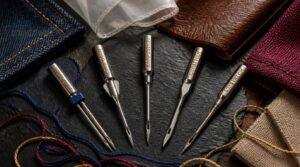
Once you move past the everyday needle types, a whole other category opens up — needles built for specific jobs that general‑purpose options simply can’t handle as well. Each one below solves a real problem, whether that’s sewing through thick layers, creating decorative effects, or getting cleaner results on specialty fabrics.
Here are five specialty needles worth knowing.
Quilting Needles
Quilting needles are purpose-built for machine quilting through multiple fabric layers and batting. Sizes 75/11 and 80/12 handle most quilting cotton projects cleanly, while 90/14 suits thicker batting. Their slightly tapered point pierces layered sandwiches without distorting seams.
| Project Type | Recommended Size | Why It Works |
|---|---|---|
| Piecing quilting cotton | 75/11 | Clean, precise stitches |
| Standard batting layers | 80/12 | Balanced penetration |
| Thick batting or multiple layers | 90/14 | Prevents needle deflection |
Topstitch Needles
Where quilting needles handle layers quietly in the background, topstitch needles are built for the work everyone actually sees — those crisp, visible lines on jacket seams, bag straps, and decorative hems.
The biggest difference is the elongated eye, which runs about 2.0 mm long — nearly twice the size of a standard needle’s eye. That extra room lets thick topstitching thread, or even two threads at once, pass through with far less friction, which directly cuts down on shredding and breakage during long decorative runs.
Pair that with a deep specialty groove along the shaft, and the thread stays tucked and protected all the way through dense or layered fabric. Size 90/14 accommodates most topstitching thread cleanly, while 80/12 suits medium-weight decorative work.
| Project | Recommended Size | Why |
|---|---|---|
| Decorative topstitching | 90/14 | Fits heavy thread without friction |
| Medium wovens, two threads | 80/12 | Balanced eye-to-thread fit |
| Fine topstitching thread | 70/10 | Reduces hole size on lighter fabric |
Many topstitch needles also carry a titanium nitride coating, which can extend needle life up to six times longer than a standard needle. That coating keeps the point sharper through metallic and specialty threads — the ones that chew through uncoated needles fast.
Denim Needles
Where topstitch needles handle what people see, denim needles handle what your machine feels — the resistance, the bulk, the brutal thickness of stacked jeans layers.
The reinforced shaft is the real difference here. It resists bending when you’re pushing through four or five layers of heavy twill, which is exactly where a standard needle deflects and snaps. Schmetz color-codes their denim/jeans needle with a blue band on the shank, so you can identify it at a glance.
Here’s a quick size guide for denim sewing:
- 90/14 — lighter denim, single layers, everyday jeans repairs
- 100/16 — heavy rigid denim, multiple seam layers, thick pockets
- 110/18 — very heavyweight fabric, stacked seams, workwear-grade denim
The tip geometry matters too — it’s sharper than a universal needle but keeps a medium ball point to push fibers aside rather than cutting them, which keeps your dense weave intact. Pair your denim needle with a polyester or corespun thread to reduce stitch resistance across those thick seams.
Twin Needles
If denim needles are your machine’s muscle, twin needles are its artistry — two stitches laid down in one pass, clean and parallel, every time.
A twin needle fits your machine’s standard 130/705H shank just like a single needle, but it carries two points on one shaft. On top, you get two parallel stitch lines. Underneath, the bobbin thread zigzags between them — that hidden zigzag is what gives knit hems their stretch without a serger.
Spacing controls the look. Narrow 2.5mm spacing suits delicate knit hems, while 4.0mm spacing creates bold, jeans-style parallel lines — great for decorative pintucks on blouses or cushions.
| Spacing | Best Use | Fabric Type |
|---|---|---|
| 2.5 mm | Narrow knit hems | Jersey, interlock |
| 4.0 mm | Pintucks, topstitching | Woven cotton, ponte |
| Stretch 4.0 mm | Stretch hem finishing | Spandex, lycra |
Dual thread tension is the trickiest part — both spools must feed evenly or one line puckers. Thread each spool separately through your machine’s guides, and always match thread weight on both sides.
Wing Needles
Heirloom sewing has its own secret weapon — the wing needle.
Those two flat wings flanking the shaft push woven threads apart, leaving decorative perforations that mimic hand-pulled threadwork on cotton and linen. Pair one with an open embroidery stitch, and your machine recreates heirloom two-hole patterns beautifully. Sizes 75/11 and 80/12 work best — always back your fabric with stabilizer to prevent distortion.
Top 9 Sewing Machine Needles
Picking the right needle brand and style can make a surprisingly big difference in how your stitches actually turn out. I’ve rounded up nine solid options that cover everything from everyday cotton projects to heavy denim and leather. Here’s what’s worth keeping in your sewing kit.
1. Singer Universal Sewing Machine Needles
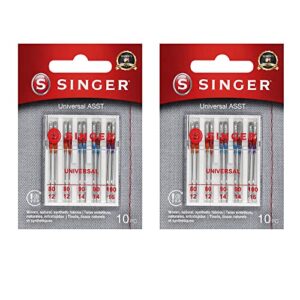
The Singer 4790 is a no-fuss, grab-and-go pack that works well for everyday woven projects. You get 20 needles across three sizes — four 80/12s for lighter cotton, four 90/14s for medium-weight fabrics, and two 100/16s for heavier layers — all using the 130/705H flat-shank system that fits Singer, Brother, Kenmore, and most other home machines.
One heads-up: those two 100/16 needles disappear fast on heavy projects, so keep a backup pack nearby.
| Best For | Beginners and casual hobbyists who sew regularly with woven fabrics and want a versatile, ready-to-use needle set without committing to a large supply. |
|---|---|
| Pack Quantity | 20 needles |
| Needle Size(s) | 80/12, 90/14, 100/16 |
| Point Type | Universal |
| Machine Compatibility | Singer, Brother, Kenmore |
| Primary Fabric | Woven fabrics |
| Needle Material | Standard steel |
| Additional Features |
|
- Covers three common needle sizes in one pack, so you can switch between lightweight and medium-weight fabrics without hunting for separate packs
- Color-coded heads make it easy to grab the right size at a glance
- Compatible with most home machines, including Singer, Brother, and Kenmore
- Only two 100/16 needles included, which runs out quickly if you’re regularly working with heavier fabrics
- Some customers have reported receiving packs with missing or pre-broken needles
- Not suitable for tough materials like denim or leather, so it has a fairly narrow fabric range
2. Schmetz Microtex Sharp Needle 80/12
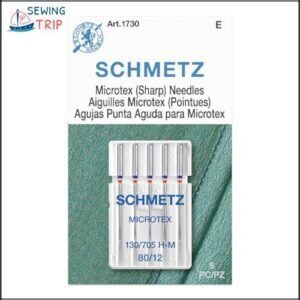
When precision is everything, the Schmetz Microtex Sharp 80/12 is hard to beat. That ultra-slim, acute point slides cleanly through silk, microfiber, and tightly woven synthetics without snagging a single fiber.
It uses the standard 130/705H shank, so it fits most home machines. The sharp tip also shines on topstitching — your stitches stay neat and perfectly aligned.
Just remember: this needle isn’t meant for knits. Swap in a ballpoint for those.
| Best For | Sewers who work with delicate or tightly woven fabrics like silk, microfiber, and coated synthetics and need clean, precise stitching for quilting, topstitching, or detailed fashion projects. |
|---|---|
| Pack Quantity | 5 needles |
| Needle Size(s) | 80/12 |
| Point Type | Microtex sharp |
| Machine Compatibility | All standard home machines |
| Primary Fabric | Delicate and dense fabrics |
| Needle Material | Standard steel |
| Additional Features |
|
- Ultra-sharp, slim tip glides through dense and delicate fabrics without snagging or distorting threads
- Fits virtually any home sewing machine thanks to the standard 130/705H shank
- Delivers noticeably cleaner topstitching and straighter seams compared to universal needles
- Only comes in one size (80/12), so you’ll need additional packs if your project calls for multiple needle sizes
- Not suitable for knit or stretchy fabrics — those need a ballpoint needle instead
- A 5-needle card goes quickly if you sew frequently, so stock up if you’re tackling high-volume work
3. Schmetz Jersey Ballpoint Needle Set
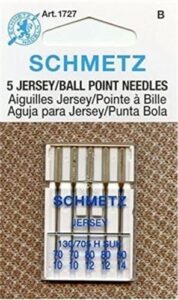
Knits are a different beast — and this set knows it. The Schmetz Jersey Ballpoint uses a rounded medium tip that slides between fabric loops instead of piercing them, so your jersey, interlock, and ponte stay snag-free.
The pack gives you five assorted sizes (70/10 to 90/14), covering lightweight to midweight knits in one card. The orange color band makes needle identification instant.
Just don’t reach for these on denim or wovens — that rounded tip won’t cut it there.
| Best For | Sewists who regularly work with knit and stretch fabrics like jersey, interlock, or ponte and want to avoid snags, skipped stitches, and fabric damage. |
|---|---|
| Pack Quantity | 5 needles |
| Needle Size(s) | Assorted sizes |
| Point Type | Ball-point |
| Machine Compatibility | Brother, Singer, Juki, Bernina |
| Primary Fabric | Knit and stretch fabrics |
| Needle Material | Chrome-plated steel |
| Additional Features |
|
- The rounded ballpoint tip glides between fabric loops instead of piercing them, keeping knits snag-free and runs at bay
- Five assorted sizes (70/10 to 90/14) cover a solid range of lightweight to midweight knits in a single pack
- Compatible with all major home sewing machine brands, so no compatibility headaches
- The ballpoint tip is a poor fit for woven fabrics like denim or canvas — you’ll need a different needle for those
- Only five sizes are included, which may not cover every specialized project you run into
- Getting the best results still requires picking the right size for your specific fabric, so there’s a bit of a learning curve for newer sewists
4. Titanium Coated Topstitch Needle
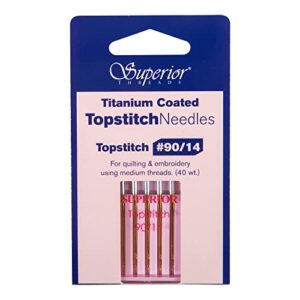
If you do a lot of topstitching, this needle is worth every extra cent. The titanium-nitride coating makes it last 6–8× longer than a standard needle — less swapping mid-project.
Size 90/14 accommodates heavy decorative and metallic threads without shredding them, thanks to a deeper groove and oversized eye. It works on denim, canvas, and quilted layers without flinching.
The pack holds five needles, so high-volume sewists may reorder often — but the reduced thread breakage and downtime make that trade-off easy to accept.
| Best For | Quilters, embroiderers, and topstitching enthusiasts who regularly work with heavy fabrics, multiple layers, or specialty threads and want fewer needle changes mid-project. |
|---|---|
| Pack Quantity | 5 needles |
| Needle Size(s) | 90/14 |
| Point Type | Universal |
| Machine Compatibility | All standard home machines |
| Primary Fabric | Heavy fabrics |
| Needle Material | Titanium-nitride coated steel |
| Additional Features |
|
- The titanium-nitride coating extends needle life 6–8× longer than standard needles, meaning far less interruption during big projects
- The size 90/14 eye handles metallic and decorative threads smoothly, reducing snagging and thread breakage
- Works reliably across tough fabrics like denim, canvas, and quilted cotton without losing sharpness quickly
- Costs more per needle than standard steel options, which adds up over time
- Very thick fabric stacks may still cause breakage if the material isn’t pre-pierced or hammered first
- Only five needles per pack, so high-volume sewists will find themselves reordering more often than they’d like
5. Schmetz Universal Needle 80 12
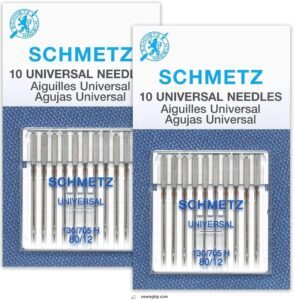
Think of the Schmetz Universal 80/12 as the everyday workhorse needle — the one that stays loaded in your machine for most projects without a second thought.
It runs on the 130/705 H system, so it fits Brother, Singer, Janome, and most other domestic machines right out of the box. The slightly rounded point glides through cotton, linen, polyester blends, and light knits without snagging or punching oversized holes.
Each pack gives you 20 needles across two cards — enough to swap fresh needles regularly without raiding your supplies mid-project. That said, skip this needle for denim or leather; those materials need a heavier, purpose-built option.
| Best For | Hobbyists, quilters, and casual sewers who work mainly with everyday woven and knit fabrics on standard domestic machines. |
|---|---|
| Pack Quantity | 20 needles |
| Needle Size(s) | 80/12 |
| Point Type | Universal |
| Machine Compatibility | Brother, Singer, Janome |
| Primary Fabric | Woven and knit fabrics |
| Needle Material | Standard steel |
| Additional Features |
|
- Fits most major home sewing machines right away thanks to the universal 130/705 H design
- The slightly rounded point handles a wide range of fabrics — cotton, linen, knits, and blends — without snagging
- 20 needles per pack means you can swap them out regularly and still have plenty in reserve
- Not suited for heavy or specialty fabrics like denim or leather, which need a purpose-built needle
- A pack of 20 can run out quickly for anyone sewing at high volume or professionally
- Stitch quality depends on matching the right needle size to your fabric, so some trial and error may be needed
6. Organ Ballpoint Sewing Needle Set
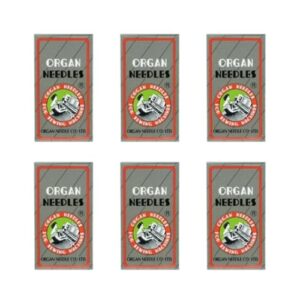
The Schmetz Universal works with wovens beautifully — but the moment you load a jersey or rib knit, you need a different tool entirely. That’s where the Organ Ballpoint Needle Set earns its place.
The rounded tip slides between fibers rather than piercing them, which means no runs, no snags, and no pulled loops on your knit projects. It fits most home machines and covers sizes 65/9 through 100/16 — lightweight jersey up to heavier fleece, all in one set.
| Best For | Home sewers who regularly work with knit, jersey, or stretch fabrics and want a reliable set of ballpoint needles that covers a wide range of fabric weights. |
|---|---|
| Pack Quantity | 60 needles |
| Needle Size(s) | 65/9 to 100/16 |
| Point Type | Ball-point |
| Machine Compatibility | Singer, Brother, Janome |
| Primary Fabric | Knit and stretch fabrics |
| Needle Material | Standard steel |
| Additional Features |
|
- Rounded tip protects knit fibers, preventing the runs, snags, and holes that sharp needles can cause
- Six sizes in one set means you’re covered from lightweight jersey all the way up to heavier fleece without buying multiple packs
- Includes two needle threaders, which makes swapping between sizes a lot less tedious
- Not a good fit for woven fabrics — the ballpoint design really is knit-specific, so you’ll still need sharp needles on hand for other projects
- Packaging only shows needle size, not type, so if you mix them up it can be tricky to sort them back out at a glance
- Like all needles, these dull over time and need regular replacing to keep your stitches looking clean
7. Schmetz Stretch Sewing Needle
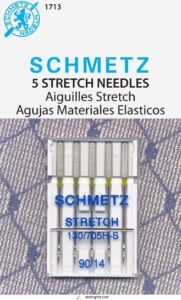
The Organ Ballpoint deals with everyday knits well — but when you’re working with highly elastic fabrics like spandex, Lycra, or stretch lace, you need something more specialized.
The Schmetz Stretch Needle (size 90/14) features a medium ballpoint tip, a widened eye, and a tuned scarf that creates a larger thread loop — so your machine’s hook catches it cleanly every time. That combination nearly eliminates skipped stitches on high-recovery fabrics like leggings and athletic wear.
| Best For | Sewers who regularly work with highly elastic fabrics like spandex, Lycra, leggings, and athletic wear and want to eliminate skipped stitches for clean, consistent seams. |
|---|---|
| Pack Quantity | 5 needles |
| Needle Size(s) | 90/14 |
| Point Type | Ball-point |
| Machine Compatibility | All major home brands |
| Primary Fabric | Stretch and knit fabrics |
| Needle Material | Standard steel |
| Additional Features |
|
- The medium ballpoint tip, widened eye, and tuned scarf work together to virtually eliminate skipped stitches on high-recovery fabrics
- Works with all major home sewing machine brands, so there’s no compatibility guesswork
- Handles a wide range of stretchy projects, from quick clothing repairs to full performance-wear builds
- Built for home machines only, so it won’t work on industrial setups without an adapter
- The 90/14 size isn’t heavy-duty enough for thick materials like denim or multiple dense fabric layers
- You’ll still need to dial in your machine’s tension and stitch length to get the best results — the needle alone won’t do all the work
8. Schmidt Heavy Denim Sewing Needle
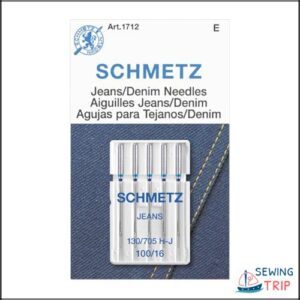
When stretch work is done, denim is next — and denim is a whole different beast.
The Schmidt Heavy Denim Needle (size 16/100) uses a medium ball-point tip and a reinforced blade to push through thick layers without bending or skipping stitches. It’s built for hemming jeans, heavy twill, and layered quilts. The polished, friction-reducing eye keeps heavy topstitch thread flowing cleanly. For tough denim projects, this needle holds up — but swap it out after each major project.
| Best For | Home sewers who regularly work with heavy fabrics like denim, canvas, twill, or thick quilt layers and need a reliable needle that won’t bend or skip stitches. |
|---|---|
| Pack Quantity | 5 needles |
| Needle Size(s) | 100/16 |
| Point Type | Ball-point |
| Machine Compatibility | Standard home machines |
| Primary Fabric | Heavy and dense fabrics |
| Needle Material | Standard steel |
| Additional Features |
|
- The reinforced blade and medium ball-point tip handle thick, dense materials smoothly without deflecting or damaging fabric
- Works with standard home sewing machines and a wide range of thread types, so no special equipment needed
- Keeps heavy topstitch thread flowing cleanly, resulting in consistent, even stitches through tough layers
- Only comes in a 5-pack, which means frequent repurchasing if you sew heavy fabrics regularly
- Too heavy-duty for lightweight or delicate fabrics — you’ll need a finer needle for those projects
- Not compatible with industrial or high-speed sewing machines, so it’s strictly a home-use needle
9. Schmetz Heavy Duty Leather Needle
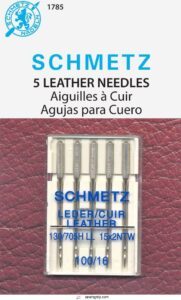
Denim pushes hard — leather pushes harder.
The Schmetz Heavy Duty Leather Needle (100/16) uses an LL left-twist cutting point that slices cleanly through genuine leather, stiff faux leather, and suede without tearing or fraying the edges. That cutting action creates crisp, evenly spaced angled stitches — exactly what handbags, belts, and upholstery projects demand.
One firm rule: don’t use it on knits or wovens. That blade will sever textile fibers fast. Swap it out after each dense hide project.
| Best For | Leatherworkers, saddle-makers, and crafters who regularly sew through genuine leather, stiff faux leather, suede, or multi-layered hides on a home sewing machine. |
|---|---|
| Pack Quantity | 5 needles |
| Needle Size(s) | 100/16 |
| Point Type | LL cutting point |
| Machine Compatibility | Brother, Juki, Husqvarna |
| Primary Fabric | Leather and faux leather |
| Needle Material | Precision-engineered steel |
| Additional Features |
|
- The LL left-twist cutting point slices cleanly through thick hides, leaving crisp angled stitches without tearing or shredding
- Fits all major home sewing machine brands, so there’s no compatibility guesswork
- Comes in a 5-needle card, making replacements quick and easy to have on hand
- Completely off-limits for knit or woven fabrics — the cutting point will damage textile fibers
- Can distort very soft faux leather, so you may need a micro-tex needle for delicate materials
- Requires longer stitch lengths and thicker thread to hold up properly, which limits how you can use it
When to Change Machine Needles
Most sewers wait too long to swap out a needle — and the machine usually starts sending signals well before anything breaks. Learning to read those signals is one of the simplest ways to protect both your fabric and your stitching. Here are the five warning signs that tell you it’s time for a fresh needle.
Skipped Stitches
Skipped stitches are your machine’s way of saying something is off.
The most common culprit? A dull or bent needle that deflects just enough to miss the hook’s timing window.
Other triggers include needle-to-fabric mismatch, improper threading paths, and needle plate burrs.
Swap the needle first — it fixes the problem more often than you’d expect.
Thread Snapping
Thread snapping mid-seam usually means your needle is done.
A damaged needle eye shreds thread instead of guiding it — you’ll notice fraying right at the break point. Other culprits include tension disc imbalance, lint buildup friction along the thread path, and fabric edge abrasion wearing the thread thin.
- Poor thread quality breaks under normal tension
- Needle mismatch causes thread shredding near the plate
- Lint buildup creates friction that snaps fine threads
- Unbalanced thread tension stresses the needle entry point
- A worn needle eye cuts rather than feeds thread
Replace the needle immediately.
Clicking Sounds
That faint click mid-seam is your machine talking — and it’s worth listening. A bent or misseated needle flexes under load, tapping the presser foot or needle plate with every stroke.
| Click Type | Likely Cause | Fix |
|---|---|---|
| Rhythmic clicking | Bent needle or shuttle misalignment | Replace needle; check timing |
| Irregular clicks | Loose needle clamp screw | Tighten clamp fully |
| Fabric-entry clicks | Needle mismatch for fabric weight | Switch to correct needle type |
Replace the needle immediately.
Visible Fabric Holes
Holes in your fabric after sewing are a clear red flag. A dull or oversized needle punches rather than pierces, breaking yarns instead of sliding between them—leaving round or oval openings that fray at the edges.
Check hole shape: irregular, ragged holes mean needle damage, not fabric defect.
Drop down one needle size immediately.
Bent Needle Checks
A bent needle is sneakier than it looks. Pull it out and try the shank roll test — lay the flat side down and roll it across a hard surface. Any wobble or resistance means it’s bent.
Watch for these bent needle wear signs:
- Skipped stitches across a seam
- Clicking sounds during sewing
- Fabric snags near the stitch line
- Micro bends around the eye
Replace it immediately.
Sewing Needle Troubleshooting Guide
Even the best needle setup can run into problems — and knowing what to look for makes fixing them much faster. Most issues trace back to just a few root causes, and once you know them, you’ll spot the pattern quickly. Here’s what to check when something feels off:
Needle Breakage Causes
A snapping needle isn’t bad luck — it’s a signal.
Needle breakage happens when stress builds faster than the metal can handle. Too-fine a needle on thick denim, misaligned bobbin cases, overly tight upper tension, or simply sewing at high speed through heavy layers — each one bends the shaft until it gives. Replace your needle every 6–8 hours to stay ahead of it.
Fabric Puckering Fixes
Puckering usually means your needle is too large for the fabric.
Drop down one needle size — say, from 80/12 to 70/10 on silk — and test on a scrap first. Also lower your upper tension slightly and increase stitch length. A walking foot keeps layers feeding evenly. For sheers, a light tearaway stabilizer underneath stops warping instantly.
Tension Problem Clues
Tension trouble often hides in plain sight. Bobbin thread showing on top means your upper thread is too loose.
Uneven stitch length or fabric rippling along a seam? That’s usually a thread path problem — rethread completely and test again.
Skipped stitches at regular spots often signal binding near the shuttle. A fresh needle fixes this faster than any dial adjustment.
Needle Deflection Issues
A needle that drifts sideways mid-stitch isn’t random bad luck — it’s bevel tip asymmetry at work. The tip’s angled edge pushes the shaft laterally as it enters dense fabric, and shaft stiffness determines how far it travels off-course.
Here’s what that actually costs you:
- The hook misses the thread loop entirely — skipped stitches appear.
- Repeated lateral deflection scores the needle plate.
- A needle bent beyond 15 degrees risks breaking and damaging the hook.
Needle deflection spikes when you manually push thick fabric while the needle is still down. Let the feed dogs do that job. Real-time rotation compensation — simply rotating fabric to equalize resistance — helps reduce path deviation on layered projects.
Wrong Needle Symptoms
Deflection gets the headlines, but the wrong needle type quietly causes just as much damage. Watch for these red flags:
| Symptom | Likely Cause | Fix |
|---|---|---|
| Skipped stitches | Wrong point shape | Switch to ballpoint or sharp |
| Seam puckering | Needle too large | Drop one size down |
| Thread breakage | Eye too small | Use a larger needle |
Frequently Asked Questions (FAQs)
How Do I Choose the Right Needle for Sewing Leather or Vinyl?
Use a leather needle with a wedge-shaped point for clean holes without tearing. Match sizes 90/14 to 110/18 based on thickness, and pair with heavy-duty thread to prevent breakage.
Can I Use a Ballpoint Needle for Woven Fabrics?
Yes, you can — but only on loosely woven fabrics. The rounded tip separates fibers rather than cutting them, which works fine on cotton blends but causes skipped stitches on tight weaves.
What Type of Needle Should I Use for Quilting?
For quilting, a quilting needle size 75/11 or 80/12 works best. Its tapered point glides through batting layers without puckering, and it manages both piecing and machine quilting with standard all-purpose thread beautifully.
What is the Difference Between a Universal Needle and a Sharp Needle?
The main difference is point shape. Universal needles have a slightly rounded tip — good for most wovens and light knits. Sharp needles have a fine, acute point for clean penetration on dense, smooth fabrics.
How to choose machine needle size?
Think of needle size as a fabric handshake — match it to your fabric weight and thread thickness, and every stitch locks cleanly without holes, puckering, or breakage.
Can I use industrial needles on home machines?
No — industrial needles won’t fit most home machines. Their shank system, clamp style, and shaft diameter differ entirely, risking needle clamp damage, skipped stitches, voided warranties, and potential injury during installation.
How should I store used sewing needles safely?
Store used needles in a puncture-resistant sharps container, label it clearly, and keep it out of reach of children. Use a needle magnet for safe pickup — never handle loose needles bare-handed.
Which needle brands are best for beginners?
For beginners, Schmetz and Organ are the top picks — both reliable, widely available, and budget-friendly. Schmetz’s color-coded shank system makes needle identification simple, which is a genuine time-saver when you’re just starting out.
Do needle sizes vary between different machine brands?
Yes — needle sizes do vary slightly between brands. While the 80/12 universal standard keeps most sizes compatible, proprietary geometry, shank tolerances, and color coding mean one brand’s 80/12 can perform differently than another’s.
How often should I change needles for abrasive fabrics?
Change needles every 8 hours when sewing abrasive fabrics like denim or canvas. Don’t wait — skipped stitches, thread breaks, or fabric snags mean your needle’s already overdue.
Conclusion
Think of your needle as the translator between your vision and your fabric—get the translation wrong, and the whole message falls apart. This needle size guide for machines gives you exactly what you need to stop guessing and start sewing with real confidence.
Match your needle to your fabric, pair it with the right thread, and swap it out before trouble starts. Small choice, enormous difference—your machine will stitch cleaner, your fabric will thank you.
- https://help.singer.com/en-US/choosing-the-right-singer-machine-needles-389061
- https://blog.wawak.com/post/sewing-machine-needle-and-thread-size-chart
- https://prizzisewing.com/blogs/news/industrial-sewing-machine-needle-size-amp-type-guide-everything-you-need-to-know
- https://topnotchsewvac.com/blogs/sewing-machine-blog/guide-to-choosing-the-right-needle-size-for-sewing-machine
- https://www.goldstartool.com/blog/the-complete-guide-to-sewing-machine-needles-and-sizes.htm