This site is supported by our readers. We may earn a commission, at no cost to you, if you purchase through links.
A pair of jeans that fit perfectly through the seat and thighs but drag on the floor is one of life’s small, persistent frustrations. Tailors charge anywhere from $15 to $40 for a basic hem—and most of them won’t preserve the original stitching, so you lose that worn, authentic look you paid for.
The good news: hemming jeans at home is a skill any careful person can learn, and doing it yourself means total control over the fit, the finish, and the details that matter. Whether you’re working with straight-leg, skinny, or flared denim, the right tools and a clear method make all the difference.
Table Of Contents
Key Takeaways
- Using a denim needle (size 90/14 or 100/16), polyester thread, and a stitch length of 3.0–3.5 mm are the non‑negotiables that keep your machine from fighting thick fabric.
- Washing and ironing your jeans before you measure prevent that frustrating post‑hem shrinkage that leaves you an inch short after the first wash.
- Folding the excess fabric up so the original hem stays visible — then stitching just below it — is the move that keeps your jeans looking store‑bought, not homemade.
- Flared and skinny jeans need style‑specific adjustments (tapered seams or curved geometry) because a one‑size‑fits‑all fold causes puckering fast.
Essential Tools and Supplies for Hemming Jeans
Before you cut a single thread, you need the right tools in your corner. Denim is tough fabric, and the wrong supplies will fight you every step of the way.
Start with a machine built for the job—a portable sewing machine designed for denim repair saves you from the frustration of forcing flimsy equipment through fabric that refuses to cooperate.
Here’s what you’ll want to have ready before you start.
Choosing The Right Scissors and Tape Measure
Your tools make or break this job. For clean cuts through thick denim, reach for fabric scissors with high-carbon steel blades — they hold their edge longer than regular craft scissors. An 8- to 9-inch blade length gives you control without fighting the fabric.
Pair that with a measuring tape offering 1/8-inch precision markings, and your seam allowance stays dead accurate every time. Remember that sharp scissors are necessary for a clean cut.
Selecting Needles and Thread for Denim
Sharp scissors get you through the fabric — right needle gets you through the seam.
For standard denim, a size 90/14 denim needle manages it cleanly.
Go heavier, size 100/16, for stiff raw denim.
Your needle selection matters as much as any other sewing tool here.
For thread, polyester beats cotton on stretch and durability.
Golden amber thread keeps those topstitches looking factory‑fresh.
Consider using cotton-wrapped polyester thread for added strength.
Must-Have Sewing Machine Settings for Jeans
Getting the needle right is half the battle — but your machine settings seal the deal.
Here’s what to dial in before you sew a single stitch:
- Stitch Length: Set it to 3.0–3.5 to match factory stitching and feed thick denim smoothly.
- Thread Tension: Start around 4–5; nudge higher if stitches look loose.
- Presser Foot: Use a standard foot, plus a hump jumper over bulky seams.
- Sewing Speed: Go slow — denim layers break needles fast.
- Stitch Type: Stick with a straight stitch. Skip zig zag stitching; it looks messy on rigid denim.
Prepping Your Workspace for Hemming
Your machine is ready — now make sure your space is too. Set up a firm Cutting Surface at a comfortable height to save your back. Good Lighting Setup (daylight-range bulbs work great) helps you match thread colors without squinting.
Keep your Ergonomic Seating adjusted so your elbows stay level with the table. Use Tool Organization — clear bins and a pegboard — so your measuring tape, pins, fabric scissors, chalk, and seam ripper are always within arm’s reach. Position your Pressing Station right beside your machine for a smooth workflow.
When you’re ready to finish your hems, a well-organized station makes it easy to follow a blind hem stitch guide without breaking your rhythm.
Preparing Jeans for Hemming
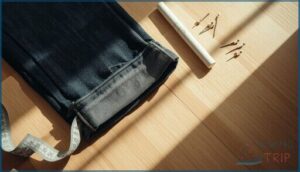
Before you touch a needle or thread, your jeans need a little prep work first.
Skip this part and you’ll likely end up with a hem that’s off by a full inch after the first wash. Here’s what to do before you make a single cut.
Washing and Drying to Prevent Shrinkage
Before you hem, wash your jeans first — skipping this step is how you end up with a perfectly hemmed pair that suddenly runs short.
Use a Cold Water Wash at around 30°C with a Gentle Cycle and mild detergent. A Vinegar Rinse helps lock in color.
For drying, the Air‑Dry Technique beats the dryer every time, but Low Heat Dryer on a short cycle works too — just pull them out slightly damp to limit fabric shrinkage.
Ironing and Smoothing Denim
Ironing denim well before you cut anything saves a lot of headache later. Set your iron to a high cotton setting — around 190°C to 210°C for pure denim — and always use a pressing cloth over dark fabric to prevent shine.
Steam pressing works best here: press down, hold, lift. A wooden clapper traps that steam beautifully, and a heat-resistant ruler keeps your fold lines razor-sharp.
Measuring and Marking The Desired Hem Length
Measuring starts at the right spot — center of the crotch seam — then follow the inner seam straight down to find your hem height. Inseam Start Point matters more than most people realize.
Shoe Height Impact by adding an inch for heels.
Use fabric marking chalk or a water‑soluble pen for Marking Tool Selection, checking Leg Circumference every four inches for consistency.
Hem Fold Calculation is simple: divide the excess in half.
Trying on and Pinning for Accurate Fit
Put the jeans on with the actual shoes you’ll wear most — that’s your Shoe Matching moment, and it changes everything about where the hem should land.
- Do a Posture Check: stand naturally, not stiffly
- Space pins 1–2 inches apart for smooth Pin Spacing
- Walk and sit for your Movement Test
- Do a Mirror Inspection from all angles
- Use fitting adjustments to even both legs
How to Hem Jeans and Keep The Original Hem
This is where the real work happens — and honestly, it’s easier than it looks.
The trick is working with your original hem instead of against it, so your jeans come out looking untouched.
Here’s exactly how to do it, step by step.
Determining How Much to Shorten

Before you cut a single thread, you need a target inseam measurement.
Put on your jeans with your go-to shoes. Stand naturally and mark where you want the hem to land using your shoe break length as the guide.
| Style | Hem Height |
|---|---|
| Straight leg | Just below ankle |
| Skinny/tapered | At or above ankle |
| Cropped | Mid-ankle or higher |
| Bootcut | ¼–½ inch off floor |
Always wash first — cotton denim shrinks roughly an inch, so build in a shrinkage buffer before cutting.
Folding and Pinning The Original Hem

This is where fold measurement precision really matters. Fold the fabric up so the original hem peeks out exactly where you want it, then press that crease flat with your iron before a single pin goes in.
- Measure your fold consistently at 2 inches using a tape measure.
- Match inner and outer seams for perfect seam alignment technique.
- Apply a pin spacing strategy of every 2–3 inches.
- Use pre‑sew verification — try them on before hitting the sewing machine.
Stitching Close to The Original Hemline
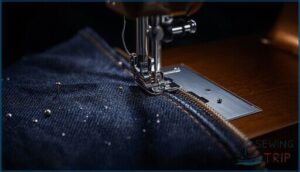
With your pins set, it’s time to stitch. Attach your zipper foot, shift the needle far left, and set your stitch length to 3.5 mm — that stitch density keeps denim seams clean without puckering. Start just before a side seam for edge reinforcement, then sew all the way around, maintaining hemline alignment as you go.
| Setting | Recommendation |
|---|---|
| Stitch Length | 3.5 mm |
| Tension | 4–5 |
| Needle | Size 90/14 denim |
| Foot | Zipper foot, far left |
Watch your fold tension — stretch the fabric slightly rightward to keep the original hem sitting upright. At thick seams, turn the handwheel manually. That controls seam visibility and protects your original jean hem work beautifully.
Cutting and Finishing The Raw Edge
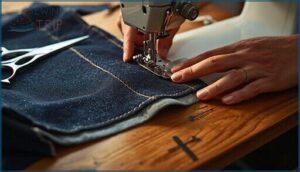
Now that your stitch is set, trimming and finishing the raw edge keeps everything neat inside the fold. Here’s how to handle it:
- Trim seam allowance to 0.5–1 cm using sharp dressmaker shears.
- Encase raw edge inside a pressed casing, hiding it between denim layers.
- Run an overlock edge finish with a serger for clean, fray‑free results.
- Use a zigzag stitch technique (2–3 mm wide) without a serger.
- Try the controlled fray method — stitch a stop line, wash, and pull loose threads for a natural frayed edge.
Hemming Techniques for Different Jean Styles
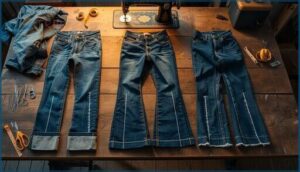
Not all jeans are cut the same, and that difference matters when it’s time to hem.
The style of the leg — straight, tapered, or flared — changes how you approach the whole process.
Here’s what you need to know for each one.
Straight Leg Jeans Hemming Steps
Measuring inseam on straight leg jeans is your starting point — run the tape from the crotch seam down to the current hem, then decide your step height.
Do a quick leg opening check: if point A equals point B, you’re good to go.
Fold ratio is half the total removed.
Set your sewing machine to a 2.8–3.0 stitch length, press well, and your original hem stays intact.
Tapered or Skinny Jeans Adjustments
Skinny and tapered leg jeans need a little extra attention. Because the leg opening is narrower, a straight fold bunches up fast — that’s where leg width reduction comes in.
Measure point A at the opening and point B just above your mark, then taper the inner seam gradually to match. Use the V-shape seam fill trick to prevent hem puckering and keep everything flat.
Why Flared Jeans Require a Different Approach
Flared jeans are a different beast entirely. The leg opening is wider than the fabric just above it — that’s your Leg Opening Ratio working against you.
Flare Width Measurement reveals the problem fast: if point A exceeds point B by more than 1.5 inches, hemming jeans while preserving the original hem causes puckering. Curved Hem Geometry and Pucker Prevention steps apply, but wide flares hit Original Hem Limits quickly.
Professional Tips for a Flawless Hem
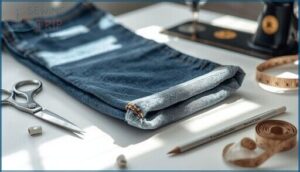
Getting a clean hem isn’t just about the stitch — it’s about the small moves that separate a homemade look from a polished one.
A few pro habits make all the difference, and they’re easier than you’d think.
Here’s what to keep in mind before you call it done.
Preventing Puckering and Ensuring Smooth Seams
Puckering is the enemy of a clean hem — and it’s almost always a tension problem. Set your thread tension low, test on a scrap first, and bump your stitch length up to 3–3.5mm. Let the feed dogs do the pulling; don’t guide the fabric yourself.
Puckering is a tension problem — lower it, lengthen your stitch, and let the feed dogs lead
- Press the fold firmly before sewing
- Hammer thick seams flat to manage bulk
- Support the jean leg’s weight on your table
- Re-press after stitching to flatten any tunneling
Using Topstitching Thread for Authentic Look
Matching your topstitching thread is what separates a professional hem from a DIY giveaway.
For Thread Color Matching, gold or amber shades like Gütermann’s orange 350 provide a classic contrast on indigo denim.
For Thread Thickness Selection, Tex 80 to Tex 90 covers most denim sewing techniques beautifully.
Pair it with a size 16 or 18 needle, set stitch length to 3.5–4mm, and adjust tension to around 7 — your original jean hem stays intact, undetectable.
Pressing and Trimming for a Clean Finish
The iron is your secret weapon here. Press each fold with steam before and after sewing — this locks the crease and flattens bulk at the seam allowance grading points.
Use a pressing cloth choice of cotton muslin on dark denim to avoid shine. Trim your seam allowance to about 0.5 inches, apply your preferred edge finishing methods, and you’re done.
Troubleshooting Common Hemming Issues
Even experienced sewists hit snags. A wavy hem usually means you pulled the fabric while stitching — let the feed dogs do the work.
Skipped stitches and needle breakage both scream "wrong needle" — grab a 100/16 denim needle.
Thread tension problems? Rethread with the presser foot raised.
For uneven length, always measure both legs. Small fixes, perfect result.
Frequently Asked Questions (FAQs)
How to cut jeans that are too long for beginners?
Think you need a sewing background to cut jeans? You don’t.
Wear your shoes, fold up the hem to your ideal length, mark it, and cut slowly on a flat surface.
How do you properly hem jeans?
To properly hem jeans, fold up the excess fabric, pin it in place, and stitch close to the original hemline — keeping your seam allowance consistent and the finish edge clean throughout.
Is hemming jeans difficult?
Hemming jeans isn’t as hard as it looks.
With the right tools and supplies for hemming jeans, most beginners finish in under 30 minutes — and your skill confidence grows fast from there.
How can I shorten my jeans at home?
Shortening your jeans at home is easier than it looks.
With basic tools, careful seam allowance calculations, and smart thread color matching, you can master DIY hemming hacks and preserve that original hem perfectly.
How to fix your jeans if they are too long?
If your jeans are too long, fold up a temporary hem, use DIY hem tape, or sew close to the original hemline — preserving denim features while nailing the perfect length.
How to fix uneven hems after hemming jeans?
Even after a careful hem job, one leg can end up slightly longer. Measure both inseams, re-pin the longer leg, press with steam, and restitch for a balanced, clean finish.
What to do if hem unravels after washing?
Even the best stitch can give way after a rough wash.
Trim loose threads first, restitch techniques hold when you reinforce hem edge using strong polyester thread — preventive washing inside-out keeps denim repair lasting.
Can jeans be hemmed without a sewing machine?
Absolutely — no sewing machine needed.
Heat-activated tape, the fabric glue method, or a hand-stitched hem all work well for no-sew hemming, preserving your original jean hem while giving you a clean, lasting result.
Are there alternatives to cutting off jean fabric?
Yes — you’ve got options that don’t touch your scissors at all. Cuffing Techniques, No‑Sew Hem Tape, and the Fold‑Inside Method all handle extra length without cutting a single thread.
How to match thread color for invisible hems?
Lay your thread spool directly on the denim in natural daylight — that’s your most honest lighting test. Match one shade darker than the fabric for invisible stitching that disappears completely.
Conclusion
The right tools make the cut. The right method keeps the hem. The right finish earns the fit.
Now that you know how to hem jeans without sacrificing that original stitching, there’s no reason to settle for dragging cuffs or tailor fees.
You measured carefully, pinned precisely, and stitched with intention—and the result speaks for itself.
Your jeans, your length, your call. That’s not just a hem. That’s ownership.