This site is supported by our readers. We may earn a commission, at no cost to you, if you purchase through links.
Walk through any couture atelier, and you’ll notice something most home sewers never see—the inside of a garment looks almost as refined as the outside. That’s the French seam at work.
Unlike a standard seam that leaves raw edges exposed, a French seam wraps everything neatly inside itself, so there’s nothing to fray, scratch, or unravel over time.
It’s a technique that transforms ordinary construction into something that genuinely lasts. Delicate silks, sheer chiffons, fine linens—these fabrics demand this kind of care.
Learning how to French seam in sewing is one of those skills that quietly upgrades everything you make.
Table Of Contents
- Key Takeaways
- What is a French Seam in Sewing
- Best Fabrics for French Seams
- Essential Tools for French Seaming
- Preparing Fabric for French Seams
- Step-by-Step French Seam Tutorial
- Tips for Perfect French Seams
- Common Mistakes and Troubleshooting
- Advanced French Seam Techniques
- Top 6 Tools for French Seams
- Frequently Asked Questions (FAQs)
- Conclusion
Key Takeaways
- French seam stitches your fabric twice to tuck all raw edges neatly inside, giving both the inside and outside of your garment a clean, professional finish.
- It works best on lightweight, tightly woven fabrics like silk, cotton voile, and chiffon — avoid it on thick materials like denim or stretchy knits, where it creates bulk and restricts movement.
- Getting the measurements right is what makes or breaks the seam: sew your first pass at 6mm, trim close, then fold and sew the second pass at 9mm to lock everything inside.
- Pressing between each stitching step isn’t optional — it’s what keeps your seam flat, straight, and truly professional-looking.
What is a French Seam in Sewing
French seam is one of those sewing techniques that looks impressive but is surprisingly simple once you understand what it does.
It works by folding the seam allowance over itself to hide raw edges — here’s a step-by-step French seam sewing tutorial that walks you through the whole process.
It’s basically a seam sewn twice, wrapping the raw edges inside so nothing frays or shows.
Here’s what you need to know before you start stitching.
Definition and Purpose
Precision matters in garment construction, and that’s where the French seam shines. This seam finishing technique uses two lines of stitching to enclose raw edges, giving you Edge Concealment and a real Durability Boost.
The result? Seam Strength and Aesthetic Cleanliness—no fraying, just smooth fabric protection inside and out. It’s a simple upgrade for any sewing technique.
For high‑end garments, a clean professional finish is essential.
History and Common Uses
French seams have been around since the late 1800s, when Victorian dressmaking relied on them for delicate blouses and undergarments.
By the Edwardian era, they were a staple in lingerie construction.
Today, you’ll spot this seam finishing technique everywhere — couture interiors, home bedding, and indie apparel brands all use it. It’s one of those sewing techniques that never goes out of style.
The technique offers a neat finish for delicate fabrics that prevents fraying and adds a professional look.
Benefits Over Other Seam Finishes
You want your garment construction to look sharp inside and out. Unlike zigzag or overlocked seam finishing, a French seam gives you a clean interior, enhanced durability, and skin comfort.
Unlike zigzag or overlocked finishes, a French seam delivers a clean interior, lasting durability, and true skin comfort
The double stitch hides raw edges, suits delicate fabric, and feels smooth. That’s why it stands out for professional appearance and careful fabric manipulation, especially when seam allowance matters.
Best Fabrics for French Seams
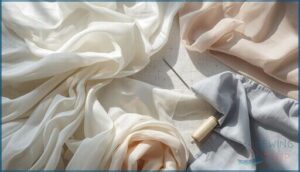
Not every fabric plays nicely with French seams, so choosing the right one makes all the difference. The good news is that once you know what works, picking your material becomes second nature.
Here’s a breakdown of the best fabrics to use, what to seek out for delicate projects, and what to leave on the shelf.
Lightweight Fabric Recommendations
Not every fabric is built the same — and your fabric selection makes or breaks a French seam. Lightweight materials with a tight weave are your best friends here.
These work beautifully on your sewing machine with standard seam allowances:
- Cotton Voile – under 60 gsm, presses crisply
- Rayon Challis – fluid drape, minimal bulk
- Silk Crispatus – smooth hand, clean fold
- Linen Blends – natural crispness holds edges flat
- Stretch Wovens – flexible yet French-seam friendly
Sheer and Delicate Materials
French seams truly shine on sheer fabrics like chiffon and organza. Because they’re see-through, any raw edge shows — so a narrow seam allowance around 6 mm keeps things clean.
Use a fine needle size (60/8 or 70/10), adjust your thread tension carefully, and always press with a press cloth on low heat settings. A stabilizer use under the fabric prevents slipping.
| Fabric | Needle Size | Heat Settings |
|---|---|---|
| Silk Chiffon | 60/8 | Low |
| Polyester Organza | 70/10 | Very Low |
| Cotton Voile | 70/10 | Medium |
| Rayon Georgette | 65/9 | Low |
Fabrics to Avoid With French Seams
Not every fabric plays nice with a French seam. Heavy denim and thick upholstery create rigid, bulky ridges that distort your garment’s shape. Stretch knits can pop the straight stitching when pulled on. Curved armholes become puckered and stiff. Loose weaves shift between passes, throwing off your seam allowance.
Stick to smooth, lightweight fabrics — that’s where this seam finishing technique truly delivers.
Essential Tools for French Seaming
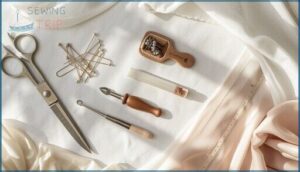
Before you sew a single stitch, having the right tools on hand makes everything go more smoothly.
French seaming doesn’t require a fancy setup, but a few key items will help you get that clean, polished finish every time. Here’s what you’ll want to have ready.
Sewing Machine and Needles
Your sewing machine is the backbone of a clean French seam. Stick to straight stitches — no overlock or zigzag needed.
Set your Stitch Length Settings between 2 and 2.5mm for lightweight fabric. Match your needle to the job: a 70/10 for sheers, 80/12 for cotton. Fine-tune Thread Tension Adjustment and Presser Foot Pressure so the seam allowance feeds smoothly without puckering.
Measuring and Cutting Tools
Precise cuts make or break a French seam. For Tape Measure Accuracy, use a non-stretch flexible tape alongside a seam gauge — set your Seam Gauge Settings to exactly 1/4 inch for the first stitch line.
quilters ruler and Cutting Mat Grids keep fabric on-grain, while Rotary Cutter Blades slice clean edges. Sharp scissors handle tight curves, where Curved Ruler Usage helps trace smooth seam lines.
Thread and Pressing Equipment
Thread weight matters more than most beginners expect. For lightweight fabrics, a 50–60 weight thread keeps French seams flat and nearly invisible. Pair it with a 70/10 or 80/12 needle — your Needle Compatibility Guide starts there.
Iron Temperature Settings, match heat to your fabric and always press between stitching steps. A pressing cloth, ironing board, and steam‑vs‑direct‑heat knowledge round out your toolkit.
Preparing Fabric for French Seams
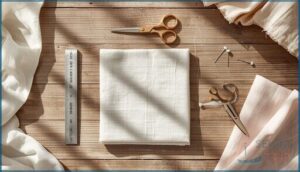
Before you sew a single stitch, a little prep work goes a long way toward getting that clean, professional finish French seams are known for.
Getting your fabric, machine, and tools ready ahead of time keeps the process smooth and frustration‑free.
Here’s what you need to take care of before you begin.
Cutting and Measuring Pieces
Getting your cuts right is half the battle.
Start with grain alignment — smooth your fabric flat and run the lengthwise grain parallel to the selvage.
For seam allowance calculation, most French seam projects need about 1.5 cm total.
Use rotary cutter precision along a clear ruler for clean edges.
Mark notches with tiny snips, and double-check pattern layout efficiency before cutting.
Thread and Machine Setup
Once your fabric pieces are cut, setting up your machine correctly makes all the difference. For a clean French seam, focus on three key adjustments:
- Thread Weight Choice — Use 50 wt all-purpose polyester thread for most fabrics, or 60 wt for sheers.
- Needle Type Matching — A Microtex 70/10 works beautifully on delicate wovens.
- Tension Calibration and Stitch Length Optimization — Aim for tension around 3–4 and a 2.0–2.5 mm stitch length.
Presser Foot Guides help you nail your seam allowance consistently.
Pressing and Prepping Fabric Edges
With your machine dialed in, iron becomes just as important. Press your first seam flat before anything else — no sliding the iron, just gentle downward pressure to keep the fabric grain aligned. Here’s a quick guide:
| Step | Tool | Detail |
|---|---|---|
| Initial press | Iron at 148–204°C | Set stitches flat |
| Trim allowance | Sharp scissors | Cut to ⅛ inch |
| Final fold press | Tailor’s clapper | Crisp, clean edge |
Step-by-Step French Seam Tutorial
Now that fabric is cut and your machine is ready, it’s time to put it all together.
Sewing a French seam is a five-step process that’s simpler than it looks once you walk through it.
Here’s exactly how to do it.
Pinning Wrong Sides Together
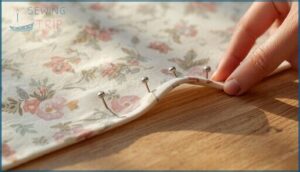
Start by placing your fabric wrong sides together — not right sides, which is the usual way.
Align the raw edges evenly, then pin perpendicular to the seam line, spacing pins about 2–3 centimeters apart.
On curved seam sections, bring pins closer together so the layers stay smooth.
Keep pins within your seam allowance for clean edge alignment throughout.
Sewing The First Seam
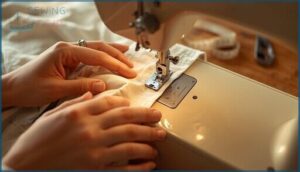
Once your pins are set, guide your fabric to the machine and stitch first seam at 1/4 inch — this seam allowance calculation is what makes the whole French seam work.
Set your stitch length to 2–2.5 mm, keep tension settings normal, and align your raw edge against an edge guide. Consistent fabric grain alignment here prevents any twisting later.
Trimming and Pressing The Seam

Now comes the part where precision really pays off. Trim your seam allowance down to 3–4mm using sharp scissors or a rotary cutter — trim consistency techniques matter here because uneven spots create bumps later.
- Press the seam flat to set stitches
- Use a seam roll for clean pressing surface support
- Select pressing side toward darker fabric
- Apply steam iron settings around 150 °C for cotton
Sewing The Second Seam
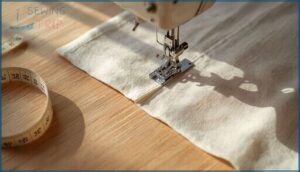
right sides together is your next move — align that fold exactly along your first stitching line so the raw edges stay tucked inside.
Use a 3/8 inch seam allowance for the second seam, and set your stitch length to 2.2–2.5 mm.
Loosen thread tension slightly on shears to avoid puckering. Guide the fabric gently, and your French seam finishing will look perfect.
Final Press and Finish
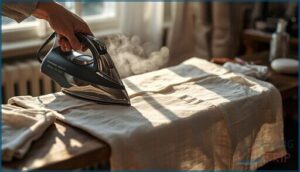
Pressing well is what separates a good seam from a great one. Lay your work on the ironing board and follow these finishing steps:
- Light-Side Press – Iron wrong side first to set stitches into the weave.
- Press Direction – Guide seams toward the garment back for clean alignment.
- Bulk Reduction – Use short steam bursts to flatten layered areas.
- Right-Side Finish – Top-press with a cloth, then do your Final Inspection for puckers or loose threads.
Tips for Perfect French Seams
Getting a clean French seam every time comes down to a few habits worth building early.
Small things — like how you handle your seam allowance or prep your fabric — make a bigger difference than you’d think.
Keep these tips in mind as you work through your next project.
Maintaining Seam Allowance Accuracy
Getting your seam allowance right is the foundation of every clean French seam.
Before cutting, do a quick Pattern Adjustment — add about 2 mm around pattern edges if your allowance is tight.
Use Presser Foot Guides for Measurement Calibration on each pass, mark lines with Seam Allowance Marking tools, and practice Trim Consistency after the first stitch.
These sewing tips keep your garment construction accurate every time.
Preventing Fabric Fraying
Fraying is the enemy of a clean French seam, but you have real tools to fight it. Pre-wash with a Vinegar Pre-treatment to tighten the weave before cutting.
Use a Short Stitch Length of 2.0–2.5 mm to lock raw edges inside your seam allowance. Add Sealant Application or Fusible Interfacing on tricky spots, and finish with Backstitch Reinforcement at stress points for lasting seam finishing.
Keeping Seams Straight and Neat
A wandering seam line can unravel all your careful work.
Use Seam Guide Alignment — tape or a magnetic guide on your machine bed — to keep your French seam on track.
Practice Stitch Length Control around 2.0–2.5 mm, and don’t rush; Machine Speed Management matters.
Marking Precision on sheer fabrics, plus consistent Pressing Technique after each pass, locks your seam allowance into a clean, professional finish.
Common Mistakes and Troubleshooting
Even with the best prep, French seams can throw a curveball or two—and that’s completely normal. The good news is that most problems come down to a few common slip-ups that are easy to fix once you know what to look for.
Here’s what to watch out for and how to get your seams back on track.
Dealing With Bulky Seams
Bulky seams are usually a sign of too much fabric stacked in one spot. The fix starts with fabric weight selection — French seams work best under 100 gsm.
From there, layer grading techniques help: trim each layer to a different length to stagger the thickness. At intersections, intersection trimming strategies like diagonal clipping reduce that stubborn bulk.
Finish with pressing for thinness using steam.
Fixing Uneven or Visible Edges
Visible raw edges usually mean the first seam wasn’t trimmed close enough.
Aim for 1/16 inch from your stitches — that’s your edge trimming precision sweet spot.
Stitch length tuning to 2.5 mm keeps the seam line alignment clean and consistent.
Pair that with a solid pin placement strategy and pressing pressure control through both passes, and those exposed fraying edges disappear inside your French seam for good.
Adjusting for Curved or Tricky Areas
French seams are where curves get humbled.
For concave curves like necklines, clip into the first seam allowance every half inch so the fabric spreads cleanly.
Convex curves need small notches — those little V-cuts are your Clip & Notch Techniques working their magic.
Use Seam Allowance Grading, keeping the inner layer slightly narrower.
A pressing ham holds the curve perfectly, and shortening your stitch length helps follow tight bends without puckering.
Advanced French Seam Techniques
Once you’ve got the basics down, French seams open up in some genuinely exciting ways.
With a few technique adjustments, you can tackle curves, work with the finest fabrics, and even turn your seams into a design statement. Here’s what to explore next.
French Seams on Curves
Curved seams aren’t off-limits for a French seam — they just need a little extra care. Start your curved seam allowance with a 3/8 inch first pass, then trim to 1/8 inch before clipping curved seams so the fabric lies flat.
For easing sleeve caps, pull your gathering threads gently before stitching. Use a tailor’s ham when pressing curved seams.
Skip French seams on princess seams or lined bodices — those are simply unsuitable curve areas.
Narrow French Seams for Fine Fabrics
Fine fabrics like silk and chiffon demand precision. For a narrow French seam, start with a 3/8 inch seam allowance, then trim both layers to 1/8 inch after the first stitch. Seam allowance precision keeps raw edges fully tucked away.
Use a size 70/10 needle, adjust thread tension on scraps first, and press each stage with a dry iron for a clean, professional garment construction finish.
Using Contrasting Thread for Decorative Effects
Contrasting thread turns a French seam from a hidden detail into a bold design choice. Think of it as Thread Embellishment meets smart Garment Construction — your seam finishing techniques do double duty.
Try these Color Blocking and Contrast Stitching pairings:
- Red thread on beige linen
- Gold metallic on black silk
- White on black voile
- Silver on navy silk
- Pastel pink on white chiffon
Decorative Topstitching and Visual Accent Lines make every stitch count.
Top 6 Tools for French Seams
Having the right tools in your sewing kit makes French seams so much easier to get right. Each one on this list earns its spot by helping you cut cleaner, press sharper, or stitch with more control.
Here are the six tools worth keeping close whenever you sit down to sew.
1. Gutermann Sew All Thread Box
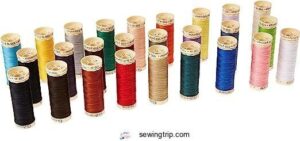
Regarding French seams, your thread does more work than you might think. The Gütermann Sew-All Thread Box gives you 26 spools of 100% polyester thread, each running 110 yards — plenty for multiple projects.
Its Micro Core Technology keeps your stitches uniform and reduces lint buildup, which matters on delicate fabrics like silk or chiffon.
The clear storage box makes color‑matching quick and easy.
It works beautifully for both hand and machine sewing.
| Best For | Sewers of all skill levels who want a reliable, colorful thread collection for both hand and machine sewing projects. |
|---|---|
| Primary Material | 100% Polyester |
| Brand | Gütermann |
| Weight | 0.01 ounces |
| Suitable For | Hand & machine sewing |
| Reusability | Reusable spools |
| Ease of Use | Convenient storage box |
| Additional Features |
|
- 26 colors with 110 yards each gives you a solid variety for everyday projects without constantly restocking.
- Micro Core Technology keeps stitches strong and clean — great for delicate fabrics like silk or chiffon.
- The clear storage box makes grabbing the right color quick and painless.
- The box lid doesn’t stay shut well, which gets annoying fast if you’re moving it around.
- Some orders arrived with damaged packaging, so it’s a bit of a gamble on presentation.
- If you do heavy sewing, the smaller spools may run out quicker than you’d like.
2. SIRMEDAL Gold Heavy Duty Tailor Scissors
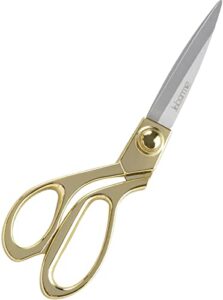
Good scissors are half the battle for clean French seams. The SIRMEDAL Gold Heavy Duty Tailor Scissors make trimming your seam allowance down to ⅛ inch feel easy.
The high-density stainless steel blades stay sharp through multiple fabric layers, from cotton to light leather, and the ergonomic design keeps your hand comfortable during long cutting sessions.
At 8 inches long and just 4.2 ounces, they’re easy to control for those precise, close snips French seaming demands.
| Best For | Sewists and crafters who need precise, clean cuts for projects like French seams, dressmaking, and detailed fabric work. |
|---|---|
| Primary Material | Stainless Steel |
| Brand | SIRMEDAL |
| Weight | 4.2 ounces |
| Suitable For | Dressmaking & crafts |
| Reusability | Durable long-term use |
| Ease of Use | Ergonomic design |
| Additional Features |
|
- Sharp stainless steel blades hold up well through multiple fabric layers
- Light at 4.2 oz with an ergonomic grip, so your hand won’t tire during long sessions
- The gold-plated design makes them a great gift as well as a solid everyday tool
- Some users find them stiff to open and close, especially over time
- Not the best pick for repeatedly cutting thick or heavy materials
- A few buyers noted they work better on paper than on clothing fabrics
3. Olfa 60mm Standard Rotary Cutter

When you’re prepping fabric for French seams, clean cuts make everything easier — and the OLFA 60mm Standard Rotary Cutter delivers exactly that. Its tungsten steel blade slices through up to 12 layers of fabric in one smooth pass, keeping edges crisp and fray-free before you even touch your sewing machine.
The straight handle works for both right- and left-handed sewers, and at just over 3 ounces, it won’t tire your hand. Pair it with a cutting mat for best results.
| Best For | Quilters, garment sewers, and crafters who want clean, precise cuts through multiple layers of fabric with minimal hand fatigue. |
|---|---|
| Primary Material | Metal |
| Brand | OLFA |
| Weight | 3.17 ounces |
| Suitable For | Quilting & garment sewing |
| Reusability | Blade replaceable |
| Ease of Use | Right & left-handed |
| Additional Features |
|
- Cuts through up to 6 layers of fabric in one smooth pass — great for fleece, cotton, wool, leather, and more
- Works for both right- and left-handed users, so no one gets left out
- Lightweight at just over 3 ounces, with an ergonomic handle that’s easy on your hand during long cutting sessions
- You’ll need a cutting mat — the cutter shouldn’t be used without one
- The blade dulls over time and will need replacing
- Not the best choice for very thick or hard materials that go beyond its range
4. Breman Precision Self Healing Cutting Mat
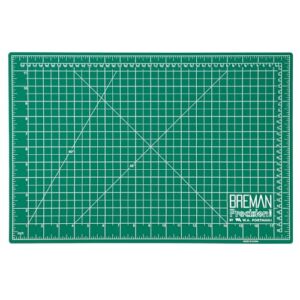
A great rotary cutter needs an equally reliable surface beneath it — and the Breman Precision Self-Healing Cutting Mat delivers that.
Its 5-ply PVC construction reseals after every slice, so you won’t end up with deep grooves throwing off your cuts.
The 12×18 inch workspace gives you room to measure and trim seam allowances accurately, while the 1/2-inch grid lines keep everything straight.
Flip it over for the black side when working with light fabrics, or use the green side for darker materials.
| Best For | Sewers, quilters, and DIY crafters who need a reliable, precise cutting surface that protects their work table and holds up to daily use. |
|---|---|
| Primary Material | PVC |
| Brand | Breman Precision |
| Weight | 1 pound |
| Suitable For | Sewing & quilting |
| Reusability | Self-healing surface |
| Ease of Use | Non-slip surface |
| Additional Features |
|
- Self-healing PVC bounces back after cuts, so grooves don’t build up and mess with your accuracy over time
- Two-sided design — green and black — means you’ve always got a high-contrast surface no matter what fabric you’re working with
- Grid lines, ruler marks, and angle guides are all built in, so measuring and squaring up cuts is quick and easy
- Markings are only on one side, so you lose that reference when you flip it over
- At 12×18 inches, it might feel a bit small if you’re cutting wide fabric panels or larger project pieces
- The non-slip backing may not grip equally well on every work surface, depending on what you’re working on
5. Rowenta Pro Master Steam Iron
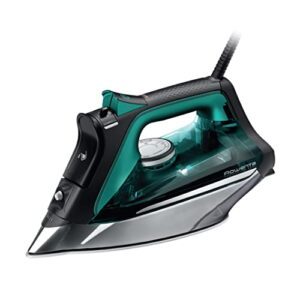
Once your fabric is cut and measured, pressing each stage of your French seam makes all the difference — and the Rowenta Pro Master Steam Iron is built for exactly that.
Its 400 microsteam holes push steady steam evenly across your seam allowance, while the precision tip gets right into tight edges without soaking delicate fabric.
At 1775 watts, it presses crisp, flat seams fast. The large water tank also means fewer refill breaks when you’re working through a longer project.
| Best For | Sewists and quilters who want professional-level steam and precision for detailed work like French seams and delicate fabrics. |
|---|---|
| Primary Material | Stainless Steel |
| Brand | Rowenta |
| Weight | 3.32 pounds |
| Suitable For | Sewing & quilting |
| Reusability | Durable appliance |
| Ease of Use | Automatic shut-off |
| Additional Features |
|
- 400 microsteam holes spread steam evenly, so you get crisp, flat results without soaking your fabric
- The precision tip makes it easy to press tight corners and seam allowances without fumbling
- At 1775 watts, it heats up fast and powers through tough creases quickly
- The temperature dial can be stiff and hard to adjust on the fly
- No indicator light to tell you when it’s actually ready to press
- Some users have reported leaking, which can be a real problem with delicate fabrics
6. MumCraft Multipurpose Plastic Sewing Clips
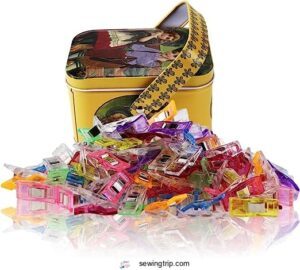
While your iron takes care of pressing, you’ll still need something to hold those layers in place — and that’s where MumCraft’s plastic sewing clips earn their spot in your kit. Each clip measures just 2.7 cm long with a flat base that feeds smoothly under your presser foot, no finger-poking required.
You get 100 clips in assorted colors, stored in a reusable tin. They’re transparent, so you can always see exactly where your seam allowance sits.
| Best For | Sewists and quilters who want a safer, pin-free way to hold multiple fabric layers while they work. |
|---|---|
| Primary Material | Plastic |
| Brand | MumCraft |
| Weight | 9.6 ounces |
| Suitable For | Sewing & quilting |
| Reusability | Reusable clips |
| Ease of Use | Flat base feeding |
| Additional Features |
|
- Transparent plastic lets you see your seam allowance at a glance
- Flat base glides right under the presser foot without fumbling
- 100 clips in assorted colors makes organizing and identifying layers a breeze
- Can snap under pressure if you’re working with thicker fabric stacks
- The storage tin isn’t the easiest to dig through mid-project
- Smaller than some people expect — worth keeping that in mind before you order
Frequently Asked Questions (FAQs)
When should you not use French seams?
Avoid French seams on thick fabrics, tight curves, stretchy knits, and patterns with narrow seam allowances. They also aren’t ideal when you’re short on time.
What is the difference between a felled seam and a French seam?
A felled seam topstitches through all layers, leaving two visible stitch lines on the outside — great for denim.
A French seam hides everything inside, giving delicate fabrics a clean, smooth finish.
What are the measurements for a French seam?
The simpler a seam looks, the more precise it needs to be. A French seam generally uses 5 cm total — split into a 6 mm first pass, then a 9 mm second pass.
When should you not use a French seam?
Skip French seams on thick fabrics like denim, stretchy knits, or sharp curves — they’ll bunch and bulk up fast. Stick to lightweight, woven materials for the cleanest results.
How does a French seam hide the raw seam edges?
French seam hides raw edges by stitching them twice — first with wrong sides together, then folding so right sides face in, trapping all raw edges neatly inside the second seam.
Do you need extra seam allowance for French seams?
Not always. Most patterns already include a 5 cm seam allowance, which is plenty. Just divide it into two passes — for example, 6 cm first, then 9 cm — and you’re set.
Can french seams work with stretchy fabrics?
Technically, yes — but it’s a rough match. French seams weren’t built for stretch. On knits, the four enclosed layers restrict movement and straight stitches snap under tension.
What thread weight works best for french seams?
For most French seams, 50wt thread is your sweet spot.
Go finer — 60wt to 100wt — for sheers or silk.
Heavier than 50wt adds bulk you don’t want hiding inside that second seam.
How do french seams affect fabric drape?
Think of a French seam as a whisper along your fabric — barely there.
On lightweight materials, it keeps the drape soft and fluid, letting the fabric fall naturally without stiff ridges pulling it out of shape.
Can you use french seams on thick materials?
Thick fabrics like denim or heavyweight wool are too bulky for French seams. The four layers create uncomfortable ridges and lumps.
Stick to lightweight or mid-weight fabrics for the best results.
Conclusion
simplest seams often demand the most discipline—and that’s exactly what makes them exceptional.
Knowing how to French seam in sewing changes how you see every project: not as fabric stitched together, but as something built to last.
Those two careful passes, that extra press, that clean enclosed edge—they’re the difference between a garment and a craft.
Your inside seams now look like your best work. Because they are.
- https://www.seamwork.com/sewing-tutorials/sewing-french-seams
- https://seweverythingblog.com/2013/04/09/sew-a-french-seam/
- https://www.coutureenfant.fr/en/techniques-for-french-seam/
- https://www.instructables.com/how-to-sew-a-french-seam-1/
- https://madamsew.com/blogs/sewing-blog/how-do-you-sew-a-french-seam-madam-sew