This site is supported by our readers. We may earn a commission, at no cost to you, if you purchase through links.
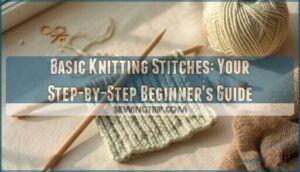
Knitting dates back over 1,000 years, yet the same two stitches that medieval craftspeople used still form every sweater, scarf, and blanket you’ve ever worn. That’s an impressive track record for something you can learn in an afternoon.
Many beginners assume knitting requires innate talent or steady hands, but the truth is simpler: it rewards patience and repetition, not natural ability. Once your fingers learn the rhythm of knit and purl, patterns that once looked impossibly complex start to make sense—like finally seeing the logic behind a language you’d only heard spoken.
The right supplies, a few core basic knitting stitches, and clear guidance are all you need to get started.
Table Of Contents
Key Takeaways
- Knitting comes down to just two stitches — knit and purl — and every pattern you’ll ever make is built from those two moves.
- Your gear list is short: grab worsted-weight yarn in a light color, US 7–9 bamboo needles, and a few small tools like stitch markers and a tapestry needle.
- Tension is the skill that makes or breaks your work — too tight and stitches lock up, too loose and your fabric falls apart.
- Once you’ve got the basics down, simple combinations like garter, ribbing, and seed stitch open up a whole world of textures without learning anything new.
Essential Knitting Supplies and Tools
Before you knit a single stitch, you need the right stuff in your hands. Don’t worry — the list is short and nothing is hard to find.
If you’re brand new to this craft, brushing up on basic crochet stitches for beginners before you start will make your first project a whole lot smoother.
Here’s what every beginner needs to get started.
Choosing The Right Yarn
Yarn is your most important knitting supply — it sets the tone for everything.
For knitting for beginners, start with a smooth, medium-weight worsted yarn in a light color. Light shades make basic knitting stitches easier to see.
Wool blends offer stretch and forgiveness, while acrylic is budget-friendly and machine washable.
Stick to solid colors until you’ve got your rhythm down. Exploring the importance of different yarn fiber types can further help you choose the best material for your projects.
Selecting Knitting Needles
Once your yarn is sorted, picking the right knitting needles makes a real difference. For beginner knitting stitches, start with US 7–9 bamboo or plastic needles—they grip yarn gently so stitches don’t slip.
- Needle Material: Bamboo suits beginners; metal suits speed
- Needle Length: 9-inch straights work for scarves and flat pieces
- Circular Options: Great for hats and holding many stitches
- Gauge Swatch: Always test before starting any project
Always knit a gauge swatch first. Achieving an ideal fit depends on understanding your knitting gauge and needle sizes.
Basic Accessories Needed
Beyond needles, a few small tools keep your knitting on track.
| Tool | Why You Need It |
|---|---|
| Stitch Markers | Mark repeats and row starts |
| Darning Needles | Weaving in yarn ends cleanly |
| Yarn Scissors | Clean cuts on any yarn |
A flexible measuring tool, a crochet hook for dropped stitches, and basic yarn and knitting supplies round out your starter kit.
How to Cast on Stitches
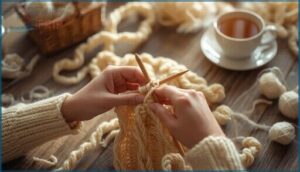
Before you can knit a single stitch, you need to get the yarn onto your needles — and that’s exactly what casting on is all about.
There are a few different ways to do it, and each one has its own feel and purpose. Here’s what you’ll want to know to get started.
Long-Tail Cast on Technique
The Long-Tail Cast On is the highest standard for clean edge structure. It builds your first row right into the cast on — saving you a step.
Follow these five essentials for perfect stitch formation:
- Estimate tail length calculation at 1 inch per stitch
- Set up the classic slingshot yarn tension hold
- Scoop, catch, release — that’s your casting on rhythm
- Leave 6–8 inches extra for weaving
- Check that cast on tips slide freely along the needle
Knit Cast on Method
The knit cast on is one of the friendliest cast on variations for beginners — you’re basically practicing your knit stitch while casting on. No measuring a long tail. No guessing. Just solid stitch formation from the very first loop.
Once you’ve got your stitches cast on, this guide to basic knit stitch patterns walks you through building real fabric with them.
| Step | What You Do |
|---|---|
| 1 | Make a slip knot on your left needle |
| 2 | Insert right needle as if to knit |
| 3 | Wrap working yarn around right needle |
| 4 | Pull new loop through |
| 5 | Slip loop onto left needle |
This builds a clean knit edge that blends beautifully into basic knitting stitches like garter and stockinette. Yarn management stays simple too — your working yarn does all the work.
Common Beginner Mistakes
Almost every beginner stumbles with yarn tension first — gripping too tight makes stitches stiff, while going too loose causes fabric distortion and dropped loops.
Watch your stitch count at each row’s end. Edge control matters more than you think. Catching these issues early makes mistake correction simple.
These basic knitting techniques become second nature faster than you’d expect with regular practice.
Mastering The Knit Stitch
The knit stitch is the foundation everything else builds on, so it’s worth getting right from the start.
There are a few things to learn here, and they’ll make a real difference in how your knitting feels and looks. Here’s what this section covers.
Step-by-Step Knit Stitch Instructions
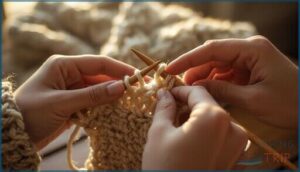
Think of the knit stitch as a four-step handshake: insert, wrap, pull, slide. Hold your left needle loosely, push the right tip through the front of the stitch, wrap the yarn counterclockwise, pull that new loop through, then slide the old stitch off.
Solid needle control and steady yarn management make your knitting rhythm click — and your basic knitting stitches look clean every time.
Continental Vs. English Style
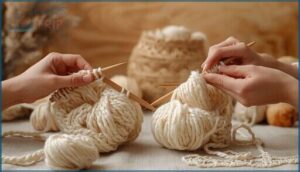
Both styles nail the same knit stitch — they just get there differently.
Continental knitting holds the yarn in your left hand, using a small pick motion that boosts knitting speed and offers ergonomic benefits during long sessions. English style throws the yarn with your right hand, making yarn tension and stitch consistency easier to control at first.
Try both and see which hand movement feels right.
Identifying Knit Stitches
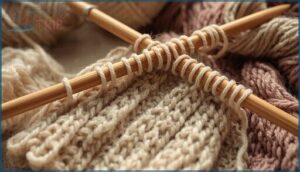
Once you learn to “read” your work, everything clicks. Each knit stitch leaves a telltale fabric V-shape — two smooth legs meeting at a point. Purl side bumps look rounder and raised, the opposite of those clean Vs. Check your on-needle stitches too — knit stitches hang open like loose loops.
- Fabric V-shape: smooth, flat, and easy to spot in basic knitting stitches
- Purl side bumps: rounder and raised — the back of every knit stitch
- On-needle stitches: knit stitches hang open; purl stitches hug the needle tighter
- Twisted vs. clean: straight legs mean a correct knit stitch; crossed legs mean a twist
Learning The Purl Stitch
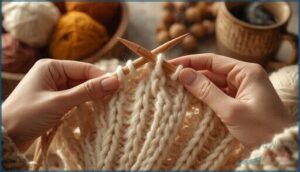
The purl stitch is the second building block every knitter needs to learn. Once you’ve got it down, a whole world of patterns opens up.
Here’s what this section will walk you through.
Purl Stitch Instructions
The purl stitch is the flip side of everything you’ve done so far — and once it clicks, your whole fabric texture game changes.
Bring the yarn to the front. Insert your right needle from right to left into the first stitch. Wrap the yarn counterclockwise, then pull the new loop through and slide the old stitch off.
| Step | Action | Purl Stitch Tip |
|---|---|---|
| 1 | Yarn to front | Keeps yarn tension even |
| 2 | Insert needle right to left | Core of purling methods |
| 3 | Wrap counterclockwise | Shapes fabric texture correctly |
Repeat across for clean, consistent purl stitches.
Differences Between Knit and Purl
Now that you’ve practiced both stitches, notice how different they feel. The knit stitch keeps yarn at the back; the purl stitch brings it front.
That small shift changes everything about stitch formation and fabric texture. Knit stitches form smooth V shapes. Purl stitches create little bumps.
Together, knit purl balance shapes every basic knitting stitch pattern you’ll ever make — yarn tension included.
Troubleshooting Purl Mistakes
Mistakes happen — even experienced knitters wrestle with purl stitches. Catching them early saves your project.
- Purl Tension: Loose purl stitches leave horizontal bars. Try tightening yarn around your tensioning finger.
- Dropped Stitches: Use a crochet hook to ladder repair from the back side.
- Twisted Purls: Rework the stitch so both legs sit open.
- Gaps Formation: Snug yarn firmly when switching front to back.
- Accidental Knit: Tink back and correct it.
Fundamental Knit Stitch Patterns
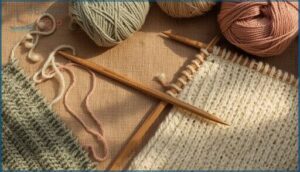
Once you know how to knit and purl, the real fun begins — combining those two moves into actual stitch patterns. Each pattern has its own look, feel, and best use, so it helps to know a few before you start your first project.
Here are the fundamental patterns every beginner should have in their toolkit.
Garter Stitch Guide
Garter stitch is the friendliest stitch — just knit every row, every time. No switching, no guessing. That simplicity is exactly why it’s the go-to for beginners learning foundational knitting techniques.
| Property | Detail | Beginner Benefit |
|---|---|---|
| Stitch Type | Knit stitch only | Easy to remember |
| Fabric Look | Ridged, reversible | No “wrong” side |
| Edge Behavior | Lies flat | No curling |
| Yarn Choices | Works with any weight | Very flexible |
| Stitch Markers | Optional flat; helpful in-the-round | Keeps count easy |
Garter fabric properties make it ideal for scarves and dishcloths. Its ridges trap warmth, and it stays flat without blocking tricks.
Stockinette Stitch Basics
Stockinette stitch is the smooth fabric you see on almost every sweater. The stockinette structure is simple: knit one row, purl stitch the next. That’s it.
Your knit stitch builds the pretty V-shaped front; the purl stitch forms the bumpy back. Keep your knit tension even — uneven rows show clearly here. Watch for fabric curl at the edges, and always swatch for gauge measurement.
Reverse Stockinette Stitch
Flip your stockinette stitch inside out — that’s reverse stockinette. Your purl stitch becomes the right side, creating a chunkier, more textured look. This basic knitting stitch works beautifully as a background for cables.
- Stitch structure uses a simple two-row repeat
- Fabric texture feels denser, more cushioned
- Edge control requires garter or rib borders
- Pattern combinations with cables create stunning contrast
Watch your gauge management — purling often runs looser than knitting.
Ribbing Patterns (1×1 and 2×2)
Ribbing basics are your secret weapon for elastic edges that actually stay put. With 1×1 ribbing, you alternate one knit stitch and one purl stitch across every row.
For 2×2 ribbing, you knit two, purl two instead — giving you bolder, more visible ridges. Both create reversible textures with impressive fabric density.
Try a stretchy cast-on so your cuffs don’t feel like a vice grip.
Seed Stitch and Moss Stitch
Two humble stitches — seed stitch and moss stitch — pack serious texture into your knitting. Both are reversible fabrics built from basic knitting stitches: just knit and purl, nothing fancy.
Seed stitch alternates every stitch, every row. Moss stitch stacks pairs over two rows for a chunkier checkerboard look. Either way, you get beautiful textured patterns without mastering anything new.
Creating Texture With Basic Stitches
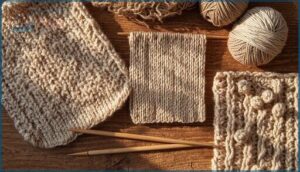
Once you’ve got the basics down, you can start playing with texture — and that’s where knitting really gets fun.
A few simple stitch combinations can completely change how your fabric looks and feels. Here are three patterns worth learning early on.
Basketweave Stitch Instructions
The basketweave stitch is one of those knit textures that looks far more complex than it actually is. Using only basic knitting stitches — knit and purl — you can create woven fabrics with real depth.
Here’s how the row instructions break down:
- Rows 1–4: Knit 4, purl 4 across
- Rows 5–8: Purl 4, knit 4 across
- Repeat this stitch repeat until your piece reaches your desired length
- Bind off in pattern to keep the edge clean
These simple basketweave patterns work beautifully for scarves and dishcloths.
Bamboo Stitch Pattern
The Bamboo Stitch creates tall knit columns that look almost woven — like actual bamboo stalks lined up in a row. And it only takes two rows to get there.
Cast on any even number, then use simple yarn overs and pass-overs to build the textured fabric. These basic knitting stitches produce a stitch structure that hides tension mistakes beautifully — a real beginner win.
Andalusian Stitch Overview
Think of Andalusian Stitch as stockinette with personality. It’s a four-row repeat that uses basic knit stitch and purl combinations to scatter raised bumps across a smooth background — like tiny pebbles on a calm pond. Simple fabric behavior, surprisingly rich texture.
Andalusian Stitch is stockinette with personality — tiny purl bumps scattered like pebbles across a calm, smooth surface
For the best results with this stitch:
- Yarn Selection matters: solid worsted weight shows the texture clearly
- Stitch Variations exist for flat and in-the-round knitting
- Fabric Behavior includes mild edge curl, so add a garter border
Finishing and Binding Off Techniques
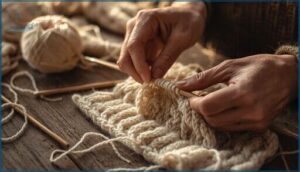
You’ve learned the stitches — now it’s time to wrap things up the right way. Finishing well is what turns your knitting into something you’re proud to give or keep.
Here’s what you need to know to close it all out cleanly.
Standard Bind Off Steps
Casting off is simpler than it sounds — just three repeating moves until one stitch remains. Here’s a quick reference for your bind off:
| Step | What You Do |
|---|---|
| 1 | Knit two stitches onto your right needle |
| 2 | Lift the first stitch over the second |
| 3 | Knit one more stitch |
| 4 | Repeat until one stitch remains |
| 5 | Cut yarn, pull tail through final loop |
Watch your yarn tension — loose stitches keep edge finishing flexible. Try a larger needle for a better knit bind off.
Weaving in Yarn Ends
Once that last loop is secure, it’s time for yarn tail management — hiding those loose ends so your work looks clean and finished.
- Thread a blunt tapestry needle with your yarn tail
- Weave through 5–6 stitches using the duplicate stitch method
- Change direction once to lock the end
- Check fabric tension — no puckers
- Trim, leaving a tiny buried length
Blocking and Final Touches
Your knitting for beginners journey doesn’t end at weaving in ends.
Blocking transforms a good piece into a great one.
Wet blocking soaks wool in lukewarm water, then dries it flat — watch stitches even out like magic.
Steam blocking works faster for delicate fibers.
Grab your blocking tools, pin your shaping knits to a foam mat, and let post-finishing techniques do the rest.
Frequently Asked Questions (FAQs)
What are the six basic stitches?
Six stitch foundations power almost every pattern ever made: knit stitch, purl stitch, garter stitch, stockinette stitch, rib stitch, and seed stitch.
Master these, and fabric textures and reversible stitches become yours to command.
What’s the easiest thing to knit as a beginner?
Start simple. A garter stitch washcloth is one of the best beginner projects — small, quick, and only needs the knit stitch. A simple scarf comes in at a close second.
What types of yarn are beginner-friendly?
Picking yarn is like choosing your first training wheels — you want just enough support.
For beginner knitting stitches, go with smooth, medium-weight worsted acrylic in a light color. It’s forgiving, affordable, and easy to see.
How do I fix a dropped stitch?
Spot a dropped stitch? Don’t panic.
Use a small crochet hook for quick ladder run repair — insert it through the loop, catch each strand, and work back up row by row.
What is the purpose of circular needles?
Circular needles do double duty — they handle continuous construction for hats and cowls, and hold wide flat projects like blankets.
They also reduce fatigue by keeping yarn distribution balanced in your lap.
How do I measure gauge in knitting?
Knit a small swatch, wash and block it, then lay it flat.
Count your stitches and rows over 4 inches using a rigid ruler for accurate gauge measurement.
Adjust needle size as needed.
What are the best tools for knitting?
Four exceptional finds fuel every knitter’s journey: yarn, needles, scissors, and a tapestry needle. Starter kits bundle these knitting tools together so you don’t have to hunt them down separately.
How do I fix dropped stitches while knitting?
Don’t panic — a dropped stitch is totally fixable. Grab a small crochet hook, catch that loose loop, and pull each ladder strand through. You’ll have your stitch recovered in seconds.
What are the best beginner knitting projects to start?
Start small and build up. Easy Scarves and Simple Dishcloths are perfect Knitting Projects for Beginners.
Using Basic Beginner Knitting Stitches from simple Knitting Patterns you’ll love, projects like Cozy Cowls, Baby Blankets, and Knit Hats are great for beginners.
How do I read a basic knitting pattern?
Reading a knitting pattern isn’t as tricky as it looks.
Scan the Pattern Layout first, then check Gauge Measurement, decode Stitch Abbreviations, follow Row Instructions, and use Chart Symbols as your visual guide.
Conclusion
Think about where you started—yarn in hand, unsure which end to pull. Now you know the cast on, the knit, the purl, and the patterns that connect them all.
These basic knitting stitches are your foundation. Everything else—cables, lace, colorwork—builds from exactly this. Keep your tension even, trust the repetition, and don’t rush the learning.
Every stitch you practice quietly shapes the knitter you’re becoming. Pick up your needles and keep going.