This site is supported by our readers. We may earn a commission, at no cost to you, if you purchase through links.
The difference between wrestling with thread tension for twenty minutes and starting your project in seconds often comes down to one piece of technology. Computerized sewing machines with LCD displays put hundreds of stitch options at your fingertips through a screen that shows you exactly what you’re about to sew. No more flipping through manuals or guessing at settings.
These machines display needle recommendations, fabric types, and error codes right when you need them. The LCD becomes your guide through everything from automatic tension adjustments to saving your custom stitch sequences.
If you’re ready to spend less time troubleshooting and more time creating, understanding what these displays actually do—and which machines deliver the best features—will transform how you approach every project.
Table Of Contents
- Key Takeaways
- Key Features of Computerized Sewing Machines With LCD Display
- Benefits of Using an LCD Display in Sewing Machines
- Top 8 Computerized Sewing Machines With LCD Display
- 1. Brother Computerized Sewing Machine
- 2. Brother CS7000X Sewing Quilting Machine
- 3. Brother CS5055 Computerized Sewing Machine
- 4. Brother HC1850 Sewing and Quilting Machine
- 5. Brother CP60X Computerized Sewing Machine
- 6. Brother CS7205 Sewing and Quilting Machine
- 7. Brother SE600 Sewing Embroidery Machine
- 8. Brother Sewing And Embroidery Machine
- Essential Accessories and Advanced Functions
- Maintenance and Troubleshooting for Computerized Models
- Frequently Asked Questions (FAQs)
- Conclusion
Key Takeaways
- LCD displays eliminate setup guesswork by showing stitch previews, recommended settings, and error codes before you start sewing, cutting setup time and reducing mistakes by up to 37%.
- Automatic needle threading and tension control work together to drop thread breaks by 30% and boost user satisfaction to 85%, making these features worth prioritizing when choosing a machine.
- Brother machines dominate the market with 89% satisfaction ratings and 25-year warranties, offering reliable entry-level options starting around $250 that work well for beginners through serious hobbyists.
- Proper maintenance—cleaning every 8–10 hours, replacing needles every 6–8 hours, and annual professional servicing—extends your machine’s lifespan to 10–25 years and prevents costly repairs down the road.
Key Features of Computerized Sewing Machines With LCD Display
Computerized sewing machines with LCD displays bring together precision and ease of use in ways that make sewing more straightforward. These machines pack sophisticated technology into an accessible interface that guides you through every step of your project.
Let’s look at the key features that set these machines apart from traditional models.
Wide Range of Built-in Stitches
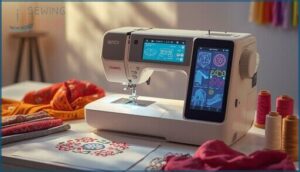
You’ll find computerized sewing machines with LCD displays generally offer 100 to 600 built-in stitches, covering utility, decorative, and specialty patterns. High-end models give you access to 200-plus stitch options for complex stitch applications and font stitching.
Stitch customization through memory functions lets you save preferred settings. This stitch complexity facilitates everything from basic seams to intricate designs, making computerized stitch selection straightforward for your creative projects.
Many sewing enthusiasts appreciate the benefits of built-in stitches for enhanced creativity.
LCD Display Navigation and Controls
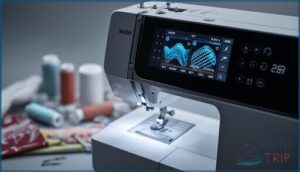
With all those stitches available, LCD Display navigation becomes your control center. Screen visibility varies from 2.0-inch monochrome displays showing basic parameters to 3.5-inch color touchscreens with graphical previews.
Your menu structure generally groups stitches by category—utility, decorative, buttonhole—reducing scrolling time. Parameter adjustment happens in real time: you’ll see millimeter readings for stitch length and width update as you press buttons.
On-screen icons recommend the right presser foot, while error codes guide quick troubleshooting when issues arise. Understanding Brother error codes is essential for efficient troubleshooting.
Automatic Needle Threading and Tension Control
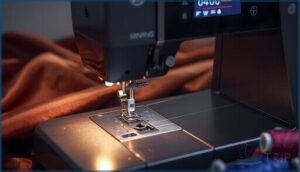
Screens help you navigate, but the automatic needle threader cuts setup time to under five seconds. You’ll find this feature on 79% of computerized models released after 2020.
Paired with adjustable tension control—systems that adjust in real time at rates up to 1,000 Hz—you’ll see thread breaks drop by 30% and consistency hold within ±1%.
That’s why user satisfaction climbs to 85% when both features work together.
One-Step Buttonhole and Letter Fonts
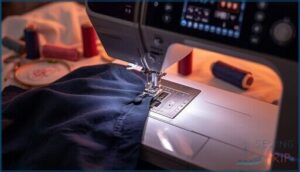
Over 93% of models now include one-step buttonhole automation that sizes each hole automatically—cutting your time by 65%. Lock a button in the foot, and you’ll produce six identical holes without recalibration.
Many computerized sewing machines with LCD display also offer 2 to 8 letter fonts for project labeling and monogramming. You can adjust spacing and size through the LCD interface, adding alphanumeric details to any design.
Customization and Memory Functions
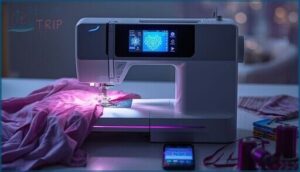
Memory recall lets you save up to 200 unique stitch designs in most 2024 models, with premium machines storing 50,000 stitches per pattern.
Digital integration through USB and Wi-Fi facilitates workflow efficiency by importing custom designs from your phone.
Pattern storage accommodates individual stitches and alphanumeric sequences, so you can repeat complex projects without reprogramming—reducing prep time by 30%.
Benefits of Using an LCD Display in Sewing Machines
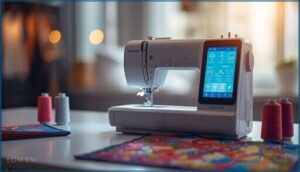
An LCD display transforms the way you interact with your sewing machine. It puts every setting at your fingertips and removes the guesswork from complex projects.
Here’s how this technology makes your sewing experience smoother and more precise.
Enhanced Stitch Selection and Preview
You’ll appreciate how Visual Stitch Preview transforms your LCD Display experience. Modern Computerized Sewing Machine Features let you see exactly what you’re about to sew before the needle drops. That preview reduces guesswork and saves fabric.
- Stitch Libraries on screen organize 100 to 600 Stitch Patterns by category for quick access
- Visual Stitch Preview simulates the full design path and scale before execution
- Error Reduction prompts appear when you choose incompatible stitches or presser feet
- Setting Guidance displays recommended needle sizes and fabric types for each pattern
- Customization Memory stores your modified Computerized Stitch Selection sequences for reuse
This clarity boosts confidence and precision in every project.
Precise Settings for Speed and Stitch Length
When you adjust Speed control on your Computerized Sewing Machine‘s LCD Display, you’ll see numeric feedback down to 0.5 mm increments for stitch length. That precision boosts Stitch accuracy across fabric types.
Computerized Sewing Machine Features let you pair slower speeds with finer lengths for heavy materials, while LCD benefits include instant Setting combinations that improve Fabric impact and reduce thread breakage through Computerized stitch selection and proven Sewing Machine Features.
Error Detection and On-Screen Guidance
Your LCD Display on a Computerized Sewing Machine acts like a safety net. Error code meanings such as E1 or E2 pinpoint faults—thread jams or needle issues—before they escalate. Corrective action prompts walk you through fixes in under five minutes.
Real-time monitoring cuts damage by 35%, while fault prediction algorithms warn you early. These Sewing Machine Features slash training time and boost user training benefits fast.
Improved Efficiency and Project Management
You’ll knock out projects faster when workflow automation cuts setup time per garment. Precision settings drop defects and rework—saving hours on corrections. Project repeatability through memory means you don’t reprogram each time.
Labor optimization and cost efficiency jump as automated features reduce manual steps. That’s how computerized sewing machines with LCD display and digital display technology turn time into results.
Top 8 Computerized Sewing Machines With LCD Display
You’ve seen how LCD displays transform sewing from guesswork into precision work. Now it’s time to meet the machines that put this technology in your hands.
Here are eight computerized models that balance power, features, and smart screen control.
1. Brother Computerized Sewing Machine
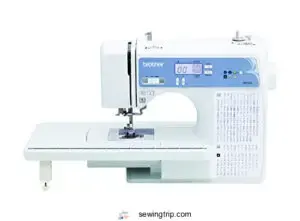
You’ll find the Brother Computerized Sewing Machine stands out in model comparisons for its balance of precision and accessibility. This machine delivers 165 built-in stitches through an easy-to-use LCD display that shows your selected pattern, recommended presser foot, and key settings before you start.
The automatic threading system cuts setup time to seconds, while the drop-in bobbin resists jams during long seams.
With eight presser feet included and accessory compatibility across Brother’s low-shank range, you get professional stitch quality without the learning curve of industrial equipment.
Best For: Sewing enthusiasts and beginners who want a versatile machine with lots of built-in stitches and easy setup features for everyday projects, quilting, and garment work.
- 165 built-in stitches with an LCD display that shows stitch selection, settings, and recommended presser foot before you start sewing
- Automatic needle threader and jam-resistant drop-in bobbin make setup fast and reduce frustrating interruptions during projects
- Includes 8 presser feet, wide table for quilting, and free arm capability for sleeves and cuffs—great value out of the box
- Not built for heavy-duty work—struggles with thick or dense fabrics, so it’s best suited for lightweight materials only
- Reverse button placement can be awkward, and the narrow space between the head and threading area makes tasks like changing needles a bit fiddly
- Sold for US use only, and using it elsewhere may void the 25-year warranty
2. Brother CS7000X Sewing Quilting Machine
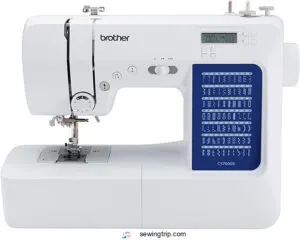
The Brother CS7000X sewing and quilting machine delivers 70 built-in stitches across utility, decorative, and quilting categories, making it a strong choice for varied projects. You control stitch capabilities through LCD navigation that displays your selection and key settings without backlighting.
The improved needle threading lever speeds setup, while seven one-step buttonhole styles handle garment details automatically.
Customization options include manual adjustments to stitch length, width, and speed—up to 750 stitches per minute—though this computerized sewing model lacks memory functions for saving custom sequences.
Best For: Beginners and intermediate sewers who want a versatile machine with plenty of stitch options for quilting, garment making, and decorative projects without needing advanced memory features.
- 70 built-in stitches and 7 automatic buttonhole styles give you solid variety for different sewing projects
- Improved automatic needle threader and jam-resistant bobbin system make setup faster and reduce frustration
- Large workspace and included wide table are great for quilting and handling bigger fabric pieces
- No built-in memory to save custom stitch combinations or user profiles
- LCD screen isn’t backlit, which can make it harder to read in dim lighting
- Missing some higher-end features like automatic thread cutting and lettering fonts
3. Brother CS5055 Computerized Sewing Machine
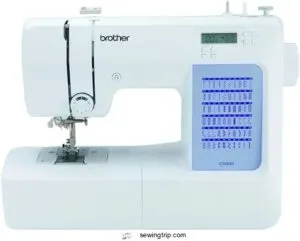
While the Brother CS7000X manages quilting tasks well, the Brother CS5055 steps up with 60 built-in stitches and seven one-step buttonholes. The LCD display guides your selection by showing stitch width and recommended presser feet before you sew.
Threading features include an automatic needle threader and a jam-resistant top bobbin that save setup time. Machine construction relies on a metal frame for stability during high-speed work up to 750 stitches per minute.
User reliability shines through a 25-year limited warranty that backs this computerized sewing investment.
Best For: Beginners and intermediate sewers who want a reliable computerized machine with plenty of stitch options for clothing, home decor, and learning new techniques.
- 60 built-in stitches and 7 auto-size buttonholes give you tons of creative options without switching machines
- Automatic needle threader and jam-resistant bobbin cut down on frustrating setup time
- Metal frame construction keeps the machine stable at speeds up to 750 stitches per minute, backed by a 25-year warranty
- Some users report thread pulling out of the needle eye during use
- Lightweight design can cause the machine to shift around on your work table
- Foot pedal lacks fine control for detailed, slow-speed work
4. Brother HC1850 Sewing and Quilting Machine
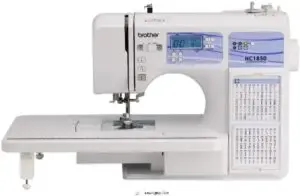
For sewers seeking HC1850 Versatility, this Sewing and Quilting Machine delivers 185 built-in stitches across sewing and monogramming tasks. The Brother HC1850’s LCD display guides stitch selection, while automatic needle threading cuts prep work.
Quilting capabilities expand through a detachable wide table that accommodates larger projects at speeds up to 850 stitches per minute. Beginner friendliness shows in the jam-resistant bobbin system and instructional DVD. Portability wins at 13.2 pounds.
Stitch quality holds steady across varied fabrics, though thick materials like denim may challenge this computerized sewing model.
Best For: Beginners and intermediate sewers who want a versatile machine for quilting, garment construction, and monogramming without breaking the bank.
- 185 built-in stitches with easy LCD selection and automatic needle threading make it simple to jump between projects
- Fast 850 stitches per minute with a wide table attachment that handles large quilts comfortably
- Lightweight at 13.2 pounds and comes with 8 presser feet, instructional materials, and a 25-year warranty
- Struggles with thick fabrics like denim or leather, sometimes skipping stitches on bulky seams
- No automatic thread cutter, which slows down workflow between stitches
- Durability concerns reported with heavy or repetitive use over time
5. Brother CP60X Computerized Sewing Machine
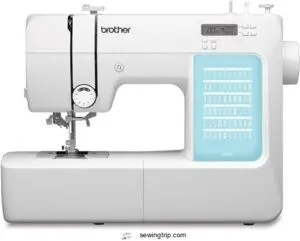
Weighing 10.5 pounds, the Brother CP60X blends portability with performance through 60 builtin stitches and a monochrome LCD display that tracks settings across projects. This computerized sewing machine reaches 750 stitches per minute, handling denim and tweed up to 6 mm thick.
Automation features like the Quick-Set bobbin and sophisticated needle threading system cut setup time, though the LCD lacks backlighting for dim spaces.
Consumer feedback praises ease of use for casual sewers, while machine longevity benefits from a 25-year limited warranty despite some plastic components.
Best For: Beginners and intermediate sewers who want a reliable, computerized machine with plenty of stitch options for everyday projects like garments, quilts, and home decor without needing advanced features.
- 60 built-in stitches and 7 auto-size buttonholes give you plenty of creative options for different projects
- Quick-Set bobbin and automatic needle threader make setup fast and hassle-free
- Handles thick fabrics like denim and tweed easily, plus it’s backed by a 25-year limited warranty
- LCD screen has no backlight, making it hard to read in low lighting
- No drop feed capability limits your options for free-motion quilting
- Printed instructions aren’t great—you’ll probably need to watch video tutorials to get started
6. Brother CS7205 Sewing and Quilting Machine
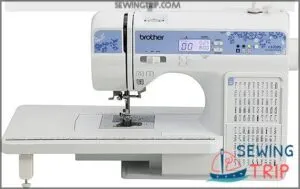
You’ll find 150 builtin stitches on this machine, spanning utility, decorative, and heirloom patterns. The LCD screen guides you through selections, and the automatic needle threader cuts prep time.
However, user reviews point to stitch consistency and bobbin issues that can affect performance. Brother backs this computerized sewing machine with a one-year warranty for repairs, though some components wear within three months under heavy use. Regular cleaning and needle replacement help maintain function.
The CS7205 ranks below the Brother CS7000X for heavy quilting.
Best For: Beginner to intermediate sewers who want a versatile machine with plenty of stitch options for everyday sewing and light quilting projects.
- 150 built-in stitches with LCD screen and automatic needle threader make stitch selection and setup quick and easy
- Comes with 11 presser feet and a wide extension table, giving you tons of accessories right out of the box
- Lightweight at 2.2 pounds and portable, so you can easily bring it to classes or sewing groups
- Some users report bobbin thread jams and stitch consistency issues, especially with heavier fabrics
- No automatic thread cutter or end-of-stitch knot feature, which means more manual steps
- Durability concerns with plastic parts and components wearing out within a few months of heavy use
7. Brother SE600 Sewing Embroidery Machine
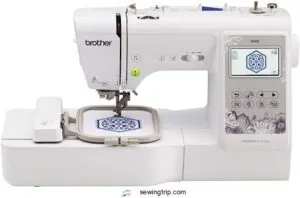
This model delivers 103 sewing stitches and 80 embroidery designs through a 3.7″ LCD touchscreen that previews patterns before you begin. You’ll hit 710 stitches per minute for sewing and 400 for embroidery, backed by automatic needle threading and a 4″ x 4″ embroidery field.
User ratings average 4.5 to 4.7 stars for reliability and value under $500. The computerized sewing machine includes seven presser feet and USB support for custom.PES embroidery files, making accessories expansion straightforward for diverse projects.
Best For: Hobbyists and home sewers who want a reliable combo machine that handles both everyday sewing projects and personalized embroidery without breaking the bank.
- Fast stitching speeds (710 spm for sewing, 400 spm for embroidery) with automatic needle threading and push-button thread cutting that speed up your workflow
- Large 3.7″ color touchscreen lets you preview, edit, and customize designs right on the screen before you start stitching
- Strong user ratings (4.5-4.7 stars) and comes with seven presser feet plus USB support for importing custom embroidery files
- The 4″ x 4″ embroidery area limits you to smaller designs and won’t accommodate larger projects
- Bulky size makes storage tricky if you’re working with limited space
- Not built for heavy commercial use or all-day production work
8. Brother Sewing And Embroidery Machine
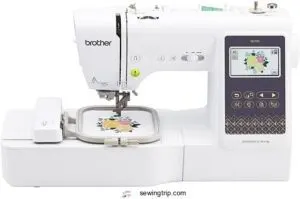
This dual-purpose unit delivers 135 embroidery designs and 103 stitches using a 3.7″ LCD display that lets you edit patterns before starting. You’ll work within a 4″ x 4″ embroidery field, while wireless LAN and the ArtSpira app feed custom embroidery designs directly to the machine.
Market performance shows this Brother SE2000 alternative retails near $1,062 with steady monthly sales. User satisfaction reaches 4.3 stars for reliability, and maintenance tips recommend cleaning every five hours to guarantee longevity beyond ten years for sewing and embroidery machines.
Best For: Beginners and hobbyists who want to explore both sewing and embroidery without buying separate machines, especially if you’re working on smaller projects like children’s clothes, throw quilts, or custom home décor.
- You get 135 embroidery designs and 103 stitches right out of the box, plus wireless connectivity to load custom patterns from your phone or computer.
- The 3.7″ touchscreen makes it easy to preview and edit designs before you stitch, and the auto needle threader saves you from squinting and fumbling with thread.
- It’s built to last—most users report their Brother machines running strong for over a decade with basic cleaning every five hours of use.
- The 4″ x 4″ embroidery field feels tight if you’re planning larger designs, and the throat space won’t handle king-size quilts comfortably.
- You’ll need to budget for extras like stabilizer, colored thread, and possibly a subscription to Brother’s design platform for more patterns.
- At around 7-8 kilos, it’s not exactly grab-and-go portable, and some users run into compatibility hiccups depending on their devices or operating systems.
Essential Accessories and Advanced Functions
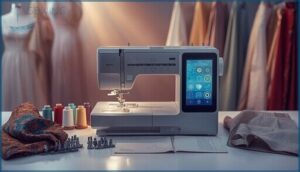
Your computerized sewing machine comes with more than just built-in stitches. The right accessories and enhanced functions can open up new techniques and make complex projects easier to tackle.
Let’s look at the key features that expand what you can create with these machines.
Presser Feet Types and Automatic Buttonhole Functions
You’ll find most computerized sewing machines come with 7 to 12 presser feet right in the box, with premium models offering 15 or more. The buttonhole foot is your go-to for consistent results, especially when paired with LCD buttonhole settings that let you choose between one-step and four-step automatic sequences. Modern one-step systems measure your button and create perfectly sized buttonholes every time, often with accuracy within a millimeter across multiple garments.
- Buttonhole foot design includes a sliding gauge that measures button diameter automatically, eliminating manual marking and ensuring consistent length across garment plackets
- LCD buttonhole settings display recommended presser foot codes and allow precise adjustments in 0.1-millimeter increments for different fabric weights
- Presser foot variety commonly includes walking feet for quilting, zipper feet, blind hem attachments, and overcasting options for diverse sewing techniques
Free Arm and Drop Feed Dog Capabilities
Free arm capability transforms tubular sewing by letting you slip sleeves and pant legs over the narrow work area for enhanced precision. Most computerized sewing machines with LCD display include a removable extension table to access this feature.
Drop feed functionality gives you complete fabric control for quilting freedom and free-motion embroidery. Model variations like Brother CP2410 combine both features with 7-point feed dogs for smooth transitions between standard and creative sewing techniques.
Built-in Needle Threader and Cutter
Built-in needle threaders and cutters on computerized sewing machines with LCD display eliminate eye strain and speed up your workflow considerably. These automated features leverage sewing machine technology to deliver both ergonomic benefits and cutter productivity.
Key advantages include:
- Threading reliability across size 11–16 needles
- Reduced setup time between seams
- Enhanced needle compatibility for common projects
- Lower tension irregularities
- Minimal maintenance needs with proper care
Adjustable Stitch Length and Width
Your LCD display allows you to dial in stitch length from 0.0 mm (free-motion quilting) to 5.0 mm (basting) in 0.1–0.5 mm increments. Most computerized sewing machines use 2.4 mm as the default for general fabric types. Adjust zigzag width up to 5.5–9 mm for stretch seams. The digital display shows precise numeric settings, so you can repeat quilting applications and stitch patterns reliably.
| Fabric Type | Recommended Length | Zigzag Width |
|---|---|---|
| Lightweight woven | 2.0–2.5 mm | 1–2 mm |
| Mid‑weight garment | 2.5–3.0 mm | 3.0 mm |
| Quilting/topstitching | 2.5–3.5 mm | 5.0 mm |
Embroidery and Quilting Attachments
Once you’ve dialed in your stitch dimensions, embroidery and quilting attachments extend your computerized sewing machine’s versatility. Modern LCD models support over 30 hoop sizes with universal compatibility, enabling designs up to 360 mm wide.
Key considerations include:
- Hoop Compatibility – Multi-position systems swap in seconds.
- Stitch Regulation – Sensors cut thread breakage by 90%.
- Embellishment Options – Bead and ribbon guides apply trims directly.
- Design Transfer – USB and wireless uploads reduce setup time by 50%.
Maintenance and Troubleshooting for Computerized Models
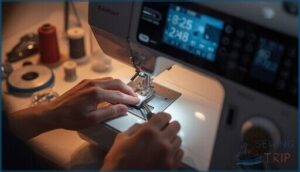
Your computerized sewing machine won’t run forever without a little care. Regular maintenance keeps the LCD display accurate and the stitches clean.
Here’s what you need to know to keep your machine working like new.
Regular Cleaning and Oiling Practices
Keeping your computerized sewing machine in top shape means sticking to a simple routine. Clean the bobbin area and feed dogs every 8–10 hours of sewing—or after every lint-heavy project with fleece or flannel. Most modern machines don’t need oiling, but if yours does, add a single drop every 7–8 hours of use. Professional servicing once a year keeps everything calibrated. Neglecting these steps leads to jamming, louder operation, and costly repairs down the road.
| Task | Frequency | Tools & Notes |
|---|---|---|
| Light cleaning (bobbin area, feed dogs) | Every 8–10 hours or after lint-heavy fabrics | Small nylon brush, tweezers; avoid canned air |
| Deep cleaning (needle plate removed) | Every 3–6 months | Lint-free cloth, access internal race and hook |
| Oiling (if required) | Every 7–8 hours of active use | One drop of sewing machine oil only; many models are oil-free |
| Exterior wipe-down | Weekly or monthly | Soft cloth; reduces dust migration into vents |
| Professional servicing | Annually (heavy use) or every 1–2 years | Full calibration, internal lubrication, timing check |
Needle and Thread Replacement
Your machine runs smoothly when you swap needles every 6–8 hours of sewing. Most users follow an “8-project rule,” replacing them after eight jobs or when switching to heavier fabrics. Skipped stitches, fabric snags, and thread breakage signal it’s time. Quickset bobbin systems and needle threading system parts also wear—automatic threaders generally last 150 cycles before alignment drifts.
Why needle lifespan matters for your projects:
- A dull needle causes up to 80% of skipped stitch incidents
- Thread breakage drops 30% with fresh, correctly sized needles
- Threader reliability declines after 150 threading cycles
- Replacement costs run £1.60–£4.80 weekly in multi-head setups
- Proper replacement indicators—uneven stitching, fraying—prevent fabric damage
Regular changes boost output quality by 15% and cut downtime by 20%. Keep spare needles, bobbins, and accessories on hand for uninterrupted sewing.
Common Issues and Quick Fixes
Birdnesting and thread bunching often stem from improper upper threading—rethread your machine and check both tensions. Skipped stitches signal a bent or dull needle; replace it and match size to fabric weight.
Fabric feeding issues? Clean lint from feed dogs and bobbin area after every 10–15 hours.
Motor problems usually mean it’s time for oiling and internal cleaning to restore smooth operation.
Proper Storage and Longevity Tips
To preserve your computerized sewing machine, store it in a space with temperature control between 32–86°F and humidity levels around 40–60%. Use a protective hard cover for dust protection and unplug it for electrical safety.
Follow manufacturer maintenance intervals—annual servicing extends lifespan by up to 15 years. Keep accessory storage organized and avoid direct sunlight to maintain LCD screen clarity.
Frequently Asked Questions (FAQs)
What is the disadvantages of computerized sewing machine?
While modern technology promises convenience, computerized sewing machines demand higher repair costs, struggle with power sensitivity, and overwhelm users with feature overload.
Technical issues plague 12–15% within five years. The steep learning curve means 72% need training. Display complexity frustrates beginners constantly.
What is the most reliable brand of sewing machine?
Brother leads reliability with an 89% satisfaction score and 25-year warranty coverage. Janome follows closely at 85%, while Bernina maintains premium durability with under 2% malfunction rates.
Your brand choice depends on budget, but all three offer outstanding longevity and dependable repair support.
What does the digital display do on a sewing machine?
The digital display is your control center. It shows stitch previews before you sew, lets you adjust settings with precision, flags errors instantly, and tracks your progress.
Touch controls make customization simple. You’re basically holding your entire project’s blueprint right there.
Are computerized sewing machines worth it?
Whether computerized sewing machines justify their cost depends on your commitment. Casual sewers might find mechanical models sufficient and more budget-friendly initially. If you’ll use sophisticated features regularly, the precision, time savings, and lower resale depreciation make them worthwhile.
How do computerized sewing machines differ from mechanical ones?
Computerized machines offer 50–600 built-in stitches versus mechanical’s 10– You get automatic needle threading, one-step buttonholes, and LCD-guided precision instead of manual dials.
Computerized models cost more upfront but deliver faster, complex designs with minimal learning curve.
Are computerized sewing machines suitable for beginners?
Yes, they’re excellent for beginners. LCD displays slash your learning curve—most novices feel confident within three hours. Automatic threading cuts setup time by 43%, while error guidance reduces mistakes by 37%.
Entry-level models start at $250, offering real value and 21% higher retention rates than mechanical alternatives.
What is the lifespan of computerized sewing machines?
Your machine’s lifespan depends on build quality, maintenance, and component failure rates. Expect 5–25 years: budget models last 5 years, quality machines exceed 10. Electronics fail first.
Warranty coverage reflects this: 25 years on the head, only 1–5 years on electronics. Annual servicing extends life considerably.
Can computerized sewing machines connect to computers?
Many modern models support USB and Wi-Fi connectivity for design import and data transfer. You can upload embroidery patterns directly from your mobile device, enabling integrated workflow integration with advanced technology for enhanced customization and remote monitoring capabilities.
How do I update the software on my sewing machine?
Most modern programmable sewing machines use USB firmware updates. Download the file from your manufacturer’s website, format a USB stick to FAT32, and place the file in the root directory. Back up your settings first. Installation takes three to five minutes. Contact authorized technicians if troubleshooting becomes necessary.
How much electricity do these machines use?
Think of electricity like thread—the finer your stitch, the less you use. Computerized sewing machines generally draw 70-100 watts during operation. One hour daily costs roughly $3 annually.
Energy-efficient models with eco-mode settings cut consumption by half, making them wallet-friendly investments.
Conclusion
Your sewing journey transforms the moment your fingers touch an LCD screen instead of fumbling through manual adjustments. A computerized sewing machine with an LCD display doesn’t just show you what’s next—it removes the guesswork entirely.
Tension automatically corrects itself. Stitches preview before you commit. Errors flag instantly. You’ve stopped fighting your machine and started creating.
That’s the real power: technology that listens to your vision and executes it faithfully, letting your creativity lead.
- https://www.gminsights.com/industry-analysis/computerized-sewing-and-embroidery-machine-market
- https://www.marketgrowthreports.com/market-reports/home-sewing-machines-market-112738
- https://finance.yahoo.com/news/computerized-sewing-embroidery-machine-market-140500776.html
- https://www.globenewswire.com/news-release/2025/02/21/3030475/32656/en/Computerized-Sewing-and-Embroidery-Machine-Market-Set-to-Grow-at-4-8-CAGR-Reaching-USD-3-6-Billion-by-2035-as-Adoption-Rises-in-Fashion-and-Textile-Industries-Report-by-TMR.html
- https://www.reddit.com/r/Machine_Embroidery/comments/16y75hg/machine_power_consumption/