This site is supported by our readers. We may earn a commission, at no cost to you, if you purchase through links.
You pull thread through fabric, and suddenly a plain seam transforms into something your grandmother would recognize—a blanket stitch edging a wool throw, chain stitch tracing a collar. Decorative hand stitch types turn functional sewing into an art form, each with its own rhythm and purpose.
Blanket stitch secures edges while adding texture. Chain stitch flows like cursive across cloth. Cross stitch builds images one X at a time. These aren’t relics from the past—they’re techniques that give your work a handmade signature no machine can replicate.
Master five core stitches, and you’ll have the foundation to embellish anything from denim jackets to linen napkins with confidence and precision.
Table Of Contents
Key Takeaways
- Master five foundational stitches—blanket, chain, cross, satin, and stem—to unlock the full range of decorative hand embroidery without needing dozens of techniques.
- Match your needle size and thread weight to your fabric type, then practice tension control on scraps before committing to final pieces to avoid puckering and uneven stitches.
- Decorative stitches transform functional sewing into personalized art on garments, quilts, and accessories, creating handmade signatures that machines can’t replicate.
- Secure your fabric in an embroidery hoop and use water-soluble markers to maintain even spacing and stitch alignment, preventing the frustration of crooked lines and loose tension.
Essential Decorative Hand Stitch Types
Decorative hand stitches transform plain fabric into something special. You don’t need to master dozens of techniques—just a handful of essential stitches will open up a world of creative possibilities.
Whether you’re working by hand or switching to a machine, understanding basic machine stitch types helps you choose the right technique for any decorative project.
Here are eight foundational decorative stitches that every textile artist should know.
Blanket Stitch
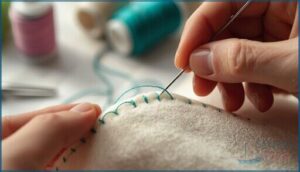
The blanket stitch creates a sturdy, decorative edge finish with uniform loops that lock raw fabric edges beautifully. You’ll pass the needle behind each previous stitch to form those satisfying border designs.
It’s your go-to for appliqué work, felt projects, and quilt edges. Master tension control and stitch variations to make your edge stitching go from basic to bold.
For more about this technique’s rich legacy, explore the history of blanket stitch.
Chain Stitch
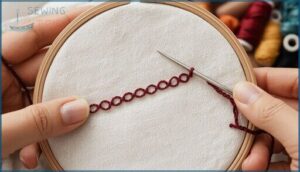
Chain stitch creates interlocking loops that flow like a continuous line across your fabric. You’ll enter and exit through the same hole, forming those satisfying connected links.
It’s perfect for bold outlines and filling narrow spaces with texture. Master chain stitch basics by controlling stitch tension and experimenting with stitch variations—tight loops for definition, loose ones for an airier feel.
For more on the fundamentals of this stitch, review these helpful chain stitch technique resources.
Feather Stitch
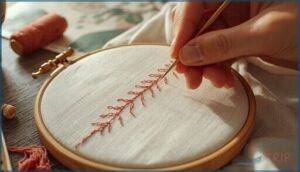
Feather stitch basics start with V-shaped spokes that alternate left and right along a central line, creating a delicate, branch-like pattern. You’ll work from the baseline outward, forming those soft scalloped edges that bring organic flow to borders and vines.
Stitch variations like closed feather or double feather adjust spacing for denser or airier effects. Thread selection matters—embroidery floss adds texture, while single strands keep it subtle.
Cross Stitch
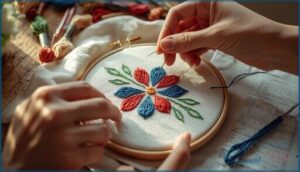
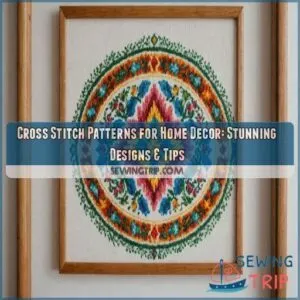
You’ll recognize cross stitch by those iconic X shapes that build up decorative patterns one counted square at a time. Start with 14 to 18 count Aida fabric—its evenly spaced holes guide your needle perfectly. Separate six-strand embroidery floss into pairs for crisp coverage.
- Cross stitch basics rely on two diagonal running stitches crossing at the center
- Stitch variations include half cross, three-quarter cross, and backstitch outlines
- Fabric counts determine detail level—higher counts create finer embroidery patterns
- Embroidery floss strand thickness affects coverage and texture in hand stitching
- Cross stitch patterns use color-coded charts for accurate decorative stitches placement
Satin Stitch
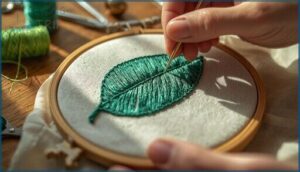
When you fill a shape with smooth, side-by-side parallel stitches, you’re creating satin stitch—an embroidery technique that mimics real satin fabric.
These decorative stitches demand careful tension control and consistent stitch density to prevent gaps or puckering.
Select fine cotton or linen fabric, then practice satin stitch variations like padded or long-and-short fills to master this essential hand stitching skill in your embroidery techniques toolkit.
Stem Stitch
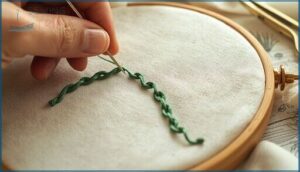
You create a rope like texture when you work stem stitch—a foundational embroidery stitch that forms continuous twisted lines along curved edges or straight paths.
Master stem stitch basics by keeping each loop on the same side and maintaining consistent thread tension throughout.
This hand stitching technique delivers clean embroidery outlines for botanical motifs, lettering, and borders in your embroidery techniques repertoire.
Herringbone Stitch
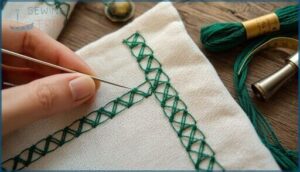
You cross diagonals in opposite directions to form herringbone basics—a zigzag embroidery stitch that mimics woven fabric texture with its V-shaped pattern.
This hand sewing tutorial demonstrates how thread selection and tension control shape your stitch variations, from tight lattice fills to open decorative stitching on medium-weight fabric choices.
Hand stitches like herringbone add dimensional interest to hand embroidery tutorials and garment embellishment.
Fagoting Stitch
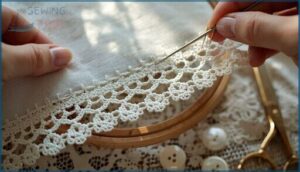
Fagoting stitch joins two fabric edges with an open, lace-like gap that’s captivated textile artists since the 18th century. This decorative edge stitching transforms seams into breathable embellishments through crossed threads that mimic lace techniques.
Key fagoting history applications:
- Heirloom sewing – Period costume collars and cuffs showcase authentic fabric selection
- Modern embellishment ideas – Hand embroidery tutorials adapt stitch variations for contemporary garments
- Hand stitching projects – Fine embroidery stitch patterns create elegant openwork joins
Techniques for Mastering Decorative Stitches
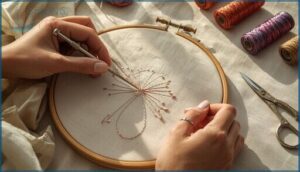
Mastering decorative stitches isn’t just about knowing the patterns—it’s about understanding the tools and materials that make each stitch shine.
You’ll need to match your thread weight to your fabric, choose needles that won’t fight you, and mark your fabric so every stitch lands exactly where you want it. Let’s break down the techniques that’ll take your decorative stitching from wobbly to confident.
Thread Selection and Preparation
Your choice of thread materials shapes every stitch you’ll make—cotton embroidery floss gives you a matte finish perfect for satin stitches, while polyester offers vibrant color that won’t fade.
Match thread thickness to your fabric weight, then condition it with a dab of beeswax to prevent tangling. Plan your color palette using just two to three shades for harmony in your needlework.
Needle Selection for Decorative Stitches
Match your needle sharpness and point types to your thread compatibility for stitches that truly shine. A microtex sharp needle between size 60 and 90 glides through woven fabrics, while a larger eye prevents metallic or thick embroidery threads from fraying.
- Test needle-thread pairs on scrap fabric before stitching your final piece
- Use ballpoint needles on knits to prevent runs during hand stitching techniques
- Replace dull needles immediately to maintain tension control and precision
- Choose topstitch needles with wider grooves for heavy decorative threads
Fabric Considerations and Marking
Your fabric texture shapes how thread selection and marking tools work together. Cotton and linen hold hand stitches crisply, while satin can hide small details.
Check grain alignment with chalk pencils or water soluble pens before stitching—these marking tools vanish after washing. Test color fastness on scraps first.
Prewashing prevents dye bleed during embroidery techniques, protecting your fabric decoration and hand sewing investment.
Maintaining Even Tension and Spacing
Thread tension separates amateur work from polished hand stitches. Pull too tight and your fabric puckers; too loose and your embroidery stitches sag. Adjust tension so running stitch, backstitch, and whip stitch sit flat without gaps.
Even spacing keeps decorative lines rhythmic—test stitch length on scraps first. An embroidery hoop locks fabric stability, letting you control thread tension uniformly across every pass.
Popular Uses for Decorative Hand Stitches
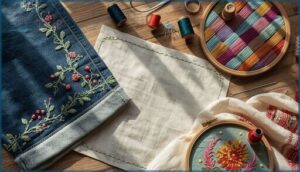
You can transform ordinary fabric into something remarkable with decorative hand stitches. These techniques work beautifully on everything from vintage jeans to heirloom quilts, giving you control over every detail.
Let’s look at four ways you’ll use decorative stitches to enhance your projects.
Embellishing Garments and Accessories
You can transform a plain tee or vintage jacket with strategic Stitch Placement—satin fills on pockets, chain lines along sleeves.
Accessory Making thrives when you add Hand Stitching to bags or scarves.
Garment Upcycling becomes art through thoughtful Embellishment Design and Fabric Selection.
Hand embroidered Edges and Embroidery stitches turn everyday pieces into one-of-a-kind treasures. Your Embroidery techniques make personal style unforgettable.
Decorative Edges and Borders
Borders showcase your artistry along hems, necklines, and cuffs with deliberate flair. Buttonhole stitch reinforces while Lace Borders echo vintage romance. Fringe Techniques add movement, and Picot Ed creates delicate loops. Hand embroidered Edges with Hemstitch or Scalloped edge stitching frame your work beautifully.
- Ribbon Edging brings glossy definition to seams
- Fagoting stitch bridges two fabric edges with open airiness
- Picot loops form tiny beads along borders
- Blanket stitch secures raw edges with soft loops
- Satin borders create smooth, raised outlines
Appliqué and Patchwork Designs
You bring shapes to life on cloth by layering cutouts onto a background—that’s Appliqué in its purest form. Fabric Selection drives contrast, while Edge Finishing with Blanket stitch or Whip Stitch locks raw edges.
Patchwork Patterns assemble small pieces into quilts or banners using precise Edge stitches. Hand Stitches like running stitch secure Appliqué Methods, and Quilting Techniques add dimension to Embroidery Designs.
Embroidery Patterns and Motifs
You choose Embroidery Patterns that reflect personal style—Floral Designs bloom with satin-stitch petals, while Geometric Motifs sharpen edges through backstitch grids.
Cultural Icons like paisley honor Historic Trends, and Abstract Patterns flow with stem-stitch spirals.
Needlework and Stitching turn fabric into storytelling canvases, blending Embroidery Designs with your vision. Stitch Patterns shift from heirloom to contemporary, making each piece uniquely yours.
Top Tools and Supplies for Decorative Hand Stitching
You can’t create beautiful decorative stitches with subpar tools. The right needles, fabric, and marking supplies make the difference between frustration and flow.
Here are eight essential tools that’ll set you up for success, whether you’re adding delicate embroidery to a vintage dress or experimenting with bold surface designs.
1. Bohin Big Eye Sharp Needles
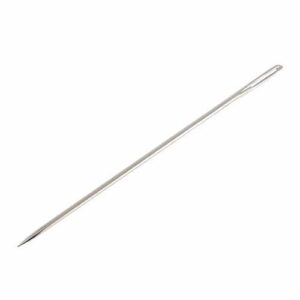
You can’t thread a needle if you’re fighting the eye of needle. Bohin Big Eye Sharp Needles solve this with an elongated opening that welcomes embroidery floss and multiple strands without fraying. Made in France from nickel-plated steel, these needles glide through woven fabrics cleanly.
The pack includes sizes 3 through 9, covering light cotton to medium linens. Each needle measures three inches long and features a polished eye that prevents thread catching. They’re ideal for cross stitch, crewel work, and quick decorative projects where precision matters.
| Best For | Embroiderers and hand-sewers who struggle with threading traditional needles or frequently work with multiple strands of floss. |
|---|---|
| Primary Use | Hand sewing |
| Material | Stainless steel |
| Brand | Bohin |
| Quantity | 1 needle |
| Skill Level | All levels |
| Key Benefit | Easy threading |
| Additional Features |
|
- Extra-large eye makes threading quick and frustration-free, even with thick embroidery floss or multiple strands
- Sharp points glide smoothly through fabric without snagging or pulling threads
- Quality French-made stainless steel construction resists rust and bending during regular use
- Some needles arrive with rough or jagged eye edges that make threading difficult despite the larger opening
- Three-inch length limits how many stitches you can load on the shaft at once
- Not strong enough for heavy fabrics or tough materials like denim or canvas
2. DMC Tapestry Hand Needles
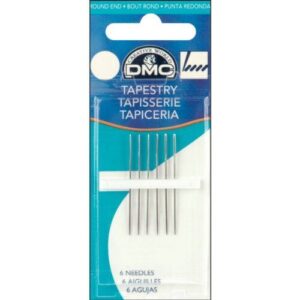
When you’re working with multiple strands of wool or thick embroidery cotton, you need a needle that won’t buckle. DMC Tapestry Hand Needles feature blunt round tips that glide through canvas without snagging fibers. The elongated oval eye carries up to six strands smoothly, while the nickel plated steel resists rust through countless projects.
Size 22 measures about two inches long. These needles handle cross stitch and needlepoint with ease, keeping tension even across open weave fabrics. Store them dry to prevent corrosion.
| Best For | Crafters working on cross-stitch or needlepoint projects with tapestry wool or thick embroidery thread who need durable needles that won’t snag canvas. |
|---|---|
| Primary Use | Cross-stitch & needlepoint |
| Material | Nickel plated steel |
| Brand | DMC |
| Quantity | 6 needles |
| Skill Level | All levels |
| Key Benefit | Large eye threading |
| Additional Features |
|
- Large oval eye makes threading multiple strands easy without frustration
- Blunt tip glides through open weave fabric without catching or tearing fibers
- Nickel plated steel construction resists rust and holds up through repeated use
- Size 22 may be too large for delicate or fine-detail cross-stitch work
- Quality control issues reported with some needles arriving bent or defective
- Limited to thicker threads and won’t work well with fine embroidery floss
3. Milliners Hand Sewing Needles
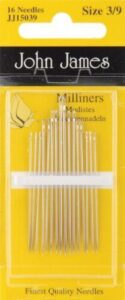
Long stitches demand long needles. Milliners needles stay thin from sharp tip to round eye, making them perfect for bullion knots and French wraps where the shaft slides through fabric folds without catching.
Colonial Needle’s English version offers gold-plated eyes that won’t shred delicate threads, while the nickel tip penetrates smoothly. Sizes 3 through 9 cover most decorative work. You’ll thread them easier than expected despite the slender profile.
They excel at basting long hems and gathering ruffles too.
| Best For | Sewers who do decorative stitching like bullion knots, French wraps, and basting work that requires long, slender needles that won’t snag fabric. |
|---|---|
| Primary Use | Hand sewing & embroidery |
| Material | Nickel & gold plated |
| Brand | Colonial Needle |
| Quantity | 16 needles |
| Skill Level | All levels |
| Key Benefit | Gold plated eye |
| Additional Features |
|
- Gold-plated elliptical eye makes threading easier than you’d expect for such a thin needle
- Stays uniform in thickness from tip to eye, so it glides through fabric folds without catching
- Nickel-plated sharp tip penetrates smoothly through various fabrics
- Needles run smaller than some users expect, which can be surprising if you’re used to other brands
- Threading may still be challenging for people with limited dexterity despite the gold-plated eye
- On the shorter side if you prefer longer needles for certain projects
4. Clover Quilting Needles
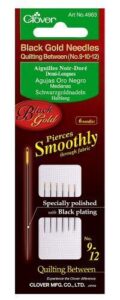
Short needles make tight stitches happen. Clover Quilting Needles come in assorted sizes—No. 9, No. 10, and No. 12—each one stainless steel with a sharp point that pierces smoothly without snagging. The round eye threads easily with standard cotton or polyester.
You’ll notice the short shaft gives you better control for detailed work, whether you’re quilting layers or adding appliqué. Six needles per pack means you’ll have backups when one dulls. They’re rust-resistant and polished to reduce friction as you stitch.
| Best For | Hand quilters and appliqué enthusiasts who want precision stitching and don’t mind threading smaller needles. |
|---|---|
| Primary Use | Quilting & applique |
| Material | Metal |
| Brand | Clover |
| Quantity | 6 needles |
| Skill Level | All levels |
| Key Benefit | Smooth piercing |
| Additional Features |
|
- Short shaft gives you better control for tight, even stitches
- Sharp points pierce fabric smoothly without snagging or pulling
- Rust-resistant stainless steel stays smooth and durable through projects
- Small eye can be tricky to thread without a needle threader
- Delicate construction means they can break if you’re not gentle
- Not ideal if you have larger hands or struggle with fine motor tasks
5. Roc Lon Cotton Muslin Fabric
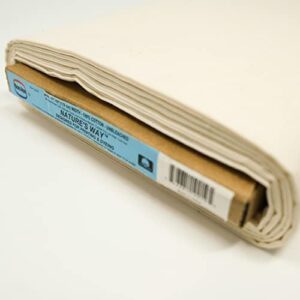
Practice stitches need something forgiving fabric beneath your needle. Roc Lon Cotton Muslin offers a 100 percent cotton plain weave in 44–45 inch widths—plenty for sampling new techniques without wasting good yardage. The soft hand drapes naturally, and the fine uniform weave won’t distort under tension.
You can choose bleached for a bright white base or unbleached for a cream tone. Either way, the breathable fabric accepts thread cleanly and shows stitch detail clearly, making it ideal for testing decorative patterns before stitching your final piece.
| Best For | Sewers who want an affordable practice fabric for testing stitches, making garment mock-ups, or trying out new techniques before working with expensive materials. |
|---|---|
| Primary Use | Fabric crafting |
| Material | 100% cotton |
| Brand | Not specified |
| Quantity | 10 yards |
| Skill Level | All levels |
| Key Benefit | Versatile crafting |
| Additional Features |
|
- Soft, breathable 100% cotton that drapes naturally and handles like real garment fabric
- Wide 47/48″ width gives you plenty of room for larger projects or multiple samples
- Available in bleached or unbleached options, and the fine weave accepts dye and shows stitch detail clearly
- Expect 6-8% shrinkage after washing, so you’ll need to account for that in your cuts
- Some bolts may have fuzzy spots or black cotton husk particles that affect appearance
- Quality can be inconsistent between different bolts, which might be frustrating if you need precise matching
6. Caydo Embroidery Hoop Set
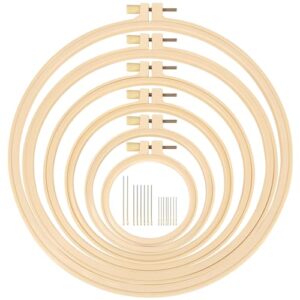
Once you’ve selected practice fabric, you need a way to keep it taut. The Caydo Embroidery Hoop Set includes six plastic hoops ranging from 3.6 inches to 10.7 inches, each with adjustable screws and anti-slip embossing.
The clever ridge design grips fabric firmly so your stitches stay even. You’ll also get sixteen embroidery needles in three sizes. The lightweight construction won’t warp over time, and the smooth inner rims prevent snagging as you work decorative patterns.
| Best For | Embroidery beginners and DIY enthusiasts looking for an affordable, multi-size hoop set to practice basic stitching techniques and small decorative projects. |
|---|---|
| Primary Use | Embroidery |
| Material | PP plastic |
| Brand | Caydo |
| Quantity | 6 hoops & 16 needles |
| Skill Level | Beginner friendly |
| Key Benefit | Keeps fabric taut |
| Additional Features |
|
- Comes with six different hoop sizes (3.6″ to 10.7″) so you can tackle various project scales without buying additional hoops
- Includes 16 needles in three sizes, giving you everything needed to start embroidering right away
- Ridge design and anti-slip texture keep fabric secure and taut for cleaner, more even stitches
- Plastic construction feels flimsy compared to wood or metal hoops and may slip during use
- Not sturdy enough for large or complex embroidery work that requires consistent tension
- Product photos and “wood” color listing can be misleading since the hoops are actually plastic
7. Okxiri Fabric Marking Kit
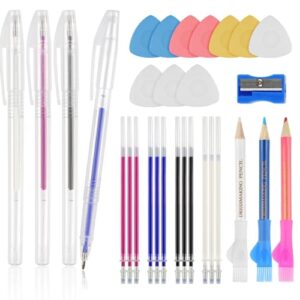
Now that you’ve got fabric secured in a hoop, you need clear guidelines. The Okxiri Fabric Marking Kit includes ten tailor’s chalks, four heat-erasable pens with 0.7mm tips, and three water-soluble pencils. Each pen comes with refills, and the pencils feature brush caps for quick fixes.
You’ll get smooth lines without messy powder. These markers work on cotton, linen, and blends—just test on scrap fabric first. The portable case keeps everything organized, whether you’re marking hems or tracing intricate embroidery motifs.
| Best For | Sewers and quilters who need multiple marking options for different fabrics and want an all-in-one kit that handles everything from hem adjustments to detailed embroidery tracing. |
|---|---|
| Primary Use | Fabric marking |
| Material | Mixed materials |
| Brand | Okxiri |
| Quantity | 10 chalks & 7 pens/pencils |
| Skill Level | All levels |
| Key Benefit | Precise marking |
| Additional Features |
|
- Gives you three different marking methods (chalk, heat-erasable, water-soluble) so you can match the tool to your fabric type
- The 0.7mm fine tips on the pens let you trace intricate patterns and make precise measurements without thick, clumsy lines
- Comes with refills and brush caps for corrections, plus a portable case that keeps all 17 pieces organized in one spot
- The chalks can break during shipping if the packaging isn’t protective enough, and they leave some mess despite being smoother than typical chalk
- Heat-erasable pen marks might not fully disappear with ironing and can reappear if the fabric gets cold later
- The plastic components feel cheap, and the pens and pencils run out of ink faster than you’d expect for the price
8. Water Soluble Embroidery Stabilizer Paper
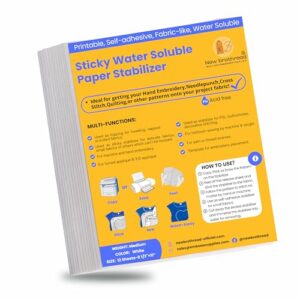
Your marks are only guides—the fabric underneath needs backup support. Water Soluble Embroidery Stabilizer Paper gives delicate materials like chiffon and silk a temporary foundation during stitching. This 8.5″x11″ sheet features a sticky side that holds fabric without pins or hoop marks.
The medium-weight paper prevents puckering on twelve pieces per pack. Once you finish your decorative stitches, rinse with cool water and the stabilizer dissolves completely. It’s non-toxic and leaves zero residue behind, perfect for wearable pieces requiring precision stitching.
| Best For | Embroiderers working with delicate fabrics like silk or chiffon who need temporary support without hoop marks or residue. |
|---|---|
| Primary Use | Embroidery stabilizing |
| Material | Natural material |
| Brand | Not specified |
| Quantity | 12 sheets |
| Skill Level | All levels |
| Key Benefit | Easy pattern transfer |
| Additional Features |
|
- Sticky backing holds fabric securely without pins, preventing shifting during stitching
- Dissolves completely in cold water with no residue, making cleanup quick and easy
- Medium weight prevents puckering on delicate materials while providing enough stability for detailed work
- Printer ink may not dissolve fully in water, requiring water-erasable pens for light fabrics instead
- Requires careful rinsing to avoid leaving any stabilizer residue behind
- May not work with all printer types or marking tools, limiting transfer options
Tips for Beginners Practicing Decorative Stitches
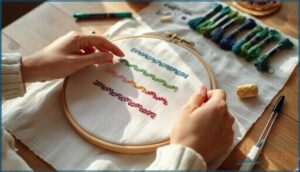
Learning decorative stitches takes practice, but a few simple habits can save you hours of frustration. You’ll develop muscle memory faster when you set yourself up for success from the start.
Here are the essential tips that’ll help you build confidence and avoid the most common beginner mistakes.
Practicing on Fabric Scraps
Scrap preparation is your secret weapon for mastering decorative stitches without wasting good fabric. Wash and dry all scraps first to remove sizing that causes puckering, then cut them into uniform 3-by-3-inch panels for consistent practice routines.
Wash, dry, and cut fabric scraps into uniform 3-by-3-inch panels to practice decorative stitches without wasting good material
- Label each scrap with fabric type to compare how stitch tension behaves across different materials
- Create simple grids using erasable markers to maintain even spacing during hand stitching
- Store finished scraps in a labeled container to track your embroidery progress over time
Using Embroidery Hoops for Control
A sturdy hoop transforms hand stitching from frustrating to fluid by locking your fabric taut.
Hoop selection matters—wooden frames grip cotton naturally, while metal hoops maintain tension control for extended embroidery sessions.
Position your design at dead center for stitch alignment, then tighten the screw until fabric resists gentle tugging.
This fabric stability gives you embroidery precision that feels almost seamless, letting decorative needlework shine.
Securing Knots and Thread Ends
Precision in knot tying turns loose thread ends into invisible anchors that won’t unravel mid-project. Bury your starting tail through three adjacent stitches using a whip stitch motion, then trim close for fray prevention.
French tacks and ladder stitch techniques create secure fastening without bulk. When finishing, weave your thread backward through existing stitches—this buried stitch method beats visible knots every time.
Achieving Consistent Stitch Lengths
Even stitch lengths make your embroidery look polished instead of chaotic. Keep your needle alignment consistent and use fabric stabilization techniques to prevent unwanted shifts while you work.
Three quick stitch regulation methods to lock in uniformity:
- Mark evenly spaced dots with a water-soluble pen before starting
- Use stitch length control by keeping your thumb at the same anchor point
- Practice thread tension management until your hand finds its rhythm
Preventing Thread Tangles and Frays
Tangled thread can derail your best work in seconds. Snip your thread ends cleanly with sharp scissors to prevent frays at entry points.
Choose a needle with a larger eye to reduce friction during hand sewing. Apply beeswax to cotton thread for tangle reduction and smoother glide.
Keep your fabric handling gentle and stable—loose fabric causes loops that snag during stitching.
Frequently Asked Questions (FAQs)
What is the difference between goldwork and whitework?
Goldwork shines with metal thread laid on fabric, creating a luxurious glint, while whitework relies on white stitches on white fabric for subtle texture—one dazzles, the other whispers elegance.
How do you repair mistakes in decorative stitching?
When you spot a mistake, gently remove wrong stitches with a seam ripper, then reweave the gap using slip stitch or ladder stitch.
For error concealment, overstitch with matching thread to blend the repair seamlessly.
Can decorative stitches be combined in one project?
Yes, you can absolutely combine decorative stitches.
Layer different Stitch Patterns for Texture Mixing—like chain outlines with satin fills.
Use Color Contrast between adjacent Hand-Applied Decorative Stitches in Dressmaking while managing Stitch Density to prevent puckering.
What are the best stitches for leather embellishment?
Saddle stitch moves through leather like a zipper—secure and rhythmic.
Running stitch adds delicate detail, while herringbone guards edges.
Choose 0 mm spacing with sharp awls for clean, embellished seams, and note that waxed thread highlights patterns.
How do you transfer patterns onto dark fabrics?
You can use white carbon paper, chalk markers, or water-soluble stabilizer sheets to transfer hand stitching and embroidery patterns onto dark fabrics.
Light tracing works on thinner materials, while prick pounce accommodates heavy weaves.
Conclusion
Your needle catches light as it pierces fabric, leaving a trail of texture behind. Each stitch—blanket, chain, feather—becomes muscle memory with practice.
These decorative hand stitch types aren’t about precision; they’re about intention. Start with one technique, master its rhythm, then layer in others. The tools matter less than your willingness to slow down and let thread tell its story.
Your hands already know how to create something worth keeping.