This site is supported by our readers. We may earn a commission, at no cost to you, if you purchase through links.
Bias tape has a reputation for being finicky—the kind of technique sewists avoid until they absolutely can’t. A neckline frays, a quilt edge needs finishing, a garment cries out for a clean bound hem, and suddenly there’s no getting around it.
Here’s the thing: bias tape isn’t hard. It just requires understanding a few mechanics before you touch the machine. The "bias" part—fabric cut at a 45-degree angle to the grain—is what gives the tape its stretch, letting it ease around curves without pulling or puckering.
Once you get that, the rest clicks into place. Knowing how to sew bias tape opens up a whole category of finishes that look polished, hold up beautifully, and honestly make your work look like you’ve been doing this for years.
Table Of Contents
Key Takeaways
- Bias tape’s 45-degree cut is what gives it stretch, and once you understand that, fitting it around curves and corners stops being a mystery.
- Whether you choose single fold for clean invisible facings or double fold to fully encase a raw edge, picking the right tape style before you start saves you from reworking the whole thing later.
- Steam-shaping your tape before pinning curves, using a walking foot, and slightly lowering thread tension are the three habits that separate polished results from puckered ones.
- You can make your own bias tape from any fabric scraps by cutting strips at a true 45-degree angle, joining them diagonally, and pressing them through a bias tape maker—giving you perfect color matches and custom widths every time.
How to Sew Bias Tape: Quick Step-by-Step Method
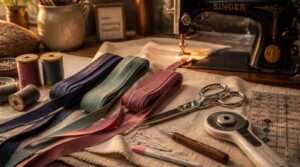
Sewing bias tape isn’t complicated once you know the order of operations. The whole process comes down to five straightforward steps, and if you follow them in sequence, you’ll get clean results every single time. Here’s exactly what to do.
If your machine’s speed feels unpredictable, mastering sewing machine speed control for beginners will make those five steps feel much more manageable.
Choose The Right Tape
Pick your tape first — it shapes everything else. Edge binding comes in two styles:
- Single fold bias tape — for facings and finishes
- Double fold bias tape — encases raw edges cleanly
- Backing material — woven cotton flexes on curves
- Adhesive tack — fabric tape sews; skip craft adhesives
- Removability — cotton washes clean; blends hold longer
Your tape choice sets the whole project up.
Open The Folded Edge
Once you’ve got your tape, unfold just one crease flat — that single fold becomes your guide line. Press it lightly so it stays crisp; this protects tape width accuracy.
Unfold gently, without tugging, or you’ll stretch the bias and lose edge alignment precision before you even pin a thing.
Match Raw Fabric Edges
Now lay that open edge right against your fabric’s raw edge, right sides together. Line them up edge to edge, no gaps, no overhang—this keeps grain alignment true and stops edge drift before it starts.
Using various edge finishing techniques can help prevent fraying and unraveling in your project.
Pin every inch or so, perpendicular to the edge. On curves, add more pins; that fabric wants to shift. A quick baste stitch helps lock things in before you commit.
Stitch Along First Fold
Set your machine to a stitch length of 1.8–2.5 mm — shorter than your usual straight stitch. Sew right along that first fold line, letting the presser foot glide smoothly without tugging the tape.
Backstitch at both ends to lock everything in place. Keep your seam allowance consistent; the fold is your guide, so trust it.
Fold, Press, and Topstitch
Wrap the tape over the raw edge to the wrong side, then press firmly with a hot iron to set that fold crisp. Keep the fabric flat so no new puckers sneak in.
Topstitch 1/8 to 1/4 inch from the folded edge, matching your thread color so the stitching disappears into the fabric. Clean, simple, done.
How to Cut and Make Bias Tape
Making your own bias tape is easier than it sounds, and honestly, it opens up a whole new level of control over your sewing projects. The key is getting a few foundational steps right — from finding the true bias to pressing your strips into shape. Here’s exactly how to do it.
Once your bias tape is ready, finishing raw edges by hemming your shirt by hand lets you apply that same careful pressing technique for a clean, polished result.
Find The True Bias
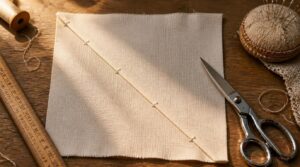
Ever notice fabric stretches more one way? That’s the bias grain, the diagonal pull across fabric grainlines. Find it by folding fabric until lengthwise and crosswise grains meet at a true 45-degree angle — that crease is your true bias, the secret behind bias tape’s stretch.
- Fold fabric diagonally
- Line up grainlines
- Crease marks bias
- Check 45-degree angle
- Pin before cutting
Calculate Strip Width
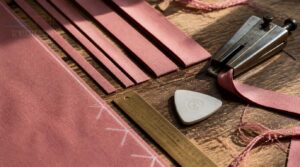
Why guess your strip width? For single fold tape, add 1/4 inch to your finished width; for double fold, add 1/2 inch—that’s fold allowance math.
A 1-inch finished bias needs a 2-inch strip, cut true bias at 45 degrees off grain. Budget 1-2% for shrinkage, then feed continuous bias strips through your bias tape maker for crisp, even, neat folds.
Cut Accurate Bias Strips
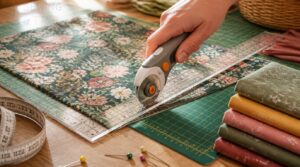
Sharp tools make all the difference here. Use a rotary cutter and clear acrylic ruler — place your pre-washed fabric flat, align the ruler’s 45-degree marking to the fabric grain line, and slice clean diagonal strips.
Ragged blades cause fraying, so replace them regularly. Measure each strip width along the cut edge to keep things consistent.
Join Strips Diagonally
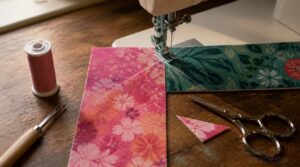
Once you’ve cut your strips, you’ll need to join them end to end. Place two strips right sides together, perpendicular to each other, and draw a diagonal line across the overlapping corner. Stitch along that line, backstitch both ends, then trim to 6 mm.
This diagonal seam distributes bulk evenly and keeps your binding lying flat — no lumpy ridges.
Press With Bias Tape Maker

Feed your joined strip wrong-side up through the metal tip, pulling it gently while pressing with a hot iron right behind the tool — the folds set instantly as they emerge. Most makers handle 6 mm to 25 mm widths, so match your tip to your project.
Once cooled, roll the finished tape onto a cardboard tube to keep those crisp creases intact.
How to Attach Single Fold Bias Tape
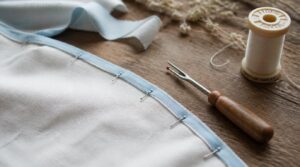
Now that your strips are cut and joined, let’s put that single fold tape to work. This style shines when you want a clean, almost invisible finish instead of a bulky one. Here’s exactly how to sew it on, step by step.
Use for Clean Facings
Single fold bias tape pulls double duty as a clean facing technique — it wraps the raw edge and disappears to the inside, leaving nothing visible from the right side. This works especially well on lightweight fabrics where a bulkier facing would show through.
Choose a woven cotton or cotton mix for the tape so it presses flat and holds its shape wash after wash.
Sew First Fold Line
Once your tape is opened flat, align the raw edge of the tape with the fabric’s right side, matching edges precisely — this is where grainline accuracy really matters.
Stitch along the first fold line at 1.5 mm stitch length. Key things to keep consistent:
- Pin every inch on straight sections
- Use backstitch at both ends
- Keep the fold crease as your stitch guide
- Maintain even seam allowance throughout
Trim Bulky Seam Allowances
Now that your stitch line is secure, grab your sharp scissors and trim the seam allowance down to about half its width — roughly 6 mm. On heavier fabrics, grade the layers by trimming each one a little shorter than the last.
For concave curves, clip small notches into the allowance so the tape turns cleanly without pulling or bunching.
Turn Tape to Underside
With your seam allowance trimmed neat, it’s time for the fun part: flipping that tape under. Use your finger or a blunt tool to ease the edge into place, easing it under the fabric for a smooth, twist-free turn.
Press lightly with moderate heat to set the fold — this keeps your underside flat and stops any peeking on the right side.
Stitch Second Row Neatly
Grab your edge stitch now and lock that fold for good. Keep stitch alignment precision by matching each new stitch above the first row. Check three things every few stitches:
- Tension stays even
- Needle hits the same spot
- Edge lies flat
Pause often—quality checks save your topstitch from puckers, keeping this bias binding technique sharp.
How to Sew Double Fold Bias Tape
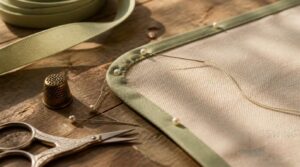
Now let’s talk double fold tape, the real workhorse for raw edges. This one wraps clean around the fabric in a single step, no flipping or second pass needed. Here’s exactly how to get it pinned, sewn, and finished right.
Use for Raw Edges
Double fold bias tape is your best defense against fraying on raw edges — no serger, no French seam, no pinking shears required. It wraps both sides at once, locking stray fibers in completely.
| Finishing Method | Raw Edge Coverage | Best For |
|---|---|---|
| Double fold bias tape | Full enclosure, both sides | Curved seams, necklines, hems |
| Serger overlock | Narrow elastic edge finish | Knits, reinforced seams |
| French seam | Hidden inside enclosed seam | Lightweight woven fabrics |
| Pinked edges | Zigzag cut, partial fraying control | Decorative or low-stress seams |
| Decorative embroidery | Fiber-securing surface stitching | Raw edge design details |
That’s what sets it apart — one step, clean finish, done.
Identify The Wider Side
Look closely at your double fold tape before pinning — one side sits slightly deeper than the other.
Spot it in three seconds:
- Unfold the tape flat and compare both edges
- The wider side shows more fabric from center crease to edge
- When refolded, that wider edge faces outward
Wrong orientation causes misaligned topstitching and uneven edge binding. Flip it right, and everything lines up cleanly.
Sandwich The Fabric Edge
This is where bias tape earns its name — the folded strip wraps your raw fabric edge, enclosing it cleanly on both sides.
Open the tape, slide your fabric edge inside the fold with the wider side facing down. That wider edge ensures the binding covers evenly from front to back, leaving no gaps.
| Placement | Tape Orientation | Result |
|---|---|---|
| Wider side down | Faces the fabric back | Even front-to-back coverage |
| Narrower side up | Faces the fabric front | Guides your topstitch line |
| Edge centered | Aligned with raw edge | Enclosed, gap-free finish |
Press gently to prevent gaps and bulk.
Pin Before Stitching
Pins keep your binding from shifting before a single stitch lands.
Set them perpendicular to the tape edge — they anchor both layers better than parallel pins, which let fabric creep sideways as you sew.
- Space pins 1–2 inches apart on straight sections
- Increase pin density on curves to prevent waviness
- Orient heads toward you for smooth mid-stitch removal
- Replace bent pins — they cause stitching errors
- Re-pin immediately if the edge shifts before you stitch
Topstitch Close to Edge
That final row of stitching is what locks everything in place. Sew close to the open edge — about 1/8 inch — on the right side of your fabric.
This is edgestitching territory, so keep your stitch length around 2.5 mm and use matching thread for a clean, low-profile finish. A walking foot helps both layers feed evenly without creeping.
Bias Tape Tips for Curves, Corners, and Mistakes
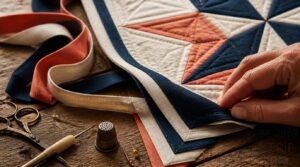
Curves, corners, and the occasional wonky seam — that’s where bias tape either looks polished or falls apart. The good news is that a few targeted tricks make all the difference, and none of them are complicated once you know what to watch for. Here’s what actually works.
Steam-shape Curved Edges
Before you pin a single curve, steam your bias tape first. Hold your iron just above the tape and let the moisture soften those fibers, making the strip pliable enough to follow any arc without buckling.
This little step changes everything. Relaxed fabric fibers mold around necklines and armholes the way stiff tape simply won’t, giving you a smooth, professional edge binding instead of a wavy mess.
Steam-relaxed bias tape molds smoothly around curves, turning wavy edges into a polished, professional finish
Pin Curves More Closely
Once steamed, your tape needs anchor points first—pin the curve’s ends and peak, then fill in every 1 to 2 inches, tighter on sharp curves, even spiraling pins for tricky spots. Sounds fussy? It saves re-dos later.
This pinning density keeps fabric geometry honest. Basting curved sections beforehand never hurts, letting you test the fit before committing to permanent stitches.
Miter Sharp Corners
Sharp corners need a plan. Cut pieces at 45 degrees for true joins; adjust angles for tighter corners. Stop near the tip, apply the needle pivot technique, continue stitching.
- Trim bulk diagonally
- Pin corner tight
- Press flat
- Check fabric stretch
Stretchier bias eases corners cleaner, reducing puckering.
Prevent Puckering
Puckering usually comes down to two things: tension and how you’re feeding the fabric.
Lower your thread tension slightly when working with bias tape — it’s already on the bias and wants to shift. Pair that with a walking foot, which keeps layers moving together evenly.
Press seams with steam after stitching, and most puckers simply relax away.
Fix Uneven Stitching
Why does your stitching suddenly look jagged? Usually it’s tension or a tired needle. Loosen the upper tension slightly, swap in a fresh sharp needle, and match your thread weight to the needle size.
Check your bobbin winding too, since uneven bobbins cause skipped stitches. Slow your fabric feeding, keep stitch length steady, and always retest on scraps first.
Frequently Asked Questions (FAQs)
How to sew double fold bias tape?
Unfold your double fold bias tape and pin the narrower edge to the fabric’s right side, following the grain. Stitch the first fold, wrap the wider edge over, then topstitch close for clean finishing.
How do you sew a bias tape?
Bias binding beautifully cleans raw edges. Open the tape, align it with your fabric edge, stitch the crease, fold it over, press, then topstitch close to the fold. Done.
Can you make bias tape yourself?
Yes, you can absolutely make your own bias tape using fabric scraps or a fat quarter, cutting strips on the true bias, then folding by hand or with a bias tape maker for custom widths and matching patterns.
How do you bind a fabric with a bias tape?
Think of bias tape binding like a warm hug for your fabric’s raw edge. Sandwich the edge inside the tape, pin it snug, and stitch close to the fold—choosing single or double fold based on bulk and curve sharpness.
How do you make bias tape?
Grab your fabric, find the true bias at 45 degrees, then cut strips to your desired width—double for single fold, quadruple for double fold. Fold edges to center, press firmly, and join ends diagonally for smooth bias binding every time.
What is bias tape used for in sewing?
What’s the one notions staple that quietly solves edge fraying, shapes curves, and adds a pop of color all at once? That’s bias tape — your go-to for clean edge finishing on necklines, hems, and seam allowances.
How do you sew double fold bias tape?
Double fold tape sandwiches your raw edge in one tidy step, no facing required. Open it, align the raw edge to the inner fold, stitch that crease, wrap snug, then topstitch close to the open edge for a clean, bulk-free finish.
How do you sew a quilt with bias tape?
Quilts don’t care about your feelings—skip binding, and that edge frays into sad confetti. Cut 2¾-inch strips on the true bias, pin snug to the raw edge, and stitch a scant ¼-inch seam for sturdy, lasting quilt binding.
How do you sew bias tape neatly?
Neat results come from matching thread to your tape, a 0–5 mm stitch length, and steady pressing. Pin every inch, stitch close to the fold, trim seam allowance, and let a walking foot guide the fabric evenly through curves.
Do you sew bias tape to the right side of the fabric?
Yes — sew bias tape right side first. Align the raw edges, pin them, then stitch along the first fold line. Wrap the tape to the wrong side and topstitch to finish.
Conclusion
Think of bias tape like a river learning its banks — it flows best when you stop fighting it and work with its nature. That 45-degree cut is the whole secret. Once you understand why it bends, every curve, corner, and raw edge becomes something you can actually control.
Knowing how to sew bias tape doesn’t just clean up your finishes. It changes how you approach a project — with confidence, not dread.
- https://amylovestosew.com/what-is-the-difference-between-single-and-double-fold-bias-tape
- https://wearinghistoryblog.com/2011/12/how-to-one-step-bias-binding-outside-corners
- https://www.bethanylynnemakes.com/how-to-sew-double-fold-bias-tape
- https://blog.closetcorepatterns.com/how-to-sew-double-fold-bias-tape
- https://inthefolds.com/q-a-series/2019/12/4/issue-attaching-single-fold-bias-binding