This site is supported by our readers. We may earn a commission, at no cost to you, if you purchase through links.
A single skipped stitch can unravel hours of careful work—and nine times out of ten, the culprit isn’t the machine. It’s the thread.
Mismatched weights, wrong needle sizes, or a bobbin loaded at the wrong angle create problems that compound stitch by stitch until the whole seam fails.
Most sewists troubleshoot these issues by instinct, cycling through guesses until something clicks.
Improving thread handling skills changes that entirely—turning frustrating trial-and-error into a reliable, repeatable process where clean stitches become the default, not the exception.
Table Of Contents
Key Takeaways
- Matching your thread type, weight, and needle size to your fabric isn’t optional—it’s the foundation that prevents fraying, skipped stitches, and tension problems before they start.
- Correct machine threading, from spool orientation to bobbin direction, eliminates most stitch failures that sewists mistakenly blame on the machine itself.
- Tension control is a two-sided conversation between your upper dial and bobbin spring, and reading both sides of your fabric tells you exactly where the imbalance lives.
- Building consistent habits—quick threading drills, regular bobbin cleaning, and a thread-fabric test journal—turns troubleshooting from guesswork into a reliable, repeatable process.
Choose The Right Thread and Needle
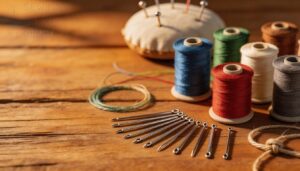
Getting thread and needle selection right is the foundation that everything else builds on. The wrong pairing causes fraying, skipped stitches, and tension problems before you’ve even started.
If you’re already seeing issues, this guide to common sewing stitch problems and fixes can help you trace them back to the source fast.
Here’s what to think about when making your choices.
Matching Thread Type to Fabric
Fiber compatibility shapes every seam you sew. Matching thread type to fabric isn’t guesswork — it’s precision.
- Cotton on cotton ensures absorbency and zero shine
- Silk thread on silk fabric preserves luster through colorfastness considerations
- Thread coating effects reduce friction on slippery synthetics
- Thread sheen matching on satin prevents mismatched surface reflections
Wrong pairings cause fraying, puckering, and weak seams quickly.
Choosing The Correct Thread Weight
Thread weight shapes how your stitch sits on the fabric. Think of it like fabric weight pairing — a 60-weight thread disappears into silk, while 30-weight anchors denim seams with authority.
Stitch weight selection affects flatness, bulk, and finish.
For most woven cottons, 40 to 50 weight hits the sweet spot, keeping seams clean without puckering or pulling the fabric out of shape.
Selecting The Right Needle Size
Just as thread weight shapes your seam, needle size shapes your stitch.
The European Needle Chart runs from 60 to 120 — higher numbers mean larger needles.
Fabric Weight Matching guides your choice: lightweight fabrics need 60/8 to 70/10, while denim demands a Denim Needle Guide size of 90/14 to 110/18.
Ballpoint vs Sharps and Microtex Needle Use depend entirely on your fabric’s weave structure.
Cotton Vs Polyester Vs Silk Thread
Once you’ve matched your needle size, the next decision is your thread material — and it matters more than you’d think.
Cotton offers natural Moisture Absorption and matte Color Vibrancy on woven fabrics. Polyester wins on Fiber Strength, durability, and UV resistance. Silk feels luxurious but demands careful Care Requirements and costs more.
For everyday projects, the Cost Comparison usually tips toward polyester or cotton.
When to Use Specialty Threads
When your project pushes beyond everyday wear, specialty threads step in where standard options fall short.
Heat‑Resistant Applications demand threads rated for industrial temperatures, while UV‑Exposed Projects and Marine Outdoor Gear require fluorocarbon or UV-resistant options to prevent degradation.
Decorative Embellishments call for metallic or variegated threads, and High‑Tensile Workwear needs bonded polyester for repeated stress.
Match the thread to the demand.
Signs of Poor Thread-needle Pairing
Your machine is telling you something when snagging stitches, thread fraying at the eye, or needle deflection appear mid-seam.
Uneven stitch length signals inconsistent feeding, while puckering seams often mean your thread is too heavy for the fabric.
Threading errors compound these issues fast. Sharpening your hand-eye coordination and fine motor skills during setup catches mismatches before they ruin your work.
Master Machine Threading Basics
Getting your machine threaded correctly is the foundation everything else builds on. Even small missteps in the process can throw off your tension, cause skipped stitches, or leave you chasing tangles for the rest of your project.
Here’s what you need to get right from the start.
Following The Correct Thread Path

Think of the upper thread path as a relay race — every handoff matters.
Start with a Guide Alignment Check, then follow the Tension Disc Entry with the presser foot raised. Next, hook the Take-up Lever Path correctly, and finish with Needle Eye Alignment.
Respecting Presser Foot Timing throughout sharpens your threading dexterity, hand-eye coordination, and visual-cue recognition instantly. For faster threading, you can use built‑in needle threader to guide the thread through the needle eye.
Positioning The Spool Properly
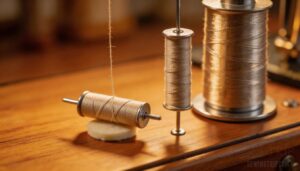
Spool orientation isn’t a small detail — it quietly controls everything downstream. Cross-wound spools feed best from the top on a horizontal pin; stacked spools need a vertical pin so they can rotate freely.
Use the correct cap sizing to secure each spool without blocking the thread path.
Felt pad centering stabilizes loose spools, while thread stand placement holds large cones.
Specialty spool handling prevents metallic and oversized threads from looping or snagging mid-seam.
Threading The Needle Cleanly
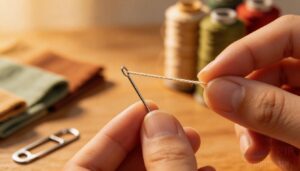
A crooked thread entry wastes more time than the stitch itself. Trim the thread tip at a 45-degree angle using the Clip Cutter Technique for smooth Needle Eye Clearance.
Apply Thread Angle Adjustment by holding the thread taut, then use needle threaders if fine motor skills or hand-eye coordination feel strained. Eye Alignment Tips and threading activities that build bilateral coordination make clean passes second nature.
Winding and Inserting The Bobbin
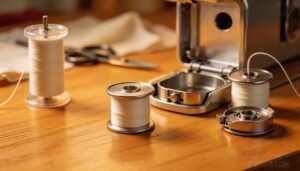
A poorly wound bobbin quietly sabotages your stitches before you even begin. Get this step right, and everything downstream flows cleanly.
- Winder Engagement requires pushing the spindle fully to the right so the mechanism actually catches.
- Spool Cap Usage keeps your thread feeding without slipping or tangling mid-wind.
- Bobbin Fill Level should be even edge-to-edge — never overpacked.
- Drop-In Loading unwinds anticlockwise; Front-Load Case clicks firmly into the shuttle.
Raising The Bobbin Thread Correctly
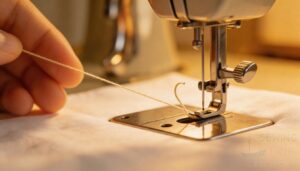
Once bobbin is seated, raise the presser foot to open the tension discs fully. Hold the upper thread firmly, then turn the handwheel toward you — one complete rotation brings the needle down through the needle plate pickup hole and back up, pulling a bobbin thread loop to the surface.
Tug the upper thread gently; that loop appears cleanly. Pull both tails back before stitching.
Common Threading Mistakes Beginners Make
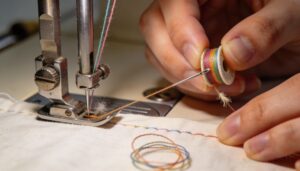
Once both threads are ready, it’s tempting to rush — but that’s exactly where most beginners stumble.
- Take-up Lever Omission skips a critical guide, causing loose loops mid-seam
- Bobbin Direction Error disrupts lower thread tension immediately
- Thread Path Rushing means missing guides, hurting hand-eye coordination and motor planning
- Lint Accumulation Neglect and Dull Needle Usage quietly shred thread over time
Threading activities genuinely build fine motor skills and pattern recognition — slow down and feel each step.
Control Tension for Cleaner Stitches
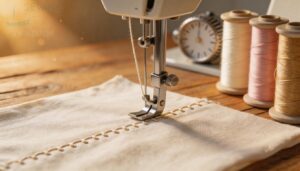
Tension is the quiet force behind every clean seam — get it wrong, and your stitches will tell on you fast.
Learning to read and adjust is one of the most practical skills you can build at the machine.
Here’s what you need to understand to take full control.
How Upper and Bobbin Tension Work
Think of tension as a tug-of-war between two threads meeting inside your fabric. Upper Dial Calibration controls how firmly the top thread passes through the tension discs, while Bobbin Spring Adjustment governs the lower thread’s resistance. Together, they determine Stitch Balance Indicators.
| Tension Source | What It Controls |
|---|---|
| Upper dial | Top thread squeeze |
| Bobbin spring | Lower thread resistance |
| Both combined | Lock point inside fabric |
Thread Color Contrast helps during Tension Testing Methods — use a contrasting thread gauge on the top versus the bobbin to spot imbalance instantly.
Recognizing Balanced Thread Tension
Once you understand how both threads work together, spotting balance becomes straightforward. Stitch Symmetry Check tells you everything — flip your fabric over and compare both sides.
Balanced Thread Tension Indicators include:
- Even stitches on both fabric sides
- No Fabric Puckering Observation or pulling
- Seam Stretch Resistance that holds without snapping
- Contrast Thread Test revealing no loops or knots
Adjusting Tension for Light Fabrics
Light fabrics demand a gentler touch — start your fine tension dial around 3 to 3.5, then make dial incremental adjustments in small steps. Thread tension testing on scrap fabric reveals your fabric stretch response before you commit.
A stitch length tweak to slightly longer settings also reduces crowding. Both sides should look even, with no pulling or drag.
Adjusting Tension for Heavy Fabrics
Heavy fabrics push back — that’s why your tension dial needs to climb to 5 or 6, pulling the bobbin thread deep into thick layers for a locked center stitch. Presser Foot Pressure increases grip on denim without slipping, while Stitch Length Settings of 3.5–4.5mm prevent perforation tears.
- Raise upper tension to 5–6 for canvas and denim
- Apply Walking Foot Use for even Layer Sewing Techniques on thick stacks
- Set Feed Rate Adjustment to match fabric resistance
- Use 40wt polyester thread paired with a 90/14 needle
- Test every adjustment on scrap before committing
Fixing Loops, Puckers, and Skipped Stitches
Spotting the symptom tells you exactly where to look. Loops signal Bobbin Alignment issues, puckers point to tension imbalance, and skipped stitches usually trace back to Needle Timing or a damaged needle.
| Problem | Likely Cause | Fix |
|---|---|---|
| Thread loops | Bobbin Alignment off | Reseat bobbin correctly |
| Fabric puckering | Tension too tight | Lower upper tension |
| Skipped stitches | Needle Timing drift | Replace needle; recheck hook timing |
Stitch Length Tuning and Feed Rate Adjustment resolve most remaining issues — test both on scrap first.
Prevent Tangles, Fraying, and Breaks
Tangles, fraying, and thread breaks are some of the most frustrating interruptions you’ll face at the machine. Most of them aren’t random — they trace back to specific habits and conditions you can actually control.
what to watch for and fix.
Why Thread Twists and Knots
Thread doesn’t knot randomly — it builds twist gradually.
Spool twist memory causes thread to kink when the spool feeds against its wound direction. Needle eye drag adds friction that tightens those kinks into knots.
Thread length slack lets the free end spin on itself. Fiber surface roughness snags neighboring strands, while improper feed speed accelerates twist buildup before thread even reaches your fabric.
Reducing Thread Shredding at The Needle
Shredding usually starts small — a little fuzz, then a frayed edge, then a snap. Begin with needle eye burrs inspection, because even a factory-fresh needle can carry rough spots that strip fibers.
Match needle size to thread weight, slow your speed down, and check spool drag control so tension doesn’t spike at the eye. Smooth path, smooth stitch.
Preventing Bobbin Jams and Nesting
tangled underside is almost always a setup problem, not a machine problem. Bobbin Case Fit matters first — Use Compatible Bobbin styles listed in your manual, because a loose fit disrupts Bobbin Thread Direction and kills tension consistency. Spring Tension Calibration keeps lower thread flowing evenly, so lubricate Bobbin Spring contacts regularly.
- Seat the bobbin until it clicks firmly
- Thread under the tension spring as directed
- Hold both thread tails before your first stitch
- Clean lint from the hook area after every project
Keeping Thread Feeding Smoothly
Once bobbin sits correctly, smooth feeding depends on what happens above it. Spool Orientation Tuning — matching horizontal or vertical pin placement to your spool’s winding style — removes hidden twist before threading even begins. Guide Path Clearance keeps each guide free of lint, supporting a Dust-Free Feed Zone where thread glides rather than drags.
| Feed Factor | Common Problem | Fix |
|---|---|---|
| Spool Orientation Tuning | Added twist before needle | Match pin to winding style |
| Guide Path Clearance | Uneven drag through guides | Clear lint after each project |
| Dust-Free Feed Zone | Friction causing snags | Brush feed area weekly |
Thread Lubrication Technique and Consistent Feed Rate work together — a lightly conditioned thread moves through guides with less resistance, maintaining even stitch rhythm throughout.
Replacing Old or Damaged Thread
Even smooth feeding can’t save you from brittle, degraded thread. Thread Age Inspection starts with a simple pull test — if it snaps without resistance, it’s done.
UV Damage Effects and Moisture Impact quietly weaken fibers long before visible fading appears.
A Spool Condition Check, revealing dryness or discoloration signals Replacement Timing Guidelines: swap it out before it costs you a seam.
Storing Thread to Avoid Damage
Once you’ve swapped out damaged thread, where you store the rest matters just as much. Cool Dry Storage — ideally between 15–25°C with 40–60% humidity — protects fibers from weakening.
Light Protection means closed drawers, not open shelves. Dust Prevention keeps feeds clean. Spool Support prevents tangles. Moisture Control with silica gel packets guards natural fibers, especially cotton and silk, from mildew.
Build Better Thread Handling Habits
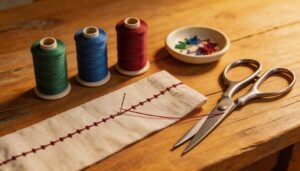
Good technique isn’t just about what you do in the moment — it’s about the habits you build over time. Small, consistent actions compound into real skill, and your thread handling is no different.
Here are the habits worth adding to your routine.
Practicing Quick Threading Drills
Threading a machine well is less about talent and more about repetition — it’s pure Muscle Memory Development in action. Short daily drills beat long irregular sessions every time.
Threading mastery isn’t talent — it’s muscle memory built through short, consistent daily drills
- Consistent Path Repetition — Follow the same thread path every drill to build automatic recall.
- Speedy Needle Positioning — Raise the needle fully first; it gives clearance and speeds up fine motor skill execution.
- Bobbin Thread Retrieval — Practice catching the lower thread smoothly to eliminate hesitation.
- Rapid Error Checking — Test a few stitches on scrap fabric immediately after threading to confirm accuracy.
Checking Thread Quality Before Sewing
Before you sew a single stitch, run a quick thread quality inspection. Check Appearance Inspection first — smooth, even strands signal reliability, while fuzzy patches don’t. Assess Twist Uniformity by rolling the thread between your fingers; uneven twist frays fast.
A simple Strength Test catches weak spots. Lint Assessment and Storage Condition both affect how cleanly thread feeds through your machine.
Cleaning The Bobbin Area Regularly
Neglecting your bobbin area is like ignoring a slow leak — small, until it isn’t. Follow this lint removal schedule:
- Use a bobbin case brush after every large project
- Run a feed dog vacuum with mini vacuum usage weekly
- Check stitch plate access monthly for packed debris
- Remove the case; photograph it first for easy reassembly
Clean machines stitch cleaner.
Using Thread Guides and Machine Diagrams
Your machine’s diagram isn’t decoration — it’s your fastest troubleshooting tool. Thread path mapping shows exactly where each guide sits, making guide visibility obvious even on machines with covered fronts.
Model-specific routing matters because missing one stop shifts tension instantly. Quick reference labels near the take-up lever and tension discs sharpen your diagram interpretation, turning re-threading from guesswork into a confident, repeatable habit.
Keeping a Thread-and-fabric Test Journal
A test journal turns scattered guesses into reliable data. Every time you document a thread-fabric combination, you’re building a personal reference that grows smarter with each entry.
- Sample Documentation — attach stitched swatches with tension dial numbers noted
- Environmental Logging — record humidity and temperature for seasonal pattern recognition
- Photo Archiving — photograph top and bottom seams before mounting
- Trend Charting — compare polyester results across cotton, linen, and silk quarterly
Troubleshooting Thread Issues With Confidence
Thread problems rarely appear out of nowhere. Start by rethreading completely — this single step rules out most errors before you touch a tension dial.
Then trace your Thread Breakpoint Analysis systematically: check Thread Guide Alignment, inspect Hook Assembly Wear for burrs, and run a Machine Vibration Check.
Stitch Pattern Monitoring reveals whether loops, skips, or puckers persist, pointing you toward the exact fix needed.
Frequently Asked Questions (FAQs)
What is the 3 thread rule?
The 3-thread rule refers to a single-needle, two-looper overlock setup offering Edge Finish Flexibility and Stitch Bulk Reduction.
Its Needle Count Impact controls Overlock Width Control, making it ideal for Fabric Stretch Compatibility on lighter materials.
Why do 80% of Java developers struggle with multithreading?
The question falls outside the scope of this article. This guide focuses on sewing thread handling — not software development. For Java multithreading guidance, please consult a dedicated programming resource.
What learning outcome is threading?
Threading builds Fine Motor control, hand-eye coordination, bilateral coordination, sensory exploration, and cognitive development through Process Sequencing, Material Knowledge, Quality Assurance, and Problem Solving — sharpening fine motor skills while training deliberate, methodical thinking across every stitch.
What are the 4 motor skills?
The 4 motor skills are Gross Motor, Fine Motor, Coordination Balance, and Reaction Agility.
Together through Skill Integration, they sharpen fine motor skills, hand-eye coordination, bilateral coordination, visual-motor skills, and sensory exploration.
How do environmental factors affect thread quality?
Heat, humidity, UV light, and pollutants quietly degrade thread quality — weakening fibers, fading dyes, and causing breaks. Stable storage conditions between 15–25°C and 40–60% humidity preserve thread strength and performance longest.
What are the cost considerations for thread operations?
Thread price covers the purchase cost, but quality losses, labor overhead, and thread consumption gaps raise real expenses.
Smart thread savings come from matching size and type precisely, which lifts manufacturing efficiency without sacrificing stitch integrity.
How to troubleshoot unexpected thread formation issues?
When stitches go wrong, start by rethreading completely—top and bobbin. Check needle eye clearance, run stitch length consistency tests on scrap, and inspect guides for lint.
Thread break detection begins with one calm, systematic pass.
When should you replace traditional tapping with milling?
Switch to CNC thread milling over traditional tapping when blind hole challenges, thin wall distortion, tough material machining, or custom thread sizes arise.
It offers better tool wear recovery, flexible thread pitch control, and safer cutting feed management.
What safety protocols are required during thread operations?
Always power off the machine before threading, changing needles, or cleaning.
Keep hands clear of moving parts, make sure guard usage is intact, and complete a setup inspection before every session to protect your work area safety.
How does spool color coding reduce misthreading errors?
Color coding turns spool selection into a Visual Color Cue system—your eyes confirm the match instantly.
Needle Color Mapping and Spool Identification Speed reduce decisions, making Error Prevention automatic through Quick Color Check habits before each threading.
Conclusion
Like a master weaver who skillfully intertwines threads to create a smooth fabric, you’ve now gained the expertise to harmonize your thread handling skills. By applying these practical tips, you’ll transform trial-and-error into a reliable process.
Improving thread handling skills becomes second nature, yielding clean stitches and fewer tangles. Your newfound confidence will shine through in every project, as precision and control become your hallmarks, making every seam a proof of your craftsmanship.