This site is supported by our readers. We may earn a commission, at no cost to you, if you purchase through links.
A quilting machine running at 12 to 14 stitches per centimeter generates wear that most hobby sewists never anticipate. That’s not a design flaw—it’s just the physics of production-level quilting, and it demands a different kind of attention than your standard sewing machine ever did.
Lint migrates deep into the bobbin housing with every layer of batting you feed through. Frames flex under tension. Motors run hot during four-hour sessions. Each of these stress points compounds quietly until you’re mid-project and something fails.
A solid quilting machine care schedule turns that slow creep of mechanical damage into a manageable routine—daily habits, weekly checks, and periodic deep inspections that keep your machine stitching clean for years.
Table Of Contents
Key Takeaways
- Quilting machines face unique mechanical stress—dense stitch counts, batting lint, frame flex, and long sessions—that demand a dedicated care routine beyond what standard sewing machine maintenance covers.
- Daily habits like brushing the bobbin area, inspecting the needle, and testing tension on scrap fabric are your first line of defense against mid-project failures.
- Weekly and monthly checks—clearing thread paths, cleaning tension discs, verifying needle timing, and testing pattern alignment—catch the slow-creep issues that daily cleaning can’t reach.
- Long-term performance depends on replacing needles every 8 hours of heavy use, scheduling a full deep clean every two years or 10 million stitches, and always referencing your manufacturer’s service manual for model-specific guidance.
Why Quilting Maintenance Differs
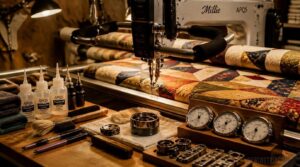
Caring for a quilting machine isn’t quite the same as maintaining a regular sewing machine. Unique demands come into play, especially when you’re working on larger projects. Here’s what makes quilting maintenance stand out.
From stitch tension to feed dog calibration, the right computerized quilting machine can actually simplify upkeep with built-in diagnostics and precision controls.
Heavy Stitch Counts
Dense quilting often pushes your machine harder than regular sewing. High stitch counts—like 12 to 14 per centimeter—mean the needle penetrates deeper and wears faster, especially across layered quilts.
You’ll need balanced thread tension to prevent looping and thread breakage, and keep an eye on motor heat. For complex designs, adjust your maintenance schedule to match increased load.
Lint From Quilt Layers
Where stitch counts wear your needle, batting fiber migration wears your machine from the inside out. Every quilt layer sheds fibers that travel directly into the bobbin area.
- Cotton batting produces the most loose lint
- Dark fabrics reveal lint accumulation instantly
- Layer friction traps fibers near the needle plate
- Post-wash lint buildup worsens over time
- Tight fabric weaves slow fiber migration
Daily maintenance checklist checks prevent buildup.
Larger Frames and Tracks
Lint buildup is just one part of the story. Once your machine starts traveling across a larger frame, mechanical stress enters the picture.
Longer track rails demand precision alignment shims and reinforced rail loading to prevent flex. Vibration dampening and proper frame weight distribution reduce wear across extended runs. Build these into your maintenance schedule — track stability depends on it.
Tension Sensitivity
Quilting adds real complexity here. As fabric thickness varies between sections, the effective pull on your thread shifts — sometimes mid-run. Batting density changes that balance further, meaning tension that worked perfectly on one block can drift noticeably on the next.
Watch for skipped stitches. That’s often your first sign that spool unwinding diffraction or inconsistent thread sheen is throwing calibration off.
Long Sewing Sessions
Long sessions — sometimes stretching four to six hours — put your machine under sustained stress that shorter projects never create. Managing Heat Buildup and Preventing Tension Drift become active jobs, not afterthoughts.
- Plan breaks every 45–60 minutes
- Cool the motor for 5–10 minutes after two hours
- Re-thread to combat needle heat drift
- Clear bobbin lint mid-session
- Adjust seating for sewing fatigue
Your maintenance schedule has to account for this.
Daily Quilting Machine Care
Daily care doesn’t have to be complicated — a few focused habits at the end of each session go a long way toward keeping your machine running smoothly. Think of it as a quick reset that protects your work before the next quilt begins. Here’s what your daily routine should cover.
Before wrapping up, double-check your tension settings and keep a few spools from a quality sewing thread set for mixed fabrics on hand so you’re always ready for whatever the next project throws at you.
Brush Bobbin Area
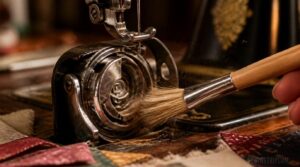
Every bobbin change is your cue to grab a lint removal tool and clear the bobbin area. Fabric fibers shed constantly during quilting, settling into the bobbin housing where they create friction against the hook race and block thread paths.
Regularly cleaning helps prevent skipped stitches caused by broken thread connections.
Use short, sweeping strokes with a dedicated lint brush — never blow with your mouth, which adds moisture.
| Tool | Target Area | Technique |
|---|---|---|
| Lint brush | Bobbin housing debris | Short sweeping strokes |
| Compressed air | Hook race friction points | Brief controlled bursts |
| Soft cloth | Bobbin case surface | Gentle wiping motion |
| Fine pin | Thread path obstructions | Careful dragging action |
| Cotton swab | Tight crevices | Light dabbing pressure |
Check Bobbin Case Lint
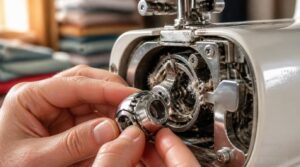
Removing the bobbin case reveals what the housing hides — lint near the tension leaf spring is the quiet culprit behind erratic stitching. When debris nests under the spring, it can’t return to rest, which shifts thread tension unpredictably.
Check the case latch and interior walls too. A mis-seated case causes needle strikes. Clean entry points, then confirm seating with a firm click.
Wipe Tracks and Wheels
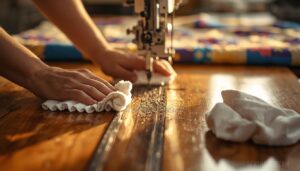
Tracks collect grit and cotton residue fast — and that friction slows your machine’s glide before you even notice it.
Use a lint-free cloth lightly dampened with water to wipe the track surfaces and wheel hubs. Don’t soak anything. Follow with a dry pass to protect metal from rust. Roll the wheels along the track to confirm smooth, quiet movement before you begin sewing.
Inspect Needle Condition
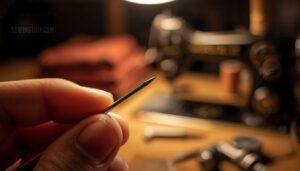
A dull needle is a silent troublemaker — skipped stitches and fabric snags are its calling cards.
Hold each needle under bright light and check for:
- Burrs or nicks along the shaft
- Bent tip or visible curvature
- Blunt point that resists sharp fabric piercing
- Misaligned eye disrupting the thread path
Replace immediately if anything looks off.
Test Tension on Scraps

Tension isn’t just a setting — it’s your machine’s daily report card.
Stitch a few loops and zig-zags on a fabric scrap sandwich before every session. Watch how the thread sits: too tight means the top thread pulls through; too loose and loops appear underneath. Either sign tells you to troubleshoot before touching your real quilt.
Weekly Cleaning and Checks
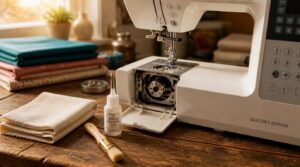
Daily habits keep your machine running, but weekly cleaning is where you catch the problems that sneak up slowly. Once a week, take a few extra minutes to work through some key areas that daily wiping usually misses. Here’s what to check each week to keep everything running smoothly:
Clear Thread Path
Once a week, trace your entire thread path from spool to needle. Check every guide for burrs, verify lower route alignment through the bobbin hook, and compare your setup against the machine’s visual diagram for accuracy. Thread path sequencing matters more than most quilters realize — one skipped guide quietly throws off thread tension across the whole project.
- Confirm upper thread enters tension discs in the correct order
- Inspect each thread guide for nicks or rough edges
- Reseat the lower thread after every bobbin change
- Clear thread dust accumulation from guides using a soft brush
- Match your actual path to the machine diagram before stitching
Clean Tension Discs
With your thread path confirmed, turn attention to the tension discs themselves. Lint quietly packs between them during long sessions, causing uneven thread tension and puckering.
Power off first, then use compressed air or a soft brush to dislodge buildup. A cotton swab with isopropyl alcohol takes care of sticky residue. Avoid metal tools — scratches ruin disc surfaces fast. Always test on scrap fabric before resuming.
Remove Needle Plate Lint
Once your tension discs are clean, shift focus beneath the needle plate — a spot that quietly gathers compacted fiber with every session.
Remove the screws, lift the plate carefully, and use a small stiff brush to sweep lint from around the feed dogs and capture slits. Skip compressed air; it pushes debris deeper. After clearing the bobbin area, run a quick stitch test on scrap fabric to confirm everything’s tracking cleanly.
Check Belts and Encoders
With the needle plate back in place, slide your attention to the drive system. Run your finger along each motor belt — cracks, glazing, or missing teeth mean replacement time.
Check encoder pulley alignment within 0.05 mm; even slight drift causes position errors. Encoder belts should deflect roughly 0.10 inches under light load. Reseat any loose encoder covers to block lint ingress.
Clean Tension Spring
Grit hiding inside spring coils acts like sandpaper against every stitch cycle. Brush debris away with a soft lint-free cloth, then vacuum the spring housing.
Apply a thin layer of manufacturer-approved light oil — not too much, or lint clings back fast. Watch for kinking or whitening coils; those signal replacement, not cleaning.
Monthly and Quarterly Maintenance
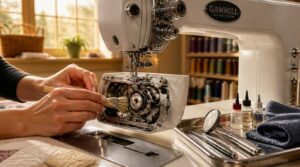
Monthly and quarterly maintenance is where you catch the problems that daily and weekly cleaning simply can’t reach. Think of it as a deeper look under the hood — the kind of check that keeps small issues from turning into costly repairs. Here’s what to work through on a monthly and quarterly basis:
Inspect Feed Rollers
Your fabric feed mechanism deserves a close look every month. Check the pinch and drive rolls for surface flattening, worn grip, or uneven wear — any of these can cause fabric to drift or wrinkle mid-quilt.
Confirm bearing play diagnostics show no axial looseness, and verify roller alignment so both rolls rotate in sync without slipping.
Check Frame Bolts
Every quarter, grab a torque wrench and check that your frame mounting bolts are seated flush and tightened to manufacturer specs. Loose bolts cause frame flex and track misalignment — small shifts that quietly ruin stitch consistency.
Apply anti-seize thread lubricant to guard against corrosion and make future re-torquing easier. A rigid frame is the foundation everything else depends on.
Test Pattern Alignment
A monthly grid test reveals whether your stitch path has quietly drifted. Run a high-contrast test motif across a fabric sandwich and let the edge detection sensors catch any horizontal or vertical offset — misalignment beyond 0.2 mm means recalibration is due.
Check X, Y, and rotation together. Small corrections now prevent compounding errors across an entire quilt.
Verify Needle Timing
Skipped stitches often trace back to needle timing drift. Check monthly by placing the needle at its leftmost position and watching whether the hook passes just behind the eye as the needle rises.
- Use a timing jig to confirm correct needle bar height
- Verify hook clearance margins stay within manufacturer spec
- Run a scrap seam to confirm consistent loop formation
Inspect Cable Connections
Wiring problems rarely announce themselves — they quietly cause skipped stitches or erratic motion until something fails.
During your monthly inspection, trace every accessible cable and check connector housing integrity for cracks or loose clips. Confirm cable jacket damage isn’t exposing bare conductors.
Quarterly, test insulation resistance and verify EMI shield continuity to catch issues before they become expensive repairs.
Long-Term Care Schedule

Daily and weekly habits keep your machine running smoothly, but some care steps only make sense over months and years. Long-term maintenance is where you protect your investment and avoid the kind of wear that sneaks up quietly. Here’s what your extended care schedule should include.
Replace Worn Needles Regularly
Needles wear out faster than most quilters expect. After 8 hours of heavy quilting, the tip dulls enough to cause skipped stitches, fabric snagging, and thread breakage — often before you notice anything wrong.
Watch for visible scratch marks on fabric or increased puckering as early warning signs. When switching fabric types, swap the needle too. A fresh needle costs almost nothing; a damaged quilt costs far more.
A fresh needle costs almost nothing; a damaged quilt costs far more
Schedule Deep Cleaning
Changing needles keeps daily work clean, but your machine also needs a deeper reset on a longer cycle. Plan a full deep cleaning every two years or at 10 million stitches — whichever comes first. Align it with seasonal maintenance to make scheduling easier.
Log each session’s date, zones cleaned, and parts inspected. That record becomes your maintenance history, keeping guesswork out of future care.
Track Stitch Counts
Deep cleaning resets your machine, but stitch count tracking keeps it running accurately between those intervals. Log counts per row using a digital counter or mechanical clicker — either method catches pattern drift before it compounds.
When counts deviate from your target, cross-reference your machine error log. That correlation often reveals a dull needle or tension shift worth addressing immediately.
Use Manufacturer Support Manuals
Stitch counts point you toward problems — but the manual tells you what to do once you find them.
Pull up the Janome.ca support tab, enter your exact model number, and download the service manual. Check the revision date on the first page to confirm you have the current version for your region before trusting any diagnostic procedure.
Frequently Asked Questions (FAQs)
Can I use compressed air on electronic components?
Yes, but with care. Power off and unplug first. Keep the nozzle 2–3 cm away, use short controlled bursts, and avoid electronic components — static discharge or moisture can cause real damage.
How do I store my machine during long breaks?
Clean it, dry it, and cover it. Store your machine indoors in a climate-controlled room, use desiccant packs to keep humidity below 50%, and place a breathable cover over it to block dust without trapping moisture.
What lubricants are safe for quilting machine parts?
Stick to sewing machine oil — either mineral or synthetic. Silicone works well for tracks and moisture protection. Avoid WD-40; it degrades plastics and attracts lint. PTFE-based oils reduce friction beautifully at the needle bar.
When should I seek professional servicing over DIY repairs?
Seek professional servicing when repairs involve electrical connections, belt tension calibration, or needle timing alignment. These tasks require specialized tools and diagnostic software. DIY attempts risk voiding your warranty and damaging expensive components beyond repair.
How does humidity affect quilting machine performance?
Humidity quietly undermines machine performance. High moisture softens thread, alters tension, and accelerates corrosion on metal tracks. Aim to keep your workspace between 40–60% relative humidity for consistent stitching.
Conclusion
Maintenance feels like one more task on an already full plate—until the day your machine skips stitches mid-quilt and you realize prevention costs far less than downtime.
A consistent quilting machine care schedule isn’t about being perfect. It’s about protecting the hours you’ve already invested. Clean daily. Check weekly. Inspect deeply every few months.
Your machine rewards that kind of attention with smooth, reliable stitching—session after session, project after project, year after year.
- https://knowledgebase.gammill.com/knowledge/maintenance-schedule
- https://www.apqs.com/simple-maintenance-tips-for-keeping-your-apqs-quilting-machine-in-top-shape
- https://threadtheneedlequilts.com/blogs/news/longarm-quilting-machine-maintenance-tips
- https://handiquilter.com/how-to-maintain-your-longarm-machine
- https://www.instagram.com/janomecanada/