This site is supported by our readers. We may earn a commission, at no cost to you, if you purchase through links.
Your fabric scissors are dull, your seams wander like a lost tourist, and that zipper you installed looks like it survived a street fight. Every dressmaker hits this wall—the moment when enthusiasm crashes into the hard truth that hand-eye coordination alone won’t cut it.
Professional results demand professional tools, and your basic sewing kit simply can’t deliver the precision dressmaking requires. The difference between a garment that looks homemade and one that turns heads isn’t talent or expensive fabric—it’s having the right must have sewing machine tools for dressmaking within arm’s reach.
From presser feet that transform how you handle zippers to seam guides that eliminate guesswork, these essentials turn frustrating struggles into confident stitches.
Table Of Contents
Key Takeaways
- Professional dressmaking results depend on having the right tools—not just talent or expensive fabric—with essentials like sharp fabric scissors, flexible tape measures, and specialized presser feet eliminating guesswork and delivering precision.
- Accurate measuring tools (flexible tape measures for body measurements, sewing gauges for seam allowances, and pattern marking tools) establish control before the first stitch, preventing fit and alignment issues that even expensive patterns can’t fix.
- Clean cutting tools (fabric scissors with high carbon steel blades, rotary cutters with self-healing mats, and pinking shears for edge finishing) directly impact how garment pieces align, seams stitch, and finished dresses hang.
- Workspace essentials like LED sewing lamps, adjustable dress forms for fitting, and organized tool storage transform amateur sewing into professional garment construction by preventing eye strain, enabling precise alterations, and maintaining efficient workflow.
Essential Measuring Tools for Dressmaking
Precision starts long before your first stitch hits the fabric.
Mastering techniques like how to sew a flat-felled seam ensures your preparation translates into clean, professional results.
Precision begins long before your first stitch—without it, even the finest pattern won’t fit
Without accurate measurements, even the most expensive pattern won’t fit the way you want it to.
Here are the three measuring tools that give you control over every seam, dart, and hemline in your dressmaking projects.
Flexible Tape Measures for Body Measurements
A flexible tape measure is your passport to garment freedom—without it, you’re flying blind.
Look for a 60- to 80-inch tape with both inches and centimeters, letting you capture every body measurement with sewing accuracy. Its fabric or vinyl coating wraps seamlessly around curves—shoulders, bust, waist, hips—while non-elastic construction prevents distortion.
Bold numerals guarantee quick reads, and a metal hook anchors your starting point for fitting tools precision every time.
For added durability and versatility, consider the advantages of a soft flexible fiberglass tape which provides accurate dual scales for both standard and metric measurements.
Sewing Gauges for Seam Allowances
Once you’ve mapped your body, command your seams with sewing gauges—handheld tools that lock down seam allowance precision from 1/4 to 5/8 inch. Their sliding marker anchors your measurement techniques, ensuring fabric compatibility across woven cottons and slippery silks alike.
Whether you’re working beside your sewing machine or hand-stitching:
- 5/8 inch remains the standard garment seam allowance
- 1/4 inch suits lightweight fabrics and delicate curves
- Clear acrylic gauges improve visibility over dark materials
- Metric and imperial markings support any pattern
- Gauge accuracy eliminates guesswork, minimizing seam ripper sessions
Understanding the importance of proper seam allowances is fundamental for achieving fit, durability, and a professional finish in your dressmaking projects. Sewing precision starts here.
Pattern Marking Tools (Chalk, Pens)
After you’ve locked down your seam allowances, transfer pattern details with chalk options and pen varieties that disappear when you need them to.
Tailors chalk delivers dust-free lines on most fabrics, while water-soluble fabric marking tools vanish in the wash.
Test marker tips on scraps first—ink removal methods vary by formulation, and your sewing notions arsenal isn’t complete without reliable fabric marking solutions.
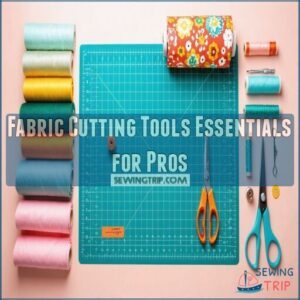
Cutting Tools Every Dressmaker Needs
Clean, accurate cuts separate amateur sewing from professional dressmaking.
Mastering decorative stitches and specialty techniques can elevate your precision even further, especially when paired with the right presser foot.
Your cutting tools directly impact how well your garment pieces align, how smoothly seams stitch, and whether your finished dress hangs properly.
Here are the three cutting tools that give you control over every fabric you work with.
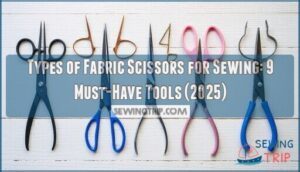
Fabric Scissors for Precision Cutting
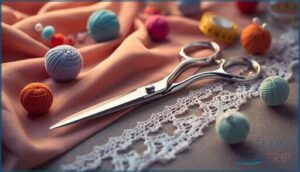
Sharp fabric scissors are your gateway to excellence—every clean cut starts here. Choose high carbon steel blades with convex grinding for edge retention that lasts through 1000+ cuts without dulling.
Look for bent grips that keep fabric flat and reduce hand strain during precision work. Slender tips handle tight curves and notches, while forged construction resists bending under heavy materials, giving you professional results every time.
Rotary Cutters and Self-Healing Mats
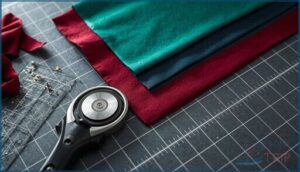
Rotary cutters paired with self-healing mats bring speed and precision you won’t get with scissors alone. Choose a sharp 45 mm blade for clean cuts through multiple fabric layers, and pair it with a mat that provides grid lines for perfect alignment.
Mat maintenance matters—store flat, clean regularly, and replace when grooves form. Safety precautions include always cutting away from yourself and closing the blade after each use.
Pinking Shears for Finishing Edges
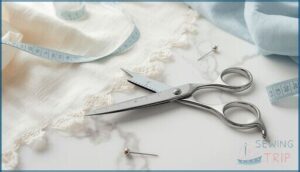
Pinking shears cut a zigzag pattern that stops fraying before it starts, giving you clean edges on woven fabrics without extra steps. The serrated blades grip fibers gently, creating shallow cuts spaced 3 to 5 mm apart for fabric stabilization and sewing efficiency.
Essential pinking shears techniques:
- Use on cotton, linen, and polyester blends for edge finishing
- Cut slowly along seam allowances for consistent zigzag cuts
- Press after cutting to set the pinked edge flat
- Avoid knits—they roll and fray at zigzag points
- Wipe blades clean after use for fray prevention
Must-Have Pinning and Holding Tools
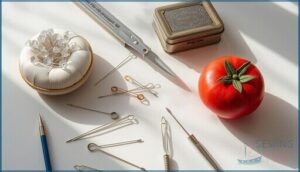
You can’t control fabric that won’t stay put. Before you sew a single stitch, you need tools that grip and hold, and keep everything aligned exactly where you want it.
Here’s what belongs in your pinning arsenal.
Straight Pins and Pin Cushions
You can’t build a perfect seam without pins holding your fabric steady. Straight pins secure layers before stitching, while pin cushions keep them accessible. Choose stainless steel pins to resist rust, and consider glass heads for visibility.
Pin techniques matter—insert perpendicular to avoid distortion. Maintain your pin cushion by replacing compressed cores, and store pins in labeled containers for quick access during projects.
Fabric Clips for Delicate or Thick Fabrics
Fabric clips grip without leaving pin holes—making them your secret weapon for silky linings and thick leather alike. Their smooth jaws won’t snag delicate chiffon, while heavy-duty spring mechanisms hold multiple denim layers securely.
You’ll handle fabric types pins can’t touch, from vinyl to velvet. Clip materials range from reinforced plastic to rust-resistant metal, so choose based on your project’s demands and watch your sewing efficiency soar.
Pattern Weights for Stable Cutting
When your tissue paper shifts mid-cut, you’ve already lost the battle for accuracy. Pattern weights anchor every piece flat, delivering cutting accuracy that pins can’t match on slippery silks or thick woolens.
- Weight placement at corners and edges ensures fabric stability during rotary cutter use
- Cast iron and metal options provide pattern security without puncturing delicate materials
- Weight materials range from heavy cast iron to lightweight vinyl for various fabric types
Indispensable Sewing Machine Accessories
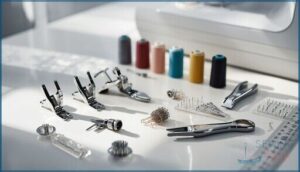
Your sewing machine becomes a powerhouse when you equip it with the right accessories. These tools aren’t optional extras—they’re what separate smooth, professional stitching from constant frustration and rework.
Here’s what you need to take full control of every seam, hem, and detail.
Presser Feet for Various Techniques
You’ll master garment construction faster when you outfit your sewing machine with the right presser feet.
Zipper feet let you stitch tight alongside closures, while walking feet tame thick layers without shifting.
Use piping techniques and edge finishing feet for professional satin stitches on hems and seams.
These sewing machine accessories reveal sophisticated sewing techniques that turn beginner projects into runway-worthy pieces.
Seam Guides for Accurate Stitching
Once you’ve conquered presser feet, magnetic seam guides lock your precision into place. These magnetic guides snap onto your sewing machine’s throat plate, giving you consistent seams without marking fabric.
Alignment techniques keep your fabric edge parallel to the guide, while adjusting allowances for 1/4 or 5/8 inch widths happens in seconds. Guide maintenance—cleaning lint and checking accuracy—preserves your edge season after season.
Needle Threaders and Extra Needles
Needle threaders solve the threading headache in seconds—a thin wire loop slides through the eye and pulls thread behind it. Stock threader types from classic wire to magnetic designs, plus needle sizes ranging from universal 70/10 to leather 110/18. Threading techniques improve sewing efficiency, while needle maintenance means replacing bent wires and rotating sharps.
Keep hand sewing needles and sewing machine needles organized for quick swaps.
- Classic wire threaders guide standard threads through most needle eyes
- Magnetic threaders use attraction to simplify the threading process
- Universal needles (70-110) handle woven fabrics across weight ranges
- Ballpoint needles prevent snags when stitching knit garments
- Leather needles feature chisel points for penetrating heavy materials
Tools for Perfect Garment Construction
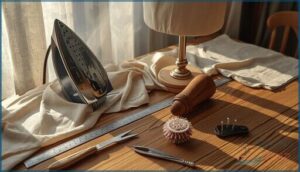
Creating garments that fit and finish beautifully requires more than just stitching skills. You need tools that help you shape fabric to the body, fix mistakes without trace, and set every seam with professional crispness.
These three essentials transform your sewing from basic construction into polished art, wearable art.
Adjustable Dress Forms for Fitting
An adjustable dress form puts you in complete control of fit—no more guessing. Form height adjustments let you match your exact shoulder-to-floor measurement, while bust fitting techniques and hip measurement methods dial in curves with precision.
Torso customization ensures proper proportions from neck to hem. With padded surfaces that accept pins easily, dress form maintenance stays simple, keeping your dressmaking essentials ready for garment construction and alterations on every project.
Seam Rippers for Quick Corrections
When seam ripper becomes your best ally, blade maintenance keeps the sharp edge ready for thread removal without fabric damage.
Ergonomic handles from brands like Dritz or Clover reduce hand fatigue during quick ripping sessions.
Different seam ripper types—from standard models to LED-equipped versions—manage everything from delicate silk to heavy denim, making garment construction and alterations faster and cleaner.
Pressing Tools (Iron, Press Cloths)
Heat control separates professional finishes from amateur attempts—your iron maintenance and steam settings determine whether seams lie flat or fabrics scorch. A quality iron with adjustable heat control paired with press cloth materials like silk organza or cotton muslin shields delicate weaves from shine and damage. Portable iron options and a stable ironing board turn fabric protection into precision, giving you command over every crisp edge.
- Shield your silk from the shine of defeat with semi-transparent organza press cloths that let you see seam details while blocking direct heat
- Tame unruly seams with steam power using continuous-flow settings that relax fibers and flatten layers faster than dry heat alone
- Test scraps before you press the real deal because one wrong temperature setting can scorch your masterpiece beyond repair
Lighting and Workspace Essentials
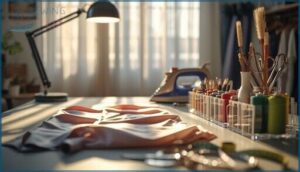
Your workspace setup can make or break your dressmaking sessions. Proper lighting prevents eye strain and helps you catch errors before they become permanent, while the right pressing tools and storage solutions keep your workflow smooth and efficient.
Let’s look at the essential workspace tools that will transform your sewing area into a professional studio.
LED Sewing Lamps for Visibility
You can’t match thread to fabric if you can’t see what you’re doing. LED sewing lamps deliver adjustable brightness levels up to 1000 lumens and color temperature settings from warm 3000K to cool 6500K for true color rendering.
Lamp flexibility lets you direct light exactly where you need it, while energy efficiency keeps these sewing tools running cool for hours without draining power or scorching delicate fabrics.
Compact Irons and Mini Boards
A nimble iron and mini board put professional pressing power right at your fingertips. Compact irons heat in 40 seconds and fold down for travel ironing, while mini boards measure 12 to 18 inches for cuffs and hems.
Master portable pressing with these sewing essentials:
- Dual voltage irons handle international projects
- Ceramic soleplates glide smoothly without snagging
- Foldable designs enable compact storage under desks
- Heat resistant covers protect delicate fabrics from scorching
Organizational Storage for Tools
Your tools deserve a home that works as hard as you do. Tool cabinets with adjustable shelves shield delicate needles from dust, while pegboard systems keep scissors within arm’s reach.
Storage bins with foam liners prevent small presser feet from shifting, and mobile carts roll between stations. Digital inventory systems track sewing tools and equipment, so you’ll never hunt for that bobbin storage organizer again.
Frequently Asked Questions (FAQs)
What does every seamstress need?
Every seamstress needs essential Sewing Tools and Supplies—fabric scissors, measuring tape, straight pins, presser feet for varied techniques, reliable thread management, and workspace organization that fosters your creative independence and mastery.
What is the most important tool in dressmaking?
Like a conductor needs a baton, your measuring tape is your fundamental tool.
This 60-inch flexible ribbon captures bust, waist, and hip measurements that guide every pattern decision, ensuring garments fit your unique curves perfectly.
What to buy as a beginner sewer?
Start with basic sewing kit essentials: fabric scissors, flexible tape measure, straight pins, hand-sewing needles, and quality thread.
Add a beginner-friendly sewing machine, simple fabric types, and an introductory sewing book or online course.
What things do you need for a sewing machine?
You’ll need a Sewing Machine Manual for troubleshooting, extra Sewing Machine Needles, Presser Feet for versatility, bobbins for Thread Management and Bobbin Storage, basic Sewing Notions.
Plus tools for Fabric Preparation and routine Machine Maintenance.
How often should I service my machine?
Service your sewing machine every six to twelve months for regular use, or every three to six months if you sew daily.
Always check your sewing machine manual for manufacturer-recommended service intervals and maintenance schedules.
When to replace sewing machine needles?
Think of your needle as a tiny blade—dull after eight hours or one major project.
Skipped stitches, fabric snags, or visible burrs signal it’s time to swap in a fresh one.
Best thread for different fabric types?
Thread selection depends on fabric compatibility—polyester works well for cotton and synthetics, silk thread suits delicate fabrics, and polyester-wrapped cotton is suitable for wool and linen, ensuring good quality thread performance across material matching needs.
How to fix common tension problems?
Adjust thread tension when loops appear on fabric surfaces by rethreading properly, checking needle selection for fabric compatibility, and testing bobbin adjustment with scrap material—presser feet position affects tension troubleshooting during sewing machine usage.
Do I need different presser feet?
Yes. A zipper foot lets you stitch close to seam edges, while a walking foot grips layers evenly for quilting.
Different presser feet improve stitch quality and fabric handling across garment construction techniques.
How often should I replace sewing machine needles?
Change your sewing machine needles after every project or roughly 5–6 hours of stitching.
Fresh needles prevent fabric damage, improve stitch quality control, and eliminate skipped stitches—your ticket to perfect seams.
Conclusion
Think your sewing skills are holding you back? The real bottleneck is your toolkit. Professional dressmaking doesn’t require supernatural talent—it demands the must have sewing machine tools for dressmaking that eliminate guesswork and deliver control.
Sharp scissors cut clean lines. Proper presser feet handle zippers without drama. Seam guides turn wandering stitches into straight precision. Stop fighting your equipment. Arm yourself with these essentials, and watch your garments transform from homemade struggles into polished, confident creations that command attention.