This site is supported by our readers. We may earn a commission, at no cost to you, if you purchase through links.
Needle in hand, fabric bunched awkwardly, thread knotted for the third time—most people quit sewing right there. What separates someone who gives up from someone who makes it past that first frustrating hour isn’t talent. It’s seeing the motion done correctly, up close, at the right pace.
Sewing techniques videos changed how beginners learn by solving a problem books never could: showing your hands exactly where to go. A static diagram can’t demonstrate how much tension to apply when pulling a backstitch tight, or how a basting stitch feels different from a running stitch beneath your fingertips.
From basic hand stitches to full project walkthroughs, the right video can compress months of trial-and-error into a single focused session.
Table Of Contents
Key Takeaways
- Watching sewing videos beats books and diagrams because they show your hands exactly how to move, how much tension to apply, and what each stitch actually feels like in real time.
- Start with five hand stitches—running, backstitch, slip, blanket, and basting—since each one does a different job and builds the control you’ll use in every project after.
- Structured, skill-level video playlists move you forward faster than random watching because they match what you’re ready for and show you clearly what comes next.
- Project-based walkthroughs are where real learning sticks—they take you through one complete item from start to finish, so every decision makes sense in context instead of feeling like a guess.
Best Sewing Techniques Videos
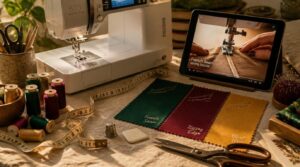
Finding the right sewing video can make the difference between a technique that clicks and one that stays frustrating.
A clear visual guide on changing a sewing machine needle correctly can immediately clear up the orientation issues that throw off your whole stitch.
Whether you’re just picking up a needle for the first time or looking to sharpen your machine work, there’s a video style out there built for exactly where you are.
Here are the best types of sewing technique videos to help you learn faster and sew with more confidence.
Beginner Stitch Demonstrations
Watching a beginner sewing tutorial video for the first time can feel like learning a new language.
Start with five basic stitches: running, backstitch, slip, blanket, and basting. Each one does a different job. The basting stitch, for example, holds fabric temporarily before you commit to a final seam.
For stability, beginners should consider using embroidery hoops to keep fabric taut during stitching.
Close-up Machine Tutorials
Once you move past basic stitches, the machine itself becomes your classroom. Close-up machine tutorials zoom in where it counts — macro needle threading, presser foot alignment, and bobbin case maintenance become clear when you can actually see them.
A good sewing tutorial video slows everything down so you catch the details that make or break a clean seam.
Hand Sewing Video Lessons
Machines do a lot, but your hands can do things no presser foot ever will. Hand sewing video lessons teach you to feel the fabric, control tension stitch by stitch, and fix problems anywhere — no power outlet needed.
Good beginner sewing tutorials cover:
- Needle safety: always store needles in a pincushion, never loose
- Threading methods, including pulling equal thread lengths before tying your knot
- A quick overhand knot tied close to the fabric tail
- Practice swatch exercises on scrap cotton to build rhythm
- On-screen annotations that illustrate each stitch technique as you go
Project-based Sewing Walkthroughs
Hand stitching teaches control — project walkthroughs put that control to work on something real. A project-based walkthrough guides you through one complete item, start to finish, every decision explained as you go.
Whether you’re assembling your first quilt block or choosing thread weight, these hand quilting techniques and beginner project guides walk you through each decision so nothing feels like a guess.
| Walkthrough Stage | What You Learn |
|---|---|
| Fabric layout accuracy | Grainline and selvage alignment |
| Pattern transfer methods | Chalk, markers, tracing paper |
| Seam construction | Allowances, tension, stitch choice |
| Professional finishing techniques | Pressing, hemming, topstitching |
Troubleshooting seam puckering, checking fit against your pattern guide — that’s built in too.
Skill-level Video Playlists
Not every sewing tutorial belongs in a random queue. Skill-level video playlists organize your learning into clear tiers — beginner, intermediate, and expert — so you always know where you stand. Visual progress bars show what’s left, while difficulty tags and required skill mapping keep you from jumping ahead before you’re ready.
That structure turns scattered watching into real mastery.
Organized learning transforms scattered watching into genuine, lasting mastery
Beginner Stitch Techniques
Every great sewing project starts with a handful of stitches you’ll use over and over again. Learning them one at a time makes the whole process less intimidating and a lot more satisfying. Here are the five beginner stitches worth adding to your skill set first.
Straight Stitch Tutorial
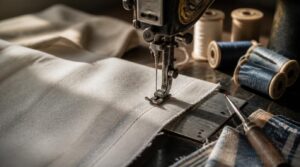
The basic straight stitch is your starting point for almost every project. Set your stitch length to 2.5–3.0 mm for woven fabrics.
Before touching your project, test tension on scrap fabric. Backstitch two or three stitches at the start and end to lock the seam. Feed fabric gently — don’t pull.
Puckering usually means your tension needs adjusting.
Running Stitch Practice
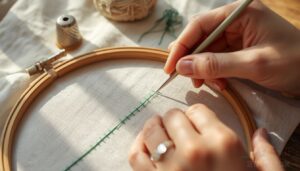
Practicing the running stitch is like learning to walk before you run — simple, but the foundation of everything.
Draw a pencil line on scrap fabric first. Push your needle up, then down, spacing each stitch about ¼ inch apart. Keep that rhythm steady. Consistent tension stops puckering. A contrasting thread color helps you spot uneven spacing fast.
Backstitch for Strong Seams
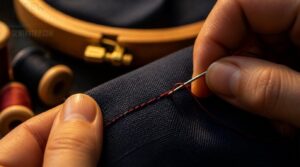
The backstitch is your seam’s best defense. Each stitch loops back into the previous one, creating an interlocking lock that won’t pull apart under tension.
On a machine, hit the reverse function at your seam’s start and end — three or four stitches back secures it. By hand, reenter the end of each previous stitch, advancing one stitch at a time.
Slipstitch for Hidden Closures
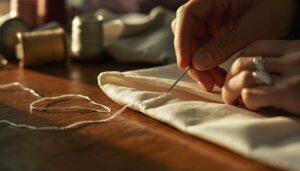
The slipstitch works like a secret handshake — all the action happens inside the fold, invisible from the outside. Thread travels under the folded edge, taking small 3–6 mm bites, never piercing the garment’s face.
Use single fine thread and keep tension relaxed. Pull too hard, and the fabric puckers. Press your fold flat before you start.
Blanket Stitch Edges
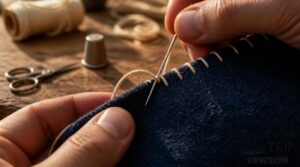
The blanket stitch wraps around the fabric edge, creating a looped border that’s both decorative and protective.
Each stitch forms a small right-angle loop — insert your needle from back to front, then pass it under your working thread before pulling through.
Keep your stitch height and spacing consistent, roughly 4–6 mm apart, for a clean, even result.
Top 4 Tools for Technique Videos
The right tools make all the difference when you’re learning from video tutorials. Having the proper needles, machine attachments, and supplies on hand means you can follow along without stopping to improvise. Here are four tools worth keeping close as you work through technique videos.
1. Dritz Compact Needle Assortment
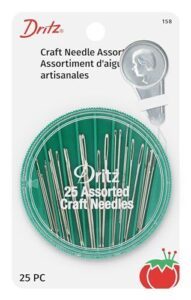
The Dritz Compact Needle Assortment packs 25 hand needles — Sharps, Betweens, Embroidery needle, Crewel, Straw, and Chenille — into a slim rotating case roughly the size of a pen. That variety means you won’t stop mid-project hunting for the right needle.
The back of the case is printed with each needle’s size and style. Check it before you pull one out. A built-in needle threader comes attached, so threading doesn’t slow you down.
| Best For | Sewers and crafters who work across multiple needlework styles — patchwork, embroidery, tapestry, or crewel — and want one organized, travel-friendly case that covers every project. |
|---|---|
| Primary Material | Alloy steel |
| Intended Use | Hand sewing |
| Skill Level | All skill levels |
| Portability | Travel-sized compact case |
| Variety Offered | 6 needle types |
| Key Limitation | Plastic case may crack |
| Additional Features |
|
- Holds 25 needles across six types in a slim, pen-sized case that slips easily into a purse or craft bag
- The back of the case is labeled with needle sizes and styles, so you always grab the right one without guessing
- Sturdy alloy steel needles hold their shape even when pushing through heavier fabrics
- The rotating case can be stiff and may need some coaxing to release needles smoothly
- The plastic housing has been known to crack or separate with frequent use over time
- The needle threader clips on externally rather than storing inside the case, so it’s easier to lose
2. Janome Treadle Sewing Machine
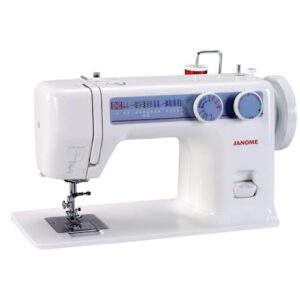
Hand needles handle detail work beautifully, but some projects need a machine — and the Janome 712T delivers without plugging into a single outlet.
It runs on a manual treadle foot control, driven entirely by your feet. That makes it perfect for off-grid sewing, power outages, or cabin living. Ten built-in stitches plus a four-step buttonhole cover most garment and repair work. The 5-piece feed dog keeps fabric moving steadily, stitch after stitch.
| Best For | Off-grid sewers, homesteaders, and anyone who wants a reliable machine that works through power outages or in spaces without electricity. |
|---|---|
| Primary Material | Metal & plastic |
| Intended Use | Machine sewing |
| Skill Level | Intermediate to advanced |
| Portability | Heavy at 17.6 lb |
| Variety Offered | 10 built-in stitches |
| Key Limitation | Requires separate treadle cabinet |
| Additional Features |
|
- Runs completely without electricity — perfect for cabins, off-grid living, or keeping projects moving during outages
- Quiet, rhythmic foot-powered operation that’s meditative and doubles as a light workout
- Handles a solid range of tasks with 10 built-in stitches, a four-step buttonhole, and free-motion quilting capability
- Requires a separate treadle cabinet to function, which adds to the overall cost and setup
- Getting started can be fiddly — belt installation and flywheel direction both need careful attention
- No built-in light, so you’ll need a separate lamp for detailed work
3. NGOSEW 9mm Wide Zigzag Foot
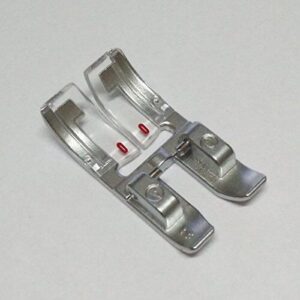
The Janome performs broad stitching beautifully, but wide decorative work needs the right foot — and that’s where the NGOSEW 9mm Wide Zigzag Foot earns its place.
Snap it onto your PFAFF machine, and you’re ready for bold decorative stitches up to 9mm wide. The metal build keeps it stable, and the broader sole holds fabric flat as the stitch widens. Use it for heirloom patterns, stretch seams, or lace trim. Always test on scrap fabric first.
| Best For | PFAFF Creative, Expression, Performance, and Ambition series sewers who want to tackle wide decorative stitches, heirloom patterns, and stretch fabrics without swapping machines. |
|---|---|
| Primary Material | Metal |
| Intended Use | Machine accessory |
| Skill Level | Intermediate |
| Portability | Lightweight snap-on |
| Variety Offered | 9 mm stitch width |
| Key Limitation | PFAFF models only |
| Additional Features |
|
- Snaps on quickly with no tools needed, so you can switch between feet without interrupting your workflow
- 9mm width opens up bold decorative, quilting, and stretch stitches that a standard foot simply can’t handle
- Durable metal construction keeps the foot stable and consistent stitch after stitch
- Only works with specific PFAFF models, so compatibility is a dealbreaker if you own a different brand or series
- The fixed 9mm width is overkill for fine-detail or narrow stitching — you’ll still need a standard foot for that
- The metal build adds weight, which can put too much pressure on delicate or lightweight fabrics
4. Hygloss Assorted Craft Buttons Bulk

Once the stitching’s done, buttons bring a project to life — and having a varied supply on hand makes that easier.
The Hygloss Assorted Craft Buttons Bulk pack delivers resin and cellophane buttons in red, blue, green, and more, ranging from tiny 2mm pieces to 20mm squares. They’re waterproof and attach with glue, thread, or ribbon. Use them on garment repairs, tote bags, or craft projects. Keep small buttons away from young children.
| Best For | Crafters, sewers, and hobbyists who need a wide variety of buttons on hand for garment repairs, DIY projects, or creative activities like scrapbooking and jewelry making. |
|---|---|
| Primary Material | Resin & cellophane |
| Intended Use | Sewing & crafts |
| Skill Level | All skill levels |
| Portability | Lightweight 4 oz bag |
| Variety Offered | Multiple sizes & colors |
| Key Limitation | Choking hazard for toddlers |
| Additional Features |
|
- Wide size and color range (2mm to 20mm) means you’ll have the right button for almost any project
- Waterproof resin and cellophane construction holds up well on clothing and outdoor crafts
- Versatile attachment options — glue, thread, tape, or ribbon — make them easy to use across different project types
- Very small buttons are a choking hazard and require close supervision around young children
- Colors can appear darker in person than in product photos, with limited bright or neon options
- Occasional non-button items like tiny nails may show up in the bag, and oversized buttons can add unwanted weight to delicate projects
Frequently Asked Questions (FAQs)
How are sewing videos taught?
The proof is in the pudding — good video teaching shows every step up close. Cameras switch between wide and macro shots, and voiceover or captions call out key moves as they happen.
Where can I find a sewing tutorial on YouTube?
Search YouTube channels like Vintage Sewing School or Sewing with Nancy. Both offer free, beginner-friendly tutorials covering machine setup, basic stitches, and simple projects — no subscription needed.
What YouTube videos are good for sewing?
YouTube is like a free sewing classroom open 24/ Crazy Little Projects’ "Learn to Sew" series is ideal for beginners, covering straight stitches, zigzag stitches, and adding elastic clearly and at no cost.
Are all YouTube sewing projects the same?
No, not all YouTube sewing projects are the same. They vary widely — from quick machine tutorials to hour-long garment sewalongs, covering quilting, hand stitching, and home décor with different styles and skill levels.
What is the best YouTube channel to learn sewing?
Annika Victoria is one of the best channels for beginners. Her tutorials break down each step clearly, using simple language and practical projects that build your confidence fast.
What is sew very easy?
Sew very easy means sewing tasks so simple even total beginners can finish them successfully — think straight stitches, basic hems, and small projects like pouches, using clear marking and minimal cutting steps.
How to fix skipped stitches?
Start with a fresh needle. Rethread both the top and bobbin, then test on scrap fabric. If stitches still skip, match your needle size to thread weight.
How to sew curved seams?
Curved seams need shorter stitch length for control. Clip small notches into convex curves so the fabric spreads flat. Press with a tailor’s ham to hold the shape without distortion.
Which presser foot for specific tasks?
Pick the straight stitch foot for silk or lightweight fabrics. Use a zipper foot for zippers, a walking foot for quilts, and a buttonhole foot for clean, reinforced holes.
How to sew buttonholes without specialized attachment?
Like a needle threading itself, zigzag stitch does the work. Mark your line, set width to 2–3 mm, stitch both sides, bar-tack the ends, then cut the center cleanly.
Conclusion
Every stitch you learn is a key that unlocks the next one. The gap between struggling beginner and confident maker closes faster than you’d think—especially when the right sewing techniques videos show your hands exactly what to do before your brain fully catches up.
Watch closely. Pause often. Repeat until the motion becomes instinct.
The needle doesn’t care how many times you practice. It only knows the last stitch you made.