This site is supported by our readers. We may earn a commission, at no cost to you, if you purchase through links.
I’ve threaded hundreds of sergers in my 15 years as a sewing machine technician, and the Singer 14CG754 consistently surprises me—not because it’s perfect, but because it delivers professional-grade features at a price point that won’t drain your fabric budget.
This 2-3-4 thread serger handles everything from delicate rolled hems to heavy denim seams at 1,300 stitches per minute, while its color-coded threading system cuts setup frustration in half. The free arm design opens up possibilities for circular sewing that most entry-level machines skip entirely.
Whether you’re finishing your first T-shirt or launching a small production line, understanding this machine’s quirks and capabilities will determine whether it becomes your workshop workhorse or gathers dust in the corner.
Table Of Contents
- Key Takeaways
- Singer 14CG754 Serger Overview
- Key Features and Specifications
- Setting Up The Singer 14CG754
- Threading and Tension Adjustments
- Stitch Options and Applications
- Working With Different Fabrics
- Achieving Professional Results
- Maintenance and Troubleshooting
- Essential Accessories and Upgrades
- Singer 14CG754 Vs. Competing Sergers
- Frequently Asked Questions (FAQs)
- Conclusion
Key Takeaways
- The Singer 14CG754 delivers professional-grade features at an entry-level price, offering 2-3-4 thread versatility, 1,300 stitches per minute, and a color-coded threading system that cuts setup frustration in half for beginners and experienced sewists alike.
- Its differential feed and adjustable stitch settings (1-4mm length, 3.0-6.7mm width) give you real control across fabric types—from delicate chiffons requiring minimal tension to heavy denim needing 4-thread overlock with maxed-out settings.
- The free arm design and removable accessory compartment unlock circular sewing capabilities absent in most budget competitors, making cuffs, sleeves, and tubular projects significantly easier to finish professionally.
- Regular maintenance matters more than you’d think—clean lint after every project, oil moving parts during deep cleans, and schedule annual professional servicing to prevent timing drift and keep this machine performing beyond its price point.
Singer 14CG754 Serger Overview
You’re looking at a serger that cuts through the learning curve without dumbing down the features you’ll actually use. The Singer 14CG754 ProFinish brings 2-3-4 thread flexibility and a color-coded threading system that won’t leave you squinting at your manual for an hour.
Let’s break down what this machine does, who it’s built for, and what makes it worth your attention.
Model Description and Primary Uses
The Singer 14CG754 ProFinish is a household 2/3/4-thread overlock serger machine that trims, seams, and overcasts fabric edges in one pass—giving you factory-quality finishes without the factory.
You’ll use it for garment construction on knits and wovens, home decor sewing like napkins and curtains, and crafting projects from fleece blankets to decorative accessories, all with professional-looking results.
This serger machine offers various high speed options for efficient sewing.
Target User Groups (beginners, Hobbyists, Pros)
Whether you’re just breaking free from hand-finished seams or you’re a pro cranking out commissions, the Singer ProFinish 14CG754 meets you where you’re at. Beginners love the gentle learning curve and community support in sewing machine reviews, hobbyists appreciate the creative projects it unlocks, and seasoned sewists rely on its serger features for maintenance-light performance across skill levels and sewing techniques.
The Singer ProFinish 14CG754 also utilizes sophisticated methodological rigor to guarantee high-quality stitches.
What Sets It Apart From Other Sergers
What really turns heads is the lay-in threading with a press-bar tension release—a standout feature when you’re switching projects fast. That free arm under the storage compartment? You won’t find it on most budget competitors, and it’s essential for cuffs and sleeves.
If you’re still weighing your options, checking out the main types of serger sewing machines can help you match features like these to your actual workload.
Here’s what makes the Singer Pro Finish 14CG754 stand out:
- 2-3-4 thread capability gives you six stitch types—overlock, flatlock, rolled hem, wrapped edge—more options than typical 3/4 machines.
- Adjustable stitch width (3.0–6.7 mm via movable knife) beats fixed-width sergers for precision.
- Color-coded lay-in threading with automatic tension release simplifies setup versus loop-through systems.
- Integrated differential feed manages knits, sheers, and gathering effects—absent on many entry-level units.
These serger features deliver professional finishes without the pro price tag or complexity.
Key Features and Specifications
You didn’t buy this serger just to admire it on your sewing table—you want to know what it can actually do. The 14CG754 packs some genuinely useful features that’ll either make your life easier or leave you wondering why you didn’t upgrade sooner.
From decorative edges to stretchy activewear, the advantages of using a serger machine go way beyond just preventing fraying.
Let’s break down the specs that matter most when you’re racing through a project.
Stitch Speed and Thread Capability
Want to sew at lightning speed without sacrificing control? The 14CG754 delivers up to 1,300 stitches per minute, letting you blaze through projects while maintaining professional-grade fabric compatibility. You’ll work with two, three, or four threads depending on your overlock techniques—perfect for everything from delicate knits to sturdy wovens.
Proper threading is crucial at these speeds—mastering your embroidery machine’s thread path ensures every stitch locks cleanly without skips or tension issues.
| Feature | Capability |
|---|---|
| Sewing Speed | 1,300 stitches/minute |
| Thread Options | 2, 3, or 4 thread configurations |
| Thread Tension | Independently adjustable upper/lower loopers |
| Stitch Optimization | Balanced tension across fabric types |
| Speed Control | Consistent feed at maximum velocity |
Your thread capability gives you real freedom—configure tensions independently to nail that perfect seam balance every single time.
Differential Feed and Adjustable Stitch Length
Dial in perfect Feed Control with your 14CG754’s differential settings—slide that lever to match fabric tension and you’ll prevent puckering on stretchy knits or rippling on delicate wovens.
Adjustable stitch length pairs directly with differential feed to fine-tune seam quality across every thread tension scenario.
Test scrap pieces first, record your winning combinations, and you’ll master stitch options that deliver pro-level results every time.
Built-in Rolled Hem and Free Arm Functionality
Your Singer ProFinish 14CG754’s rolled hem feature folds delicate fabric twice before stitching, creating a narrow, polished edge perfect for sheer materials—no needle-plate swapping required.
If you’re comparing rolled-hem models across brands, Juki’s industrial-grade sewing machines handle similar delicate finishing at much higher speeds.
The free arm unlocks sewing precision on cuffs and sleeves, letting you manipulate tubular pieces smoothly for consistent overlock stitching.
Both hem finishing and free arm sewing deliver professional rolled edge techniques that enhance fabric manipulation on every project.
Setting Up The Singer 14CG754
Getting your Singer 14CG754 out of the box and ready to serge doesn’t have to feel like you’re defusing a bomb. I’ve walked dozens of first-timers through this process, and honestly, the setup is more straightforward than you’d think.
Let’s break down what you’ll find inside, how to get everything in place, and the safety checks you don’t want to skip.
Unboxing and Included Accessories
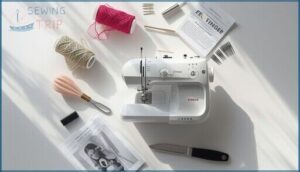
When you crack open your Singer 14CG754 box, you’ll find everything needed to start serging: the machine body, presser foot, user manual, spare needles, thread nets, and a lint brush. The accessory kit is straightforward—no fluff, just essentials.
The Singer ProFinish 14CG754 package contents reflect practical design: sewing machine accessories stored neatly, with a large on-board compartment keeping your weaving tools accessible during projects.
Initial Setup Steps
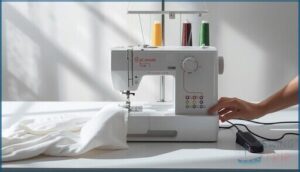
Once you’ve checked the manual and cleared your workspace, set up your Singer ProFinish 14CG754 by plugging in the foot pedal and power cord, raising the presser foot, and powering on. Test thread flow before threading the loopers and needles following the color guides. Run a quick stitch on scrap fabric to confirm tension, then celebrate—you’re ready for sewing machine operation.
- Clear a stable surface so nothing shifts mid-stitch
- Verify power connections before raising that presser foot
- Follow threading guides religiously to avoid frustration
- Test on scraps first to lock in confidence
- Adjust tension settings until balance feels right
Safety Considerations for Setup
Before you flip the power switch, respect your machine’s sharp edges and moving parts. User protection starts with unplugging during blade changes and keeping the workspace free of liquids—electrical safety isn’t negotiable when precision meets 1,300 stitches per minute.
Solid machine maintenance habits prevent troubleshooting headaches and keep sewing machine operation smooth.
| Safety Zone | Key Action |
|---|---|
| Threading Precautions | Power off completely |
| Workspace Hazards | Clear clutter, stable surface |
| Machine Inspection | Check needle plate, cords |
Threading and Tension Adjustments
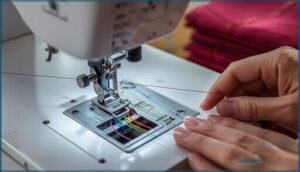
Threading a serger can feel like untangling a puzzle box the first time, but the 14CG754’s color-coded system takes most of the guesswork out.
Once you’ve got the basics down, you’ll want to fine-tune your tension settings to match whatever fabric you’re working with. Here’s what you need to know to thread confidently and adjust tension like you’ve been doing it for years.
Color-coded Threading System
Ever feel like threading a serger is like defusing a bomb? The Singer 14CG754 ProFinish flips that script with its color-coded threading system.
You’ll find matching color markers guiding each thread path from spool to looper, eliminating guesswork and threading errors.
This setup tip transforms tension control from intimidating puzzle to paint-by-numbers simplicity, letting you focus on mastering your craft instead of wrestling with thread management.
Threading Tips for Beginners
Once you’ve mastered the colorcoded threading system, lock in these fundamentals. Always lift your presser foot first—that opens the tension discs so thread seats properly.
Try this threading sequence for bulletproof results:
- Start with the upper looper, then tackle the lower looper before threading needles
- Use your user manual and guides to confirm each path runs smoothly through tension discs
- Thread one needle at a time to catch skipping before it ruins your project
- Test on scrap fabric to verify needle alignment and looper setup before cutting into your good material
Adjusting Thread Tension for Various Fabrics
Tension control transforms your seam integrity across fabric types. Lower needle thread tension by 0.5 to 1.0 unit when wovens pucker—that fabric stretch demands it. Knits need looser upper-thread settings to maintain stitch quality. Delicates like chiffon require minimal tension on both needles and loopers.
Test tension settings on scrap before cutting into your project—thread balance proves everything.
Stitch Options and Applications
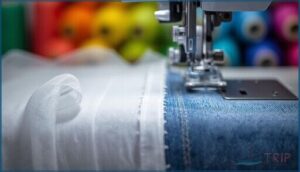
The 14CG754 gives you the creative freedom to tackle pretty much any seam finish you can imagine. From basic overlocking that locks raw edges tight to rolled hems that look like they came off a factory floor, this machine manages the essentials and then some.
Let’s break down exactly what stitches you can pull off and where they’ll make the biggest difference in your projects.
Overlock and Rolled Hem Stitches
You’ll master two powerhouse stitches on the Singer ProFinish 14CG754: overlock stitches trim and finish fabric edges in one pass, while rolled hemming creates that delicate curled edge perfect for scarves.
Stitch tension matters—balance your thread types between needle and loopers to avoid puckering.
Your differential feed keeps knits smooth at sewing speed, and the overlock machine manages both techniques with zero drama once you’ve dialed in your hem techniques.
Blind Hemming and Decorative Stitches
Beyond overlock stitches, you’ll discover blind hemming techniques that hide seams on the right side—ideal when your fabric selection demands subtlety.
The Singer ProFinish 14CG754 manages stitch variations for decorative edges too, though thread choices and tension control matter here.
Practice these sewing techniques on scraps first; your sewing machine rewards patience with invisible hems and creative finishes that rival store-bought.
Customizing Stitch Length and Width
You’ll find two critical dials on the right side that let you fine-tune every seam: adjustable stitch length (1–4 mm) and seam width (3.0–6.7 mm). Shorter lengths create higher stitch density for rolled hems, while longer settings handle fabric stretch on heavy textiles. Work with differential feed to prevent puckering, and test your seam finish on scraps before committing.
- Dial down stitch length for tighter, more secure rolled-hem edges that won’t unravel.
- Widen seam width to encapsulate raw edges on loosely woven or fraying fabrics.
- Pair shorter length with higher differential feed to flatten stretchy knits without wave.
Working With Different Fabrics
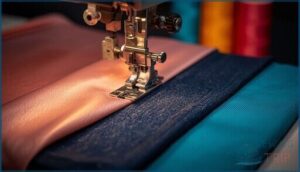
The Singer 14CG754’s differential feed gives you real control over how different fabrics behave under the presser foot.
I’ve found that understanding your fabric type before you start serging saves you from frustration and wasted material.
Here’s how to handle the three main fabric categories you’ll encounter.
Serging Knits and Stretchy Materials
You’ll master stretchy seams when you dial in the Singer ProFinish 14CG754’s differential feed—it’s your secret weapon against waves and puckers on knit fabric. Ease the tension slightly, slow your speed for control, and that serger will glide through jersey like butter.
Prewash knits first, skip the high heat, and trim bulk after finishing. These fabric stabilizers and elastic edges demand respect, but the payoff? Professional serging techniques that actually stretch.
Handling Delicate and Sensitive Fabrics
Chiffons, sheers, and lace demand finesse—this serger manages them beautifully when you drop your needle size to 70/10 or 80/12 and switch to a two-thread rolled hem for edge finishing. Adjust your differential feed below 1.0, ease thread tension way down, and test-sew scraps first.
Here’s your fabric stabilization checklist for delicate hemming and seam finishing:
- Support fabric gently front and back while sewing
- Slow your stitching speed for control
- Trim minimal seam allowance to prevent fraying
Finishing Seams on Heavy Fabrics
Denim, canvas, and wool blends need muscle—switch your Singer ProFinish 14CG754 to a 4-thread overlock for bulletproof seams that won’t pop under stress.
Bump stitch width and length to their max settings, dial differential feed to 1.5 for Heavy Knit Serging, and use 90/14 needles with polyester thread.
The heavyduty metal frame manages Bulk Seam Finishing like a champ when you’re Overlocking Stitches on thick fabric sewing projects.
Achieving Professional Results
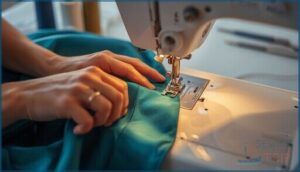
Getting clean, professional results with your serger isn’t about luck—it’s about knowing a few key techniques that make the difference between homemade-looking seams and the kind you’d find in a boutique garment.
Once you understand how to control fabric movement, adjust tension properly, and use your machine’s features strategically, you’ll start producing work that rivals anything off the rack.
Here’s what you need to master to take your serging from functional to impeccable.
Tips for Neat and Durable Seams
You want seams that won’t unravel after a few wears? Start with smart stitch options—four-thread overlock gives you maximum strength on medium fabrics, while rolled hem settings at 2mm create beautifully compact edges. Here’s what really moves the needle:
- Thread selection matters: Match heavier thread (around 60 tex) to heavier fabrics for seam finishing that lasts
- Dial in stitch density: Shorter stitch length packs more loops per inch, distributing stress and preventing failure
- Master fabric handling: Slide material under the presser foot instead of lifting it fully—consistent feeding means uniform edge trimming
- Balance your tension: Too tight creates puckering, too loose leaves sloppy loops that snag
Coordinate your knife width with stitch width around 3.5mm on medium-weight projects.
These sewing techniques transform raw edges into professional fabric finishing that holds up through laundering and wear. Regular sewing machine maintenance keeps everything dialed in perfectly.
Preventing Fabric Puckering and Stretching
Wavy seams and puckered edges kill your momentum—you’ve escaped those problems with smart differential feed adjustment. Set it above 1.0 for stretchy knits, preventing distortion as fabric layers feed evenly under your presser foot.
Dial back stitch length toward 3-4mm on lightweight materials while loosening tension settings when ripples appear.
Test thread selection and fabric tension on scraps first—proper stitch optimization transforms seam finishing into smooth, professional fabric finishing every time.
Using The Free Arm for Small Projects
Once your seams lie flat, pop off the accessory compartment and you’ll access the Singer 14CG754’s free arm—your secret weapon for tight spaces.
Slide cuffs and sleeves over it for clean finishing without wrestling bulky fabric around.
This serger transforms tricky small project ideas like hemming kids’ clothing or repairing tote bag straps into smooth, confident fabric handling that saves time and frustration.
Maintenance and Troubleshooting

Your serger won’t stay in top form without a little care, and knowing when something’s actually wrong saves you time and frustration. I’ve seen too many people panic over simple threading issues or let lint build up until the machine starts acting temperamental.
Let’s break down the essential maintenance routines, troubleshoot the most common hiccups, and figure out when it’s time to call in a pro.
Cleaning and Lubricating The Serger
Your Singer ProFinish 14CG754 craves regular attention to keep those seams razor-sharp. Sergers generate way more lint than regular machines—especially around the loopers and knife—so cleaning after every project isn’t overkill, it’s liberation from future headaches.
Sergers devour lint like nothing else—clean after every project or pay the price in frustration later
Here’s your maintenance rhythm:
- Lint removal: Unplug, pop the looper cover, and brush out the knife and looper area with a dry brush—never canned air, which blows debris deeper inside.
- Oil application: Drop 1–2 drops of light sewing machine oil on the visible moving shaft behind the front cover whenever you deep-clean.
- Professional servicing: Schedule a shop visit roughly once a year to keep your serger machine features humming and prevent timing drift.
Skip the shortcuts—brush or vacuum lint outward, stick to proper lubrication intervals, and you’ll dodge the most common troubleshooting sewing issues before they ambush your next project.
Common Threading and Stitch Issues
Even with flawless maintenance, you’ll face threading errors and tension issues—it’s part of the game. Looper setup mistakes cause stitch distortion more often than anything else, so rethread all four paths if one breaks. Bent needles trigger thread breakage and skipped stitches instantly. When loops appear beyond the fabric edge, dial back the corresponding tension.
Master these troubleshooting sewing techniques and you’ll solve 90% of hiccups before they derail your flow.
When to Seek Professional Servicing
Some hiccups demand expert hands. If your Singer 14CG754 churns out grinding noises, vibrates hard, or skips stitches after needle swaps and rethreading, timing or internal alignment is off—mechanical issues you shouldn’t tackle at home.
Motor failures, chronic jamming, and persistent tension chaos signal it’s time for machine repair.
Plan annual service intervals to catch wear early, preserve warranty claims, and dodge steep maintenance costs down the road.
Essential Accessories and Upgrades
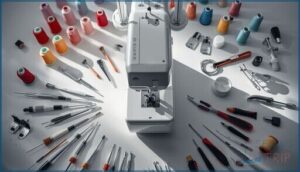
Your Singer 14CG754 comes with basic tools to get you started, but there’s a whole world of add-ons that’ll take your serging from functional to freedom. Whether you’re looking to expand what your machine can do or just keep everything organized and running smooth, the right accessories make all the difference.
Here’s what you need to know about the feet, storage hacks, and upgrades that’ll release your serger’s full potential.
Included and Recommended Presser Feet
Out of the box, you’ll find just one presser foot: a general-purpose snap-on that manages your 2-, 3-, and 4-thread overlock seams with ease. But don’t stop there—the Singer 14CG754 thrives when you add specialty accessories like the elastic, blind hem, gathering, beading, taping, and cording feet. These upgrades release intermediate serging techniques and edge finishing that transform this sewing machine from a reliable workhorse into a creative powerhouse.
- Elastic foot: Insert elastic while overcasting stretch garments in one smooth pass
- Blind hem foot: Create invisible hems where stitching stays hidden on the right side
- Gathering foot: Ruffle and attach layers simultaneously for flounces and decorative seams
- Beading foot: Guide pearls or bead strings along edges for show-stopping embellishment
- Taping/cording feet: Stabilize seams with tape or add decorative corded finishes effortlessly
Storage Solutions and Extra Tools
Your Singer ProFinish 14CG754 includes a removable accessory compartment that doubles as free-arm access—keep your tweezers, spreader, and spare needles right on the sewing machine.
For workspace optimization beyond those built-in storage compartments, grab a magnetic strip for pins, a clear organizer for sewing notions, and a small brush for tool maintenance.
Smart accessory organization means you’ll spend less time hunting and more time mastering bold sewing techniques on your next sewing projects.
Compatible Upgrade Options
You’ll discover new techniques with aftermarket presser feet sets—seven-piece kits designed for the Singer Pro Finish 14CG754 include elastic, gathering, and blind-hem feet that snap onto your serger’s standard bar.
Cutting upgrades like replacement upper knives restore factory-sharp trimming when blades dull.
Thread sets, accessory kits, and Singer 14CG754 replacement parts keep your sewing machine performing at its best without buying new equipment.
Singer 14CG754 Vs. Competing Sergers
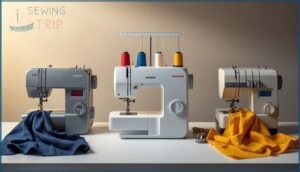
You’ve got options regarding choosing a serger, and knowing how the Singer 14CG754 stacks up against the competition can save you from buyer’s remorse down the road.
I’ve worked on all three of these machines in my shop, so I can give you a real sense of where the Singer shines and where it falls short.
Let’s break down how it compares to the Brother 1034D and Juki MO644D so you can make the call that fits your sewing style.
Comparison With Brother 1034D
You’ve probably asked yourself whether the Singer Pro Finish 14CG754 or Brother 1034D deserves a spot on your sewing table. Here’s what matters in this serger review: the Singer 14CG754 cranks out 1,300 stitches per minute while the Brother 1034D hovers in the mid-range speed zone. Both machines handle 2-3-4 thread options for flexible seams. User reviews highlight the 1034D’s metal frame durability, but durability tests show both machines hold up with proper care. Price points stay competitive, though the Brother often edges slightly lower. For sewing machine comparison purposes, consider your workspace—compact footprints win here.
| Feature | Singer 14CG754 | Brother 1034D |
|---|---|---|
| Stitch Speed | 1,300 SPM | Mid-range SPM |
| Thread Config | 2-3-4 thread | 3-4 thread |
| Frame Build | Standard construction | Metal stress areas |
| Price Range | Competitive entry | Slightly lower |
| Setup Time | Color-coded quick | Color-coded quick |
Comparison With Juki MO644D
The Juki MO644D trades the Singer 14CG754’s beginner-friendly color codes for industrial-grade reliability that keeps thread tension steady under marathon sessions. Speed comparison shows both hit 1,300 stitches per minute, yet maintenance costs favor Juki’s sturdy looper design. You’ll appreciate the Singer Pro Finish 14CG754’s free arm use for cuffs, while differential feed performance stays matched in this sewing machine comparison.
| Feature | Singer 14CG754 | Juki MO644D |
|---|---|---|
| Threading System | Color-coded beginner setup | Standard industrial layout |
| Build Focus | Home crafter versatility | Continuous production durability |
| Maintenance Frequency | Regular alignment checks | Fewer adjustments needed |
| Price Tier | Affordable hobbyist | Mid-to-high entry professional |
Pros and Cons Versus Alternatives
Choosing between sergers means weighing serging costs against fabric limits—and user reviews reveal clear trade-offs. This sewing machine comparison shows the Singer ProFinish 14CG754 wins on budget options at roughly $300, while the Brother 1034D delivers smoother tension control and the Juki MO644D handles heavy materials.
Your serger buying guide starts with honest comparison charts:
| Decision Factor | Singer 14CG754 Advantage | Competitor Edge |
|---|---|---|
| Initial Investment | Lowest entry price | Brother 1034D: better stitch consistency |
| Learning Curve | Color-coded threading | Juki MO644D: industrial precision |
| Fabric Range | Light to medium weights | Both handle thick layers better |
| Durability Concerns | Adequate for occasional use | Juki and Brother: longer service life |
| Speed and Noise | 1,300 SPM, noticeable vibration | Juki quieter; Brother smoother operation |
Frequently Asked Questions (FAQs)
What is a Singer serger used for?
A serger transforms raw fabric edges into professional finishes in one pass—trimming, stitching, and securing seams simultaneously.
It excels at overlocking knits and wovens, creating stretch-resistant hems, and speeding garment construction dramatically.
Is an Overlocking machine the same as a serger?
Yes, they’re the same machine. In North America, we call them sergers, while Europe uses “overlocking machine.” Both trim fabric edges and create overlock stitches using multiple threads simultaneously.
What is the difference between Singer 401 and 403?
The Singer 401 is a slant-needle machine with built-in stitches, while the 403 offers zigzag capability but fewer decorative options—both classics among Singer sewing machines, yet they serve different creative ambitions.
Which Singer Overlocker is best?
For most home sewers, the 14CG754 ProFinish balances affordability with 2-3-4 thread versatility and differential feed—ideal if you’re moving beyond basic seams without breaking the bank on industrial-grade Singer overlockers.
Is the Singer 14CG754 beginner friendly?
Think of threading your first serger like learning to ride a bike—it wobbles at first, but the Singer ProFinish 14CG754’s color-coded system and supportive sewing community flatten that learning curve, making beginner tips accessible and user experience genuinely confidence-building.
How does the differential feed work?
Differential feed uses two sets of feed dogs moving at independent speeds—the front pulls fabric in while the rear pushes it through.
You adjust this ratio to prevent stretching on knits or puckering on delicate materials.
Can it handle decorative threads?
You can absolutely run decorative threads through the Singer ProFinish 14CG754, especially in flatlock and rolled hem modes where thread visibility shines.
Test your fabric suitability first—lighter materials showcase decorative stitch work beautifully.
Whats included in the purchase?
Your Singer 14CG754 ProFinish ships with everything you need: the serger unit, foot control, power cord, general-purpose presser foot, needles, tweezers, screwdriver, spreader tool, operators manual, warranty docs, and a tutorial DVD stored conveniently in the front compartment.
Is assembly required out of the box?
When you lift your new serger from the carton, you’ll find it basically ready to roll—factory assembled, prethreaded, and waiting. Just raise the thread mast, plug in, and start stitching within minutes.
Can the Singer 14CG754 handle multiple fabric layers?
Yes, you can stack layers confidently with the Singer ProFinish 14CG Its extra-high presser foot lift, adjustable pressure dial, and differential feed manage bulk seam management and layered fabric sewing when you adjust settings properly.
Conclusion
Think of the Singer 14CG754 as your backstage crew—it won’t steal the spotlight, but it’ll keep your seams from unraveling under pressure. You’ve learned its threading rhythm, explored its stitch range, and discovered where it flexes versus where it flinches.
Now comes the real test: pushing fabric through those feed dogs until muscle memory replaces hesitation. Every serger demands commitment, but this one rewards it without demanding a second mortgage.
- https://www.youtube.com/watch?v=MrqHC2CNjVI
- https://www.allbrands.com/products/9340
- https://www.scribd.com/document/766223622/Manual-14CG754-1409385L
- https://www.mygoldenthimble.com/best-sergers-for-beginners/
- http://custombagpatterns.com/product/sample-product/singer-14cg754-profinish-2-3-4-thread-serger-with-machine-intro-dvd/