This site is supported by our readers. We may earn a commission, at no cost to you, if you purchase through links.
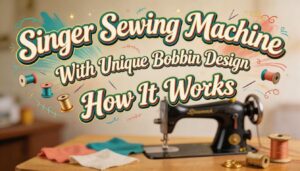
Most sewers never think twice about the small spool spinning beneath their needle plate—until the thread jams, the stitch skips, or the tension collapses mid‑seam. That humble component, the bobbin, has driven more than 170 years of Singer’s engineering decisions, from Allen B. Wilson’s 1850 vibrating shuttle patent to the precision rotary hook systems powering modern machines.
Singer didn’t stumble into distinctive bobbin designs by accident; each mechanism shift solved a specific mechanical problem, whether friction at high speed, noise in home settings, or thread consistency across fabric weights. Understanding how these systems differ across models—and why Singer built them that way—gives you sharper control over your machine and fewer frustrating surprises at the seam.
Table Of Contents
Key Takeaways
- Singer’s bobbin systems evolved through three distinct engineering eras — vibrating shuttle, transverse boat-shuttle, and rotary hook — each solving specific problems like friction, noise, and stitch inconsistency at speed.
- Not all Singer bobbins are interchangeable; your machine’s hook system, production era, and regional variant determine the exact bobbin spec you need, and using the wrong one risks thread jams, hook wear, and voided warranties.
- The Class 66 drop-in bobbin, introduced with models like the Singer 500A, changed home sewing by standardizing parts across compatible machines and making thread alignment visible before you sew a single stitch.
- Small maintenance habits — cleaning lint every 4–8 hours of sewing, winding bobbins evenly, and replacing worn parts approximately every 20,000 stitches — have a direct, measurable impact on stitch quality and machine longevity.
Singer’s Unique Bobbin Design: a Historical Overview
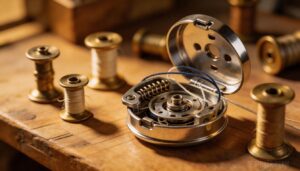
Singer’s bobbin design didn’t happen by accident — it evolved over decades of real-world use, factory feedback, and shifting technology. Each major shift left a distinct mark on how these machines stitch.
If you’re curious about how these innovations shaped sewing comfort and efficiency, this guide to Singer’s unique machine features breaks down their lasting impact.
Here are three turning points that shaped the system you’re working with today.
The Birth of The Vibrating Shuttle Bobbin System
Allen B. Wilson’s 1850 patent — US 7776 — introduced Arc Motion Mechanics that became the Patent Legacy behind modern bobbin systems. His vibrating shuttle mechanism enabled reliable lockstitch operation, driving Early Consumer Adoption across households.
Shuttle Material Evolution followed, shaping machines like the Singer Model 28, Singer Model 128, and Singer Model 185.
Wilson’s Innovation didn’t just improve stitching — it redefined what home sewing could be.
The enduring popularity of the vibrating shuttle system showcases its impact on modern sewing.
Transition From Transverse Boat-Shuttle to Rotary Hook
The vibrating shuttle delivered dependable lockstitch operation for decades, but the transverse boat‑shuttle had real limits — friction, speed, and timing synchronization between needle and hook race machining demanded constant refinement. The rotary hook answered those problems directly.
Engineers tackled lubrication redesign, noise reduction, and hybrid semi‑rotary configurations during the shift, improving your bobbin system’s consistency across fabric weights.
Key engineering milestones in that shift:
- Precision hook race machining eliminated skipped stitches
- Lubrication redesign reduced wear at high rotational speeds
- Timing synchronization between needle drop and hook rotation was standardized
- Noise reduction improved through continuous circular motion versus reciprocating shuttle travel
- Hybrid semi‑rotary systems bridged older vibrating shuttle designs into full rotary hook production
How The Class 66 Drop-in Bobbin Changed Home Sewing
The Class 66 drop-in bobbin didn’t just simplify threading — it fundamentally reshaped what home sewing could be. Standardized parts meant your Singer 500, Singer 500A, or Singer 503 used the same bobbin across compatible machines, reducing setup time dramatically.
The transparent cover confirmed thread alignment instantly, improving stitch quality before you’d sewn a single seam. Enhanced portability followed naturally when fewer components meant less to manage.
Singer Models Known for Distinctive Bobbin Systems

Not every Singer model manages the bobbin the same way, and that’s exactly what makes the lineup so interesting to study. Across decades of production, Singer introduced distinctly different bobbin systems tied to specific machines and eras.
For a closer look at how Singer bobbins compare to European models in both size and design, check out this detailed guide to sewing machine bobbin types and variations.
Here are the models that stand out most for their unique bobbin designs.
Early Vibrating-Shuttle Models (12K, 13K, VS2)
Singer’s earliest mass-produced models — the 12K (1865), 13K (1870), and VS2 — each pioneered distinct approaches to stitch formation mechanics and treadle power mechanism design.
The VS2 introduced a fiddle-shaped base as part of its base shape evolution, refining vibrating shuttle action and drop-in bobbin access.
Its shuttle ejector design and motor integration phase laid groundwork for the lockstitch precision that defined Singer’s industrial reputation.
Featherweight 221 and Its Vertical Oscillating Hook
The Singer Featherweight 221 earns its iconic status through more than just portability — its vertical hook geometry sets it apart mechanically. The oscillating motion advantages reduce catch points and keep the slim magnesium alloy body balanced during use.
Drop-in bobbin access stays straightforward, and user serviceability features let you oil and clear the hook area without tools.
Compact stitch precision, reliable lockstitch performance, and a lightweight portable machine design make the 221 genuinely purpose-built.
The 400 Series and Horizontal Rotary Hook Bobbins
Where the Featherweight oscillates, the 400 Series rotates — and that shift defines everything. The horizontal rotary hook in Singer Model 401, Singer Model 403, and Singer Model 404 completes a full clockwise cycle, with Hook Rotation Speed and Bobbin Case Alignment working together for consistent lockstitches.
Key design features include:
- Case Groove Design guiding thread smoothly through the raceway
- Spring Force Tuning maintaining balanced bobbin tension across Production Year Variants (1907–1939)
- Singer Model 411G introducing automatic lockstitch and chain-stitch capability via rotary hook
Regional Variants With Specialized Bobbin Configurations
you sew in the world shapes what’s inside your machine.
Europe’s compact-frame variants used region-specific drop-in bobbin designs, while Asia Pacific machines featured anti-slip plastic bobbins suited for portable use.
North American front-load configurations dominated pre-1970 models, including the Singer Model 301 and Singer Model 401.
Latin American machines handled heavier coats and denim, and Africa’s metal deep-well bobbins managed coarse threads reliably.
How Singer’s Bobbin Mechanism Actually Works
Understanding how Singer’s bobbin mechanism works is the key to getting clean, consistent stitches every time. The system has more moving parts than most sewists realize, and each one plays a specific role.
Here’s a closer look at how it all comes together.
Drop-in Vs. Front-Load Bobbin Systems Explained
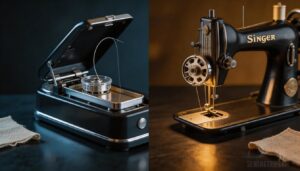
Two designs define Singer’s bobbin world: drop-in and front-load.
The drop-in bobbin system, found on machines like the Singer 500A Rocketeer, prioritizes user convenience — you load from the top, thread path visibility stays clear, and maintenance speed improves dramatically.
Front-load systems use a dedicated bobbin case, giving you tighter tension balance but requiring more disassembly.
Compatibility issues arise when you mix bobbin types across these distinct sewing machine mechanics.
How The Bobbin Thread Pairs With The Top Thread
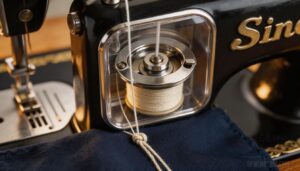
Every lockstitch depends on precise thread interlock timing — the needle drives the upper thread down through your fabric, where the rotary hook mechanism catches it and loops it around the bobbin thread path below.
A lockstitch forms only when perfect timing lets the hook wrap the upper thread around the bobbin below
This upper-lower thread interaction, synchronized through thread feed synchronization, forms the stitch loop formation that creates a balanced seam.
Drop-in bobbin systems make this sewing machine mechanics process remarkably visible.
Role of The Tension Spring in Bobbin Thread Control
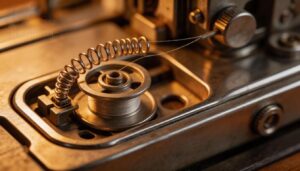
Think of the tension spring as the silent regulator inside your drop-in bobbin system.
Its spring preload adjustment controls how firmly the class 66 bobbin thread feeds into each lockstitch, maintaining stitch tension balance across varying fabric weights. Spring-latch alignment keeps thread feed consistent through the rotary hook mechanism, while material fatigue impact and wear detection signs — like skipped stitches or looping — signal that it’s time to inspect or replace.
Plastic Vs. Metal Bobbins and Tolerance Differences
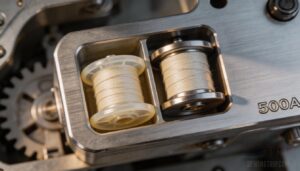
Material mass impact sets plastic and metal class 66 bobbins apart inside the Singer 500A’s aluminum housing.
Plastic bobbins expand slightly under heat expansion effects, shifting thread tension stability mid-seam.
Metal bobbins hold tighter fit tolerance variance, supporting durability under load during precision stitching.
For your drop-in bobbin system, always match the material your machine’s manual specifies.
Are All Singer Sewing Machine Bobbins The Same?
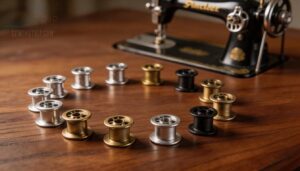
Not all Singer bobbins are created equal, and that’s where a lot of sewists run into trouble. Across more than a century of production, Singer built machines around different hook systems, bed sizes, and tension mechanisms — each with its own bobbin spec.
Here’s what you need to know to get it right.
Why Bobbin Size and Shape Vary Across Singer Models
Bobbin size and shape across Singer models aren’t arbitrary — they’re dictated by each machine’s hook mechanism, manufacturing constraints, and thread tension requirements.
The Singer 500A Rocketeer‘s horizontal rotary hook demands wider, flatter Class 66 drop-in bobbins, while early vibrating-shuttle models require narrower profiles entirely.
Regional production standards further introduced dimensional tweaks, meaning the historical timeline of Singer household sewing machines directly shaped bobbin compatibility.
Identifying The Correct Bobbin for Your Specific Machine
machine’s serial number is the fastest path to accurate bobbin code decoding — Singer stamped model-specific codes near the bobbin case on most machines.
For the 500 series, including the Singer 500A, the drop-in bobbin system uses Class 66. Cross-reference your serial number matching against Singer’s official thread compatibility guide, and always verify needle, bobbin, and foot compatibility together, since bobbin material identification matters too.
Risks of Using Incompatible or Off-Brand Bobbins
Off-brand bobbins might seem like a harmless shortcut, but they introduce real mechanical risks — especially in precision machines like the Singer 500A and Singer 401, where drop-in bobbin system tolerances are tight.
Watch for these common hazards:
- Thread jamming from slightly oversized bobbins misaligned in the hook race
- Stitch inconsistency caused by uneven winding or flange variations
- Hook wear accelerated by poor runout tolerances
- Machine overheating from repeated jams straining the motor
- Warranty risk when non-genuine sewing machine accessories void manufacturer protections
Caring for Your Singer Bobbin System

Keeping your Singer’s bobbin system in good shape doesn’t take much — but the small habits matter more than you’d think. A little regular attention can mean the difference between smooth, even stitches and a frustrating afternoon of thread jams.
Here’s what you should be doing to keep things running right.
Cleaning Lint From The Bobbin Area Regularly
Lint is the silent saboteur of any precision bobbin system — and your Singer deserves better.
Whether you’re restoring a Singer Rocketeer or maintaining a modern drop-in bobbin setup, your Lint Inspection Frequency should hit every 4–8 sewing hours.
| Tool | Purpose | Safety Note |
|---|---|---|
| Natural-bristle brush | Brush Selection Guide: dislodges lint gently | Won’t scratch metal |
| Compressed air (low setting) | Clears shuttle race | Compressed Air Safety: never aim at feed dogs |
| Lint-free cloth | Wipes surfaces dry | Prevents rust on vintage parts |
Follow with a Tension Check Routine before resuming.
Proper Bobbin Winding for Even Thread Layers
Even winding starts before the bobbin spins — your Thread Path Alignment matters more than most sewists realize. Keep the thread under light tension from spool to shaft, aiming for complete Layer Uniformity Check coverage across every revolution.
Stop at the Fill Line Indicator, roughly 90 percent full.
Proper Winding Speed Control and Tension Calibration here directly influence your precision stitching results downstream.
Correct Insertion Technique for Drop-in and Front-Load Bobbins
Drop-in or front-load — each system rewards deliberate hands. For the Singer 500A (Rocketeer), follow these core insertion principles:
- Clockwise Rotation Rule: Your drop-in bobbin rotates clockwise when viewed from the front.
- Notch Alignment Guide: Seat the bobbin notch against the housing notch precisely.
- Spring Compression Test: Gently pull the thread to confirm it passes under the tension spring.
Proper Shuttle Hook Engagement depends entirely on correct seating.
When to Replace Worn Bobbin Parts
Your Singer 500A’s bobbin system won’t fail silently — it telegraphs distress.
Watch for bobbin case cracks, audible grinding on lightweight fabrics, and skipped stitches as clear wear indicator signs.
Spring fatigue symptoms include inconsistent loop formation and loose tension.
Material degradation effects accelerate in plastic bobbins exposed to UV.
For sewing machine restoration of any vintage sewing machine, replace worn parts every 20,000 stitches or annually.
Frequently Asked Questions (FAQs)
What is the most sought after vintage Singer sewing machine?
Imagine a museum spotlight shining on the Featherweight 221—its mint condition, original decals, and intact case, manual drive, collector price trends.
Regional rarity factors and drop-in bobbin innovations define value and collectibility of vintage Singer machines.
Are all Singer sewing machine bobbins the same?
No, all Singer sewing machine bobbins aren’t the same. Bobbin Case Wear and needle bobbin and foot compatibility depend on model specifics.
For instance, the Singer 500A Rocketeer uses a drop‑in bobbin system, demanding precise Storage Bin Practices and Replacement Tool Guide adherence.
What is the most sought after Singer sewing machine?
Among collectors, the Rocketeer 500 — officially the Singer 500A — commands serious Collectors Premium in the vintage collector market, prized for its iconic space-age styling, High-Speed Performance, and drop-in bobbin convenience.
Do all Singer sewing machines use the same bobbin case?
No, they don’t.
Bobbin cases vary considerably across Singer’s lineup — size standards, case markings, and factory part numbers differ by era and mechanism, making interchangeable myths a costly assumption for any serious sewist.
What is the difference between Singer 4411 and 5511?
Powerful performance pairs with practical differences: the 4411 offers 11 stitches and a solid motor torque, while the 5511 expands the stitch library, refines ergonomic controls, and includes a more flexible accessory kit.
What is the difference between Singer Heavy Duty 4423 and 4411?
The 4423 offers 23 stitches, automatic buttonhole, and a built-in needle threader, while the 4411 keeps things simpler with 11 stitches and manual threading — ideal for beginners.
What are the pros and cons of Singers bobbin design?
Every design has two sides of the coin.
Singer’s drop-in bobbin system wins on speed impact, and vibration reduction, but repairability concerns and bobbin tolerance issues can frustrate users of older models.
How does Singers bobbin system compare to other brands?
Singer’s drop-in bobbin system, seen in machines like the Singer 500A Rocketeer, generally requires less hands-on maintenance than competitor front-load designs, though thread path differences mean bobbin case compatibility rarely crosses brand lines.
Can I use any type of bobbin in my Singer machine?
No, you can’t use just any bobbin.
Your Singer model — whether a 500A Rocketeer with its drop-in bobbin system or a vintage front-loader — requires a specific size for proper needle, bobbin, and foot compatibility.
What issues might I face with Singers bobbin design?
Shuttle timing misalignment, bobbin case wear, and spring fatigue can cause thread bunching and noise vibration.
With a drop-in bobbin system, needle, bobbin, and foot compatibility matter — so thread tension adjustment keeps mechanical sewing technology running smoothly.
Conclusion
Like a master key unlocking a world of creative possibilities, understanding Singer’s unique bobbin design enables you to utilize your sewing machine’s full potential. With this knowledge, you’ll navigate complex projects with confidence, precision, and control.
A Singer sewing machine with a unique bobbin design becomes an extension of your artistic vision, allowing you to bring intricate ideas to life.
Your mastery begins with the bobbin, a small but essential component.