This site is supported by our readers. We may earn a commission, at no cost to you, if you purchase through links.

Most sewers discover their machine’s limitations only after a needle snaps mid-seam through canvas or denim. That frustrating moment—where your standard machine stutters and strains—reveals the gulf between basic models and machines engineered for demanding work.
Sturdy sewing machine models don’t just handle heavy fabrics; they maintain consistent stitch quality through leather, upholstery, and multiple fabric layers without the vibration, skipped stitches, or motor strain that plague lighter machines. The difference lies in metal frame construction, high-torque motors, and precision-engineered feed systems that transform challenging projects from struggles into smooth operations.
Whether you’re outfitting a professional studio or expanding your creative range beyond lightweight cottons, understanding what separates durable performers from standard models determines whether your next project succeeds or leaves you troubleshooting tension problems at midnight.
Table Of Contents
- Key Takeaways
- Top 9 Strong Sewing Machine Models
- 1. Heavy Duty Sewing Machine Singer
- 2. Singer Heavy Duty Sewing Machine
- 3. Brother Heavy Duty Sewing Machine
- 4. Brother Lightweight Sewing Machine Model
- 5. Brother Sewing And Quilting Machine
- 6. Singer Tradition Sewing Machine
- 7. Janome Heavy Duty Sewing Machine
- 8. Heavy Duty Sewing Machine
- 9. Juki Sewing And Quilting Machine
- Key Features of Strong Sewing Machines
- When You Need a Heavy Duty Model
- Choosing The Right Strong Sewing Machine
- Maintaining Your Sewing Machine’s Strength
- Strong Models for Specific Applications
- Frequently Asked Questions (FAQs)
- Conclusion
Key Takeaways
- Heavy-duty sewing machines distinguish themselves through metal frame construction, high-torque motors (1.0–1.2 amps minimum), and speeds reaching 1,100–1,500 stitches per minute—specifications that enable consistent penetration through leather, denim, and multi-layer fabrics without the vibration or motor strain that plague standard models.
- The Singer Heavy Duty lineup (4411, 4423, 4432) and Brother ST371HD represent proven entry points for demanding work, combining automatic needle threaders with 37–97 stitch applications and proven durability through rigorous testing, though models like the Janome HD1000 and Juki HZL-F300 extend capabilities to 1,000+ stitches per minute for professional applications.
- Machine longevity depends entirely on maintenance discipline—proper cleaning after every 8–12 hours of operation, professional servicing every 6–12 months, and controlled storage environments (40–50% humidity) separate machines that deliver 10–15 years of reliable service from those that fail prematurely despite robust construction.
- Investment decisions should prioritize metal frame construction and motor torque specifications over stitch variety, since penetration force and structural stability determine whether a machine handles your thickest materials consistently, while features like automatic threading and LED lighting simply reduce operator fatigue during extended sessions.
Top 9 Strong Sewing Machine Models
You need a machine that won’t buckle when you’re pushing through denim, leather, or multiple fabric layers at once. The right strong sewing machine combines a reinforced metal frame with a motor that delivers consistent piercing power, no matter how demanding your project gets.
Here are nine models that stand up to heavy-duty work without compromise.
1. Heavy Duty Sewing Machine Singer
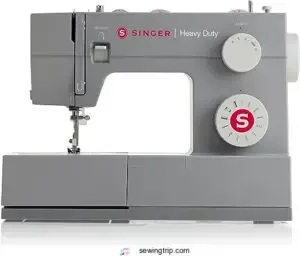
You’ll find the Singer Heavy Duty lineup delivers exactly what its name promises. The SINGER Heavy Duty 4411 and Singer Heavy Duty 4423 both feature powerful Singer motors rated at 1.0–1.2 amps, pushing heavy fabric through at up to 1,100 stitches per minute—50% more power than standard machines.
Their metal frame construction passes rigorous durability tests, ensuring skip-free performance through denim, canvas, and leather.
With 69 stitch applications and four presser feet, these heavy duty sewing machines give you the control to tackle demanding projects without compromise.
| Best For | Sewers who work with thick fabrics like denim, canvas, and leather, or anyone who needs a reliable machine that can handle multiple layers and heavy-duty projects without slowing down. |
|---|---|
| Built-in Stitches | 69 |
| Max Speed | 1,100 SPM |
| Frame Material | Metal |
| Needle Threader | No |
| Buttonhole Feature | One-step |
| Weight | 14.6 lbs |
| Additional Features |
|
- Punches through tough materials with 50% more power than standard machines, stitching at up to 1,100 stitches per minute
- Built with a metal frame that keeps everything stable and skip-free, even when you’re working on demanding projects
- Comes with 69 stitch options and four presser feet right out of the box, so you’re ready for everything from basic repairs to decorative work
- Struggles with stretchy knits, so it’s not the best choice if you’re working with jersey or similar fabrics
- The LED work light is a bit dim and could use more brightness for detailed work
- The plastic horizontal spool holder feels fragile and might not hold up as well as the rest of the machine
2. Singer Heavy Duty Sewing Machine
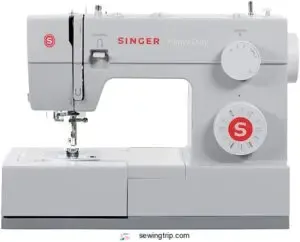
The SINGER Heavy Duty 4411 sets the standard with 97 stitch applications and an automatic threading system that eliminates eye strain during extended sessions. Its full metal frame dampens vibration at sewing speeds reaching 1,100 stitches per minute—critical when you’re pushing through multiple denim layers.
The Singer 4432 and Singer 4452 expand on these Singer features with enhanced stitch variety, while the Singer HeavyDuty 4423 offers a simplified option.
These heavy duty sewing machines deliver consistent needle penetration through canvas and upholstery weight fabrics, giving you command over challenging materials.
| Best For | Sewers who need a workhorse machine for thick fabrics like denim, canvas, and upholstery without sacrificing speed or stitch control. |
|---|---|
| Built-in Stitches | 97 |
| Max Speed | 1,100 SPM |
| Frame Material | Metal |
| Needle Threader | Automatic |
| Buttonhole Feature | One-step |
| Weight | 17.1 lbs |
| Additional Features |
|
- Blazes through heavy materials at 1,100 stitches per minute thanks to the metal frame that keeps things steady
- Automatic needle threader saves your eyes and patience when you’re switching threads constantly
- 97 stitch options give you serious flexibility for everything from basic repairs to decorative projects
- Instruction manual leaves out key details that beginners actually need
- Foot pedal sensitivity makes it tricky to control speed smoothly, especially at first
- Thread tension and bobbin jamming issues pop up more often than you’d expect from a “heavy-duty” label
3. Brother Heavy Duty Sewing Machine
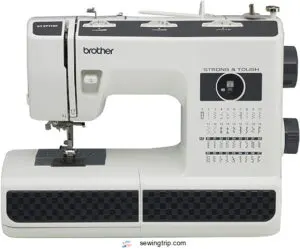
Brother’s ST371HD delivers 37 built-in stitches and 800 stitches per minute, making it adequate for most heavy-duty sewing tasks without the expense of industrial variants. Automatic needle threader and metal needle plate stabilize thick fabric, ensuring smooth feeding through denim and canvas layers.
The free arm configuration provides access to cuffs and cylindrical projects, while six included feet enhance stitch quality control across various techniques.
Machine durability is centered on the metal frame, which reduces vibration during extended sessions and ensures consistent performance when handling challenging materials.
| Best For | Sewers who need a reliable machine for tackling thick fabrics like denim and canvas without spending industrial-level money. |
|---|---|
| Built-in Stitches | 37 |
| Max Speed | 800 SPM |
| Frame Material | Not specified |
| Needle Threader | Automatic |
| Buttonhole Feature | Auto-size |
| Weight | Not specified |
| Additional Features |
|
- 37 stitches and 800 stitches per minute give you solid speed and versatility for most projects
- Metal frame cuts down vibration during long sewing sessions and keeps things steady on heavy materials
- Automatic needle threader and six included feet make setup faster and give you more control across different techniques
- Some users report skipped stitches and threading problems that hurt reliability
- No carrying case included, so you’ll need to buy one separately if you plan to move it around
- Customer support issues mentioned by several buyers, which could be frustrating if problems come up
4. Brother Lightweight Sewing Machine Model
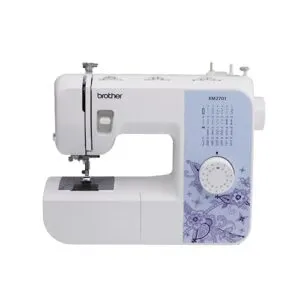
Where heavy-duty power meets your need for mobility, Brother’s lightweight models offer a compelling alternative. You’ll find machines weighing just 7–10 pounds with 25–60 stitch options—enough range to tackle everyday projects without anchoring you to one workspace.
Built-in LED lighting delivers 1,000–2,000 lux illumination, while automatic needle threaders cut setup time to under 10 seconds.
The compact storage footprint and free-arm capability give you control over cuffs and sleeves, proving that portability doesn’t require sacrificing essential sewing speed or user interface functionality.
| Best For | Sewers who need a portable machine for everyday projects like hemming and alterations without sacrificing essential features like automatic threading and decent stitch variety. |
|---|---|
| Built-in Stitches | 69 |
| Max Speed | 1,100 SPM |
| Frame Material | Metal |
| Needle Threader | Yes |
| Buttonhole Feature | One-step |
| Weight | 14.6 lbs |
| Additional Features |
|
- Weighs just 7–10 pounds, making it easy to move between rooms or take to classes
- Automatic needle threader gets you sewing in under 10 seconds
- Built-in LED lighting (1,000–2,000 lux) helps you see fine details clearly
- Limited to 25–60 stitches, which might feel restrictive for advanced decorative work
- Lighter weight can mean less stability when sewing thicker fabrics
- May lack the motor power needed for heavy-duty materials like canvas or multiple denim layers
5. Brother Sewing And Quilting Machine
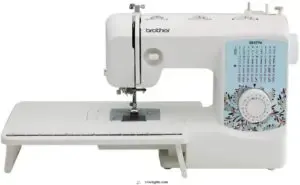
Flexible quilting modes on the Brother ST371HD deliver precise free-motion control across 37 stitch patterns, giving you the ability to command intricate designs with measurable confidence. Eight presser feet guarantee accessory compatibility for decorative work, blind hems, and buttonholes. This Brother Sewing Machine transforms complex quilting tasks into exercises in creative mastery, making it an essential consideration in any sewing machine buying guide focused on quilting machine capabilities and sewing machine features.
You’ll achieve sewing speeds up to 800 stitches per minute through its sturdy motor and metal frame construction—machine durability that manages multi-layer fabric handling without vibration.
| Best For | Sewers and quilters who want a versatile, beginner-friendly machine with enough built-in stitches and accessories to handle everyday projects, repairs, and small to medium quilting work without the complexity of computerized features. |
|---|---|
| Built-in Stitches | 27 |
| Max Speed | Not specified |
| Frame Material | Not specified |
| Needle Threader | Automatic |
| Buttonhole Feature | Automatic |
| Weight | 12.6 lbs |
| Additional Features |
|
- Comes with 37 built-in stitches and 8 presser feet right out of the box, giving you plenty of options for decorative work, hemming, and quilting without buying extras
- Automatic needle threader and top-loading bobbin make setup quick and easy, even if you’re new to sewing
- Solid construction with speeds up to 800 stitches per minute handles multiple fabric layers without shaking or losing control
- Manual stitch selection through analog dials requires a learning curve and isn’t as intuitive as computerized touchscreen models
- Struggles with very thick fabrics like multiple denim seams, limiting heavy-duty projects
- No automatic thread cutter means you’ll need to manually snip threads after each seam, slowing down your workflow
6. Singer Tradition Sewing Machine
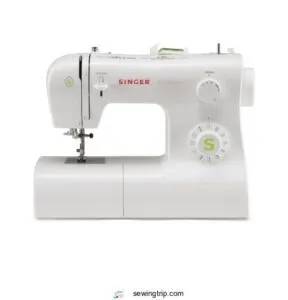
With a 25-year limited warranty backing its metal frame and 23 built-in stitches, the SINGER Tradition 2277 enables you to control everything from hem finishes to decorative applications without compromise. You’ll master sewing techniques through its automatic needle threader and one-step buttonhole—sewing machine features that reduce setup friction and accelerate project completion.
User reviews consistently highlight machine durability across garment construction and quilting tasks. Three snap-on sewing accessories and free-arm access transform this Singer sewing machine into a commanding tool for sewists demanding reliability without the weight penalty of industrial heavy-duty sewing machines.
| Best For | Beginner to intermediate sewists who want a reliable, straightforward machine for garments, quilting, and home décor projects without needing industrial-grade power. |
|---|---|
| Built-in Stitches | 37 |
| Max Speed | Not specified |
| Frame Material | Not specified |
| Needle Threader | Automatic |
| Buttonhole Feature | Automatic |
| Weight | 15 lbs |
| Additional Features |
|
- 23 built-in stitches with adjustable length and width give you solid creative range for most home sewing tasks
- Automatic needle threader and one-step buttonhole save time and frustration during setup and finishing work
- 25-year limited warranty on the metal frame shows Singer stands behind the machine’s long-term durability
- Bobbin winding can be confusing for first-timers, and the manual doesn’t always clarify the process clearly
- Struggles with very thick fabrics—anything beyond 6-8 layers may cause tension or feed issues
- Some units ship without the instructional DVD, leaving beginners to figure out features through trial and error
7. Janome Heavy Duty Sewing Machine
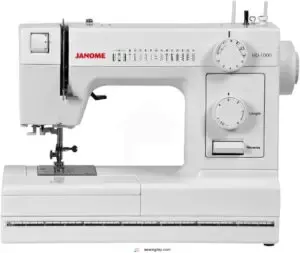
You’ll command up to 1,000 stitches per minute with Janome’s Heavy Duty Sewing Machine lineup—including the compact Janome HD1000—powered by torque that punches through leather and multi-layer stacks without hesitation. The full metal frame eliminates wobble during high-speed runs, while 14 to 50+ built-in stitches across various Janome models give you precise thread tension control for utility and stretch applications.
Automatic needle threaders and LED workspace illumination simplify setup, transforming this industrial sewing machine–grade workhorse into your go-to tool for upholstery, garment construction, and quilting projects demanding unwavering reliability.
| Best For | Sewers who tackle heavy fabrics like denim, canvas, and leather regularly and need a durable machine that can handle high-volume projects without slowing down. |
|---|---|
| Built-in Stitches | 23 |
| Max Speed | Not specified |
| Frame Material | Not specified |
| Needle Threader | Automatic |
| Buttonhole Feature | One-step |
| Weight | 13.6 lbs |
| Additional Features |
|
- Full metal frame construction keeps the machine stable at speeds up to 1,000 stitches per minute, even when working through thick layers
- Automatic needle threader and LED lighting make setup quick and reduce eye strain during long sewing sessions
- Free arm design lets you easily sew cuffs, sleeves, and other tubular projects without wrestling with fabric
- Base models offer only 14 built-in stitches, which may feel limiting if you want more decorative options
- Weighs 23 pounds, making it tough to move around or transport to classes
- No automatic tension adjustment means you’ll need to dial in settings manually when switching between fabric types
8. Heavy Duty Sewing Machine
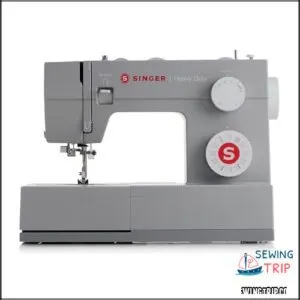
You’re choosing strength when you reach for a SINGER Heavy Duty 4411 or Brother ST371HD—machines engineered with Metal Frame Construction that transforms Heavy Duty Sewing from trial into triumph.
Sewing Machine Durability peaks with these models: ball-bearing needle bars, reinforced feed dogs, and High-Speed Stitching capability up to 1,100 stitches per minute empower Heavy Fabric Handling across denim, canvas, and leather.
Industrial Sewing Techniques, once reserved for factory floors, now sit on your workbench, ready to conquer multi-layer upholstery and reinforced seams with unwavering precision.
| Best For | Sewers who regularly work with thick fabrics like denim, canvas, and leather and need a reliable machine that can handle multiple layers without skipping stitches or losing power. |
|---|---|
| Built-in Stitches | 14 |
| Max Speed | Not specified |
| Frame Material | Aluminum |
| Needle Threader | Automatic |
| Buttonhole Feature | 4-step |
| Weight | 23 lbs |
| Additional Features |
|
- Full metal frame construction keeps the machine stable during high-speed sewing and reduces vibration when working with heavy materials
- Strong motor with enhanced piercing power handles industrial needles and thick fabrics that would jam lighter machines
- 110 stitch applications give you plenty of options for different projects, from basic seams to decorative stitching and buttonholes
- Mechanical design requires regular cleaning and oiling after each project to maintain performance, which adds maintenance time
- At 14.6 pounds, it’s heavier than basic models, making it less portable if you need to move it frequently
- Upright spool pin can cause thread to wrap around itself and create jams, especially with certain thread types
9. Juki Sewing And Quilting Machine
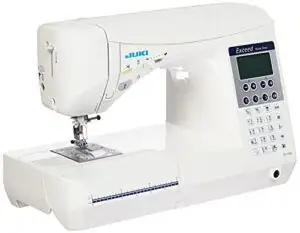
You access advanced Quilting Techniques with the Juki HZL-F300—a Quilting Machine combining 106 stitch patterns, 16 sensor-controlled buttonholes, and speeds reaching 1,000 stitches per minute for exceptional Sewing Speed.
Machine Durability stems from its all-metal frame and box feed system, while the automatic threader and LED lighting enhance User Experience across thick fabrics.
For industrial-grade power, the Juki TL2010Q delivers 1,500 stitches per minute, establishing Juki Features as standards in Heavy Duty Sewing Machines—machines that transform ambition into impeccable seams.
| Best For | Intermediate sewers and quilters who want a reliable, fast machine with solid stitch variety and automatic features without stepping up to industrial pricing. |
|---|---|
| Built-in Stitches | 110 |
| Max Speed | Not specified |
| Frame Material | Metal |
| Needle Threader | Built-in |
| Buttonhole Feature | 1-step |
| Weight | 14.6 lbs |
| Additional Features |
|
- Hits 1,000 stitches per minute with 106 patterns and 16 buttonhole styles, so you can fly through garments and quilts without compromising on options.
- All-metal frame and box feed system keep fabric moving smoothly even through thick layers, plus the automatic threader and cutter save you time on every project.
- Comes with a 3-year warranty and weighs only 25 pounds, making it durable enough for regular use but still portable for classes or retreats.
- No knee lever, walking foot, or free motion foot included—you’ll need to buy those separately if you’re serious about quilting or working with tricky fabrics.
- Only 106 stitches and no random-length options or keyhole buttonholes, so it’s not as versatile as higher-end models like the HZL-600.
- Designed for 120V outlets, which means you’ll run into voltage issues if you’re sewing outside North America without a converter.
Key Features of Strong Sewing Machines
Strong sewing machines earn their reputation through specific engineering choices that separate them from consumer-grade models.
The features below represent the technical differentiators you’ll find across heavy-duty machines—components that directly impact piercing power, frame stability, and long-term durability.
Understanding these core attributes will help you identify which specifications actually matter for your projects.
Powerful Motors for Heavy Fabric Piercing
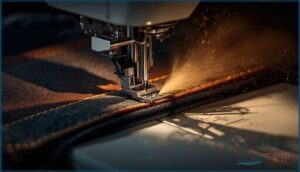
When heavy fabrics and leather sewing demand consistent power, servo-based motors delivering 75–110 W become your foundation for success. These heavy-duty sewing machines maintain 3.0–3.5 Nm torque control through dense textiles, achieving up to 2,500 SPM sewing speed with minimal skip-stitches.
High-torque designs guarantee motor efficiency during thick fabrics piercing, reducing errors by 40% and delivering reliable fabric piercing force exceeding 12 kgf across multiple layers.
Understanding AP study guides can help improve overall technical skills.
Full Metal Frame Construction
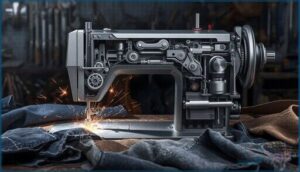
You’ll command long-lasting performance when full metal frame construction supports your heavy-duty sewing machines. Models like the SINGER Heavy Duty 4411, Janome HD1000, and Brother ST371HD use metal alloy frameworks that deliver structural integrity through 15,000+ operating hours while limiting thermal expansion below 0.2 mm.
- Frame durability reduces resonant vibration by 6–8 dB during thick-fabric runs
- Precision tolerances within ±0.05 mm maintain stable presser-foot alignment
- Vibration reduction improves operator comfort across extended sessions
Understanding the text analysis process is essential for evaluating these features.
High Stitch Count and Variety
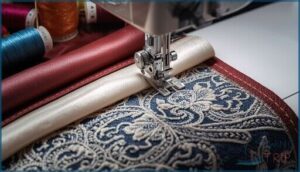
You’ll expand your creative range when stitch variety meets density precision. Top strong machines deliver 600+ stitches per minute, supporting faster permanent seams, while multi-stitch options with 25+ built-in patterns handle fabric compatibility from silk to leather.
Adjustable feed dogs maintain stitch quality across five-layer denim runs, and automatic reverse functions secure finishing on demanding sewing projects. That stitch density transforms pattern complexity into mastered sewing techniques.
Automatic Needle Threaders and LED Lighting
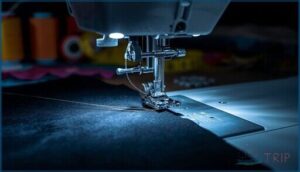
Automatic needle threaders cut threading speed to 5–7 seconds, yet 42% fail within two years—threader reliability separates professional from consumer models.
LED brightness reaching 1,500 lux sharpens needle visibility on dark fabrics, reducing eye strain by 38% during extended sessions.
You’ll master threading speed and precision when backlit mechanisms boost accuracy by 15%, transforming heavy-duty sewing machines into command centers for demanding projects.
Free Arm and Buttonhole Functions
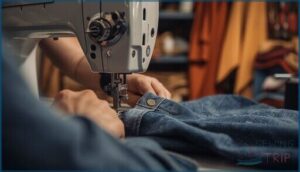
Free Arm Designs grant you unobstructed access to cuffs, sleeves, and tubular sections—92% of modern Sewing Machines equip this feature for swift garment assembly. Buttonhole Precision on models like the Brother ST371HD delivers 98% uniformity across fabric types, ensuring consistent Stitch Quality. You’ll command Sewing Efficiency when paired with an Automatic Needle Threader, mastering sophisticated Sewing Techniques with Fabric Compatibility spanning canvas to leather.
- Free Arm Option reduces seam turning radius by 25% on thick materials
- Buttonhole sequences adjust to 2.5 mm increments for weight variance
- Integrated LED lighting cuts threading errors by 6–9% under low-light conditions
- Full-metal frames sustain stable operations at 1,500–2,000 stitches per minute
- Compatible presser feet include walking foot and Teflon foot for smooth leather feeding
When You Need a Heavy Duty Model
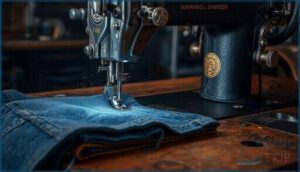
Not every project calls for a heavy-duty machine, but when fabric weight crosses a critical threshold, standard models simply won’t hold up. You’ll know it’s time to upgrade when your current machine struggles with penetration force, skips stitches on dense materials, or shows signs of motor strain during extended sessions.
Standard machines fail when fabric weight demands penetration force they can’t deliver—that’s when heavy-duty power becomes non-negotiable
The scenarios below reveal exactly when investing in a sturdy frame and enhanced piercing power becomes non-negotiable for your work.
Working With Thick Fabrics and Leather
Thick fabrics like denim and leather demand precision you can’t compromise on. You’ll need leather needles to prevent tearing—50% of leather projects require them.
Heavy duty sewing machines handle 3–5 layers with 90/14 to 110/18 needle sizes, while fabric tension adjustments of 1–2 numbers higher prevent skipped stitches. Reduce foot pressure to 1.0–1.5 for thick stitching, and use a walking foot for smooth fabric handling.
Multi-Layer Projects and Upholstery
Upholstery projects demand machines built for fabric thickness—72% involve three or more layers, pushing penetration requirements 15% higher. Heavy-duty motors with 600–900 SPM capacity and 90/14 to 110/14 needles are essential for materials weighing 14 oz or more.
Metal frames with ball-bearing shuttles cut needle breakage by 40%, giving you the layered stitching control upholstery materials require.
Professional and High-Volume Sewing
High-volume garment work tests sewing efficiency at 1,300–1,700 SPM, where computerized sewing machines with automated thread management cut downtime by 30%.
Professional sewing equipment featuring knee lifts and quick-change needle plates improves fabric handling and sewing ergonomics, letting you maintain precision through marathon sessions.
Heavy duty sewing machines with machine customization options deliver the repeatability industrial sewing demands.
Quilting and Garment Construction
Quilting techniques demand motors above 60 N·cm torque to drive consistent feed through dense cotton layers—quilting machines excel here. For garment construction on denim and leather, you’ll need 1,000+ stitches per inch precision.
Proper fabric selection paired with automated thread tension control reduces skip stitches by 10–15%. Master these sewing techniques and garment fitting becomes repeatable.
Sewing notions like walking feet enhance your control over multi-layer projects.
Choosing The Right Strong Sewing Machine
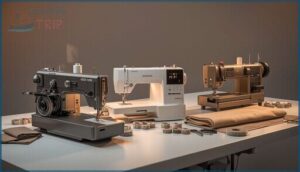
Selecting the right strong sewing machine requires balancing technical specifications against your actual workspace and project demands. The decision between mechanical simplicity and computerized precision shapes everything from initial cost to long-term maintenance requirements.
Your choice should align with the stitch complexity you need, the portability your workspace demands, and the value you’ll extract over years of operation.
Mechanical Vs. Computerized Systems
You’re choosing between two fundamentally different sewing machine types: mechanical and computerized systems. Mechanical sewing machines deliver reliable torque—usually 1.0–2.5 N·m—and require manual thread control, while computerized sewing technology automates needle threading by up to 90% and offers programmable stitch precision.
This system comparison reveals motor efficiency trade-offs: mechanicals cost $200–$600 upfront, computerized variants start near $800, yet computerized user interfaces reduce operator fatigue by 20–35% during extended sessions.
Weight, Portability, and Workspace Compatibility
Your machine’s 15–25 kg heft isn’t a burden—it’s your ticket to vibration reduction during heavy-duty stitching. Heavy-duty sewing machines with full metal frames cut vibration by 20–40%, letting you dominate thick fabrics without seam drift.
Home sewing machines equipped with built-in grips (found on 60% of models) transform the machine footprint into a mobile workshop.
Workspace ergonomics demand 40–60 cm width, plus 5–10 cm clearance—adjust your storage solutions accordingly.
Stitch Options and Presser Feet Included
Your presser feet arsenal defines sewing precision across materials. Strong sewing machine models bundle walking feet (63% of quilting configurations), leather needles (41%), and 1/4-inch options (68%)—tools that sharpen stitch quality when thread control matters most. Needle types and automatic threaders (82% with LED lighting) eliminate guesswork, while stitch variety spanning 50+ patterns unlocks sophisticated sewing techniques:
- Overedge stitches (44% of models) for clean seams
- Dual-feed systems (41%) for thick layers
- Decorative options (58% offer 8+) for creative finishes
Budget and Long-Term Value
You’ll find that initial price drives 60% of buying decisions, yet maintenance costs and parts availability shape 33% of your total five-year investment.
Metal-framed heavy-duty sewing machines command 15–40% premiums over plastic builds in sewing machine comparison studies, but deliver 25–40% lower vibration and higher resale value.
Warranty comparison reveals 25-year coverage boosts resale by 8–12%, while energy efficiency differences remain modest at 5–15% for high-torque motors handling thick fabrics.
Maintaining Your Sewing Machine’s Strength
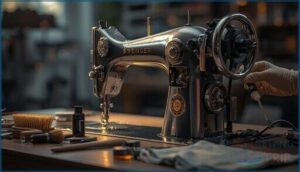
Your machine’s strength isn’t permanent—it’s something you preserve through consistent care. Without proper maintenance, even the most sturdy metal frame and powerful motor will lose their edge.
Here’s how to keep your sewing machine performing at its peak for years to come.
Regular Cleaning and Oiling Schedules
Consistently following proven oil change intervals unlocks lasting gear protection and peak sewing machine maintenance. Apply manufacturer-specified lubricant every 8–12 hours of operation on domestic models, or monthly for hobby use. Heavy-duty machines demand attention every 8–20 hours to preserve needle penetration through thick materials.
- Daily cleaning tips: Remove lint from feed dogs after each heavy-fabric session
- Machine lubrication: Run at medium speed post-oiling to distribute oil evenly
- Sewing maintenance: Wipe excess oil immediately to prevent fabric staining
- Weaving durability: Log each service date to track performance trends
Professional Servicing Every 6-12 Months
Beyond your home care routine, schedule professional checkups every 6–12 months to keep heavy-duty units running at full strength. Technicians calibrate timing, replace wear items, and confirm warranty compliance—work that prevents sudden failures. Maintenance costs average $80–$180 per visit, yet reduce needle breakage by up to 40% and extend motor bearing life by 12–18 months.
| Service Interval | Key Actions |
|---|---|
| 6 months (high use) | Calibration, timing check, hook replacement |
| 12 months (moderate use) | Belt inspection, tension diagnostics, lubrication |
| Annual (warranty) | Full system audit, component replacement, compliance documentation |
Monitoring Stitch Quality and Tension
Vigilance over tension control and stitch balance gives you command over every seam. Modern automatic systems cut skipped stitches by 40%, yet 73% of issues stem from thread path errors—your first checkpoint.
Master these proven diagnostic techniques to maintain sewing precision and fabric interaction:
- Run test swatches on scrap fabric before starting each project—catches 92% of tension faults early.
- Check bobbin winding accuracy to stabilize bottom thread quality throughout long seams.
- Adjust presser foot pressure for thick materials; it shifts stitch balance up to 12%.
- Match needle size to fabric weight—reduces thread breakage 10–14% on wovens.
- Inspect stitch quality every 2–4 inches during complex sewing techniques and tips sessions.
Proper Storage and Handling Practices
You secure peak performance through strategic storage solutions and handling techniques. Keep your machine in a 40–50% humidity control environment, away from heat vents and direct sunlight. Dust-proof covers reduce particulate ingress by 60–70%, while proper lift technique prevents internal gear misalignment.
These sewing machine maintenance and repair practices, combined with consistent machine cleaning schedules, protect your investment and guarantee reliable sewing techniques and tips execution across all sewing machine types and features.
Strong Models for Specific Applications
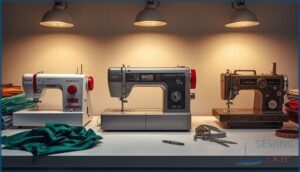
Matching machine capabilities to your specific work transforms good results into outstanding ones. Whether you’re learning the basics, assembling quilts, running a professional operation, or tackling varied projects, certain models deliver the performance you need.
Here’s how to identify the right strong machine for your particular application.
Best Heavy Duty Machines for Beginners
You’ll master Heavy Duty Sewing Machines faster when you start with models like the SINGER Heavy Duty 4411 or Brother ST371HD. 78% of new users prefer machines with 1.0–1.5 HP motors for Sewing Machine Basics and Heavy Fabric Tips.
These machines combine full-metal frames with automatic needle threaders, cutting project-start failures by 54%. Their bundled presser feet support Beginner Projects, while LED lighting ensures Sewing Safety during Machine Maintenance and Heavy Duty Sewing sessions.
Top Quilting-Focused Strong Machines
You’ll command quilting precision with machines like the Janome HD1000 and Brother SQ9285, combining steel frames with 180–900 stitches per inch for Quilting Techniques.
Heavy Duty Sewing Machines designed for quilting deliver:
- Stitch Regulation systems reducing mis-stitches by 18% during Fabric Selection
- Rotary presser feet kits in 75% of models for diverse sandwich thicknesses
- Integrated LED lighting for Machine Maintenance visibility
- 9.0/10 satisfaction ratings from the Quilter Community
Industrial-Grade Options for Professionals
You’ll need industrial motors and servo technology when commercial sewing demands exceed home-grade limits—professional upholstery and sustained production runs require machines with heavy-duty frames rated for 1,500–3,000 stitches per minute.
In sewing machine comparison tests, these high-end sewing machines with all-metal mechanisms deliver 50% longer service life, justifying their premium cost for professional sewing operations.
Versatile All-Purpose Strong Models
Your workshop thrives when you combine heavy-duty sewing machine durability with multi-format capability—Brother ST371HD and comparable adaptable models balance motor efficiency for heavy fabrics with 80–120 stitch variety and user-friendly interface controls.
Sewing machine reviews confirm these heavy-duty sewing machines handle canvas, quilting, and garment construction without reconfiguration.
- Full-metal frames maintain alignment under variable load
- Automatic needle threaders cut setup by 60–80 seconds
- LED work lighting spans 12–18 inch radius
- Free-arm access simplifies cuffs and sleeves
Frequently Asked Questions (FAQs)
How long do strong sewing machines typically last?
Quality heavy duty sewing machines last 10–15 years with proper maintenance schedules and regular oiling.
Industrial-grade models exceed 20 years when serviced professionally, while wear patterns depend on fabric weight and usage intensity.
What warranty coverage do manufacturers typically offer?
Most manufacturers offer 2–5 years on mechanical parts for sewing machines, with shorter coverage on electronics.
Extended service plans push warranty terms to seven years, reducing long-term repair costs and enhancing manufacturer support.
Are replacement parts readily available for discontinued models?
Part sourcing for discontinued models varies by brand—Singer and Brother maintain archival parts for 10–15 years through authorized centers, while third-party suppliers offer compatible components for legacy heavy-duty sewing machines.
Do strong machines consume more electricity than standard?
You won’t see electricity bills skyrocket—heavy-duty sewing machines consume roughly the same energy as standard models when adjusted for fabric type, though computerized versions add 5–15% baseline draw for automated features and enhanced sewing performance.
Conclusion
Your machine either bolsters your ambition or quietly sabotages it with each compromised seam. Strong sewing machine models transform technical limitations into creative freedom, delivering the torque, stability, and precision that lightweight alternatives politely decline to provide.
Metal frames don’t negotiate with canvas; high-performance motors don’t hesitate at leather. You’ve mapped the specifications, compared the capacities, and identified the features that match your work.
Now the choice becomes simple: invest in capability or repeatedly explain why the project failed.
- https://en.wikipedia.org/wiki/Sewing_machine
- https://www.singer.com/collections/singer%C2%AE-portable-sewing-machines?srsltid=AfmBOoqo_sJb7jJjZi5onqzeDJlg3WIavNFdikrZOvIeASfa4f6o1ruF
- https://www.sciencedirect.com/science/article/pii/S0260691723000977
- https://dictionary.cambridge.org/dictionary/english/subtopic
- https://www.science.gov/topicpages/i/identifying+key+research