This site is supported by our readers. We may earn a commission, at no cost to you, if you purchase through links.
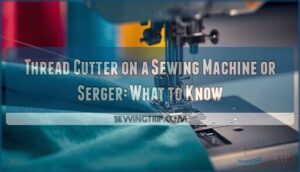
Reaching for mid-seam breaks your rhythm and, more often than not, leaves you with a thread tail that disappears straight into the bobbin case. A thread cutter on a sewing machine or serger solves that problem before it starts—keeping tails short, tension consistent, and your hands exactly where they belong.
Once you sew with one, going back feels like driving without cruise control.
Whether you’re choosing between manual and automatic styles or figuring out where to mount one, knowing what to look for makes all the difference.
Table Of Contents
Key Takeaways
- thread cutter — manual or automatic — keeps your hands on the fabric and your rhythm unbroken, eliminating the constant reach for scissors between seams.
- Blade material matters: ceramic blades last longest and resist rust, while carbon steel cuts sharper out of the box but dulls faster and needs more frequent swapping.
- Where you mount your thread cutter is just as important as which one you pick — left side of the machine head or the presser foot area puts it exactly where your hand naturally lands.
- Clean your thread cutter every 8–10 sewing hours and swap dull blades before they start snagging, because a dull blade is the quietest way to ruin a clean seam.
What is a Thread Cutter on Sewing Machines and Sergers
A thread cutter is exactly what it sounds like — a small blade attached to your machine that lets you snip threads without reaching for scissors.
Most run quietly with just a quick snip, and you can see which sewing machines come with an automatic thread cutter if you’re ready to ditch the scissors for good.
They come in both manual and automatic styles, and where you place one actually matters more than you’d think.
Here’s what you need to know about each of these key points.
Definition and Purpose
A thread cutter is your silent partner at the end of every seam. It performs precision trimming so you can keep moving. Here’s what it actually does for your workflow:
- Delivers clean seam completion without grabbing scissors
- Prevents jams by shortening bobbin tails perfectly
- Maintains workflow continuity between seams
- Provides consistent thread management across every pass
Sewing machine thread cutters make every stitch count. The industry benefits from automatic thread cutting technology, which has been refined by leading manufacturers.
Types of Thread Cutters (Manual Vs. Automatic)
Once your seams are clean, the next choice is how you cut.
You’ve got two solid thread cutting solutions: manual and automatic.
| Feature | Manual Thread Cutter | Automatic Thread Cutter |
|---|---|---|
| Cost Comparison | Under $5–$15 | $300+ machines |
| Speed Efficiency | Moderate | Fast, consistent |
| User Skill Level | Beginner-friendly | Any level |
| Fabric Compatibility | Delicate to medium | Most fabrics |
| Maintenance Frequency | Occasional blade swap | Professional servicing |
automatic thread cutting benefits improve sewing efficiency and reduce thread waste.
Common Placement on Machines
Placement depends on your machine type.
On most sewing machines, you’ll find the thread cutter on the left arm — right where your hand naturally reaches after lifting the presser foot.
Sergers often use head side mounting near the presser foot vicinity.
Bobbin area spots work well for bottom threads.
With adhesive surface options, you can customize where your manual or automatic thread cutter lands.
Key Features and Benefits of Thread Cutters
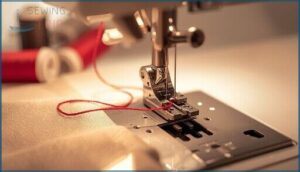
Not all thread cutters are created equal, and knowing what to look for makes a real difference.
The right one can save you time, fit your machine perfectly, and keep your fingers safe.
Pair it with a few sewing speed and accuracy tips and you’ll notice the difference in every seam.
Here are the key features worth paying attention to.
Blade Material and Sharpness
The blade you choose makes all the difference. Each material deals with wear and corrosion differently:
- Ceramic blades win on Ceramic Longevity — they resist rust completely and hold a clean edge through thousands of cuts
- Stainless steel offers solid Stainless Edge Retention and Blade Corrosion Resistance in damp workspaces
- Carbon Steel Hardness gives razor-sharp initial cuts, but demands higher Sharpening Frequency
Ceramic blades simply outlast the rest.
Mounting Options and Compatibility
Most sewing machine thread cutters mount two ways: adhesive or screw. 3M VHB peel-and-stick options work on nearly any flat surface — just clean the spot first. Screw Mount Techniques give a permanent hold near the light guard.
Here’s a quick compatibility guide:
| Feature | Adhesive | Screw Mount |
|---|---|---|
| Surface Compatibility | Clean flat areas | Drillable machine body |
| Brand Compatibility | Brother, Singer, Janome, Juki | Most domestic machines |
| Placement Variations | Presser foot area, left side | Near light guard |
| Mountable On | Serging and Overlocking machines | Sewing Machine Thread Cutters |
| Install Time | Seconds | Minutes |
Cutting Accuracy and Safety
Getting clean, precise cuts isn’t luck — it’s design. Good Blade Alignment and Guard Design work together so your thread cutter trims exactly where you want it, every time.
- Sensor Precision in automatic thread cutters delivers consistent cuts under 1mm
- Friction Reduction coatings prevent thread drag and fraying
- Thread Tension Control ensures the thread stays taut for cleaner snips
- Safety guards protect fingers during manual thread cutter use.
Convenience and Time-Saving Advantages
Stop hunting for scissors mid‑project — that’s Scissor Elimination in action.
A well‑placed automatic thread cutter keeps your hands on the fabric and your mind in the work.
A well-placed automatic thread cutter keeps your hands on the fabric and your focus in the work
Workflow Continuity, Hand Fatigue Reduction, Chain Piecing Efficiency — these aren’t buzzwords. They’re real gains.
| Benefit | Manual Cutting | Thread Cutter |
|---|---|---|
| Speed | Slow | Up to 20% faster |
| Hand Strain | High | Minimal |
| Chain Piecing | Interrupted | Smooth |
| Scissors Needed | Always | Never |
| Focus | Broken | Maintained |
Top 5 Thread Cutters for Sewing Machines and Sergers
Not all thread cutters are created equal, and finding the right one can make a real difference in how smoothly your sewing sessions go.
There are a few standout options worth knowing about, whether you’re working with a basic sewing machine or a multi-thread serger.
Here are five thread cutters that consistently earn high marks from sewers at every skill level.
1. Singer Thread Cutter Adhesive Set
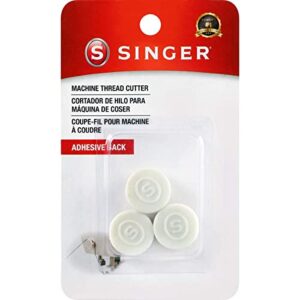
If you want thread cutting to feel smooth, the Singer Thread Cutter Adhesive Set (Model 42071) is hard to beat. You get three compact, 1‑inch cutters, each housing a razor‑sharp blade inside a safe plastic casing.
Just peel the backing and press it onto your machine — left side of the head works best. Pull your threads down against the blade and they snap cleanly. No scissors, no fumbling. It’s a small addition that quietly changes how you work.
| Best For | Sewers of all levels who want a faster, hands-free way to cut threads — especially those using vintage machines without a built-in cutter. |
|---|---|
| Mounting Method | Adhesive backing |
| Blade Material | Steel blade |
| Primary Use | Thread cutting |
| Machine Compatibility | Sewing machines |
| Safety Design | Covered blade |
| Unit Count | 3 cutters |
| Additional Features |
|
- Three cutters in the pack means you can stick one on your machine, keep a spare, or set up multiple stations
- The covered blade keeps things safe while still cutting thread cleanly and quickly
- Works on older or vintage machines that don’t have a built-in thread cutter
- The adhesive backing can lose its grip over time and may need hot glue for a more permanent fix
- Blade sharpness isn’t always consistent — some users find it less sharp than expected
- A few buyers feel the price doesn’t quite match what you’re getting for such a simple tool
2. Thread Cutterz Stainless Steel Flat Mount Cutter
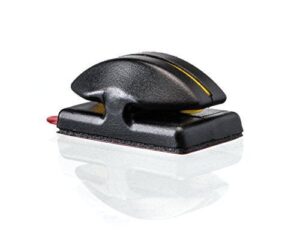
Thread Cutterz Stainless Steel Flat Mount Cutter (Model TCF01B) is a small but mighty upgrade for your sewing station. Its two-sided stainless steel blade cuts thread, yarn, and embroidery floss cleanly from either direction — no fraying, no snagging.
The heavy-duty 3M adhesive sticks firmly to your machine, travel case, or crafting table, and won’t leave residue when you remove it. At just 0.45 inches thin, it stays out of your way until you need it.
| Best For | Sewers, quilters, and crafters who want a clean, no-fuss thread cutter they can stick right on their machine or table and forget about until they need it. |
|---|---|
| Mounting Method | 3M adhesive |
| Blade Material | Stainless steel |
| Primary Use | Thread cutting |
| Machine Compatibility | Sewing machines & crafting |
| Safety Design | Safe enclosed blade |
| Unit Count | 1 cutter |
| Additional Features |
|
- Cuts from either direction with no fraying or snagging — works great on thread, yarn, and embroidery floss
- Mounts in seconds with 3M adhesive and comes off clean with no sticky residue left behind
- Super slim at 0.45 inches, so it sits flush and stays out of the way
- The adhesive weakens if you keep removing and repositioning it
- Blades will dull over time and need replacing
- A bit pricey for what it is — some folks feel it’s a lot to spend on something this small
3. CampTek Seam Ripper Thread Cutter Scissors
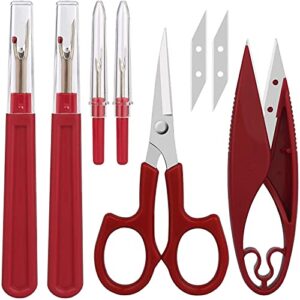
Sometimes one tool just isn’t enough — and that’s exactly where the CampTek Seam Ripper Thread Cutter Scissors kit earns its place.
You get four color-coded seam rippers in two sizes, plus a compact metal thread snip, all tucked into a small storage bag.
The large ripper manages long seams fast, while the small one gets into tight corners without tearing fabric.
The included trimming scissors cut thread close to the surface. It’s a practical, all-in-one kit for serious sewing sessions.
| Best For | Sewers of all skill levels who want a complete, ready-to-go kit for removing stitches, trimming threads, and handling detailed needlework. |
|---|---|
| Mounting Method | No mounting (handheld set) |
| Blade Material | Stainless steel |
| Primary Use | Thread cutting & seam ripping |
| Machine Compatibility | Sewing machines |
| Safety Design | Capped seam rippers |
| Unit Count | 7-piece set |
| Additional Features |
|
- Four seam rippers in two sizes means you’ve got the right tool for both long seams and tight, fiddly spots
- Stainless steel blades stay sharp and hold up well through regular use
- Comes with thread snips and curved scissors, so it’s a genuinely complete kit in one small bag
- The small rippers can be tricky to grip if you have arthritis or joint pain in your hands
- Only useful for sewing and embroidery — not much crossover to other crafts
- Some sewers might prefer more ergonomic or specialized tools over a general-purpose set
4. Grip Snip Sewing Machine Thread Cutter
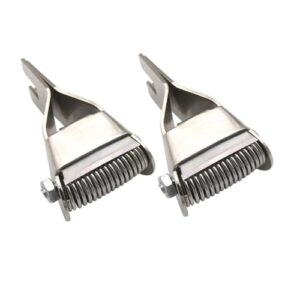
The Grip Snip takes a smarter approach — it mounts directly onto your presser foot bar using the same screw that holds your presser foot.
No extra hardware, no modifications.
Once it’s on, you slip the thread in after sewing, and the internal spring grips it instantly while the blade cuts cleanly.
No scissors, no pausing, no rethreading.
It fits most industrial and home machines, and it genuinely speeds up your workflow when you’re sewing collars, pockets, or long seam runs back‑to‑back.
| Best For | Sewers who work on industrial machines and want to cut thread faster without reaching for scissors every few minutes. |
|---|---|
| Mounting Method | Presser foot bar mount |
| Blade Material | Alloy steel |
| Primary Use | Thread cutting |
| Machine Compatibility | Industrial sewing machines |
| Safety Design | Open spiral spring |
| Unit Count | 1 cutter |
| Additional Features |
|
- Mounts right onto the presser foot bar — no extra tools or modifications needed
- The spring grips and cuts in one motion, so you stay in a rhythm while sewing
- Tiny and lightweight at under an ounce, so it won’t get in your way
- Designed for industrial machines, so it may not fit your home machine
- The blade is sharp enough to cause real cuts if you’re not careful
- Not the best pick for beginners who are still getting comfortable around the machine
5. Creative Notions Lady Bug Thread Cutter
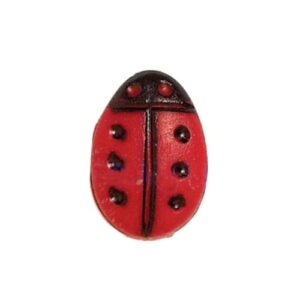
Not every sewist wants a mechanical mount — and that’s where the Creative Notions Lady Bug Thread Cutter earns its place. You just peel the adhesive backing and press it onto any smooth surface near your needle. After 24 hours, it’s there for good. Pull your thread across the slot, and it cuts cleanly. It’s passive, simple, and always within reach.
For chain piecing or quick serger runs, that little ladybug keeps your hands moving without ever chasing scissors.
| Best For | Sewists who want a simple, no-fuss thread cutter that sticks right to their machine without any tools or hardware. |
|---|---|
| Mounting Method | Permanent adhesive |
| Blade Material | Plastic/blade |
| Primary Use | Thread cutting |
| Machine Compatibility | Sewing machines & Sergers |
| Safety Design | Slotted blade housing |
| Unit Count | 1 cutter |
| Additional Features |
|
- Sticks to any smooth surface near your needle — no screws, no drilling
- Always within reach, so you can cut threads without breaking your rhythm
- Great for chain piecing or serger runs where every second counts
- The blade isn’t the sharpest — you have to line the thread up just right into the slot
- Thread can snag on the outside of the cutter if you’re not careful
- The adhesive needs a full 24 hours to set, so you have to be gentle with it at first
How to Attach, Use, and Maintain a Thread Cutter
Getting the most out of your thread cutter comes down to three things: where you put it, how you use it, and keeping it in good shape.
Each step matters more than you’d think. Here’s what you need to know to get it right.
Best Locations for Attachment
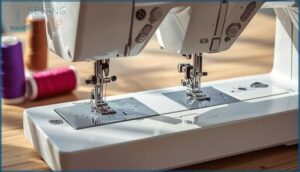
Where you place your thread cutter matters more than most sewists realize. The right spot keeps your workflow smooth and your hands moving naturally. Here are the best mounting locations:
- Left side head – easy access without shifting hand position
- Presser foot area – ideal for serger overlock chains
- Flat surface mounts – works on any smooth sewing machine surface
- Light guard spots – stable, screw-secured placement
- Custom workflow spots – match your personal sewing rhythm
Step-by-Step Usage Instructions
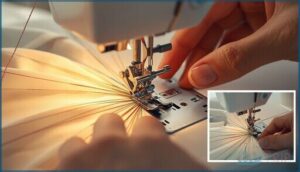
Now that you’ve nailed your Cutter Placement Guide, here’s how to actually use it.
For a sewing machine thread cutter, drape both threads over the blade and pull down firmly — that’s your Cutting Motion Technique. On a serger, wrap the chain around the cutter and tug both ends evenly. Your Seam Start Preparation and Post-Cut Thread Management stay clean every time.
Tips for Safe and Effective Cutting
Staying safe while cutting comes down to a few smart habits. Keep your Hand Positioning consistent — fingers behind the blade, never in front.
Pull threads taut for clean Thread Tension before each snip.
Angle fabric away for Fabric Protection, and don’t bundle multiple threads at once for Jam Prevention.
Sit upright for Posture Control, and your sewing machine thread cutter or serger becomes second nature.
Cleaning and Replacing Thread Cutters

Keeping your thread cutter clean is the backbone of good sewing machine maintenance. Lint builds up fast, so follow this simple maintenance schedule:
- Lint Removal — brush gears after each project
- Adhesive Pad Care — wipe residue monthly to maintain grip
- Replacement Blade Sourcing — Singer and Thread Cutterz offer direct replacements online
Dull blades mean failed cuts. Don’t wait — swap them out.
Frequently Asked Questions (FAQs)
What can a serger do that a sewing machine cannot?
A serger offers Multi‑Thread Overlock, Built‑in Knife trimming, Differential Feed, Rolled Hems, and High‑Speed Sewing — all in one pass. Your sewing machine simply can’t match that efficiency.
Which sewing machines have an automatic thread cutter?
Think of auto thread cutters as the express lane of sewing.
Singer models like the 9960, Janome lineup’s Skyline series, Brother options, Pfaff selections, and several serger variants all include this feature built right in.
How do you replace a dull thread cutter blade?
Turn off your sewing machine and unplug it first — Safety Precautions matter. Note the Blade Orientation, swap it out, then test with scrap thread. Clean hands, good lighting, done.
What causes thread cutters to jam frequently?
Dull blades, lint accumulation, improper threading, wrong thread types, and mechanical misalignment are the usual culprits. Regular sewing machine maintenance and correct serger setup prevent most jams before they start.
Can thread cutters work with all thread types?
Not quite.
Most thread cutters handle cotton and polyester well, but heavy upholstery thread, metallic, or elastic fibers can dull blades fast or cut unevenly.
Match your blade material to your thread type.
How often should thread cutters be cleaned?
Clean your thread cutter every 8–10 sewing hours. High-lint fabrics like fleece? Clean after every use. A quick brush keeps lint buildup from slowing your cuts.
Why wont my automatic thread cutter activate?
Your automatic thread cutter won’t activate due to incorrect Power Settings, high Needle Height, Thread Tension issues, Lint Blockage, or a Dull Blade.
Check each one — most fixes take under a minute.
Can thread cutters damage delicate or specialty fabrics?
Yes, they can—but only if blade is dull. A sharp thread cutter glides cleanly through delicate fabric without pulling.
Replace blades early, and you’ll avoid snags on silk, chiffon, or lace.
Are thread cutters compatible with all needle types?
Most thread cutters work across needle types — from fine 60/8 to large 120/19 — with proper shank compatibility and needle threading clearance built in. Your serger’s multi-needle support stays fully intact.
How do thread cutters affect machine warranty coverage?
Using an aftermarket thread cutter won’t automatically void your sewing machine warranty. Under FTC compliance rules, manufacturers must prove the accessory caused the damage before denying any claim.
Conclusion
A dull blade is a quiet saboteur—it doesn’t announce itself until your thread frays and your seam unravels.
That’s exactly why the right thread cutter on a sewing machine or serger isn’t a luxury; it’s the difference between momentum and frustration.
Choose the right style, mount it well, and keep the blade clean.
Your hands stay in control, your rhythm stays unbroken, and every cut becomes as deliberate as the stitch before it.
- https://www.sailrite.com/Sailrite-Sewing-Machine-Thread-Cutter
- https://www.singer.com/products/singer-14hd854-heavy-duty-serger
- https://patents.google.com/patent/CN203741554U/en
- https://www.sewingmachinefun.com/sewing-machines-automatic-thread-cutters/
- https://konsew.com/blog/automatic-thread-cutter-convenience-feature