This site is supported by our readers. We may earn a commission, at no cost to you, if you purchase through links.
A warped or deeply scored cutting mat quietly sabotages your work long before you notice—seams drift, cuts veer off-grain, and you spend more time correcting than creating.
Most seamstresses discover this the hard way, usually mid‑project when a rotary cutter follows an old groove instead of the line they marked.
The mat underneath your fabric isn’t passive equipment; it actively shapes your accuracy, blade longevity, and pace of work.
Cutting mats for professional seamstresses range from basic self‑healing PVC to large double‑sided workhorses with calibrated grids, and the difference between a mediocre mat and the right one shows up in every cut you make.
Table Of Contents
- Key Takeaways
- Key Features of Cutting Mats for Seamstresses
- Types and Materials of Professional Cutting Mats
- How to Choose The Right Cutting Mat
- Top 10 Cutting Mats for Professional Seamstresses
- 1. Dahle Vantage Self Healing Cutting Mat Blue
- 2. Aneuzs Self Healing Rotary Cutting Mat
- 3. Fiskars Rotary Cutter Set with Mat
- 4. Alvin Self Healing Cutting Mat
- 5. OLFA 35×70 Double Sided Rotary Cutting Mat
- 6. Fiskars Rotating Self Healing Cutting Mat
- 7. ReArt Cutting Mat Variety Pack
- 8. Fiskars Double Sided Cutting Mat
- 9. Cricut Explore Air 2 Lilac Kit
- 10. Silhouette Cameo 5 Vinyl Cutter Bundle
- Maintaining and Caring for Cutting Mats
- Frequently Asked Questions (FAQs)
- Conclusion
Key Takeaways
- A warped or deeply scored mat quietly ruins your accuracy long before you notice—your rotary cutter follows old grooves instead of your marked lines, and every cut after that is damage control.
- The right mat isn’t just a flat surface; its thickness (3–5mm), self-healing PVC layers, and non-slip backing actively protect your blades, your table, and the precision of every cut you make.
- Matching mat size to your project scale matters more than most sewists realize—a 24×36-inch mat handles most yardage cuts cleanly, while compact or rotating options serve detail work and small blocks far better.
- How you care for your mat determines how long it performs: store it flat between 60–80°F, rotate cutting zones regularly, and do monthly vinegar soaks to restore PVC flexibility before grooves become permanent.
Key Features of Cutting Mats for Seamstresses
cutting mats are built the same, and for a seamstress, the details really do matter.
A closer look at cutting mats designed specifically for classroom use shows exactly which features hold up under daily, heavy-handed student work.
The right mat can mean the difference between a clean, confident cut and a frustrating one.
Here’s what to look for before you commit to one.
Self-Healing Surfaces and Durability
A self healing cutting mat isn’t just a nice-to-have sewing tool — it’s what separates clean, consistent fabric cutting from frustrating, jagged lines.
Most quality mats use a layered construction with soft outer PVC over a firmer core, letting rotary cutters compress the surface without permanent damage.
At around 3mm thick, that thickness-longevity impact is real: blades stay sharper longer, and the mat keeps working for years.
They’re also suitable for professional or industrial use.
Grid Lines and Measurement Markings
Good grid markings do more than decorate a mat — they’re your silent measuring partner.
Look for dual Metric‑Imperial Scales along every edge, plus bold Angle Guides at 30°, 45°, and 60° for clean bias cuts.
Strong Contrast Colors keep Grid Markings readable under any light, while fine Subdivision Density and clear Edge Numbering make Precision Cutting and Measurement genuinely easy.
The mat’s triple layer surface ensures durability and smooth cutting.
Non-Slip and Stable Work Surfaces
Accurate grid lines only help when your mat stays put. A non-slip work surface is what separates precise cuts from frustrating do-overs.
Here’s what to look for in Cutting Mat Selection:
- Backing Materials — PVC or rubber grips smooth tables without adding bulk
- Texture Grip — fine surface texture locks fabric without snagging threads
- Thickness Stability — 3–5 mm mats resist flexing under rotary pressure
- Table Contact — flat, curl-free edges maintain full grip across the whole surface
- Comfort Safety — steady mats mean lighter hand pressure and less wrist strain
Protection for Workspaces and Cutting Tools
A steady mat does more than hold still — it shields your table and your tools.
Self healing cutting mat layers absorb blade impact, slowing wear on rotary edges and supporting blade longevity session after session.
They also act as a chemical barrier against basting sprays and glues.
For seamstresses focused on precision cutting, that work surface protection is quiet, unglamorous, and completely worth it.
Variety in Sizes and Thickness
Cutting mats come in a surprisingly wide range of standard dimension ranges — from compact 9×12 inches for precision cutting near your machine, up to oversize table coverage at 40×72 inches for full quilt layouts.
Thickness impact matters too: 1.5 mm portable folding options travel easily, while 3 mm self healing cutting mats stay rigid under heavy layers.
Match your project size to your mat, and double sided mats stretch that investment further.
Types and Materials of Professional Cutting Mats
Not all cutting mats are built the same, and that difference shows up fast once you’re deep into a project. The material and construction behind your mat shape how it performs, how long it lasts, and which tools it actually works with.
Here’s a closer look at the main types you’ll find on the market today.
PVC Construction and Layering
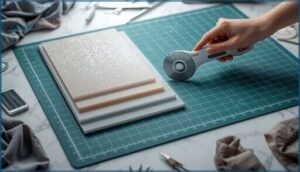
Most professional cutting mats rely on a Multi‑Layer Architecture that makes all the difference under your rotary blade.
The outer soft PVC compresses on contact — Self‑Healing Particle Dynamics close the groove almost instantly.
Beneath that, Core PVC Density keeps the mat flat and warp‑free.
This Layered Thickness Grading, reaching 3mm in premium models, creates a Surface Hardness Gradient that protects both your table and your blade edge.
Double-Sided Vs. Single-Sided Mats
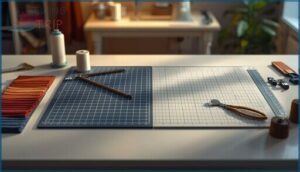
When choosing between double-sided and single-sided options, your workflow flexibility and budget both deserve consideration.
- Lifespan comparison: double-sided mats spread wear across two faces, lasting noticeably longer
- Color contrast: flip between light and dark sides to match any fabric
- Cost efficiency: higher upfront cost, but fewer replacements over time
- Rotary cutters: groove one side? Switch immediately
- Storage considerations: same footprint, double the sewing surface
Hard Vs. Soft Surface Mats
Hard mats feel firm underfoot — stable, rigid, predictable. Soft self-healing cutting mat surfaces cushion your blade just enough to reduce edge dullness, so your rotary cutter stays sharper longer.
Surface hardness directly affects blade wear: harder boards transmit more cutting pressure, while self-healing flexibility impacts softens each pass.
For daily garment cutting, soft self-healing materials consistently outperform rigid boards on stability differences and longevity.
Specialized Mats for Rotary Cutters
Rotary cutters demand a mat built specifically for their circular blades. A quality self-healing cutting mat designed for rotary blade compatibility cushions each pass, letting the surface reseal cleanly and preserving blade sharpness considerably longer.
Look for modular grid systems with 1/8-inch precision markings, heat resistance for heated workrooms, color coding to distinguish zones, and eco-friendly materials — every feature working together to protect both your rotary blades and your work.
Folding and Interlocking Mats
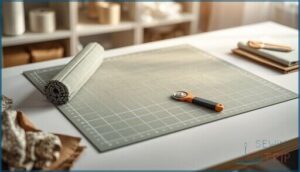
Folding mats collapse from a full 36 x 48 inches down to around 11 x 17 inches, making portable storage easy for classes and retreats.
Precision hinge mechanisms keep the surface smooth, so your rotary cutter won’t snag crossing panel joints.
Interlocking tile connectivity lets you expand your workspace gradually.
Many use eco-friendly TPE materials with self-healing cutting mat properties, rivaling double-sided mats in durability for daily sewing.
How to Choose The Right Cutting Mat
Picking the right cutting mat isn’t complicated, but a few key factors make a real difference in how well it performs for your specific work.
The wrong choice can slow you down, wreck your blades faster, or leave you fighting a mat that’s too small or too slippery to be useful.
Here’s what to look at before you buy.
Assessing Workspace and Project Needs
Mapping your workspace before buying sets you up for real success. Your table height, lighting setup, and storage layout all shape which mat actually works for you. A self‑healing cutting mat in the wrong spot creates friction, not flow.
The right cutting mat starts with knowing your workspace — size, light, and layout before anything else
- Match mat placement to your workflow flow
- Position near natural light for accurate grain reading
- Keep tool accessibility within arm’s reach
- Plan storage layout under or beside the table
- Align mat size with your typical project scale
Selecting The Appropriate Size
Once workspace is mapped, size becomes your next real decision.
Project dimensions matching matters more than you’d think — a 24 by 36 inch self‑healing cutting mat manages most yardage cuts, selvage to selvage, while an 18 by 24 inch works for quilt blocks.
Fabric width compatibility and grid coverage ratio guide portability versus size, keeping your precision consistent across projects.
Importance of Thickness and Material Quality
Thickness does more than you’d think. Mats between 3 mm and 5 mm offer real impact absorption, protecting both your table and your blades — blade longevity improves noticeably when edges aren’t hitting hard surfaces.
Self healing cutting mat construction with surface uniformity keeps cuts clean over time.
Double sided mats and eco-friendly materials add versatility while noise dampening makes long sessions far more comfortable.
Evaluating Grid and Measurement Features
Grid markings are where precision lives. Look for metric-imperial grids so you can switch between measurements without guessing.
Fiskars adds 30-, 45-, and 60-degree angle guides — angle guide accuracy matters when cutting bias tape.
Creative Grids’ contrast visibility keeps lines readable under rulers.
Yardage increment scaling and dual-sided grid consistency help quilters and sewists cut faster on any self-healing cutting mat.
Considering Portability and Storage
For sewists always on the move, portability isn’t an afterthought — it’s a priority. Folding Mechanisms like hinged panels reduce mats from 24×36 inches down to a compact 9×12. Lightweight Materials such as TPE keep weight under three pounds.
Here’s what makes a self healing cutting mat travel-ready:
- Compact Sizes that slide into totes
- Vertical Storage solutions like pegboard racks
- Carrying Accessories including protective sleeves
Smart Craft Room Setup starts with mats that move with you.
Top 10 Cutting Mats for Professional Seamstresses
After weighing all the size, thickness, self-healing quality, and how each mat supports a rotary cutter, ten options consistently rise above the rest.
Some are built for heavy daily use, others for portability or precision grid work, but each earns its place for a specific reason.
Here’s what you need to know about the top cutting mats worth your money in 2026.
1. Dahle Vantage Self Healing Cutting Mat Blue
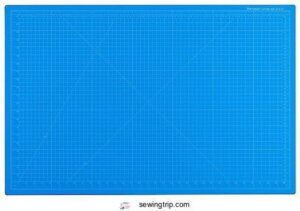
The top‑ranked spot of the Dahle Vantage 10693 is earned through sheer reliability. Its five‑layer PVC construction, measuring 1/8‑inch thick, manages repeated rotary cuts without permanent scarring — shallow cuts simply close back up.
The 36" × 24" surface gives you real room to work, and the screened guides include a 1/2‑inch grid with inch, metric, 45‑degree, and 60‑degree angle markings.
The blue high‑contrast background makes every cut line crisp and easy to follow, even during detailed seam work.
| Best For | Crafters, sewers, and leatherworkers who need a reliable, large-format cutting surface for precise, repeated cuts. |
|---|---|
| Material | PVC |
| Primary Use | Crafts & Sewing |
| Surface Type | Self-Healing |
| Blade Compatibility | Rotary & Straight |
| Weight | 5 lbs |
| Brand | Dahle |
| Additional Features |
|
- Self-healing design holds up through heavy use — cuts close back up instead of leaving permanent grooves
- Generous 36" × 24" surface gives you plenty of room to work on bigger projects
- Built-in inch, metric, and angle guides make measuring and trimming quick and accurate
- May arrive folded or rolled and need some time to lay flat before use
- Grid lines can be tough to see in dim lighting
- Not meant for heavy-duty tools like box cutters, which can damage the surface
2. Aneuzs Self Healing Rotary Cutting Mat
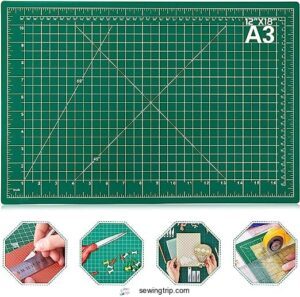
Anezus Self-Healing Rotary Cutting Mat is a solid mid-range pick when you need reliable performance without a big investment.
12 x 18-inch surface — A3 size — accommodates most sewing, quilting, and scrapbooking layouts comfortably. Five layers of PVC give it genuine durability, and the self-healing surface closes up rotary cuts cleanly, protecting your blades in the process.
Both sides carry inch and metric grid markings with angle guides, so you can flip it and keep working without losing accuracy.
| Best For | Crafters, quilters, and hobbyists who work on small to medium-sized projects and want a durable, accurate cutting surface without spending a lot. |
|---|---|
| Material | PVC |
| Primary Use | Crafts & Sewing |
| Surface Type | Self-Healing |
| Blade Compatibility | Rotary & Straight |
| Weight | 11.6 oz |
| Brand | Unbranded |
| Additional Features |
|
- Self-healing surface closes up cuts and keeps your blades sharp longer
- Double-sided with both inch and metric grids plus angle guides — great for precision work
- Lightweight and portable at just 11.6 oz, easy to move around your workspace
- At 12 x 18 inches, it’s too small for larger quilting or fabric projects
- Only comes in one size, so you can’t scale up if your needs grow
- Some users may find themselves needing a second, bigger mat pretty quickly
3. Fiskars Rotary Cutter Set with Mat
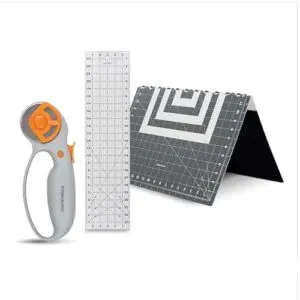
The Fiskars Rotary Cutter Set with Mat gives you three tools in one box — a 45mm rotary cutter with an ergonomic loop handle, an 18" x 24" self‑healing mat, and a 6.5" x 24" acrylic ruler with highlighted seam allowances.
That combination cuts setup time and keeps your workspace tight. The mat’s measuring grid manages both alignment and precision, and the folding design stores flat when you’re done. It works equally well for right- and left-handed sewers.
| Best For | Quilters, sewers, and crafters who want a reliable all-in-one cutting setup that works whether you’re left- or right-handed. |
|---|---|
| Material | Acrylic |
| Primary Use | Quilting & Sewing |
| Surface Type | Self-Healing |
| Blade Compatibility | Rotary Cutter |
| Weight | 3.9 lbs |
| Brand | Fiskars |
| Additional Features |
|
- Three tools in one box — cutter, mat, and ruler — so you’re ready to go right out of the package
- The ergonomic loop handle makes long cutting sessions way more comfortable on your hand
- Self-healing mat with a clear measuring grid keeps your cuts accurate and your table scratch-free
- The fold in the mat can cause the cutter to skip if you’re cutting right over it
- Measurements are inches only — no centimeters, which is a bummer if you work in metric
- The blade and mat aren’t covered under the lifetime warranty, so those replacement costs are on you
4. Alvin Self Healing Cutting Mat
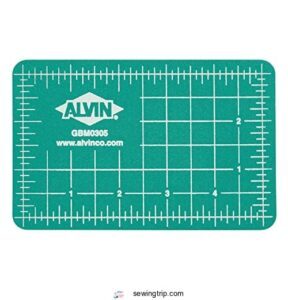
The Alvin Self-Healing Cutting Mat punches above its weight for such a compact tool.
At just 3.5 × 5.5 inches and 0.12 inches thick, it’s built from 3-ply composite vinyl that reseals after each pass of your blade.
The reversible green and black sides let you match contrast to your fabric — light materials on green, dark ones on black.
A 0.5-inch grid with 45- and 60-degree angle guides keeps your cuts precise, and cleanup takes nothing more than soap and a damp cloth.
| Best For | Crafters, quilters, and hobbyists who need a reliable small cutting mat for precise detail work with fabric, ribbon, leather, or other materials. |
|---|---|
| Material | Vinyl |
| Primary Use | Arts & Crafts |
| Surface Type | Self-Healing |
| Blade Compatibility | Rotary & Straight |
| Weight | 0.8 oz |
| Brand | ALVIN |
| Additional Features |
|
- Self-healing vinyl keeps the surface smooth and your blades sharper for longer
- Reversible green and black sides make it easy to work with both light and dark materials
- Tiny footprint makes it perfect as a desk mat or go-to tool for small, detailed cuts
- At 3.5 × 5.5 inches, it’s too small for larger projects or high-volume cutting
- Repeated cuts can leave faint ridges on the surface over time
- The printed grid lines can fade with heavy use, making precise alignment trickier
5. OLFA 35×70 Double Sided Rotary Cutting Mat
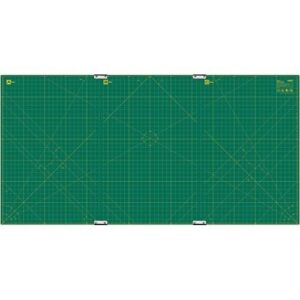
If you’ve ever repositioning fabric mid-cut, the OLFA RM-CLIPS/3 changes that frustration immediately.
Three interlocking 23" × 35" mats clip together to create a generous 35" × 70" workspace — enough to handle full fabric widths without shifting.
The 1.5mm silicone surface is triple-layer heat welded and genuinely self‑healing, keeping your rotary blades sharper longer.
Flip it over for yellow grid lines when precision angles matter.
Just note: it’s designed exclusively for rotary cutters, not utility knives.
| Best For | Quilters, sewers, and fabric crafters who need a large, stable cutting surface for full-width fabric projects. |
|---|---|
| Material | Silicone |
| Primary Use | Fabric Cutting |
| Surface Type | Self-Healing |
| Blade Compatibility | Rotary Cutter |
| Weight | 5.23 lbs |
| Brand | Omnigrid |
| Additional Features |
|
- Big 35" × 70" workspace gives you plenty of room for large cuts without repositioning fabric
- Self-healing silicone surface keeps rotary blades sharper for longer
- Double-sided design with grid lines on one side makes measuring and precise angle cuts easy
- Comes in three separate pieces, so the seams can be a minor annoyance mid-project
- Clips can be tricky to assemble and may shift during use
- Grid is inches only, which isn’t great if you work in metric
6. Fiskars Rotating Self Healing Cutting Mat
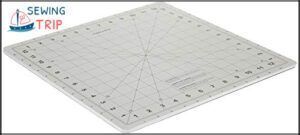
When you’re trimming small blocks and hate repositioning your ruler every few seconds, this mat solves that problem quietly.
The 14×14-inch platform rotates a full 360 degrees, so you cut all four sides without moving your fabric once. The self-healing surface manages repeated rotary blade use well, and the printed grid goes to 13×13 inches with 1/8‑inch increment markings — genuinely useful for patchwork accuracy. Bias lines at 30, 45, and 60 degrees round out a compact mat that punches well above its price.
| Best For | Quilters and crafters who work with small fabric pieces and want a portable, accurate mat that saves time on angle cuts. |
|---|---|
| Material | Plastic |
| Primary Use | Quilting & Sewing |
| Surface Type | Self-Healing |
| Blade Compatibility | Rotary Cutter |
| Weight | 1.8 lbs |
| Brand | Fiskars |
| Additional Features |
|
- Rotates 360 degrees so you can cut all sides of a block without shifting your fabric
- Self-healing surface holds up well to regular rotary blade use
- Clear grid with 1/8-inch markings and 30, 45, and 60-degree bias lines make accurate cuts easy
- The usable gridded area is 12×12 inches, not the full 14×14 the size suggests
- Rotation can feel less smooth compared to pricier mats
- Only comes in gray, which not everyone will love
7. ReArt Cutting Mat Variety Pack
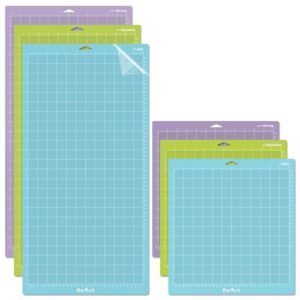
ReArt Cutting Mat Variety Pack earns its place because not every project needs the same grip. Six mats total — three 12×12‑inch and three 12×24‑inch — each in light, standard, or strong adhesive grip.
Light blue mats handle delicate vellum and paper; standard green mats manage cardstock and vinyl; strong purple mats hold thick fabrics and poster board. All six work with Cricut Maker and Explore machines, making this pack genuinely practical for mixed‑material sewing projects.
| Best For | Crafters who work with a mix of materials and need the right grip for every project. |
|---|---|
| Material | Plastic |
| Primary Use | Crafting & Cutting |
| Surface Type | Adhesive |
| Blade Compatibility | Machine Blade |
| Weight | 1 lb |
| Brand | ReArt |
| Additional Features |
|
- Comes with six mats in three grip levels, so you’re covered whether you’re cutting delicate paper or thick fabric
- Works with Cricut Maker and Explore machines right out of the box
- Good value since you get both 12×12 and 12×24 sizes in one pack
- Adhesive can wear out over time and may need cleaning or replacing sooner than expected
- Some users have had stickiness issues with certain materials
- Not as durable as some other cutting mats on the market
8. Fiskars Double Sided Cutting Mat
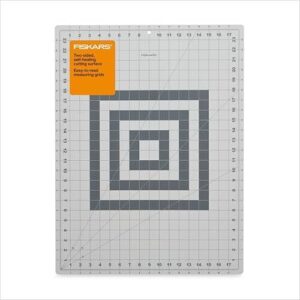
If your work spans multiple materials, the Fiskars Double Sided Cutting Mat keeps things grounded.
It measures 12" x 18" — right-sized for most fabric work — with a gray side and a white side, each carrying a full measuring grid.
The 30-, 45-, and 60-degree bias lines handle triangles, diamonds, and star blocks without guesswork.
Its self-healing polypropylene surface closes up after rotary cuts, so your blade stays sharp longer.
Clean it with warm water and mild soap, and it’ll hold up well.
| Best For | Sewers, quilters, and crafters who work with fabric and need a reliable, accurate surface for rotary cutting and patchwork shapes. |
|---|---|
| Material | Acrylic |
| Primary Use | Fabric Cutting |
| Surface Type | Self-Healing |
| Blade Compatibility | Rotary & Straight |
| Weight | 1.4 lbs |
| Brand | Fiskars |
| Additional Features |
|
- Double-sided with measuring grids on both sides, so you get twice the usable surface
- Bias lines at 30, 45, and 60 degrees make cutting triangles and star shapes easy and accurate
- Self-healing surface keeps your blade sharper for longer and the mat looking clean
- Needs careful storage — flat, away from heat and sunlight — or it can warp over time
- Some users have dealt with sticky residue from packaging stickers
- The price point might give budget-conscious crafters some pause
9. Cricut Explore Air 2 Lilac Kit
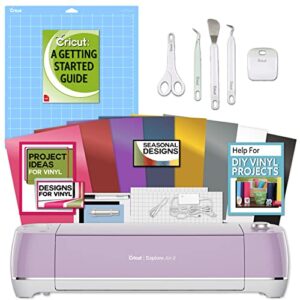
Cricut Explore Air 2 Lilac Kit steps beyond a standard mat setup — it’s a cutting system built for seamstresses who want precision and creative range in one package.
The included 12" x 12" LightGrip mat features a self-healing surface with grid markings, handling vinyl, fabric, and delicate paper without leaving residue.
With 400 grams of cutting force and Bluetooth connectivity to Design Space, you get clean cuts on over 100 materials, plus 25 free sewing patterns to start immediately.
| Best For | Beginners who want to dive into DIY crafts — think custom invitations, wedding decor, or personalized gifts — without a steep learning curve. |
|---|---|
| Material | Vinyl |
| Primary Use | DIY Projects |
| Surface Type | Adhesive Mat Included |
| Blade Compatibility | Machine Blade |
| Weight | 18.04 lbs |
| Brand | Cricut |
| Additional Features |
|
- Comes with everything you need to get started: vinyl, a cutting mat, and a tool kit right out of the box
- Connects wirelessly to your iPad, so no messy cables or complicated setup
- Handles a huge range of materials and projects, from simple stickers to professional-looking custom items
- The warranty is short, so if something goes wrong down the road, you’re on your own
- Bundle pricing isn’t always the best deal — some pieces are cheaper if you buy them separately
- A few buyers got a different color than expected, so don’t count on the lilac being exactly what you see online
10. Silhouette Cameo 5 Vinyl Cutter Bundle
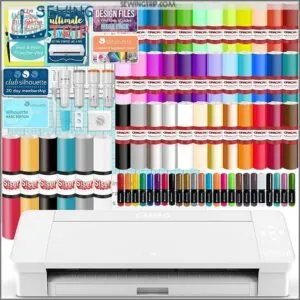
Silhouette Cameo 5 bundle takes things a step further for seamstresses who cut vinyl and fabric regularly.
Its 12" × 12" self‑healing mat accommodates materials up to 3 mm thick, while the machine cuts at speeds up to 300 mm per second with 5,000 grams of force.
You get 36 sheets of Oracal 651 vinyl, dual tool heads for cutting and embossing, and Silhouette Studio software.
It’s a serious workstation for custom labels, appliqués, and pattern work.
| Best For | Small business owners, DIY enthusiasts, and professional designers who regularly work with vinyl, cardstock, and heat transfer materials for custom decals, stickers, t-shirts, and wall art. |
|---|---|
| Material | Vinyl |
| Primary Use | Custom Decals & Crafts |
| Surface Type | Adhesive |
| Blade Compatibility | AutoBlade |
| Weight | 18.66 lbs |
| Brand | Silhouette |
| Additional Features |
|
- Comes loaded out of the box — 24 vinyl rolls, AutoBlade, roll feeder, and Designer Edition software mean you’re ready to cut from day one.
- Intelligent Path Technology keeps cuts precise and minimizes wasted material, which adds up fast when you’re running a small business.
- Works with a wide range of materials and is compatible with both 110v and 220v power, so it fits most setups without extra adapters.
- The software has a real learning curve — beginners should expect to spend some time getting comfortable before feeling confident.
- Print and cut functionality has caused headaches for some users, so that workflow may not be totally reliable out of the box.
- Customer support has been hit or miss, and replacement blades and materials add ongoing costs that can sneak up on you.
Maintaining and Caring for Cutting Mats
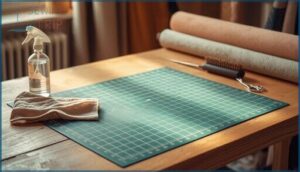
A good cutting mat is an investment, and how you care for it determines how long it actually lasts.
Most mats fail early not from heavy use, but from simple neglect — wrong storage, harsh cleaners, or skipping routine maintenance.
Here’s what every professional seamstress should know to keep her mat in top shape.
Cleaning Techniques and Best Practices
dirty cutting mat is a dull cutting mat.
Start with a lint roller to lift loose threads, then use fiber removal techniques — bend the mat slightly and drag clear packing tape or a rubber eraser across the grooves.
Follow with a soap scrub using mild dish soap, or try a vinegar soak (¼ cup per gallon) for odor and stain control.
Always air-dry flat.
Proper Storage and Handling
How you store your cutting mat matters just as much as how you use it. A self‑healing cutting mat warped from heat or creased from poor transport handling won’t recover. Build these habits into your craft room setup:
- Flat Storage — slide large mats under furniture
- Vertical Hanging — use wooden pant hangers in closets
- Temperature Control — stay between 60–80°F
- Transport Handling — carry vertically, never folded
- Damage Prevention — keep heavy tools off the surface
Extending The Lifespan of Your Mat
Your cutting mat rewards consistency. Stick to a rotation schedule — flip it 180 degrees weekly during heavy use and turn it 90 degrees after quilting projects to balance wear.
Monthly moisture soaks (cool water plus ¼ cup vinegar per gallon, 15–20 minutes) restore PVC flexibility in your self healing cutting mat. Regular fiber removal and blade sharpness checks handle the rest.
Common Mistakes to Avoid
Even experienced seamstresses fall into habits that quietly destroy a good cutting mat. Watch for these three killers:
- Ruler Misalignment — skipping ruler checks lets cuts drift 1/8 inch off over a 12-inch strip
- Repeated Line Cuts — fixed rotary cutter paths prevent self‑healing, carving permanent grooves
- Heat Damage — irons above 120°F warp PVC layers fast
Excessive pressure and an unstable surface finish can ruin the job.
Frequently Asked Questions (FAQs)
Can cutting mats be used on uneven surfaces?
Uneven surfaces are a mat’s worst enemy — technically speaking.
Yes, you can, but soft or bumpy bases cause warping, blade skips, and grid distortion. Thickness compensation and base layer grip matter most here.
Are cutting mats safe for use around children?
PVC with phthalate plasticizers — a real concern if children mouth or chew them.
Keep mats elevated, stored flat in closed cabinets, and choose phthalate-free options when kids share your workspace.
How do temperature changes affect cutting mat performance?
Temperature swings are a silent saboteur.
Heat above 50°C triggers self‑healing degradation and grid distortion, while cold brittleness cracks PVC edges. Both ruin precision fabric cutting and cause grip loss mid‑project.
Can cutting mats be repaired after deep cuts?
Deep gouges won’t fully self-heal, but moisture rehydration, sanding repair, and duct tape extraction can restore shallow damage. Persistent grooves signal replacement indicators — it’s time for a new mat.
Do professional seamstresses prefer colored or clear mats?
Color contrast wins every time.
colored mats—green, gray, or pink— because fabric visibility stays sharp, eye strain drops, and the studio décor gets a bonus upgrade over any clear alternative.
Conclusion
Your cutting mat is the silent partner in every project—when it’s right, you barely notice it; when it’s wrong, nothing else works. The cutting mats for professional seamstresses reviewed here represent genuine performance differences, not just price points.
Match the mat to your workspace size, project volume, and blade type, then maintain it consistently. Accurate cuts don’t happen by accident—they’re built on a reliable surface that enhances your skill every single time.
- https://www.allfreesewing.com/Basics-and-Tutorials/Self-Healing-Cutting-Mat-Care-NSM2019
- https://rhinocuttingmat.co.uk/everything-you-need-to-know-about-self-healing-cutting-mats/
- https://siemachtsewingblog.com/2023/01/fabric-cutting-mats/
- https://excelblades.com/blogs/diy/cutting-mat-sizes-how-to-choose-the-right-one-for-your-projects
- https://mellysews.com/rotating-cutting-mat/