This site is supported by our readers. We may earn a commission, at no cost to you, if you purchase through links.

A single thread controls more of your seam quality than most sewers realize. Upper thread tension dictates where the stitch knot locks between your fabric layers—get it wrong by even half a number on the dial, and you’ll see loops pooling on the underside or puckering rippling across the top.
Most machines leave the factory set between 4 and 4.5. That works until it doesn’t—new fabric, a rethreading shortcut, or lint wedged in the tension discs, and suddenly your stitches look like a mess you can’t explain.
This upper thread tension troubleshooting guide walks you through diagnosis and correction, step by methodical step.
Table Of Contents
- Key Takeaways
- What Upper Thread Tension Controls
- Read Your Tension Dial Correctly
- Test Stitches Before Adjusting
- Diagnose Bottom Thread Loops
- Fix Puckering and Tight Stitches
- Adjust Upper Tension Step-by-Step
- Match Tension to Fabric Type
- Check Thread and Needle Fit
- Clean Tension Discs and Guides
- Log Settings for Future Projects
- Frequently Asked Questions (FAQs)
- Conclusion
Key Takeaways
- Before touching the tension dial, always rethread with the presser foot raised — skipping this single step keeps the tension discs open and no dial adjustment will fix what bad threading breaks.
- Bottom thread loops almost always mean an upper thread problem, not a bobbin issue — check your thread path, clean the discs, and reseat the thread before you ever blame the bobbin.
- Adjust tension in half-number increments only, testing on a matching fabric scrap after each change, because one full-number jump can swing you from puckering straight into loops.
- Match your tension setting to your fabric — lightweight sheers need a dial around 2–3.5, medium cotton sits at 4–4.5, and heavy denim pushes up to 5–6, so your "factory default" isn’t a one-size solution.
What Upper Thread Tension Controls

Upper thread tension does more than most sewers realize — it’s the hidden hand behind every stitch your machine makes. Getting it right means understanding exactly what it controls and why each piece matters. Here’s what you need to know before touching that dial.
Even small tension missteps ripple through every seam, so brushing up on common needle and thread tension problems can save you hours of frustrating trial and error.
Stitch Knot Placement
Every stitch your machine makes depends on one thing: where the knot forms. Upper thread tension controls whether that knot locks at the midpoint between fabric layers — buried cleanly, invisible from both sides.
- Too loose: knot shifts down
- Too tight: knot pulls up
- Balanced: knot sits dead center
Top Thread Flow
Where the knot forms matters — but getting the thread to that point without disruption matters just as much. Top thread flow describes how smoothly your upper thread travels from spool pin through every guide down to the needle.
Any snag along that path throws off your upper thread tension, even if you never touch the tension dial.
Balanced Stitch Appearance
When thread flow is smooth and your upper thread tension is dialed in, the result is a balanced stitch — and you’ll see it immediately on both sides of the fabric.
The knot locks at the midpoint between fabric layers, producing symmetrical thread coverage with no loops, no puckering, and a flat, clean seam throughout.
A true balanced stitch displays a continuous upper‑thread line on the fabric’s surface.
Common Default Settings
Most domestic machines ship with upper thread tension set between 4 and 5 — calibrated for medium-weight cotton and standard polyester blends. That’s your baseline.
The tension dial defaults assume a size 90/14 needle, 40-weight thread, and proper thread path alignment through every guide and the take-up lever. Deviate from any one of those, and your default no longer holds.
Read Your Tension Dial Correctly

Your tension dial is the command center for upper thread control—and knowing how to read it changes everything. Most sewists glance at it without really understanding what each number means or why direction matters. Here’s what you need to know before you touch that dial.
Dial Location
The upper thread tension dial sits on the front or side panel — usually near the needle and take-up lever. That placement is deliberate. You need to reach it without disturbing your fabric.
On compact machines, it’s integrated into the free arm.
Computerized models replace the physical dial with digital tension controls entirely.
Number Scale Meaning
Nine numbers — that’s all separating a perfect seam from a tangled mess. Most domestic machines run a 0-to-9 tension scale, where 0 is barely any disc grip and 9 clamps hard enough to distort delicate fabric. Your safe working zone sits between 3 and 6 for standard wovens.
Some machines skip numbers entirely, using a plus-minus indicator or color-coded scale — blue for light, red for heavy tension. Computerized models display a digital tension readout instead of a physical dial. Different interface, same fundamental logic.
Clockwise Tightening
Turn the dial clockwise — each notch raises upper thread tension by a half-number increment. Think of the tension discs closing like a gentle vice: too fast, and thread breakage follows. Stop after every adjustment, sew a test line, and check both sides before continuing.
- Start at your current dial number
- Move one half-increment clockwise only
- Sew a straight line on a matching fabric scrap
- Inspect the top and underside for puckering or loops
- Repeat until stitches sit balanced and flat
Guide path alignment matters here — correct clockwise tightening keeps the thread sitting flush through every guide without wandering off-path. That reduces looping underneath and keeps stitch density consistent across your seam.
Counterclockwise Loosening
Loosening works the opposite way — turn counterclockwise to release upper thread tension gradually. This mirrors basic right-hand thread directionality: clockwise tightens, counterclockwise loosens. Move in half-number increments only. Rushing past one number risks overly loose tension, which drops the stitch knot below the fabric midpoint and produces visible loops underneath.
One half-turn. Test. Evaluate. That’s the discipline.
Safe Adjustment Range
The safe adjustment range spans roughly one to two numbers on either side of your factory setting — stray beyond that, and you’re risking thread breakage or skipped stitches.
When something feels off, reset to the midpoint first, then make incremental adjustments in half-number steps.
One change. One test seam. That’s how you preserve stitch quality without chasing your tail.
Test Stitches Before Adjusting
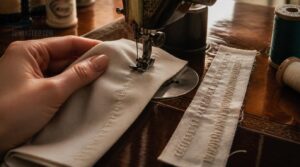
Before you touch that tension dial, run a test stitch — it tells you exactly what’s wrong before you commit to any change. Skipping this step is like guessing at a diagnosis without checking the patient first. Here’s what to do each time you sit down to sew a new project.
Use Matching Fabric Scraps
Cut your scraps to 2 by 4 inches — small enough for a quick test, large enough to show real stitch behavior. Use fabric from the same family as your project.
Denim scraps for denim seams. Sheer for sheer. That match is everything.
Simulate actual seam stress by aligning edges flush before stitching.
Try Contrasting Threads
Once your fabric scrap is ready, swap in a contrasting thread color for the top — something visibly different from your bobbin thread. This single move exposes exactly where the stitch knot lands.
- Fiber type changes how thread grips the tension discs
- Heavy thread creates more drag through guides
- Metallic threads need a larger needle size
- Rayon shows stitch quality shifts clearly on both sides
Sew a Straight Line
With contrasting threads loaded, sew a straight 2-inch line across your scrap. Don’t rush — steady, even speed prevents tension fluctuations mid-seam.
This single test line tells you everything: whether the thread pull is balanced, whether the stitch knot sits centered, and whether your current upper thread tension setting is even close.
Check Both Fabric Sides
Flip that scrap over.
The top side and underside rarely tell the same story — surface sheen on the face differs noticeably from the matte, sometimes textured reverse.
On woven fabrics, fiber grain reads more clearly on the face side, while the back may show subtle loom texture.
Your stitch knot should sit invisibly between both layers, invisible from either angle.
Label Test Swatches
Once you’ve inspected both sides, don’t discard that scrap — label it. A swatch without notes is just fabric.
- Date and machine model go first
- Tension dial number used during the test
- Fabric weight and type clearly noted
- Pass or fail with a brief irregularity note
Photograph it alongside your machine settings for a reliable visual reference later.
Diagnose Bottom Thread Loops
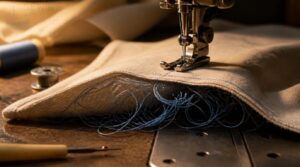
Bottom thread loops are one of the most common tension complaints—and almost always, the fix is in the upper thread path, not the bobbin. Before you touch the tension dial, you need to rule out a handful of specific causes that mimic loose upper tension. Here’s what to check first.
Loose Upper Tension
When upper tension runs loose, the top thread races through the needle with too little resistance — and the stitch knot drops below the fabric instead of locking at the midpoint.
Loose loops on the underside are the clearest sign. You’ll also notice uneven stitch length across the seam, occasional skipping needle stitches, and inconsistent fabric feeding as the thread fails to interlock properly.
The root cause is usually tension disc slipping — the discs aren’t gripping the thread. This happens when lint coats the contact surfaces or the thread wasn’t seated correctly in the guides. Improper thread seating lets the upper thread bypass disc pressure entirely, mimicking a low dial setting even when you haven’t touched it.
| Symptom | Likely Cause | Action |
|---|---|---|
| Loops on underside | Loose upper tension | Raise dial half a number |
| Skipped stitches | Tension disc slipping | Clean discs, reseat thread |
| Uneven stitch length | Improper thread seating | Rethread with foot raised |
Before touching the tension dial, confirm the thread actually runs through every guide. A single missed guide is enough to collapse stitch quality troubleshooting into frustration. Fix the path first — then adjust.
Before adjusting the tension dial, trace every thread guide — one missed step unravels everything
Incorrect Top Threading
Threading errors cause more tension problems than the dial itself ever will. If the thread missed a guide — even one — the tension discs won’t grip it properly, and the upper thread tension collapses.
The fix isn’t adjusting the upper tension dial.
Rethread the upper thread completely, presser foot raised, tracing every step of the thread path from the spool pin down.
Presser Foot Position
The presser foot being up when you start sewing is a surprisingly common culprit behind bottom thread loops. Foot raised during sewing means the tension discs stay open — the thread runs free, and the knot can’t form properly. Lower it before you sew a single stitch.
Take-up Lever Threading
The take-up lever is easy to miss — but skipping it breaks everything.
Thread must pass through the lever eye in the exact direction your manual specifies. Get that path wrong, and the lever can’t pull slack efficiently, leaving loose loops underneath.
Check for burrs inside the lever eye too; rough edges fray thread and mimic tension failure.
Bird-nesting Symptoms
Bird-nesting is exactly what it sounds like — a chaotic tangle of thread bunched beneath the needle plate. It happens when the presser foot is down before you start sewing, or when threading was skipped entirely.
The machine can’t regulate upper tension without foot engagement.
Result: loops on top, thread piling underneath.
Rethread with the foot raised. Problem solved.
Fix Puckering and Tight Stitches

Puckering and tight stitches usually point to one culprit—upper tension that’s too high. Before you start tweaking the dial, it helps to know exactly what you’re looking at. Here are the key signs to watch for and how to bring things back into balance.
Excessive Upper Tension
When the tension dial climbs too high, your machine grips the top thread like a vice. The result hits fast: seam puckering, fabric rippling, and frayed thread at the needle eye. Here’s what excessive upper tension actually causes:
- Thread fraying at the needle entry point
- Skipped stitches from needle deflection
- Uneven stitch length on lightweight fabric
- Stiff, rippled seam lines that won’t lie flat
Bobbin Thread Showing
Puckering from tight stitches often reveals its worst symptom: bobbin thread showing on the fabric surface. When your upper tension pulls too hard, it drags the bobbin thread upward through the layers.
Loosen your tension dial slightly — even a half-number drop can restore balance. Always rethread and test on matching scrap first.
Stiff Seam Lines
Stiff seam lines are the next complaint — your fabric won’t drape naturally when upper tension runs too tight. Thread locked in rigid stitches restricts movement between layers.
- Dense stitching reduces fabric mobility along the seam
- Heavy fabric amplifies stiffness even at normal settings
- High humidity can quietly raise effective tension
- Wide seam allowances worsen the rigid appearance
Lower your dial gradually and test.
Fabric Ripples
Ripples are stiff seam lines made visible — instead of locking fabric flat, excess upper tension buckles lightweight material into wave-like peaks.
| Fabric Type | Ripple Risk | Tension Range |
|---|---|---|
| Chiffon/Silk | High | 2–3 |
| Cotton Voile | Moderate | 3–3.5 |
| Jersey Knit | Variable | 3.5–4.5 |
High humidity quietly worsens this — raised yarn elasticity amplifies ripple formation even before you touch the dial.
Lower Dial Gradually
Once ripples appear, the fix is a controlled retreat.
Turn the dial counter-clockwise in half-number increments — never full turns. Each small step releases upper thread tension gradually, preserving stitch geometry across the seam.
Sew a quick test line after every adjustment. Two to four quarter-turns usually resolve puckering without triggering loops on the underside.
Adjust Upper Tension Step-by-Step
Getting the tension right comes down to following a specific sequence—skip a step, and you’ll chase your tail adjusting a dial that isn’t the real problem. Before you touch anything, there are a few non-negotiable actions that set the stage for every accurate adjustment you’ll make. Work through each one in order.
Rethread With Foot Raised

Before you touch the tension dial, raise the presser foot. This single step opens the tension discs — without it, the thread can’t seat correctly between them, and no dial adjustment will fix the problem.
Thread from spool to needle with the foot up. Then lower it, and test on scrap fabric.
Clean Tension Discs

Even with the foot raised and thread freshly seated, lint between the discs quietly sabotages tension. A quick pass with a dry lint brush clears loose debris.
For sticky residue, a cotton swab with isopropyl alcohol dissolves buildup — let it dry completely before rethreading.
While you’re there, inspect disc edges for nicks or wear. Damage here means inconsistent grip on every stitch.
Turn Half-number Increments
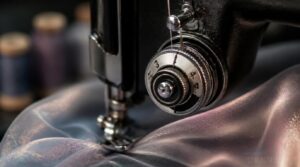
Think of the upper thread tension dial as a fine-tuning knob — not a toggle switch. Move it in half-number increments only. A half-step change, say from 4 to 4.5, shifts disc pressure subtly enough to correct a minor loop without overshooting into puckering territory. Delicate silks and chiffons especially punish full-number jumps.
One increment. Then stop.
Sew After Each Change

After every half-step dial change, sew at least three inches of test seam on a matching scrap — not your project fabric. That short run tells you everything: whether loops reappear on the underside, whether puckering returns on top.
Inspect both sides before touching the dial again.
Document the dial number. That record becomes your shortcut next time.
Stop at Balanced Stitches
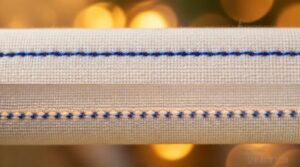
You’ve arrived — stop here.
When both fabric sides show flat, even stitches with no loops, puckering, or thread show-through, that’s your signal. Don’t keep turning the dial chasing perfect result that’s already there.
- No bobbin loops on the underside
- No top-thread rippling or shininess
- Seam lies flush, no raised ridge
- Equal thread pressure, both sides
- Clean, nested stitches throughout
Match Tension to Fabric Type

Not every fabric plays by the same rules, and that’s where tension settings get personal. Your dial needs to shift based on what’s actually under the presser foot. Here’s how to match your tension to the most common fabric types you’ll encounter.
Lightweight Fabrics
Sheer voile or chiffon demands a dial setting of 2–3.5 — anything higher and you’ll see puckering within the first inch. These fabrics, often weighing as little as 40–70 g/m², have minimal fiber resistance, so the thread locks too aggressively at higher settings.
Fiber composition matters here. Rayon, silk blends, and microfibre all behave differently under tension.
Medium Cotton Fabrics
Medium cotton — calico, percale, twill — sits comfortably at a dial setting of 4–4.5. That’s the default range for a reason: cotton’s tight plain or twill weave creates predictable thread resistance.
Mercerized or enzyme-washed cotton may run slightly looser — try 3.5 first.
At 0.25–0.40 mm thick, these fabrics reward balanced tension with clean, flat stitches on both sides.
Denim and Canvas
Heavier builds — denim and canvas — demand more from your machine. Dial up to 5–6 for denim weighing 12–16 oz per yard. Canvas, especially duck canvas above 14 oz, sits similarly.
Pre-wash denim first; shrinkage of 3–5% changes fabric density, which shifts your effective tension. Use a denim needle, size 16, and test before committing to a seam.
Stretch Knit Fabrics
Knits are a different beast entirely. Unlike denim’s rigid structure, stretch knits — jersey, rib — contain 5–10% elastane that wants to move.
Set your dial between 2–3.5 and use a ballpoint needle; it parts the knit loops cleanly instead of piercing them. Tight tension snaps elastane fibers over time, killing recovery permanently.
Decorative Stitch Fabrics
Decorative fabrics — velvet, jacquard, embroidered brocades — demand respect. Dense embroidery patterns load the needle with resistance, effectively tightening upper thread tension beyond what the dial shows. Start at 3.5–4, then test.
- Satin stitch fills flatten beautifully at balanced tension
- Velvet bases need lower settings to preserve pile lift
- Jacquard depth suffers when tension crushes raised motifs
- Metallic threads run best between 3–4
Check Thread and Needle Fit
Thread and needle fit might be the last thing you check, but it’s often the first thing causing your tension problems. The wrong combination creates friction, skipped stitches, and tension readings that no dial adjustment can fix. Here’s what to look at before you touch that tension knob again.
Thread Weight Differences
Thread weight isn’t just a label — it directly changes how your tension discs behave. A 40 wt all-purpose polyester sits comfortably at mid-range settings.
Switch to 70 wt coarse thread and you’ll need to loosen the dial; it creates more friction through the take-up lever path. Finer 60 wt thread runs tighter. Always adjust after switching weights.
Needle Size Selection
Matching needle size to your thread isn’t optional — it’s a calibration decision. Too-small a needle forces heavy thread through a tight eye, increasing friction and throwing your upper tension high without you touching the dial.
For 40 wt all-purpose thread, a size 80/12 needle is your baseline. Step up to 90/14 for anything heavier.
Dull Needle Problems
A dull needle is a silent tension thief. It drags through fabric instead of piercing cleanly, increasing resistance and mimicking loose upper tension — even when your dial setting is correct.
Replace the needle every 8–12 sewing hours. Coarse fabrics dull tips faster. Check for visible nicks or bends before each project. Store needles by the shaft, never the tip.
Metallic Thread Tension
Metallic thread is a high-maintenance material — treat it differently or pay the price in shredding and skipped stitches.
- Lower top tension to 2–3.5 to reduce foil shredding
- Sew at 300–600 SPM to prevent heat buildup
- Use a size 80/12 metallic needle with a larger eye
- Confirm a smooth, twist-free thread path from spool to needle
- Raise the presser foot before rethreading to seat the thread correctly
Poor-quality Thread
Bargain thread is false economy — it costs you far more in ruined seams than it ever saves on price.
Uneven thread diameter feeds inconsistently through the needle eye, causing erratic tension spikes mid-stitch. Slubs snag. Frayed fibers shed lint directly onto your tension discs.
Brittle fibers break under normal machine tension, producing skipped stitches that mimic a threading problem. Stick to quality thread.
Clean Tension Discs and Guides

Lint and residue on your tension discs can throw off your stitch balance even when the dial setting looks right. A quick cleaning routine—done consistently—keeps everything running at its actual calibrated values. Here’s what to check and clean to get your tension back on track.
Remove Lint Buildup
Lint is the silent saboteur of consistent tension. Every sewing session deposits fiber inside your tension discs, narrowing the thread path and raising resistance you never dialed in yourself.
Use a small soft brush first — sweep the bobbin area, needle plate, and disc channels. For stubborn buildup, compressed air clears what brushes miss. Heavier fabrics shed more fiber, so clean more often.
Check Thread Path
Even clean discs can’t save you from a misrouted thread. Check spool pin alignment first — thread unspooling at the wrong angle creates friction before it reaches the first guide.
- Follow thread guide order exactly
- Watch for crossovers or tight bends
- Confirm the takeup lever catches correctly
- Identify any friction point along the path
Avoid Excess Oil
Oil is the enemy of your tension discs. A single stray drop creates a slick surface that lets the top thread slip instead of gripping — and your stitches pay the price immediately.
After oiling any machine component, wipe the entire thread path with a lint-free cloth before sewing. Never apply oil near tension components.
Brush Bobbin Area
The bobbin area collects lint faster than you’d expect — especially with fibrous fabrics like fleece or plush. Dust buildup here quietly disrupts bobbin race rotation and throws your tension off.
Use a microfiber swab or dedicated brush to clean the bobbin area after each bobbin change:
- Power off and unplug the machine
- Remove the needle plate to expose the bobbin race
- Brush lint outward — never push debris deeper
- Wipe with a lint-free cloth to finish
Compressed air dust removal works, but only if your manual permits it.
Follow Machine Manual
Your machine’s manual isn’t optional reading — it’s your baseline. Every model carries model-specific tension disc tolerances and threading sequences that general advice can’t replace. Cross-referencing manufacturer setup diagrams before troubleshooting stubborn loops saves you from chasing problems that a correct threading sequence would have prevented entirely.
| Manual Section | What It Covers | Why It Matters |
|---|---|---|
| Setup Diagrams | Thread path and disc engagement | Prevents misrouting that mimics tension faults |
| Safety Guards | Presser foot and needle position | Avoids damage during sewing machine adjustment |
| Maintenance Schedule | Cleaning intervals and oil type | Keeps tension discs performing consistently |
Log Settings for Future Projects

Every great tension fix is worth remembering—your future self will thank you. A simple log of what worked keeps you from guessing the next time you pick up the same fabric. Here’s exactly what to record for each project.
Record Fabric Type
Every fabric tells a different story — and your log needs to capture it accurately.
- Woven or knit — document the construction type first
- Fabric weight in g/m² — lightweight under 150, medium 150–350, heavy above 350
- Elastane content — even 2% stretch changes tension behavior
- Special finishes — waterproof coatings or flame-resistant treatments affect feed and needle choice
- Drape and seam behavior — note how the fabric responds after stitching
Note Thread Weight
Thread weight isn’t just a number — it’s the hidden variable that shifts your tension dial up or down before you’ve touched it.
| Thread Weight | Common Use | Tension Direction |
|---|---|---|
| 60–80 wt | Sheer, chiffon | Lower setting |
| 40–50 wt | Cotton, quilting | Mid-range default |
| 30–40 wt | Denim, canvas | Higher setting |
Log the exact weight and fiber type — polyester 40 wt behaves differently than cotton 40 wt. Specialty threads like rayon, metallic, or silk introduce friction variables that standard weights don’t. Note spool shape too; unusual geometry creates feed resistance, effectively tightening perceived tension without touching the dial.
Save Needle Size
Needle size belongs in your log — not just fabric type. A size 70 on sheer prevents fabric hole distortion; a size 90 works with denim without skipped stitches.
Log the exact size used alongside your thread weight. They’re calibrated together.
Swap one without recording the other, and your next session starts with tension guesswork.
Track Dial Number
The dial number you sewed with today won’t feel obvious six months from now. Log it — every project. A setting of 4 on medium cotton versus 3 on voile looks like a small difference, but that half-number gap separates balanced stitches from subtle puckering.
Record each tension dial adjustment alongside fabric type. Your log becomes a calibration shortcut, not guesswork.
Compare Stitch Samples
Your log means nothing without the swatches attached to it. Pin each labeled test swatch beside its recorded settings — fabric type, thread weight, needle size, dial number.
- Satin stitch samples reveal edge flatness at a glance
- Heavier thread weights show bold, unmistakable texture shifts
- Lightweight fabric swatches expose puckering patterns instantly
- Decorative stitch samples capture density and sheen differences
Side-by-side, the patterns tell the story your notes can’t.
Frequently Asked Questions (FAQs)
Why is my upper thread bunching up?
Upper thread bunching usually comes down to improper threading or tension disc debris — the most overlooked culprits. A misrouted thread path or presser foot left down while threading can collapse the tension discs entirely.
Can humidity affect how my thread behaves?
Yes — humidity absolutely affects thread behavior. Natural fibers like cotton absorb moisture, swelling slightly and increasing effective tension. Synthetic threads resist this. In humid rooms, try dropping your dial by half a number.
When should I call a technician for tension issues?
Call a technician when tension adjustments repeatedly fail, unusual machine sounds appear, needles bend or break consistently, or bird-nesting persists after cleaning and rethreading. Internal gear wear and recurring issues need professional machine tension calibration.
How do tension measurement gauges work in practice?
A tension gauge like the Towa Bobbin or Tajima Top Tension Gauge measures thread resistance in grams. A strain gauge detects deformation, converts it via a Wheatstone bridge, and outputs a calibrated electrical reading.
Do older machines need different tension approaches?
Older machines often use a fixed tension system with a narrower range. Worn discs and exposed guides drift over time. Match era-appropriate thread and expect more frequent cleaning to keep tension predictable.
Conclusion
Thread tension is the compass of your machine—when it’s calibrated, everything points true. Every loop, pucker, or bird’s nest is just your machine telling you something’s off.
This upper thread tension troubleshooting guide gives you the language to listen. Clean the discs. Rethread with the foot raised. Test on scraps. Adjust in half-number steps.
You don’t need luck—you need a system. Now you have one. Trust it.
- https://madamsew.com/blogs/sewing-blog/no-more-bird-nests
- https://archaicarcane.com/fly-little-nestling-ditching-the-thread-nests-part-1
- https://lindas.com/blogs/tips-and-tricks/sewing-machine-tension-settings
- https://sewfearless.com/2016/10/tension-machine-broken
- https://paigehandmade.com/sewing-machine-basics/tension