This site is supported by our readers. We may earn a commission, at no cost to you, if you purchase through links.
Machine embroidery looks deceptively simple from the outside—load a design, press start, watch it stitch.
But ask anyone who’s ruined a custom jacket or fought through a thread breakage mid‑run, and you’ll hear a different story.
The machine manages the needle work, but you’re still the one calling the shots.
Knowing what skills you need for machine embroidery makes the difference between designs that look polished and projects that end up in the trash pile.
From reading tension settings to choosing the right stabilizer for a stretchy fabric, each decision builds on the last—and the good news is, every one of them is learnable.
Table Of Contents
Key Takeaways
- Getting machine setup right—threading, hooping, and tension—forms the foundation that everything else builds on, so don’t rush past the basics.
- Digitizing software gives you full creative control over your designs, letting you resize, adjust stitch density, and convert file formats without guesswork.
- Matching your thread, fabric, and stabilizer as a team is what keeps designs clean and prevents the puckering and misalignment that trip up most beginners.
- Troubleshooting skills like fixing thread breakage, correcting tension, and keeping up with routine maintenance are just as important as any design decision you’ll make.
Essential Machine Embroidery Skills
Before anything else, you need to get comfortable with the machine itself.
A great way to do that is by watching beginner sewing machine projects on YouTube — hands-on tutorials make the learning curve a lot less intimidating.
A few core skills will carry you through most projects, from your very first test run to more complex designs. Here’s what you’ll want to build first.
Operating and Setting Up The Machine
Setting up your machine the right way makes everything else easier. Start with power setup on a stable, level surface, then attach the embroidery arm and lock it into place. Before stitching, run your safety checks — clear the hoop path, verify stitch speed control is low, and confirm hoop alignment over the center mark.
These machine embroidery basics set you up for consistent, confident results. Using magnetic embroidery hoops can speed up setup and reduce fabric puckering.
Threading, Needle, and Bobbin Management
Once your machine is set up, threading becomes your next foundation. Always follow your machine’s built-in diagram for top thread routing — skipping even one guide causes tension problems fast.
For needle selection, a 75/11 embroidery needle works well for most fabrics.
Wind your bobbin evenly, insert it counterclockwise, and check bobbin path alignment carefully.
Balanced thread tension means both threads pull equally — that’s your goal. Using high quality threads ensures smoother stitching.
Hooping Fabric Correctly
Good hooping technique is the difference between clean embroidery and a frustrating mess. Start with center marking using a water‑soluble pen, then cut your stabilizer at least two inches beyond the hoop edges. Grain alignment matters — keep fabric threads perpendicular to the hoop edges.
- Stabilizer Cutting: Trim generously for full coverage
- Hoop Screw Technique: Tighten gradually, not all at once
- Tension Testing: Tap fabric — it should ping like a drum
- Embroidery Hooping: Smooth outward from center to remove bubbles
Navigating Embroidery Machine Controls
Once your fabric is hooped and ready, knowing your way around the controls makes everything click.
Most embroidery machines put Touch Screen Navigation front and center — you’ll scroll Design Menu Shortcuts, tweak Parameter Key Functions, and manage Thread Tension without guessing.
Speed Slider Settings let you ease into dense areas, and Start‑Stop Button Tricks keep you in control when Machine Embroidery Techniques get tricky.
If noise is a concern while you practice these controls, check out quiet sewing machine options ideal for apartment living so you can stitch freely without disturbing your neighbors.
Mastering Embroidery Design Creation
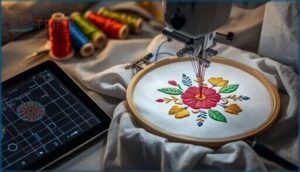
Once you’ve got your machine running smoothly, the next big skill to build is creating and working with embroidery designs. This is where digitizing software comes in, and it’s more approachable than it sounds.
Here’s what you need to know to get started with design creation.
Using Digitizing Software
Digitizing software is where your ideas actually become stitchable designs — and it’s more approachable than it sounds. With embroidery digitizing tools, you can handle design vector import, apply color palette mapping, and run auto-path generation without guesswork.
Three things this skill unlocks for you:
- Cleaner file format conversion across machine brands
- Smarter stitch density optimization for every fabric
- Full creative control over embroidery design creation
Adjusting Design Size and Stitch Density
Resizing a design sounds simple, but it’s where stitch quality can quietly fall apart. Most designs handle a 10–20% shift safely, but beyond that, density calibration becomes essential.
| Change | Action Needed | Why It Matters |
|---|---|---|
| Enlarging | Reduce density | Prevents stiff, overfilled results |
| Shrinking | Increase density | Keeps edges clean and readable |
| Fabric swap | Stabilizer adjustment | Ensures fabric compatibility |
Your digitizing software makes these fixes straightforward.
Importing and Editing Embroidery Files
Getting designs into your software is easier when you know your file formats. PES works for Brother machines, JEF for Janome, and DST covers most commercial setups.
Use Design Preview Filtering to check compatibility before importing. Raw Object Conversion unlocks Vector Curve Editing, letting you adjust shapes and swap stitch types. Stitch Density Optimization keeps everything clean as you build your Embroidery Digitizing skills.
Choosing Threads, Fabrics, and Stabilizers
Getting your materials right is honestly where a lot of beginners either click or struggle. The thread you pick, the fabric you work with, and the stabilizer underneath all have to work together.
Here’s what to focus on when making those choices.
Selecting Suitable Embroidery Threads
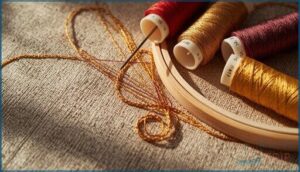
Thread choices shape everything about your finished design. Polyester embroidery thread is your best bet for durability considerations — it resists fading and manages frequent washing well. Rayon brings gorgeous sheen but wears faster.
For fiber material choice, match thread weight to your project: 40-weight covers most designs, while 30-weight suits heavier fabrics. A smart color contrast strategy and cost performance balance keep your work looking polished.
Pairing Fabrics With Stabilizers
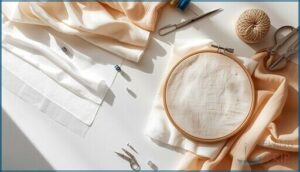
Pairing the wrong stabilizer with your fabric is one of the fastest ways to ruin a project. Here’s a quick guide:
- Lightweight Fabric Stabilizer: Use 1.0–2.5 oz tear-away for batiste or lawn
- Knit Stretch Support: Cut-away stabilizer locks jersey and fleece in place
- Sheer Fabric Techniques: Dissolve water-soluble backing after stitching
- High Density Stabilizer: Stack layers for dense designs without puckering
- Stabilizer Layering Strategies: Limit to two medium-weight layers maximum
Managing Tension, Stitching, and Color
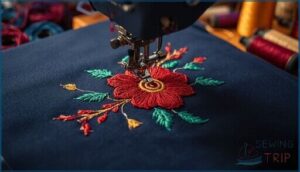
Once your materials are sorted, the real craft begins — and a lot of it comes down to control.
Getting your tension right, knowing your stitches, and working with color intentionally are what separate decent results from ones you’re actually proud of.
Here’s what you need to understand in each of these areas.
Setting and Adjusting Thread Tension
Think of thread tension as a handshake — too tight and something breaks, too loose and nothing holds. Upper tension calibration usually falls between 2 and 6 on your dial, while bobbin tension testing targets around 18–22 grams.
Thread tension is a handshake — too tight and something breaks, too loose and nothing holds
Thread-type adjustments matter too — polyester needs more tension than rayon. Use tension measurement tools like a TOWA gauge, and apply tension troubleshooting techniques when stitches pucker or pull.
Understanding Stitch Types and Applications
Once tension feels right, stitch types become your next big lever.
Running stitch basics give you clean outlines with minimal thread use.
Satin stitch uses tight columns for crisp text and borders.
Fill stitch patterns cover large shapes evenly, while underlay stitch’s role keeps everything stable underneath.
Bean stitch features bold, durable lines built for high-wear spots.
Each stitch type shapes your overall stitch quality.
Applying Color Theory in Embroidery
Color theory turns a good embroidery design into a great one. The color wheel basics—primary, secondary, and tertiary hues—guide every thread color decision you make.
- Analogous palettes use 3–5 adjacent hues for smooth, natural flow
- Complementary schemes pair opposites like blue and orange for bold contrast
- Hue value adjustments add depth using light and dark thread variations
- Saturation control keeps your color palette from feeling flat or harsh
- Limiting embroidery thread choices to 3–5 tones creates visual balance
Troubleshooting and Improving Embroidery Results
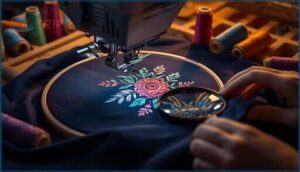
Even experienced embroiderers run into problems — thread snapping mid-stitch, designs that don’t sit quite right, or fabric that bunches where it shouldn’t.
The good news is that most issues have straightforward fixes once you know where to look.
Here are the key troubleshooting and improvement skills worth building:
Preventing and Resolving Thread Breakage
Thread breakage often sneaks up on you mid‑project, but most causes are preventable.
Smart needle selection matters — swap to a fresh 75/11 every 8 hours.
Proper thread storage keeps spools from becoming brittle.
Thread lubrication with Sewer’s Aid helps metallic threads run smoothly.
Speed adjustment to 500–600 SPM reduces friction on dense stitches.
Balanced bobbin tension, consistent thread tension, and management keep everything running cleanly.
| Issue | Cause | Fix |
|---|---|---|
| Thread snapping | Dull needle | Needle care: replace every 8 hrs |
| Uneven stitching | Poor bobbin tension | Rethread bobbin, test on scrap |
| Metallic shredding | High speed | Speed adjustment to 500–600 SPM |
Fixing Design Misalignment and Puckering
Even with breakage solved, puckering and misalignment can still derail a project.
Start with proper Embroidery Hooping — fabric should sit drum-tight without distorting the grain. Basting Stitch Placement catches shifting early, before main stitching begins.
Stabilizer Selection and Stabilizer Layering matter too — add a second tearaway layer mid-stitch if puckering appears.
Stitch Density Reduction in your software smooths things out on lightweight materials.
Performing Routine Machine Maintenance
Keeping your machine in good shape is just as important as any design decision you make.
Daily Lint Removal from the bobbin area and needle plate prevents jammed stitches before they start.
Stick to an Oil Scheduling routine, check your Belt Inspection points weekly, and don’t overlook Sensor Cleaning or Needle Bar Timing.
Consistent Machine Embroidery Maintenance is what separates smooth sessions from frustrating ones.
Engaging in Continuous Skill Development
Growing your embroidery skills doesn’t happen by accident — it takes a plan.
Keep a Practice Log to track what works and what doesn’t, and use Goal Setting to stay focused, like mastering hooping in a month.
Join communities for Community Feedback, explore Online Workshops, and monitor Progress Metrics to see real growth.
Improving Embroidery Skills means staying curious.
Frequently Asked Questions (FAQs)
How can i Improve my embroidery skills?
Improving embroidery skills comes down to consistent practice with sample projects, studying color palettes, and joining embroidery communities.
Experimenting with textures, analyzing professional work, and refining thread management and stabilizer selection will sharpen your embroidery techniques steadily.
How do I learn embroidery?
Start with community workshops or online tutorials, pick a small practice project, and build from there. Embroidery for beginners gets easier fast when you just jump in and stitch.
What is a machine embroidery tutorial?
A machine embroidery tutorial walks you through the basics using step‑by‑step guidance, video demonstrations, and beginner project ideas.
giving you a clear, structured path from setup to your first finished stitch.
Should you buy a beginner embroidery machine?
Yes — if you’re ready to practice and patient with the learning curve, a beginner-friendly embroidery machine under $600 offers solid long-term value without overwhelming you.
What skills do you need to be an embroidery machine operator?
To run an embroidery machine well, you need hooping techniques, thread tension and management, machine calibration, speed management, material preparation.
Embroidery digitizing, embroidery software skills, quality inspection, safety protocols, and embroidery machine maintenance.
Can you embroider on viscose?
Viscose sounds tricky, but it’s actually very embroidery-friendly.
Pre‑wash viscose first, pick the right stabilizer choice, match your needle size to the fabric, and choose a soft thread type for best results.
How much does machine embroidery equipment typically cost?
Entry-level pricing starts around $300–$400 for a single needle home machine. Mid-range budgets reach $700–$800, while commercial machine costs climb to $7,000–$50,000 depending on head count and production needs.
Can embroidery designs be transferred between different machine brands?
Transferring embroidery designs between brands is like speaking different dialects — possible, but you need the right translator.
File compatibility depends on matching formats: PES for Brother, JEF for Janome, VP3 for Viking.
How long does it take to complete an embroidery project?
Project sizing and stitch count estimation matter most. A 10,000-stitch design runs about 14 minutes at machine speed, but hooping and thread changes add time. Always build in buffer time.
What safety precautions should beginners follow while embroidering?
Keep your fingers at least an inch from the needle, hoop fabric firmly, maintain proper tension, and never leave the machine running unattended.
Good workspace safety and routine machine maintenance prevent most beginner mishaps.
Conclusion
Old-school embroiderers once said the needle never lies—and that still holds true. What skills do you need for machine embroidery?
Every single one covered here: setup, hooping, tension, digitizing, troubleshooting, and the patience to learn from each mistake.
None of it arrives overnight, but each project sharpens your eye and steadies your hand.
Keep running test stitches, keep adjusting, keep going. The machine does its part. Now you know how to do yours.
- https://imprintconnect.com/blogs/news/embroidery-essentials-10-must-know-skills-for-success
- https://www.toughkittencrafts.com/4-must-know-machine-embroidery-hooping-techniques/
- https://allstitch.com/blogs/embroidery-blogs/embroidery-hooping-tips-tricks
- https://embroiderylegacy.com/how-to-hoop-machine-embroidery-tutorial/
- https://nancyzieman.com/blog/embroidery-2/stabilizer-know-how/