This site is supported by our readers. We may earn a commission, at no cost to you, if you purchase through links.
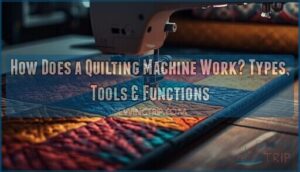
A hand-quilter working through a full-size bed quilt can spend hundreds of hours—sometimes an entire year—stitching by hand. A quilting machine compresses that same project into days.
But the speed isn’t the interesting part. What’s impressive is how these machines grip, move, and stitch through three layers of fabric simultaneously while keeping every stitch perfectly balanced.
The mechanics behind that process are more precise than most people expect. Understanding how a quilting machine works changes how you approach every project—from choosing the right machine to getting professional results on your first serious quilt.
Table Of Contents
Key Takeaways
- A quilting machine’s rotating hook catches each thread loop at just 0.1 mm clearance, which is what keeps every stitch perfectly balanced through all three fabric layers.
- Throat space — the gap between the needle and the machine body — determines what size projects you can tackle, so matching it to your work is the first decision that matters.
- Stitch regulation uses sensor feedback to adjust needle speed as you move, meaning consistent stitch length holds even through tight curves and sharp direction changes.
- Keeping your machine clean and oiled — one drop on the bobbin race every two hours, lint cleared after every bobbin change — is the simplest thing you can do to prevent most common stitching problems.
What is a Quilting Machine?
A quilting machine isn’t just a beefed-up sewing machine — it’s a purpose-built tool designed to handle the bulk, weight, and precision that quilting actually demands.
If you’re shopping on a budget, there are solid affordable quilting machine options that still deliver the tension control and throat space serious quilting requires.
Understanding what sets it apart starts with knowing the basics: how it differs from a regular machine, what types exist, and which features actually matter. Here’s what you need to know.
Key Differences From Regular Sewing Machines
Think of a quilting machine as a regular sewing machine’s more capable sibling. Here’s what sets it apart:
- Throat Width reaches 8–14 inches, versus 5–7 on standard machines
- Motor Power sustains Stitch Speed of 800–1,000 stitches per minute through thick layers
- Feed Dog Capacity grips your quilt sandwich evenly
- Extension Table Size carries your quilt’s weight, reducing drag
The machine’s AcuFeed System precision ensures even layer movement. That’s how Stitch Quality stays consistent.
Types of Quilting Machines (Long-Arm, Mid-Arm, Short-Arm)
Knowing your machine size categories shapes every quilting decision you’ll make. Long Arm Quilting Machines offer 18+ inches of throat space and full head mobility on rolling frames — ideal for bed-size quilts. Mid Arm Quilting Machines split the difference at 12–17 inches. Short Arm Quilting Machines stay under 9 inches, great for smaller work.
| Machine Type | Throat Space |
|---|---|
| Long Arm | 18+ inches |
| Mid Arm | 12–17 inches |
| Short Arm | 9 inches or less |
| Frame Compatible | Mid & Long Arm |
A generous throat space reduces fabric repositioning during quilting.
Essential Features for Quilting
Once you’ve landed on the right size, focus shifts to what’s under the hood.
From thread weight to needle choice, brushing up on hand stitching techniques and their uses helps you pick the right approach before you sew a single stitch.
A reliable thread tension system keeps stitches balanced through all three quilt layers.
Speed control lets you stay comfortable and precise.
Throat space and frame compatibility determine project scope.
Look for stitch quality consistency, portability options, noise reduction, digital preset patterns, and a clean user interface — your quilting machine selection depends on all of it.
How Does a Quilting Machine Operate?
Understanding how a quilting machine operates starts with knowing what happens at each stage of the process. few key elements work together to keep everything running smoothly and accurately.
Here’s a closer look at how it all comes together.
The Quilting Process Step-by-Step
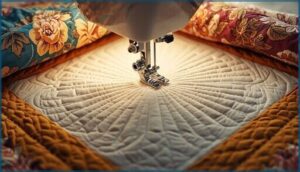
Good quilting machine operation starts with layer alignment — tape your backing face-down, smooth batting over it, then add the quilt top.
Roll the bulk inward for manageable quilt rolling through the machine.
Begin stitch initiation at the center, locking threads with a quick backstitch.
Maintain consistent thread tension and speed control throughout, finishing each edge cleanly before moving on.
Role of Throat Space and Frame Compatibility
Throat space is the distance from the needle to the machine body — and it shapes everything about your quilting machine operation.
Short-arm machines top out at 9 inches, mid-arms reach 17 inches, and long-arms push to 26 inches.
Those throat size limits also define pantograph width constraints: subtract 6 inches for batting clearance requirements.
Frame rail alignment and rolling frame integration depend entirely on matching your machine’s specs to the right quilting frame compatibility.
Stitching Mechanisms and Movement
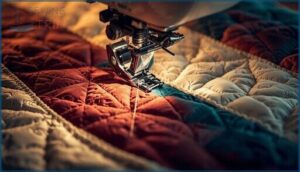
Every stitch starts with precise needle lift — the needle rises 2–3 mm, and the rotating hook catches the thread loop at just 0.1 mm clearance. That’s the hook timing doing its job.
At just 0.1 mm clearance, the rotating hook catches each thread loop with extraordinary precision
From there, your XY carriage uses servo control to guide the machine across the quilt. Pantograph tracing maps repeating designs, while stitch regulation keeps stitch length consistent. Swap between a walking foot or free motion foot depending on your pattern needs.
Core Functions and Technologies
Once you understand how a quilting machine moves, the next step is knowing what actually controls that movement.
Modern machines pack some surprisingly smart features into a compact space — and those features are what separate a good result from a great one.
Here’s a closer look at the core functions that keep everything running smoothly.
Stitch Regulation and Speed Control
Stitch regulation is what separates smooth, even quilting from a tangled mess. Your quilting machine uses sensor feedback and encoder calibration to track exactly how fast you’re moving — then adjusts needle speed to match.
Here’s how speed control works together:
- Variable speed lever caps your maximum stitching pace
- Pedal modulation fine-tunes acceleration in real time
- Stitch length consistency holds firm through curves and direction changes
- Stitch regulation responds instantly — some machines reach 3,500 stitches per minute
Master these, and your quilting threads land exactly where you want them.
Manual Vs. Computerized Operation
Manual operation puts every curve and motif in your hands — but that means hours of physical steering, and operator fatigue is real.
Computerized quilting machines take over the movement, giving you design repeatability across every block.
Interface feedback alerts you to thread breaks automatically.
Many frames offer an upgrade path, so you don’t have to choose everything upfront.
Cost reliability favors manual machines short-term, but computerized systems scale better.
Advanced Features (NLP, Design Input, Automation)
Today’s quilting machine is practically a creative partner.
With Voice Pattern Selection, you just describe what you want — and the machine responds.
AI Design Suggestions push your vision further, while Real-time Error Detection catches thread breaks before they ruin a row.
Smart Frame Calibration keeps alignment tight, and Adaptive Speed Adjustment manages the rest.
Quilting Software, Sewing Automation, and Computerized Quilting Technology finally work together seamlessly.
Tools and Techniques Used in Machine Quilting
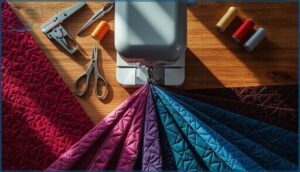
The right tools can make or break your quilting results — even a great machine won’t do much without the right setup behind it.
From the foot you attach to the pattern you choose, each decision shapes how your finished quilt looks and feels.
Here’s what you’ll want to know about the key tools and techniques that keep everything running smoothly.
Quilting Feet and Accessories
The right quilting foot changes everything. Each one is built for a specific job, so choosing wisely saves you time and frustration.
- Walking foot mechanics move all quilt layers together evenly, preventing puckering
- Free‑motion foot design lets you stitch curves and swirls in any direction
- Ruler foot precision guides acrylic templates for clean, consistent lines
- Quarter‑inch foot usage keeps your seam allowances perfectly accurate
- Extension table benefits support large quilts and reduce fabric drag
These sewing machine accessories and tools work alongside quilting frames to give you full control.
Quilt Design and Pattern Selection
Once your feet are sorted, the next puzzle is what to actually stitch. Picking the right quilting patterns and designs starts with matching pattern complexity to your skill level — beginner blocks need simpler motifs, more complex work can handle denser detail.
Check fabric contrast by snapping a black-and-white photo. Use quilt design software to plan pattern density, or grab pantograph templates for consistent, repeating rows.
Common Machine Quilting Methods
With your pattern chosen, your machine quilting technique does the heavy lifting. Each method suits a different skill level and goal:
- Straight Line quilting uses a walking foot to feed layers evenly, preventing shift.
- Stitch Ditch sinks stitches invisibly into seam channels.
- Free Motion Meandering drops feed dogs, letting your free motion foot float freely.
- Ruler Work guides precise arcs using stitch regulation.
- Echo Quilting repeats contour lines outward for layered depth.
Maintenance and Troubleshooting for Quilting Machines
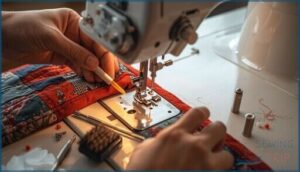
A quilting machine that’s well cared for simply works better — and lasts longer.
Like any mechanical tool, it needs a little attention to stay in top shape. Here’s what to keep on your maintenance checklist.
Regular Cleaning and Oiling
Consistent quilting machine maintenance starts with the small stuff. Clear bobbin lint removal after every bobbin change keeps your hook running clean — use a soft brush or quick air burst, never a long one.
Hook oil application is just as simple: one drop on the bobbin race every two hours. Wipe frame tracks weekly, and check the needle plate underside for debris buildup.
Adjusting Tension and Needle Checks
Once your machine is clean, tension is the next thing to dial in. Start with bobbin tension testing — the drop test tells you a lot. A bobbin case that falls slowly means you’re in range.
For top tension calibration, set your dial around 4–5, then adjust in half-turns. Always check needle alignment tips: flat side back, fully seated. Replace needles every 8–10 hours for consistent stitch quality inspection.
Addressing Common Operational Issues
Even with good tension and a fresh needle, problems still pop up. Thread breakage fixes usually start with re-threading completely and dropping your tension dial one notch. For skipped stitch solutions, check that your needle sits fully seated — flat side back.
Lint buildup removal keeps frame movement problems and stitch regulation errors at bay. Clean tracks, check encoder wheels, and you’re back to quilting smoothly.
Frequently Asked Questions (FAQs)
How do I choose the right quilting thread?
The softest thread often breaks the fastest.
Match your thread material to your fabric — cotton thread for cotton quilts, polyester for strength. Weight selection and color matching matter just as much as the weave.
Can quilting machines handle thick or heavy fabrics?
Yes, most quilting machines handle thick fabrics well. Use a larger needle size, adjust your presser foot lift, and choose strong thread.
A long arm quilting machine makes heavy layers much easier to manage.
What is the learning curve for beginner quilters?
Beginner quilters don’t need flawlessness on day one. Start with straight lines, practice often, and let skill progression happen naturally. Small wins build confidence faster than any shortcut ever could.
How long does a typical quilting project take?
Project size impact and skill level effect both shape your timeline. A baby quilt might take 8–15 hours, while a king-size can span a week or more with detailed machine quilting.
Are quilting machines compatible with embroidery designs?
It sounds counterintuitive, but quilting machines and embroidery designs actually work together well — when the formats match.
File Format Conversion, Hoop Size Limitations, and Embroidery Module Integration are the key factors to check first.
Conclusion
Once you truly grasp how a quilting machine works, you’ll never look at a finished quilt the same way again. Every stitch represents a tiny mechanical miracle—tension balanced to the thread, movement guided to the fraction of an inch, layers held perfectly in place.
That knowledge doesn’t just satisfy curiosity. It sharpens every decision you make, from choosing your machine to troubleshooting mid-project. The quilt on your frame deserves that understanding, and now you have it.
- https://ironinglab.com/quilting-vs-sewing/
- https://sewvacauthority.com/the-difference-between-sewing-and-quilting-machines/
- https://modishquilter.com/2023/01/18/top-7-best-sewing-machine-features-for-quilters/
- https://stitchinheaven.com/blogs/howdy/quilting-vs-sewing
- https://www.janome.com.au/what-makes-a-quilting-machine-different-from-a-sewing-machine/