This site is supported by our readers. We may earn a commission, at no cost to you, if you purchase through links.
The fly front zipper separates handmade trousers that look polished from ones that quietly broadcast "home sewn." It’s a construction detail with almost no tolerance for guesswork—misalign the topstitching by a few millimeters, skip the bartack at the curve base, or choose the wrong zipper weight for your fabric, and the whole front panel suffers for it.
Tailors who’ve mastered the fly front zipper method treat it less like a closure and more like a structural system: interlocking layers, precise tension, reinforcement exactly where stress accumulates. Get the sequence right, and the result is a fly that lies flat, opens cleanly, and holds up through years of wear.
Table Of Contents
- Key Takeaways
- Essential Tools for Fly Front Zipper Sewing
- Preparing Fabric and Pattern for a Fly Front
- Constructing The Fly Shield and Facing
- Step-by-Step Fly Front Zipper Installation
- Topstitching and Finishing Techniques
- Top Sewing Products for Fly Front Zippers
- Frequently Asked Questions (FAQs)
- Conclusion
Key Takeaways
- Matching your zipper weight and interfacing to your fabric isn’t optional — get it wrong and the fly buckles, puckers, or wears out fast.
- The fly front is a layered system, not a single seam, so the order you build it in — crotch seam, basting, facing, zipper, topstitch — determines whether the finished front lies flat or fights you.
- Topstitching and bartacks aren’t just cosmetic; precise stitch length, thread weight, and reinforcement at the curve base are what keep the fly holding up through real wear.
- Small prep steps — accurate seam marking, pre-shrinking interfacing, and symmetry checks before any permanent stitch — are what separate a clean result from one you’ll rip out and redo.
Essential Tools for Fly Front Zipper Sewing
Before you cut a single piece of fabric, getting your tools right makes everything easier.
A solid beginner’s guide to sewing napkins walks you through exactly which tools you’ll actually use, so nothing goes to waste.
A fly front zipper has a few moving parts, and each one works best with specific materials behind it. Here’s what you’ll need to pull it off cleanly.
Choosing The Right Zipper Type and Length
Garment-specific zippers make a real difference here. For lightweight trousers, a size 3 plastic coil zipper keeps the fly flat and flexible. Chinos handle a size 3–4.5 well, while heavy denim needs a size 4.5–5 metal zipper for durability.
Can’t find the right length? Buy longer and shorten from the top. Always keep that factory bottom stop intact.
Selecting Suitable Thread and Needles
Once your zipper is sorted, thread and needle choices deserve the same care. For most fly fronts, polyester all-purpose thread — around Tex 25–30 — manages everyday stress beautifully. Pair it with a size 80/12 needle on medium-weight fabrics.
Denim needs a size 90/14 jeans needle for clean stitch formation and tension control. Microtex needles keep topstitching crisp on tightly woven suiting, while stretch needles prevent skipped stitches on elastane blends.
Zipper Foot and Machine Setup Essentials
With your needle dialed in, the right zipper foot makes or breaks that stitch line. A standard foot works, but an adjustable one lets you shift the needle position left or right for precise clearance against the teeth. Snap it on, turn the handwheel slowly to confirm clearance, then drop presser pressure slightly on bulky layers.
Alignment guides on your needle plate keep everything tracking straight. For detailed setup, compatibility, and safety tips, refer to this adjustable zipper foot guide.
Interfacing Materials for Fly Stabilization
The fly area needs a solid foundation — that’s where interfacing does the heavy lifting. Match your choice to your fabric weight for clean results:
- Fusible options like Pellon SF101 bond permanently on cotton or linen around 250–350 gsm
- Sew-in types work better on heat-sensitive fabrics like silk or rayon
- Knit fusibles handle stretch denim without killing crosswise give
Wrong interfacing types create visible ridges. Right ones keep everything flat and moving naturally.
Preparing Fabric and Pattern for a Fly Front

Before you ever thread a needle, the prep work is what separates a clean fly front from a frustrating one.
Getting your fabric marked, cut, and interfaced correctly sets you up for smooth sailing through every step that follows.
Here’s what you need to handle first.
Marking and Basting Seamlines Accurately
Precision here is everything — one misplaced mark and your fly curve will tell on you. Use chalk wheels, washable fabric pens, or tailor’s tacks as your fabric marking tool for seamline transfer methods and fly curve marking.
For a full walkthrough on getting these details right from the start, sewing pants step-by-step from waistband to hem shows exactly where precise marking makes or breaks the fit.
Basting sequence planning matters: baste the center front first, then the zipper tape. Hand basting keeps layers honest.
Run symmetry checks by folding both front pieces together, confirming marks mirror perfectly before any permanent stitches land.
Cutting and Interfacing Fly Components
Cutting smart saves you headaches later. Start with Fly Shield Drafting by folding your self-fabric on grain — Interfacing Grain Direction should run parallel to center front to prevent stretching. Pre-shrinking Interfacing before you cut is non-negotiable for cotton and linen trousers.
Follow these Cutting Order Tips when preparing fly shield and facing:
- Cut the fly shield on the fold, sizing it to cover the zipper teeth plus 1–1.5 cm
- Draft the fly facing so its length matches zipper length plus waistband seam allowance
- Apply fusible interfacing to both pieces before sewing any construction seams
Pattern Adjustments for Fly Front Zippers
Small adjustments here make a big difference in how the finished fly sits and moves. Check these four pattern areas before you cut anything:
| Pattern Area | Key Adjustment |
|---|---|
| Center Front Shift | Move seam 0.5–0.7 cm off true center |
| Fly Extension Width | Draft 3–4 cm beyond center front |
| Crotch Curve Blending | Redraw upper curve to meet fly opening cleanly |
Always confirm overlap direction changes and zipper length placement match across all pattern pieces.
Constructing The Fly Shield and Facing
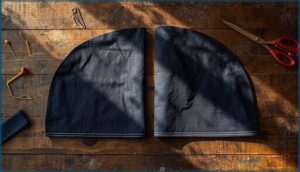
Before you touch that zipper, two small pieces of fabric do a lot of heavy lifting — the fly shield and the fly facing. Getting them right sets the tone for everything that follows.
Here’s how to build each one and finish those curved edges cleanly.
Assembling The Fly Shield
Think of the fly shield as your zipper’s bodyguard — it sits between the coils and the skin.
For solid Shield Stabilization, cut two pieces in your main fabric, right sides together, then stitch the curved outer edge with a 1.5 cm seam. Trim to 6 mm, clip every 10–15 mm, turn, and press. Understitch close to the seam so the edge stays put during flyfront zipper installation.
For a visual walkthrough of how the shield interacts with the fly extension and crotch seam, check out this guide on finishing the fly front.
Preparing The Fly Facing
The fly facing is your zipper’s backbone — get it wrong and the whole front buckles.
Start with proper Fly Facing Drafting: mirror the center front curve, extending 2–3 cm past it. Use Seamline Transfer Methods like chalk or tracing paper to mark your zipper placement line and grainline. Fuse interfacing to the wrong side first, then practice Pressing Curved Folds over a tailor’s ham for clean results.
Positioning Facing Accurately against the front now saves headaches later.
Attaching and Finishing Curved Edges
Curved Edge Staystitching is your first move — sew 1–2 mm inside the seam allowance before touching anything else. Then clip curved seams every 8–10 mm, stopping just shy of the stitching line. Seam Allowance Shaping and grading keeps bulk out of the curve.
Press curved edges over a tailor’s ham, finish raw edges with an overlock or zigzag, and your fly facing and fly shield will lie perfectly flat.
Step-by-Step Fly Front Zipper Installation
This is where everything comes together. Each step builds directly on the last, so working through them in order keeps the process clean and frustration-free.
Here’s what you’ll move through to get that fly front installed right.
Sewing The Initial Crotch Seam
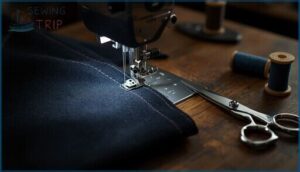
Sewing the center front crotch seam is where your fly front takes shape. Join your pant legs only from the crotch point down to the inseam, leaving the upper opening free.
Keep your seam allowance consistent — 5/8 inch works reliably here. Use a 2.5–3.0 mm stitch length, backstitch at both ends, and press carefully over a tailor’s ham for clean crotch curve control.
Aligning and Basting The Zipper
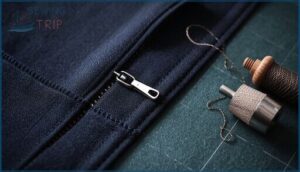
With your crotch seam pressed and ready, zipper tape management becomes your focus. Lay the zipper face down on the wrong side, teeth sitting 2–3mm inside the folded edge. Hand basting with 6–10mm running stitches keeps everything honest on slippery fabric.
Check your center front seam alignment, confirm the pull clears the future waistband, then press gently with steam before committing.
Attaching The Zipper to The Facing
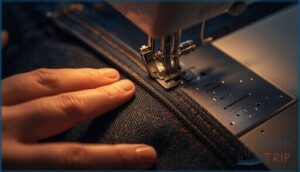
Now the real work begins. Place the zipper tape on the fly facing, keeping zipper tape placement tight — teeth sitting 2–3mm from the folded edge for clean facing edge alignment. Stitch length control matters here: 2.5–3mm straight stitch, first row close to the teeth.
Managing fly bulk means keeping the main pant front completely clear. Integrating fly shield into this seam locks three layers — tape, facing, and shield — in one pass.
Securing and Topstitching The Fly Front

With your zipper attached, it’s time to lock everything in place. Press the fly front flat before you stitch — a clapper works wonders on denim.
For fly topstitch spacing, sew your first line 2–3mm from the fold, then a second 6–8mm out. Securing shield layer within that second pass keeps everything behind the teeth. Reduce to 2.5mm for smoothing fly curves, and finish with bartacks at the base.
Topstitching and Finishing Techniques
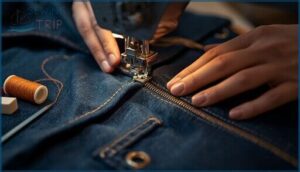
The zipper is in — now it’s time to make it look like it belongs there. Finishing is where good sewing becomes great sewing, and a few deliberate steps separate a homemade fly from a professional one.
Finishing is where good sewing becomes great sewing
Here’s what to focus on to get that clean, polished result.
Achieving Professional Topstitching
Good topstitching starts before you touch the machine. Press the fly area flat, let it cool under a clapper, then trace your J-curve with washable chalk.
For denim, set stitch length to 3–3.5mm; lighter twill needs 2.5–3mm. Use polyester topstitch thread in the needle, all-purpose in the bobbin.
Slow down at the curve. Stitch control and sewing precision make that line look intentional, not accidental.
Reinforcing Stress Points With Bar Tacks
Bar tacks are the unsung heroes of a durable fly front zipper. Hit the key Fly Stress Points: base of the fly curve, the fly facing edge, and just below the waistband seam.
For Bar Tack Placement, keep ideal Tack Length between 4–8mm. Stitch Density Choices matter — 0.5–1.0mm stitch length packs stitches tight.
After Testing Tack Strength by tugging the fronts apart, you’ll know it holds.
Cleaning Up Basting Stitches and Raw Edges
Cleaning up is where the fly goes from "almost there" to finished. Work through it in order:
- Basting Stitch Removal: Slide a seam ripper under every third stitch, then pull the tail to release a full section
- Protecting Permanent Stitching: Stop 2–3mm before any backstitched ends
- Seam Allowance Grading: Trim inner layers to 6mm, outer to 10–12mm
- Fly Edge Finishes: Use a narrow serger stitch or tight zigzag for finishing raw edges in sewing
- Final Fly Pressing: Press wrong-side first over a tailor’s ham, then steam the topstitching and let it cool completely
Adjusting for Metal or Plastic Zippers
Metal and plastic zippers don’t play by the same rules. For sewing with metal zippers, use a 90/14 needle, bump your stitch length to 2.8–3mm, and plan for Shield Width Adjustments of 0.5–1cm extra. Plastic needs lower heat pressing and a 2.5mm stitch. Stitch Length Adjustments, Wear And Durability, and Comfort And Flexibility all shift depending on which you choose.
Top Sewing Products for Fly Front Zippers
The right supplies can make or break a fly front zipper project. From detailed tailoring guides to well-drafted patterns, having reliable resources in your corner saves real time and frustration.
Here are three products worth adding to your sewing toolkit.
1. Tailoring Book Measuring Cutting Fitting Altering Finishing
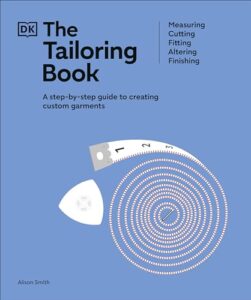
Alison Smith’s The Tailoring Book is one of those references you’ll reach for every time you tackle trousers. Published by DK, it covers measuring, cutting, fitting, altering, and finishing across 304 pages — including dedicated guidance on fly facings, shields, and zipper placement.
It walks you through crotch depth, rise adjustments, and topstitching curves. At around $40, it earns its shelf space fast.
| Best For | Home sewers and aspiring tailors at any skill level who want a thorough, go-to guide for making and altering structured garments like trousers, jackets, and coats. |
|---|---|
| Language | English |
| Skill Level | All levels |
| Format | Book |
| Garment Type | Shirts, jackets, coats, trousers |
| Instructions Included | Yes, 304 pages |
| Sizing Info | General guidance |
| Additional Features |
|
- Covers everything from the basics to couture-level techniques, so you won’t outgrow it quickly
- 10 real garment projects plus 80 step-by-step techniques make it genuinely practical, not just theoretical
- Downloadable patterns are a nice touch — you can get straight to work without hunting anything down
- It’s a book, so if you learn better from video or hands-on instruction, it might not click the same way
- At 3.4 pounds and over 300 pages, it’s hefty — not something you casually flip through on the couch
- Focuses on business-style and tailored clothing, so it’s less useful if you’re mainly sewing casual or casual wear
2. Butterick Misses Collared Shirt and Shorts Pattern
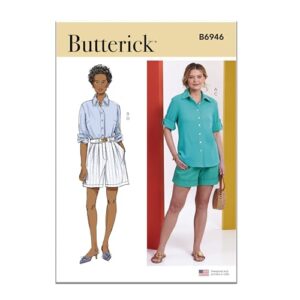
Butterick B6946 is a smart choice if you want real fly-front practice with an actual finished garment at the end. The pattern covers misses sizes 4–12 and includes pleated, high-waisted shorts with a traditional zip-fly opening — plus a collared, button-front shirt to match.
Light- to medium-weight wovens like poplin or chambray work best. You’ll also need interfacing for the waistband, fly sections, and collar.
| Best For | Sewists with some experience who want to practice fly-front construction while making a polished, mix-and-match shirt and shorts set in misses’ sizes 4–12. |
|---|---|
| Language | English |
| Skill Level | Intermediate |
| Format | Pattern packet |
| Garment Type | Shirts and shorts |
| Instructions Included | Yes, with pattern |
| Sizing Info | Sizes 4-6-8-10-12 |
| Additional Features |
|
- Covers both a collared button-front shirt and pleated high-waisted shorts, so you get a full outfit from one pattern
- Multiple views let you switch up details like rolled sleeves, button tabs, and cuff styles to keep things fresh
- Great for building real skills — the zip-fly, bust darts, and collar band are all solid technique practice
- Only goes up to size 12, so it won’t work for everyone
- Requires a decent foundation in sewing — beginners may find the fly-front and collar construction a bit much
- You’ll need extra materials like interfacing on top of your main fabric, which adds to the planning and cost
3. Style Arc Hendrix Coat Sewing Pattern
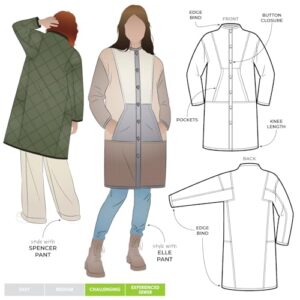
If you want a more ambitious project, the Style Arc Hendrix Coat is worth considering. Sized 10–22 in PDF format, it suits intermediate to expert sewists.
It’s an unlined, knee-length coat with panelled front seams, dropped shoulders, and a button or snap-front band.
Recommended fabrics include wool, linen, faux fur, or velvet — all structured enough to hold those clean panel lines beautifully.
| Best For | Intermediate to advanced sewists who want a stylish, structured coat they can customize with fabric choices like wool, faux fur, or velvet. |
|---|---|
| Language | English |
| Skill Level | Intermediate to advanced |
| Format | Pattern packet |
| Garment Type | Coat |
| Instructions Included | Yes, basic instructions |
| Sizing Info | Sizes 10-22 |
| Additional Features |
|
- Sizes 10–22 are each printed in a different color, making it easy to cut the right pieces without confusion.
- Lots of creative flexibility — swap fabrics to take it from a cozy winter coat to a breezy linen layer.
- Clean, modern design with panelled seams, patch pockets, and optional top-stitching for a polished finish.
- Medium to challenging difficulty — not the best pick if you’re still building your sewing confidence.
- Unlined construction means the inside finish is on you, which takes extra care with fabric choice and seam finishing.
- Requires sourcing additional trims — 7 buttons or snaps plus fusing — which adds to prep time and cost.
Frequently Asked Questions (FAQs)
Why is the front zipper called a fly?
The word "fly" traces back to the early 1800s, when it meant a flap of cloth that could hang or flutter — like a tent flap.
That fabric flap on trousers kept the name when zippers replaced buttons.
How to do fly front?
A fly front is a fabric flap that conceals the zipper closure on pants or trousers.
It overlaps the center front, hiding the teeth and creating a clean, polished finish on the garment’s exterior.
Can a fly front zipper be sewn by hand?
Yes, you can sew a fly front zipper entirely by hand. Use tight backstitch along the zipper tape, wax your thread, and work slowly — the result holds just as well as machine stitching.
How do you fix a fly zipper that keeps unzipping?
A loose slider is usually the culprit. Squeeze the back of the slider gently with pliers to restore grip.
If teeth are bent or missing, replace the whole zipper — no patch fixes that.
Can fly front zippers be added to existing pants?
Absolutely — adding a fly front zipper to existing pants is doable. Woven trousers with a center front seam and at least 5 cm of seam allowance are your best candidates for a clean conversion.
How do you sew a fly on stretch fabric?
Stretch fabric shifts constantly, so full interfacing on the fly area is non-negotiable. Fuse lightweight tricot, use a stretch needle, and sew with polyester thread for a flat, stable result.
What causes puckering around a finished fly front?
Puckering usually comes down to three culprits: off-grain fabric cuts, under-interfaced fly pieces, or a zipper tape that got stretched during stitching. Any one of those will ripple the finished front.
Conclusion
Sewers have ripped out more fly fronts than they care to admit—and every single one taught them something the instructions never quite captured. Now you’ve got the full picture.
The fly front zipper method isn’t just about a working closure; it’s the detail that separates a garment worth keeping from one that gets retired early. Nail the sequence, trust your topstitching, and reinforce those stress points. Your trousers will prove the difference every time you wear them.