This site is supported by our readers. We may earn a commission, at no cost to you, if you purchase through links.

Freestanding lace sounds intimidating until you realize the whole trick comes down to one thing: the stabilizer dissolving cleanly and leaving your stitches intact.
Get that wrong, and you’re left with a limp, misshapen piece that took hours to make. Get it right, and the lace holds its structure, its edges stay crisp, and the finished piece looks like it came from a specialty shop.
The difference usually isn’t the design or even the thread—it’s whether you matched your embroidery stabilizers for freestanding lace to the actual stitch density of your project. That matching process is simpler than it sounds.
Table Of Contents
Key Takeaways
- Matching stabilizer weight to your design’s stitch density is the single most important factor in whether your freestanding lace holds its shape or falls apart after rinsing.
- Double-layer wash-away stabilizer is your best move for dense designs above 700 stitches per inch, while a single lightweight sheet handles anything under 300.
- Warm water around 40–50°C, gentle agitation, and multiple rinse passes are what separate clean, residue-free lace from a sticky, clumped mess.
- Small setup details — using the snuggest hoop that fits, keeping stabilizer bone dry before hooping, and slowing your machine through dense sections — protect your lace long before the stitching even starts.
Choosing The Right FSL Stabilizer
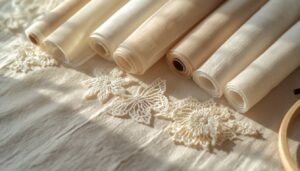
Not every stabilizer works the same way, and with FSL, that difference really matters. The wrong pick can leave your lace falling apart the second the water hits it.
FSL has its own quirks, so it’s worth checking out embroidery stabilizer picks for small businesses before you commit to anything.
Here’s what to look for before you grab a roll off the shelf.
Wash-away Vs Film-style Stabilizers
Two types rule the FSL world: washaway stabilizer and film backing for embroidery. Here’s how they break down:
- Dissolving power — water soluble stabilizer vanishes completely, leaving zero residue on your lace.
- Edge Crispness — film-style nonwoven stabilizer holds dense designs sharper during stitching.
- Handling Flexibility — sticky-back washaway lets you reposition before committing.
Cost comparison and environmental impact both favor washaway for everyday lace projects.
For more details, see the film stabilizers dissolve rapidly.
Stabilizer Weight and Thickness
Weight matters more than most beginners realize. Think of it like thread count in fabric — the weight‑thickness ratio tells you how much support you’re actually getting.
For FSL, stabilizer weight and thickness usually run from 1.5 oz to 4.2 oz. Lighter weights suit delicate designs; heavier ones handle dense stitch counts.
density‑weight matching keeps your lace clean and structured throughout stitching.
Single-layer Vs Double-layer Support
One layer works great for light designs — it keeps your freestanding lace flexible and cuts cleanup speed down considerably. But when stitch density climbs, hoop tension effects start pulling things out of shape.
That’s where double-layer wash away stabilizer earns its place. It improves fiber pull resistance and holds complex motifs steady.
For most crafters, stabilizer thickness selection really comes down to your design’s stitch count.
Residue-free Dissolution and Cleanup
Once your stitching is done, cleanup should feel satisfying — not stressful. A good water soluble stabilizer dissolves cleanly, leaving zero tackiness behind.
Here’s how to nail residue‑free removal every time:
- Temperature Optimized Soak — Warm water around 38–45°C cuts dissolution speed nearly in half
- Dissolution Timing Control — Soak 2–5 minutes, then check for cloudiness
- Rinse Water Clarity — Clear water means you’re done; cloudy means rinse again
- Residue Detection Techniques — Feel for stickiness once dry; any tackiness signals incomplete washaway stabilizer removal
- Post-Dry Stiffness Boost — Apply light starch after ensuring residue‑free results in freestanding lace
Matching Stabilizer to Stitch Density
Think of stitch density as your stabilizer’s job description.
Low-density lace (under 300 stitches per inch) needs just a lightweight water‑soluble stabilizer — one thin layer covers it.
Mid-range density calls for medium-weight support.
Dense designs above 700 stitches per inch? Double up.
| Stitch Density | Stabilizer Weight | Layer Count |
|---|---|---|
| Low (under 300 SPI) | Lightweight (10–20 g/m²) | Single layer |
| Medium (300–500 SPI) | Medium (40–60 g/m²) | Single or double |
| High (700+ SPI) | Heavyweight (70–120 g/m²) | Double layer |
Top 6 FSL Stabilizers
Not all water-soluble stabilizers are created equal, and picking the wrong one can unravel your whole project — literally.
After testing and comparing, these six options stand out for FSL work across different stitch densities and project types. Here’s what made the cut.
1. New brothread Wash Away Embroidery Stabilizer
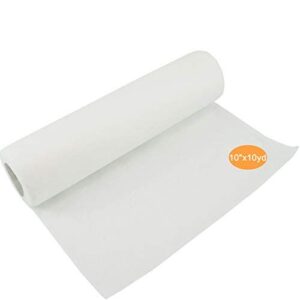
The New brothread Wash Away Embroidery Stabilizer is a solid starting point for FSL beginners and seasoned stitchers alike. At $14.99 for a 10-yard roll, it’s budget-friendly without cutting corners.
It dissolves completely in cold or warm water — no sticky residue, no backing left behind.
The 1.5 oz weight manages light to medium stitch densities well, and you can layer two sheets for denser lace designs.
It’s also non-toxic and skin-friendly, which is a quiet but nice bonus.
| Best For | Embroiderers working with washable, high-pile fabrics like towels and fleece who need a clean, residue-free finish for FSL or machine embroidery projects. |
|---|---|
| Roll Width | 10 in |
| Roll Length | 10 yd |
| Dissolves In | Cold or warm water |
| Residue Left | None |
| Stitch Density | Light to medium |
| Layering Supported | Yes |
| Additional Features |
|
- Dissolves completely in cold or warm water — no sticky backing left behind
- Non-toxic and acid-free, so it’s safe to handle during long stitching sessions
- Comes on a generous 10-yard roll at $14.99, easy to cut and layer as needed
- Can get sticky during dissolution, so you’ll need to rinse it really thoroughly
- Only reliable for light to medium stitch densities — heavy designs need extra layers
- Slightly thicker than ultra-lightweight options, which may not play well with very delicate fabrics
2. Sulky Ultra Solvy Water Soluble Stabilizer
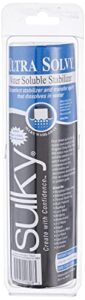
If you’re ready to level up, the Sulky Ultra Solvy is worth every penny at $20.89 for an 8-inch by 8-yard roll. It’s about four times firmer than standard Solvy, so it holds its shape through dense stitch runs without buckling.
The clear, traceable surface lets you place motifs exactly where you want them — no guessing. It dissolves in warm water without leaving sticky residue, and you can even use leftover pieces as a liquid stabilizer for spot stiffening.
| Best For | Embroiderers working with delicate fabrics like lace or organza who need a firm, reliable stabilizer that disappears cleanly after stitching. |
|---|---|
| Roll Width | 8 in |
| Roll Length | 8 yd |
| Dissolves In | Warm water |
| Residue Left | Minimal (needs rinsing) |
| Stitch Density | Medium to heavy |
| Layering Supported | Yes |
| Additional Features |
|
- About four times firmer than standard Solvy, so it holds up through dense, detailed stitch runs without shifting or buckling
- Crystal clear surface makes it easy to trace and place designs exactly where you want them
- Dissolves in warm water with no sticky residue, and leftover scraps can be melted into a liquid stabilizer for spot stiffening
- Full dissolution can take 20–30 minutes and may need multiple rinses, which slows things down on bigger projects
- At $20.89 a roll, it’s pricier than generic alternatives — and you might waste material if the roll width doesn’t match your hoop
- Shipping can take up to 25 days, so it’s not something you can grab last minute when a project deadline is looming
3. HBI Wash Away Embroidery Stabilizer
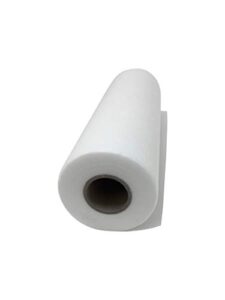
HBI Wash Away Embroidery Stabilizer keeps things simple without cutting corners. At $23.89 for a 12-inch by 25-yard roll, you get a lot of stabilizer for the price.
It’s a fibrous nonwoven — not a film — so it hoops easily and remains stable without slipping around on you.
The 1.5 oz weight works well for low-to-medium stitch density FSL designs, and you can double it up for denser motifs.
Rinse it in warm water and it dissolves cleanly, leaving only your finished lace behind.
| Best For | Embroiderers working with delicate or sheer fabrics like gauze and lace who want a clean, residue-free finish without a lot of post-project cleanup. |
|---|---|
| Roll Width | 12 in |
| Roll Length | 25 yd |
| Dissolves In | Tepid or warm water |
| Residue Left | None |
| Stitch Density | Light to medium |
| Layering Supported | Yes |
| Additional Features |
|
- Dissolves fully in warm water, so there’s no picking or scraping after you’re done — just rinse and go.
- Thin enough to hoop without bulk, which makes it a solid pick for lightweight and delicate fabrics.
- Works for both machine and hand embroidery, plus plays nicely with cut-away stabilizers and fusible interfacing.
- Thinner than some competing brands, so denser designs may need a double layer for enough support.
- Cold water won’t cut it — you need warm or tepid water, or you risk leaving residue behind.
- Only comes in a 25-yard roll, so bigger projects could mean buying multiple rolls.
Superpunch O Wash Away Stabilizer
Superpunch O Wash Away Stabilizer earns its spot through solid thread compatibility with both fine and standard embroidery threads, making it genuinely flexible for freestanding lace projects.
Its eco-friendly formula dissolves fast — wash-away stabilizer removal methods don’t get much easier than this.
For cost efficiency, it competes well. Choosing the right embroidery lace stabilizer matters, and this water soluble stabilizer holds its shape cleanly through every stitch.
4. World Weidner FSL Water Soluble Stabilizer
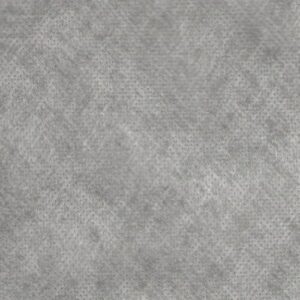
World Weidner’s FSL Water Soluble Stabilizer is built specifically for freestanding lace — and it shows. dissolves cleanly in warm water around 40–50°C, leaving zero residue or film on your finished lace.
That means less scrubbing, less guessing, and crisper edges right out of the rinse. It plays nicely with rayon, polyester, and cotton threads, and it won’t clog your needle or bobbin.
For delicate motifs where shape really matters, this one holds steady through every stitch.
| Best For | Embroiderers and sewists working on freestanding lace, cut-work, or delicate in-the-hoop projects who need a clean-dissolving stabilizer that won’t damage fine fabrics. |
|---|---|
| Roll Width | 12 in |
| Roll Length | 10 yd |
| Dissolves In | Cold or warm water |
| Residue Left | None |
| Stitch Density | Light to medium |
| Layering Supported | Yes |
| Additional Features |
|
- Dissolves completely in warm or cold water with no residue left behind — no extra scrubbing needed.
- Works with all the major machine brands, so you don’t have to worry about compatibility.
- Holds stitches firmly on tricky fabrics like knits and towels, keeping everything stable while you sew.
- The 8-inch width can be too narrow for larger hoops, meaning you may need to buy wider rolls separately.
- Finished lace can feel stiff after the first rinse and might need a second wash or fabric softener to loosen up.
- Heavy stitch designs often need multiple layers, which burns through your roll faster and adds to the cost.
5. Water Soluble Embroidery Stabilizer Topping

Sometimes you don’t need stabilizer underneath — you need it on top. That’s exactly where this water soluble topping earns its place.
Made from 100% PVA, it dissolves quickly in warm or cold water with zero residue left behind.
At around 1.5 oz, it’s light enough for delicate FSL designs without adding bulk in the hoop.
You can layer it for denser stitch patterns too.
Skin-safe and easy to rinse out — it’s a simple tool that quietly does a lot.
| Best For | Embroiderers working with high-pile fabrics like terry cloth or towels, or anyone making free-standing lace and delicate designs that need a topping that disappears after stitching. |
|---|---|
| Roll Width | 10 in |
| Roll Length | 25 yd |
| Dissolves In | Tepid or warm water |
| Residue Left | None |
| Stitch Density | Light to medium |
| Layering Supported | Yes |
| Additional Features |
|
- Dissolves completely in cold or warm water — no sticky residue, no fuss
- Skin-safe PVA material, so no irritation worries on garments worn close to the body
- Lightweight and stackable, so it works for both delicate FSL projects and denser stitch patterns
- Too soft to handle very heavy or tightly woven fabrics on its own
- Not great for high-density designs unless you layer multiple sheets
- Can slip or tear during stitching if it doesn’t have pre-punched holes for hoop attachment
Hoop and Machine Setup
Getting your hoop and machine set up correctly makes a bigger difference than most people expect. A few small adjustments before you even start stitching can save you from a lot of frustration later.
Here’s what to get right before you hit that start button.
Use The Smallest Hoop That Fits
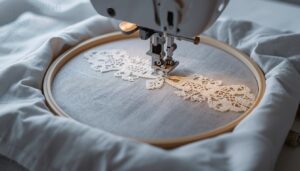
When setting up embroidery hoop for FSL projects, smaller is genuinely better.
Hoop size measurement starts with your design’s widest point — then pick the snug fit.
This sharpens edge alignment accuracy and keeps freestanding lace from drifting mid‑stitch.
- Tighter hoops improve tension control tips in action
- Minimizing fabric drift protects your lace symmetry
- Needle deflection reduction happens naturally with less slack
- Choosing the right embroidery lace stabilizer matters less if your hoop is too loose
Hoop Stabilizer Tautly Without Crushing
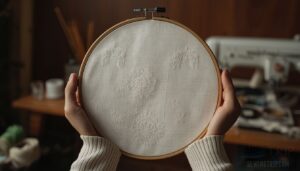
Once your hoop size is locked in, taut is the goal — but crushing the stabilizer ruins everything. Think of it like a drum: tight enough to hold, not so tight that it tears. Run a quick Pressure Evenness Check around the edges before you stitch. Even tension prevents waviness and keeps your Freestanding lace crisp.
| Step | Screw Tightening Technique | Result |
|---|---|---|
| 1 | Snug, not forced | Stabilizer Surface Flattening |
| 2 | Tension Calibration check | Embroidery hoop tension holds |
| 3 | Real-time Tension Monitoring | No mid-run shifts |
Keep Stabilizer Dry Before Hooping
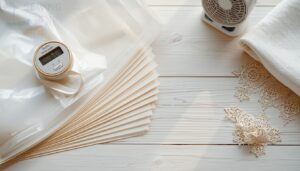
Moisture is sneaky — and it’s the enemy of good stabilizer preparation. Even slightly damp water soluble stabilizer loses its grip before you stitch a single thread.
Good Pre-Hoop Drying and Humidity Management make all the difference:
- Work on a Dry Work Surface only
- Store stabilizer where humidity stays below 50 percent using Moisture Indicators
- Dab Condensation Prevention — wipe surfaces with a lint-free cloth before hooping
- Fan large sheets to dry both sides evenly
- Keep stabilizer sealed until you’re ready to hoop
That’s preparing and hooping stabilizer the right way for perfect freestanding lace every time.
Use a 75/11 Needle
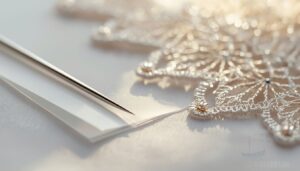
Grab a 7511 embroidery needle before you start your Free Standing Lace project — it makes a real difference. Its fine 0.75mm diameter punches cleaner holes through your water‑soluble stabilizer without tearing it apart.
Thread compatibility is spot‑on for 40wt embroidery thread, and the eye clearance keeps feeding smooth.
Stick to a simple wear schedule: swap it out every 6–8 hours, and add a quick cleaning routine between sessions.
Slow The Machine for Dense Stitches
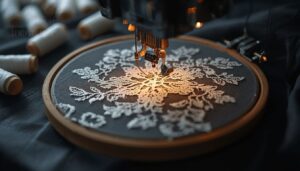
Dense lace sections can fight back hard if your machine blazes through them at full speed. Lower stitch speed in those areas — it’s one of the simplest stitch density considerations you can make.
Use stepwise acceleration to ease into tight fills, adjust motor torque for smoother pulls, and fine-tune thread tension so nothing snags. Your wash away stabilizer stays intact, and your lace looks clean.
Stitching Free-Standing Lace
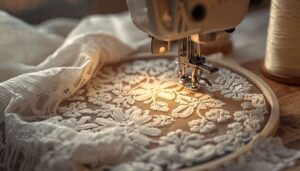
Once your machine is set up and your stabilizer is hooped, the real work begins. Getting your thread and stitching details right makes the difference between lace that holds together and lace that falls apart, the second the stabilizer dissolves.
Here are the key stitching steps to get it right.
Match Top and Bobbin Thread Colors
Color matching isn’t just about looks — it’s structural. For FSL, your top and bobbin thread colors need to match because both sides of the lace stay visible.
Bobbin color matching keeps your design clean front and back.
Aim for Value Matching over exact hue contrast. Fiber Consistency and Weight Coordination matter too — mismatched weights throw off tension balance and affect how your embroidery thread tension holds after the stabilizer dissolves.
Wind The Bobbin With The Same Thread
Same Thread Winding is one of those small habits that makes a huge difference in freestanding lace. Wind your bobbin with the exact same thread — same brand, same weight — that’s on top.
- Follow the Clockwise Winding Direction standard for most home machines
- Do a Full Circumference Prewind so there are no gaps
- Practice Secure Tail Anchoring under the first few wraps
- Maintain Even Wrap Tension throughout to prevent puckering
Consistent bobbin thread keeps your Wash Away Water Soluble Stabilizer experience smooth and your lace edges clean.
Add Underlay for Structural Support
Think of underlay stitches as your lace’s skeleton. Before decorative stitches go down, the first layer distributes tension evenly and keeps delicate motifs from stretching out of shape.
Underlay stitches are the skeleton of freestanding lace, holding every delicate motif in shape before decorative threads take over
Underlay Material Selection matters here — choose a water-soluble stabilizer compatible with your top layers.
Match Underlay Thickness Guidelines to your stitch density, and always do Underlay Compatibility Testing on scrap first.
Watch for Shifts During Long Runs
Long runs are where things can quietly go wrong. Tiny shifts build up stitch by stitch — and suddenly your lace pattern drift becomes real.
- Do Stabilizer Shift Detection checks every 30 minutes
- Pause for Run Interval Pauses at each color change
- Confirm Hoop Alignment Verification if Needle Penetration Frequency increases
- Slow speed when Lace Pattern Drift starts to show
Cut Excess Stabilizer Close to Edges
Once you’ve paused at that last color change, it’s time to cut the excess stabilizer. For freestanding lace, Edge Trimming Precision matters — stay 1/8 to 1/4 inch from your outermost stitch. Use Scissor Angle Technique: angle micro‑tip blades slightly inward for Curved Edge Cutting. Short snips beat one long cut every time.
| Step | Margin Measurement Guidelines | Tool |
|---|---|---|
| Straight edges | 1/8 inch from stitch line | Micro‑tip scissors |
| Curved sections | 1/4 inch, then retrim | Curved embroidery scissors |
| Dense motifs | Check for Fiber Residue Removal | Clean blades between cuts |
| Final check | No stabilizer fibers visible | Good lighting |
After stabilizer removal, rinse your work away from the stabilizer or water soluble stabilizer thoroughly — this clears any leftover clumps near trimmed edges.
Removing and Finishing Lace

You’ve done the hard part — now it’s time to bring your lace to life. Getting the stabilizer out and finishing the piece properly makes all the difference between lace that holds its shape and lace that falls apart.
Here’s how to handle each step.
Soak in Warm Water to Dissolve Stabilizer
Once your freestanding lace is stitched, the stabilizer dissolution process is straightforward — just keep temperature control in mind. Soak your piece in warm water around 40–50°C for 10 to 15 minutes. That sweet spot manages most wash away stabilizer types without distorting delicate threads.
Gentle agitation tips the process along evenly. Before soaking, run a quick color fastness test to protect lace shape retention throughout.
Rinse Out Clumped Fibers Thoroughly
After the Warm Water Soak, don’t skip the rinse — clumped fibers cling stubbornly and dull your finished lace.
Gentle Agitation in a Tilted Basin Flow keeps dissolved bits moving toward the drain.
Secondary Rinse with warm water (never cold — it causes fibers to re-cling) ensures residue-free results in freestanding lace.
Quick rinse checklist:
- Agitate gently with fingertips
- Tilt basin to direct fiber flow
- Use a Fiber Brush Aid on stubborn spots
- Repeat until water runs clear
Air-dry Flat for Firmness
Once your Free Standing Lace is rinsed clean, lay it on a flat board surface right away. Room temperature air dry works best — no shortcuts with heat.
Add gentle edge weighting around the borders to stop curling as it dries. Low humidity speeds things up without warping threads.
That strong hold comes from letting fibers settle slowly and evenly.
Wash Away Water Soluble Stabilizer releases cleanly, so stabilizer weight and thickness directly shape how firm your finished lace feels.
Dry at an Angle for Dimension
Want that sculptural, dimensional look? Skip the flat board this time and prop your lace at a gentle angle right after rinsing.
Here’s what angled air drying does for you:
- Edge Lift creates subtle rises that change light interaction across the surface
- Moisture Gradient lets thicker areas dry first, preserving shape naturally
- Rotational Angle exposure keeps the overall form balanced
Rotate the piece halfway through for even results.
Press or Starch for Extra Stiffness
Once your free‑standing lace is dry, quick press or starch treatment makes all the difference. Cornstarch sprays give you a clear, flexible hold, while potato starch adds heavier stiffness for rigid motifs.
Spray from 8–12 inches, then press with a cloth to activate heat activation without scorching. Starch maintenance is simple — just reapply lightly after wear.
Fixing Common FSL Problems

Even the most careful stitchers run into snags with FSL — it happens to everyone. The good news is that most problems have simple fixes once you know what to look for.
Here are the most common ones and how to handle them.
Prevent Thread Breakage in Dense Areas
Dense stitch areas are where most thread breaks happen — and it’s usually fixable. Start with Tension Gauge Testing to confirm your upper and lower threads aren’t fighting each other.
Then check Needle Eye Clearance; a worn or too-small needle creates friction fast.
Stitch Density Spacing and Thread Elongation Choice matter too — give threads room to breathe.
Keep Thread Path Smoothing part of your regular routine.
Stop Unraveling After Stabilizer Removal
Unraveling usually means something slipped during stitching — and it’s easier to prevent than fix. Nail your Thread Tension Control and Stitch Overlap Management before the stabilizer even hits water.
Then use solid Stabilizer Layer Bonding and smart wash away stabilizer removal methods to lock everything in place.
- Rinse thoroughly to flush loose fibers
- Apply Edge Sealing Methods along scalloped edges
- Use Post-Dry Heat Setting to firm up threads
- Soak 10–15 minutes for full dissolution
- Trim stray threads before they travel
Avoid Tearing With The Right Stabilizer Weight
Tearing often comes down to one thing: the wrong stabilizer weight for your stitch density. Use Density Zone Mapping to identify heavy-hit areas before you start.
Then apply Layering Strategy Optimization — double up for dense designs. Stabilizer Weight Testing on scrap pieces saves your actual project. Pair smart Thread Tension Management with Edge Reinforcement Techniques, and choosing the right embroidery lace stabilizer becomes second nature.
Reduce Residue After Rinsing
Sticky residue after rinsing? That’s usually a rinsing method problem, not a stabilizer problem. Ensuring residue‑free results in freestanding lace comes down to three things:
- Warm Water Temperature — warm water dissolves and washes away stabilizer performance issues quickly; cold water leaves clumps.
- Gentle Agitation Technique — soft swishing, not scrubbing, lifts stubborn fragments without damaging delicate threads.
- Rinse Frequency Optimization — two passes using distilled water rinsing beat one long soak every time.
Use rinse aids designed for fabric to speed up water‑soluble stabilizer removal methods, and you’re done.
Improve Symmetry and Lace Shape
Getting your freestanding lace to look symmetrical starts before you stitch a single thread. Use precise underlay alignment and balanced stitch distribution to keep both halves of your motif pulling evenly.
Consistent thread tension and symmetrical color matching between top and bobbin threads make a real difference. Pair those habits with edge trimming and the right stabilizer weight, and your wash away stabilizer does the rest.
Frequently Asked Questions (FAQs)
Can FSL designs be digitized for beginners at home?
Yes — with the right software selection and a simple open motif, beginners can tackle FSL digitizing at home.
Start with vector tracing, apply stitch density basics, and always run a test swatch first.
What thread weights work best for freestanding lace?
For freestanding lace, 40wt rayon thread gives you beautiful sheen and flexibility. Want a matte, vintage feel? Try 30wt cotton.
Polyester 40wt holds up great, and 60wt cotton adds real stiffness.
How do you store finished freestanding lace pieces safely?
finished lace as a pressed flower — delicate, worth protecting.
Store pieces flat using acid-free tissue, breathable packaging, and cotton glove handling.
Keep humidity control steady at 40–50% for clean, lasting lace preservation.
Conclusion
Stabilizer selection shapes every stitch you make in freestanding lace. Match the wrong weight, and hours of careful work rinse away as a limp tangle. Match it right, and the lace holds its shape like it was born that way.
The embroidery stabilizers for freestanding lace you choose aren’t just a supply decision—they’re the foundation your design stands on.
Pick well, set up your hoop with care, and your finished lace will speak for itself.