This site is supported by our readers. We may earn a commission, at no cost to you, if you purchase through links.
A quilt block that measures perfectly before sewing can end up a full quarter-inch off after pressing—and the iron never moved an inch out of place.
That’s the quiet frustration quilters rarely talk about: the pressing itself caused the problem.
The difference between a flat, accurate block and a wavy, warped one often comes down to a single habit—sliding the iron instead of lifting it.
Knowing how to press quilting fabric without distorting it means understanding that heat, motion, and grain work together in ways that either lock your seams into place or slowly pull them apart.
The techniques ahead will change how you treat every seam, from your very first cut to your final block.
Table Of Contents
Key Takeaways
- Lifting and lowering your iron — never sliding it — is the single most important habit that keeps your fabric grain true and your blocks accurate.
- Letting your pressed fabric cool flat for 2–5 minutes before cutting prevents bias stretch and locks your seams exactly where you want them.
- Choosing the right seam method (open, to one side, or spun) based on your block’s complexity, directly determines how flat and precise your finished quilt top will be.
- The right tools — a wool pressing mat, pressing cloth, and tailor’s clapper — do as much work as your iron when it comes to preventing distortion.
Pressing Vs. Ironing Quilting Fabric

Most quilters use the words "pressing" and "ironing" like they mean the same thing — but they don’t, and that difference matters more than you’d think.
Getting this right is part of the bigger picture covered in this guide to fabric preparation for quilting projects, where the details really do change your results.
One keeps your fabric perfectly square, and the other quietly wrecks it.
Here’s what’s actually going on with each technique.
Why Pressing Prevents Stretch
Unlike ironing, pressing uses straight-down, lift-and-lower motions — no sliding. That single habit protects your fabric’s grain alignment and prevents unwanted stretch.
| Action | Effect on Fibers | Result |
|---|---|---|
| Controlled Heat + Even Pressure | Fiber Compression along seam | Flat, stable seam |
| Minimal Steam | Limits moisture migration | Grain stays true |
| Lift-and-lower motion | No lateral drag | Avoiding fabric stretch during quilting |
Proper pressing techniques for quilting keep every block square and accurate.
How Ironing Distorts Grain
Sliding the iron sideways pulls fibers off their original path — that’s Heat-Induced Fiber Shift in action. Each pass creates Grain Drift Patterns that skew your blocks before you’ve even sewn one seam. Steam Grain Realignment compounds this: moisture loosens fibers, and Iron Tip Pressure drags them sideways, locking in Directional Fabric Stretch that no amount of pinning fixes later. A pressing cloth protects fabric while you press, preventing scorch marks and preserving grain.
| Iron Movement | Effect on Grain | Block Result |
|---|---|---|
| Side-to-side slide | Grain shifts laterally | Skewed, warped block |
| Excessive steam ironing | Fibers loosen and drift | Stretched, unstable edges |
| Heavy iron temperature settings | Locks in grain misalignment | Permanently distorted fabric |
| Repeated passes over seams | Progressive grain tilt | Mismatched intersections |
| Dragging over bias cuts | Amplifies fabric distortion | Wavy, unusable edges |
Proper pressing techniques to preserve grain in quilting fabric start with one rule: keep that iron still.
When to Lift and Lower The Iron
Keeping iron still is only half the story — knowing when to lift and lower matters just as much.
Think of it like a gentle up-and-down motion: lower your steam iron, hold for 1–2 seconds (that’s your Dwell Duration), then lift fully before repositioning.
This Heat Transfer Control prevents drag and protects fabric moisture balance.
| Action | Lift Timing | Lower Timing |
|---|---|---|
| Starting a new seam | After fabric cools briefly | Once stitch line is aligned |
| Pressing bulky intersections | After 1–2 second dwell | Slowly, with light pressure |
| Moving along a seam | Before sliding, always | After full repositioning |
| Using a pressing cloth | When sheen appears | After cloth is flat |
| Avoiding fabric distortion | Before any repositioning | Perpendicular to grain |
Cooling Pause between spots keeps everything square.
Why Flat Seams Improve Block Accuracy
Flat seams are the secret behind blocks that actually line up. When you press — not iron — you get minimized seam shift and consistent grain orientation, which means your corners meet exactly where they should.
Here’s what proper pressing techniques for quilting actually do for your blocks:
| What You Get | Why It Matters |
|---|---|
| Reduced bulk intersection | Corners lie flat and layer evenly |
| Precise corner alignment | Points match without fudging |
| Accurate block measurements | Blocks stay the size you cut |
| Seam alignment | Assembly becomes almost smooth |
Prepare Fabric Before Cutting
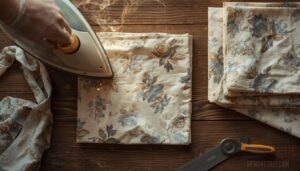
Before your rotary cutter ever touches the fabric, your pressing work has already begun. Wrinkled or creased fabric leads to crooked cuts — and crooked cuts throw off every block that follows.
A clean wool pressing mat makes a real difference here — residue buildup can leave your fabric less crisp and your cuts less accurate.
Here’s how to get your fabric smooth, flat, and ready before you cut a single piece.
Remove Deep Creases With Light Steam
Deep creases in new yardage can throw off every cut you make. Steam lightly to relax those stubborn folds — but technique matters. Always do Pre‑Steam Testing on a scrap first to check your temperature and steam settings for different quilting fabrics.
- Set your iron to a light steam setting
- Practice Steam Distance Control — hold the nozzle 1–2 inches away
- Use the Vertical Swipes Technique with steady upward strokes
- Pause briefly on tough creases, then keep moving for Nozzle Angle Adjustment
- Prioritize Cooling After Steam — let fabric rest flat before touching it
A pressing cloth helps avoid fabric distortion during ironing and pressing, especially on printed cottons.
Use a Large Surface or Pressing Mat
Your pressing mat is the unsung hero of accurate quilting. A large, stable surface with non-slip backing keeps yardage from shifting mid-press, while wool’s natural texture delivers even heat distribution on both sides of your fabric.
Mat material selection matters — wool beats foam every time for crisp results.
Add a simple maintenance routine: brush off fibers after each session, store flat, done.
Press Yardage Flat Without Dragging
Think of yardage like fresh pasta — handle it too aggressively and everything warps. A drag-free motion is your best friend here. Use section-by-section press technique: lift, lower, hold 2–3 seconds, then move.
- Work steam-free for yardage leveling — moisture distorts grain
- Set temperature control between 350–400°F for cotton
- Use a pressing cloth on printed fabrics
- Support full width on your pressing mat
Let Fabric Cool Before Cutting
Patience pays off here — once you’ve pressed, just WAIT. Letting your fabric cool flat for 2 to 5 minutes on your pressing mat is a key advantage for fabric preparation before cutting.
This post-press rest gives fibers time for true relaxation and heat dissipation, so your grain settles naturally. Skip it, and you’re inviting bias stretch prevention problems right at your ruler’s edge.
| Fabric Type | Cooling Time Benefits | Bias Stretch Prevention |
|---|---|---|
| Plain cotton | 2 minutes | Low risk after cooling |
| Cotton blends | 3–4 minutes | Moderate — cool flat fully |
| High polyester | 5+ minutes | High risk; never rush cutting |
| Thicker cotton | 3–4 minutes | Medium; fiber relaxation takes longer |
| Bias-cut pieces | 4–5 minutes | Critical — press before cutting again if needed |
Use Starch for Crisp Bias Pieces
Bias sewing is where most quilters lose their mind — those stretchy edges seem to have a life of their own. Spray some starch, and suddenly you’re in control again.
Bias edges have a mind of their own — until a shot of starch puts you back in charge
Here’s what works best:
- Spray starch application: Mist from 6–8 inches for crisp, precise lines without soaking fibers
- Liquid starch benefits: Ideal for wider bias edges needing a firm, washable hold
- Starch reapplication technique: Build crispness in thin coats, letting each layer dry fully
- Starch maintenance tips: Store pieces flat and refresh with a hydrating mist before final assembly
Press immediately after misting, and your bias pieces will behave beautifully.
Choose Tools That Prevent Distortion

Your iron matters, but so does everything else on your pressing table. The right tools make the difference between a flat, accurate block and one that fights you at every step.
Here’s what to have on hand before you press a single seam.
Best Iron Settings for Quilting Cotton
Most quilting cottons love a hot iron — we’re talking 400°F to 445°F with light steam. That sweet spot relaxes fibers without scorching them.
Start by testing your cotton temperature and steam settings on a scrap piece first. Use a clean soleplate, keep iron speed slow and deliberate, and control your pressure. A pressing cloth treats delicate prints beautifully.
Why a Pointed Tip Helps Seam Pressing
Your iron’s pointed tip is doing more than you think. That narrow end gives you targeted heat application right where seams turn corners, so you get seam corner accuracy without nudging nearby fibers.
It’s perfect for intersection bulk reduction and precise edge definition when you press seams open or press seams to one side — all with minimal fabric shift.
When to Use a Pressing Mat
A pointed tip manages the detail work — but large block stability? That’s where a pressing mat earns its place.
Whenever you’re pressing seams open or pressing seams to one side, a mat gives you simultaneous bottom heat, which means crisper results, faster.
It’s a portable workspace solution that also delivers bias edge control and heat retention efficiency, keeping your pieces exactly where you put them.
How a Pressing Cloth Protects Prints
Your mat keeps blocks stable — now let’s talk about protecting what’s ON them.
A pressing cloth is your prints’ best friend. Lay a piece of cotton muslin between your steam iron and the fabric, wrong side up, and you’ve instantly got heat diffusion working for you. It controls moisture, cuts gloss reduction problems, and keeps color safety intact — no bleeding, no shine, no regrets.
Using a Tailor’s Clapper for Flat Seams
Now here’s a tool most beginners overlook — the tailor’s clapper. This solid hardwood block does something your iron simply can’t: it sits on a freshly steamed seam and holds it flat while the fabric cools.
That’s the Seam Cooling Technique in action.
The Hardwood Clapper Benefits come from its weight and steam absorption timing — press seams to the side, set the clapper down, wait, and watch seam bulk reduction happen almost like magic.
Press Seams Without Stretching

Pressing seams the right way is honestly where a lot of quilters lose accuracy without even realizing it.
A few small habits make a big difference between a seam that lies flat and one that waves, stretches, or pulls your block out of square.
Here’s what to keep in mind as you work through each seam.
Set The Seam Before Opening It
Before you press seams open, always set the seam first — it’s a small step that makes a BIG difference. Just press the seam closed, right along the stitching line, for 3 to 5 seconds.
This Thread Nest Setting locks the thread in place, facilitates Grain Consistency Check, and prepares your Seam Alignment Technique. It’s your foundation for bias edge protection and Cooling Sequence Importance.
Press Without Sliding The Iron
Once your seam is set, resist the urge to glide — sliding the iron side-to-side is exactly how grain gets wrecked. Instead, use Lift and Place: lower the iron straight down with Vertical Weight Application, hold briefly for Seam Flatness Assurance, then lift and reposition.
This Grain Safe Pressing approach keeps Minimal Contact Pressure consistent, protecting every thread without distortion.
Press Beside Bulky Intersections First
Bulky intersections — star points, log-cabin corners, anywhere multiple seams pile up — need attention BEFORE you press outward. That’s Bulk Intersection Targeting in action.
Start with Marked Bulk Points, then work outward using Incremental Edge Pressing:
- Feel for raised layers first
- Apply Focused Steam Application directly on the thickest spot
- Lift, check flatness, repeat
- Finish with a Post-Press Grain Check
Seams behave beautifully after that.
Use Gentle Pressure on Bias Edges
Bias edges are sneaky — they stretch with almost no encouragement. That’s why Bias Edge Stabilization matters so much here.
Use Pin Support to hold pieces steady, then work with a gentle up-and-down motion instead of sliding.
Light Tapping along the edge, combined with Temperature Control on a medium setting and a pressing cloth, keeps Edge Alignment tight and prevents fabric distortion.
Cool Seams Flat Before Handling
Think of a freshly pressed seam like hot caramel — move it too soon and everything shifts. Let your seam rest undisturbed for at least 60 seconds.
That Cooling Rest Period is where real Seam Stabilization happens.
Use Backside Cooling with a Tailor’s Clapper for Heat Dissipation, then add Seam Weighting on top.
Your seam crispness depends on patience.
Open, Side, or Spun Seams
Not all seams should be pressed the same way — and knowing the difference is what separates a lumpy quilt top from a flat, polished one.
method you choose depends on your block design, how many seams meet at one point, and how you plan to quilt it. Here are the main options to help you decide.
When to Press Seams Open
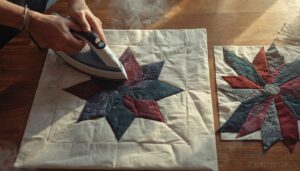
Open seams are your best friend for dense patchwork blocks — star patterns, log cabins, anything with multi intersection alignment. When three or more pieces converge, pressing seams open spreads the bulk evenly instead of stacking it.
This matters for bias edge stability too, since open allowances reduce stretching. Heavy fabric bulk? Open them every time.
For pattern point precision, open seams make those tiny corners land perfectly.
When to Press Seams to One Side
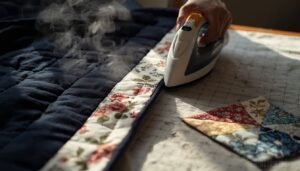
Not every seam needs to open flat. For simpler blocks — half-square triangles, straight strips, basic four-patches — pressing seams to one side is faster and genuinely stronger.
Your directional seam choice matters here: always press toward the darker fabric for color shadow alignment. This keeps seam bulk management easy, your fabric grain consideration intact, and block pattern compatibility right on track.
How Nesting Seams Improves Alignment

Here’s where locking seam directions become your secret weapon. Nest your seams by pressing one unit left, the adjacent unit right — those opposite pressing technique choices make the allowances butt together like puzzle pieces.
That tiny lock gives you a intersection accuracy boost and seam tension control without extra pins. The result? Consistent block geometry, clean corners, and seam alignment that practically holds itself.
How Spinning Seam Allowances Reduces Bulk

Spinning seams takes bulk minimization one step further. Instead of folding your seam allowance flat, you guide it to radiate outward from the intersection — that twist geometry naturally distributes fiber tension so layers don’t stack.
The result is real corner slimming, up to a third less bulk. Your seam stability improves, and those tight intersections suddenly lie flat without fighting you.
Choosing The Best Method for Block Type

Now that you know how spinning works, match your method to your block.
Dense designs like stars or log cabins? Press seams open for Seam Bulk Reduction and better Block Grain Alignment.
Simpler blocks handle one-side pressing well — it’s faster and adds strength.
Always consider Fabric Weight Matching and Pattern Density Consideration.
Block Shape Compatibility guides everything, keeping your corners crisp and your blocks perfectly square.
Fix Common Pressing Mistakes
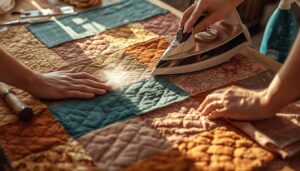
Even experienced quilters run into pressing problems — it happens to everyone. The good news is that most mistakes are fixable with a few simple corrections.
Here’s what to do when things go sideways.
Stop Scorch Marks and Shine
Scorch marks and shine are sneaky little disasters — usually caused by too much heat or a dirty iron plate. First, set the right temperature for your cotton before you begin.
Use a pressing cloth between the iron and your fabric, especially over dark prints. A dry iron works best here; avoid steam on delicate pieces. Build in cooling intervals, and keep your iron plate clean to prevent residue transfer.
Correct Wavy Seams and Warped Blocks
Wavy seams usually mean iron traveled sideways — classic ironing instead of pressing. Here’s how to fix it:
- Re-press the seam open using the seam opening method, gently easing fibers back into place with your fingertips.
- grain alignment techniques by pressing with the grain, not against it.
- block squaring methods to confirm corners are true before moving on.
Seam tension control and warp prevention strategies both start with that simple lift-and-lower motion.
Re-press Curled Seam Allowances
Curled seam allowances are sneaky little troublemakers. To reset them, use a Steam Curl Reset approach: place your iron directly on the curl without sliding, let gentle heat relax the fibers, then guide the allowance flat.
This Micro‑Press Technique performs Bias Edge Flattening beautifully.
Use Low‑Heat Silk settings on delicate fabrics. Always finish by Cooling Seam Flat before touching it.
Ease Misaligned Seams Before Pressing
Misaligned seams happen — don’t press them in permanently.
First, do Pin Alignment Checks every two inches and use Finger Seam Guiding to gently coax edges into place. Try an Edge Offset Adjustment so pieces nest naturally before heat touches them. Pre-Press Scraping with your fingernail flattens stubborn spots.
Maintaining fabric grain consistency and seam tension here keeps seam flatness locked in once you press.
Prevent Distortion in Future Quilt Blocks
Good habits now save you from fixing the same problems later. Think of every pressing session as a chance to build better muscle memory.
- Run Grain Alignment Checks before each press
- Practice Seam Tension Control when setting seams open or to one side
- Apply Bias Edge Reinforcement using light starch on tricky cuts
- Plan with Layered Block Planning to press smarter, not harder
- Always finish with Cooling After Press before moving fabric
Frequently Asked Questions (FAQs)
Can you press fabric for quilting?
Yes, you absolutely can — and should!
Proper pressing techniques for quilting are what separate flat, accurate blocks from wobbly ones. A little heat and the right motion make all the difference.
How do you press a quilt?
To press a quilt, lift and lower your iron using controlled Iron Pressure Control — never slide it.
This simple Fabric Stretch Prevention habit keeps your blocks square and your seams flat.
Can you use a pressing board on a quilt?
Absolutely — a pressing board is one of the best tools you can have. It distributes heat evenly, keeps blocks square, and holds long seams without fabric sag.
How do you distort a quilt?
Quilts distort from stretching during quilting, uneven pressure, over-tight stitching, improper block assembly, and avoiding fabric distortion during ironing and pressing mistakes.
Even a misaligned pattern or wrong pressing direction quietly warps your entire quilt top.
How to stop fabric puckering when quilting?
Puckering usually comes down to Tension Control and Grain Alignment. Use steam control wisely, press seams to one side, and practice Bias Stretch Management.
Fabric Stabilization through careful fabric handling keeps everything smooth and flat.
Can I use a tea towel as a pressing cloth?
In a pinch, yes — but choose wisely. A clean, white, pre-washed cotton tea towel works for low to medium heat, offering basic heat diffusion.
Watch for lint accumulation, color bleed, and poor steam penetration.
How to press fabric for quilting for beginners?
Press fabric for quilting by lifting and lowering your iron — never sliding it.
Use a pressing mat, light steam settings, and let pieces cool flat before cutting for accurate, distortion-free results.
Can I press seams on a cutting mat?
Short answer: not directly.
Direct heat on a cutting mat warps it over time. Use a pressing mat or wool pad on top as a heat shield layer to protect the surface while you work.
How do I press curved quilt pieces flat?
Curved pieces need patience. pointed tip precision along the arc, then let a microfiber glide smooth tight spots.
Press the inner edge first, cool flat, and do a quick arc width check before moving on.
Should I press before or after trimming blocks?
Ironically, most quilters do it backwards. Press first, then trim.
Pressing locks your block shape retention and seam weight management in place, so your cuts stay true and your grain alignment strategy holds.
Conclusion
Funny how the iron gets all the credit—or all the blame. Quilters invest in premium fabric, precise cuts, and perfectly matched points; then unknowingly drag a hot iron straight through all that hard work.
Mastering how to press quilting fabric without distorting it isn’t about working harder; it’s about working smarter with every lift, set, and cool-down. Treat your iron iron like a stamp, not a sled, and your blocks will finally tell the truth.