This site is supported by our readers. We may earn a commission, at no cost to you, if you purchase through links.
Somewhere between your third cup of coffee and the first real hour of weekend quiet, a quilting project transforms from a good idea into something you can actually finish. That window matters—and the machine sitting on your table either helps you use it well or fights you every step of the way.
The difference between a 850-stitch-per-minute Singer and a 1,500-stitch-per-minute Juki isn’t just speed; it’s how much you accomplish before Sunday slips away. Throat space, feed systems, and built-in stitch counts all shape what’s possible in those stolen hours.
The right quilting machine for weekend hobbyists doesn’t just sew—it fits your pace, your projects, and your workspace.
Table Of Contents
Key Takeaways
- Your machine’s throat space — ideally 7–9 inches — is the single most overlooked spec, and it directly decides whether a king-size quilt glides through or fights you the whole way.
- Speed isn’t one-size-fits-all: casual weekend quilters do well at 850 SPM (Singer, Brother), while serious project quilters benefit from the Juki’s 1,500 SPM for powering through thick, large-scale work.
- Small accessories like a walking foot, quilting bar, and open-toe free-motion foot punch way above their price tag by giving you better fabric control, straighter lines, and cleaner stitches.
- Matching your machine to your budget and skill level matters more than chasing features — entry-level picks ($260–$300) cover the basics well, while mid-range and premium machines earn their cost through metal frames, dual-feed systems, and faster throughput.
Top Quilting Picks for Weekends
Finding the right quilting machine for your weekends doesn’t have to feel overwhelming. Each pick below was chosen for how well it manages real quilting tasks, from free-motion work to layered piecing.
Understanding the key differences between sewing and quilting machines helps you pick the right tool before you invest.
Here’s what made the cut for 2026.
1. Singer Quantum Stylist 9960 Sewing Machine
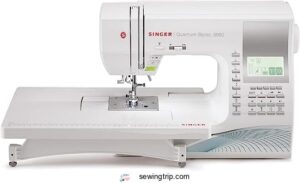
The Singer Quantum Stylist 9960 is a serious workhorse for weekend quilters. With 600 built-in stitches and a maximum speed of 850 stitches per minute, it manages everything from detailed appliqué to long straight seams.
The included extension table, walking foot, and quilting bar give you real quilting tools right out of the box — no hunting for extras.
At 14.6 lb, it stays put on your table without being impossible to move.
The automatic thread cutter and needle-up/down function save you real time between blocks.
| Best For | Weekend quilters and home sewers who want a feature-packed machine that can handle everything from delicate appliqué to heavy multi-layer projects without breaking a sweat. |
|---|---|
| Built-in Stitches | 600 |
| Automatic Threader | Yes |
| Weight | 14.6 lb |
| Construction Material | Metal frame |
| Extension Table | Included |
| LED Lighting | Yes |
| Additional Features |
|
- 600 built-in stitches plus automatic buttonholes and built-in fonts make it genuinely versatile — garments, quilts, home décor, you name it.
- The automatic needle threader and thread cutter are real time-savers, especially during long sewing sessions with lots of starts and stops.
- Comes loaded out of the box — 13 presser feet, a quilting bar, and an extension table means you’re ready to go without buying extras.
- The throat space is on the smaller side, which can get frustrating when you’re wrestling with a big quilt.
- At 14.6 lb with only a dust cover included, it’s not exactly travel-friendly — you’d want a proper bag if you’re taking it to classes.
- Beginners might feel overwhelmed by all the options, and little quirks like the tension screw being on the bottom add to the learning curve.
2. Brother Computerized Sewing Quilting Machine
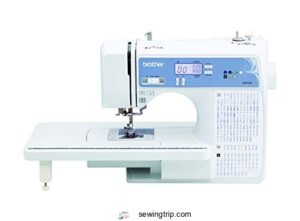
If the Singer feels like a lot of machinery, the Brother XR9550 keeps things lighter — literally. At 10.1 lb, it’s easy to set up on a folding table and pack away after a weekend session.
You still get 165 built-in stitches, an automatic needle threader, and a jam-resistant drop-in bobbin.
The included quilting foot and wide table handle quilt blocks without fuss.
The LCD screen makes stitch selection straightforward, even mid‑project when you just want to keep sewing.
| Best For | Beginners and hobbyist quilters who want a capable, lightweight machine without a steep learning curve. |
|---|---|
| Built-in Stitches | 165 |
| Automatic Threader | Yes |
| Weight | 10.1 lb |
| Construction Material | Metal/plastic |
| Extension Table | Wide table included |
| LED Lighting | Not specified |
| Additional Features |
|
- 165 built-in stitches plus an automatic needle threader and drop-in bobbin make setup and sewing genuinely easy
- At 10.1 lb, it’s portable enough to bring to a class or tuck away between projects
- The LCD screen and included quilting foot mean you can jump into most projects right out of the box
- Plastic construction raises questions about long-term durability, and repairs aren’t really an option — you’d replace it
- Warranty is US-only, so international use is a no-go
- A few users have noted the hard cover doesn’t fit great and stitch tension can pull left occasionally
3. Juki TL2000Qi Sewing Quilting Machine
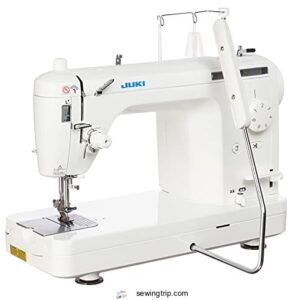
When you’re ready to step up to something serious, the Juki TL-2010Q changes the game.
It runs at 1,500 stitches per minute — nearly double what most hobbyist machines offer — and its aluminum die-cast frame keeps vibration low even at full speed.
You get a wide extension table, walking foot, and automatic thread cutter included.
It weighs 25.4 lb, so it’s not a grab-and-go machine, but it holds steady on a table and manages thick quilt sandwiches with ease.
| Best For | Quilters and sewists who work on large, heavy projects — think king-size quilts, canvas bags, or thick garments — and need a machine that can keep up without slowing down. |
|---|---|
| Built-in Stitches | 1 (straight) |
| Automatic Threader | Yes |
| Weight | 25.4 lb |
| Construction Material | Aluminum |
| Extension Table | Included |
| LED Lighting | Yes |
| Additional Features |
|
- Screaming fast at 1,500 SPM, so you can power through big projects in a fraction of the time
- Aluminum die-cast frame keeps things rock-solid even at full speed — no walking across the table
- Comes ready to work with an extension table, walking foot, and automatic thread cutter included
- Straight stitch only — no decorative stitches, no buttonholes, nothing fancy
- No built-in speed control, so beginners may find full throttle a bit intense to manage
- Needs a voltage converter for 220V regions, which is an extra cost and one more thing to carry
4. Brother SE600 Embroidery Sewing Machine
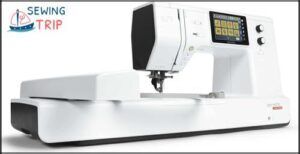
Not every weekend project needs raw speed.
The Brother SE600 is a lighter pick — 47 lb with the embroidery table — and it brings a 4×4-inch embroidery field, 103 built-in stitches, and a color touchscreen to the table.
You get 80 ready-to-use designs, USB import, and an automatic thread cutter. It tops out at 710 stitches per minute, which suits careful decorative work.
Just know that the interface takes some learning, and the manual is download-only at around 170 pages.
| Best For | Hobbyists who want to do decorative embroidery, cosplay costumes, or light home-decor projects without stepping up to a full commercial machine. |
|---|---|
| Built-in Stitches | N/A |
| Automatic Threader | N/A |
| Weight | 54 lb |
| Construction Material | Stainless steel |
| Extension Table | N/A |
| LED Lighting | N/A |
| Additional Features |
|
- Hands-free operation with the programmable foot control and back-kick function makes longer sessions way less tiring.
- The dual-feed mechanism and pause-and-cut function keep your embroidery clean and consistent without a lot of babysitting.
- Solid cast-aluminum frame with LED lighting and presser-foot hover gives it a sturdy, well-lit workspace that holds up over time.
- Boots up in over 40 seconds and the menu-heavy interface has a steep learning curve — especially with no printed manual in the box.
- Not built for heavy fabrics, thick layers, or bag-making, so it’ll hit a wall fast if your projects go beyond light-to-medium work.
- Replacement parts and specialty accessories are hard to find, and it needs regular oiling and adjustments to stay running smoothly.
5. Metal Open Toe Free Motion Presser Foot
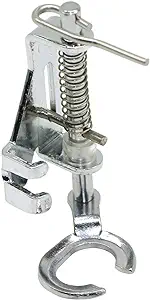
One small accessory can change how free-motion quilting feels entirely.
The right foot attachment, for instance, can mean the difference between fighting your fabric and gliding through it—something covered well in this guide to top-rated sewing machines for quilting and embroidery.
This metal open-toe presser foot has a 12 mm hoop opening that gives you clear sightlines to the needle — no guessing, no drifting off your marked lines. The polished metal frame glides smoothly over thick batting, and the spring-loaded pin helps reduce skipped stitches.
It snaps onto most low-shank machines, including Brother, Singer, and Janome.
Just lower your feed dogs, and you’re ready to move freely in any direction.
| Best For | Quilters and embroiderers working with thick fabrics or leather who want better needle visibility and smoother free-motion control on low-shank machines. |
|---|---|
| Built-in Stitches | Multiple embroidery |
| Automatic Threader | Semi-automatic |
| Weight | 47 lb |
| Construction Material | Cast aluminum |
| Extension Table | N/A |
| LED Lighting | Yes |
| Additional Features |
|
- Open-toe design gives you a clear view of exactly where the needle lands — great for detailed work
- Spring-loaded pin helps keep stitches consistent when you’re moving fabric up and down
- Snaps onto most popular home machines (Brother, Singer, Janome) with no fuss
- The spring pin can loosen or break over time, and when it does, you’ll start getting skipped stitches or needle breaks
- Feels a bit flimsy compared to higher-end feet — some wobble during use
- Only works with low-shank machines; high-shank setups need an adapter or are just out of luck
6. Janome 3160QDC Quilting Sewing Machine
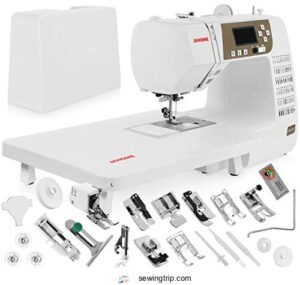
The Janome 3160QDC-G punches well above its $749 price tag for weekend quilters. It weighs just 12.5 lb, so taking it to a retreat won’t wreck your back.
You get 60 built-in stitches, a 6.9-inch throat space, and the Premium Plus Feed System — which manages everything from delicate silk to thick quilt sandwiches without shifting. The included extension table and automatic thread cutter keep your workflow clean and your focus on the fabric, not the machine.
| Best For | Weekend quilters and sewists who want a reliable, portable machine that handles everything from delicate fabrics to thick quilt layers without a lot of fuss. |
|---|---|
| Built-in Stitches | N/A (presser foot) |
| Automatic Threader | N/A |
| Weight | N/A |
| Construction Material | Metal alloy |
| Extension Table | N/A |
| LED Lighting | N/A |
| Additional Features |
|
- The SFS feed system is a genuine game-changer — silks, knits, and chunky quilt sandwiches all feed through smoothly with no shifting or puckering.
- One-hand needle threading and an automatic thread cutter make setup and finishing fast, so you spend more time sewing and less time fiddling.
- At 12.5 lb with a hard travel cover included, it’s easy to toss in the car for a class or retreat without any back regrets.
- The post-bin arm runs bulkier than older models, which makes precise hemming on small garments — think kids’ pants or cuffs — a bit awkward.
- Heavy stacks like six layers of denim can cause the machine to creep around on your table; a rubber grip mat basically becomes a necessity.
- No embroidery module and only 60 built-in stitches, so if decorative or embroidery work is your thing, you’ll hit a ceiling pretty quickly.
Workspace and Throat Space
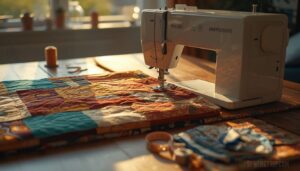
Your machine’s workspace can make or break a quilting session, especially when you’re wrestling a thick quilt sandwich through a tight opening. Throat space — the gap between the needle and the right side of the machine — is one of the most overlooked specs until you actually need it.
what to look for before you buy.
Why Throat Space Matters for Quilt Layers
Throat space is the gap between the needle and the machine’s body — and it makes or breaks your quilting experience. Without adequate throat space, you’re fighting bulk management on every pass.
Large throat space improves fabric flow, keeps needle visibility clear through thick quilt layers, and even facilitates heat dissipation by reducing friction. Aim for at least 7–8 inches for comfortable layer clearance.
mid‑arm machines throat space generally offers 8‑10 inches, which can reduce the number of fabric repositionings needed.
Extension Tables for Larger Quilt Projects
Think of an extension table as the breathing room your quilt has been begging for. It adds 12–18 inches of extra width, with a Tempered Acrylic surface that lets fabric glide instead of dragging. Most mount with Quick-release Clamps and feature Edge Lip Guides to keep layers aligned.
5 reasons extension tables transform large quilting projects:
- Telescoping Legs match your chair height for comfortable, posture-friendly sessions
- Under-table Pockets keep presser feet and tools within reach
- Smooth acrylic reduces fabric drag during free-motion quilting
- Distributes quilt weight evenly — fewer bulk shifts, straighter seams
- Pairs with large throat space to handle queen-size projects comfortably
Free Arm Vs. Wide Sewing Surface
free arm shines at edge handling and fabric curvature — think sleeve hems, quilt borders, and tight curves that a flat bed can’t easily reach. wide table wins when you’re spreading large panels and need stability across every layer.
arm length and bed conversion options let you do both.
setup efficiency means switching takes seconds, not a full reorganization.
Choosing a Machine for Lap-size Quilts
A lap quilt demands just enough machine — not too much, not too little.
Look for a throat space of at least 6 inches, a compact machine footprint, and quiet operation, so weekend sessions stay relaxed.
Lightweight quilting machine with an LCD interface, automatic thread cutter, and budget‑friendly price point covers everything a beginner sewing machine needs for lap quilts, without overcomplicating your setup.
Portability for Weekend Sewing Setups
Once you’ve got your lap quilt setup dialed in, moving it shouldn’t feel like a chore.
Rolling Carts with 2-inch casters roll easily between rooms, while Foldable Tables at 18–24 inches wide fit tight weekend spaces. Toss your lightweight quilting machine in a bag with Shoulder Straps, add Battery Powered Lights, and your portable quilting solutions for retreats practically pack themselves.
Stitch Speed, Tension, and Controls
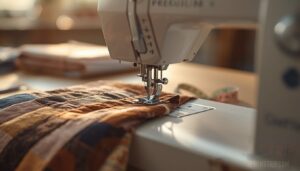
Speed and control might not be the flashiest part of picking a quilting machine, but they’re often what separates a frustrating session from a smooth one. Getting these details right means fewer mistakes, better tension, and more time actually enjoying your project.
Speed and control separate a frustrating quilting session from a smooth one
Here’s what to look at before you decide.
Matching Stitches Per Minute to Your Pace
Calibrating your pace to the machine makes all the difference. Hobbyist models like the Singer and Brother run at 850 stitches per minute — steady for piecing and curves.
Juki pushes to 1,500 spm, great for long straight seams.
Match pedal pressure to fabric thickness sync needs: lighter touch on cotton, steadier on dense layers.
Real-time feedback and preset rhythm settings help you stay consistent without guesswork.
Manual Speed Control Vs. Electronic Regulation
Speed consistency builds on more than pedal pressure. Manual speed controls reward muscle memory — your hands learn the rhythm, and maintenance simplicity means fewer things break.
Computerized machines with sensor precision and LCD screens use load adaptive response to auto-correct mid-seam. Tactile feedback suits creative free-motion work, while adjustable speed control with electronic regulation keeps thick layers steady without guesswork.
Built-in Stitch Counts for Quilting Versatility
Beyond speed, the built-in stitch library quietly does a lot of heavy lifting. Most machines run a density range from 8 to 14 stitches per inch — lighter counts for flowing cotton, higher for micro quilting.
Programmable count presets let you save your favorites using digital stitch memory through an LCD touchscreen interface, so layer-specific stitching stays consistent across every weekend session without re-dialing settings.
Tension Consistency for Piecing and Quilting
Tension is the unsung backbone of clean quilt piecing. When Thread Tension Balance is off, you’ll spot loops or puckers before you’ve finished your second row.
Here’s how consistent tension management keeps your work looking sharp:
- Run a Tension Test Swatch on scrap fabric before every session
- Match Needle Size to thread weight for steady Bobbin Tension
- Use a walking foot for smooth Fabric Layer Feeding through thick sandwiches
- Adjust fabric tension when switching thread weights — cotton and polyester behave differently
Thread tension control isn’t set-it-and-forget-it, but small checks go a long way.
Needle-up and Needle-down Convenience
A simple needle up/down button can transform how you handle corners and seams. Needle down keeps fabric locked in place during pivots, giving you Pivot Accuracy without guessing.
Needle up lifts cleanly for Quick Needle Release and smooth Fabric Positioning at every start. Some machines even store Needle Position Memory between sessions.
| Feature | Needle Up | Needle Down |
|---|---|---|
| Fabric Positioning | Clean start, thread aligns easily | Stable hold mid-project |
| Hand-Free Pivoting | Pairs with knee lifter | Locks corner precisely |
| Quilting Benefit | Easier thread trimming | Tighter, accurate corners |
| Control Type | Button or pedal pause | Dedicated needle up/down button |
| Best For | Point-to-point piecing | Free-motion and pivoting |
Free-Motion and Feed Options
How your machine manages fabric movement changes everything about the quilting experience. Whether you’re stitching in tight curves or running long straight lines, the right feed options give you real control over the outcome.
Here’s a look at the key features that make the biggest difference.
Drop-feed Capability for Free-motion Quilting
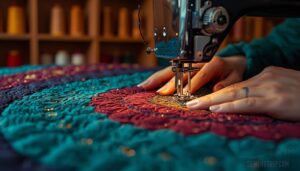
Free motion quilting opens up a whole new creative territory — and the Drop Feed Mechanism is what makes it possible.
When you lower the drop feed dogs and set Zero Stitch Length, you take full control of Fabric Slip Prevention by guiding the quilt yourself. Pair this with a free motion quilting foot, and Free Motion Control becomes effortless.
Keep up with Drop Feed Maintenance for consistently smooth free motion quilting techniques.
Walking Feet for Even Quilt Layers
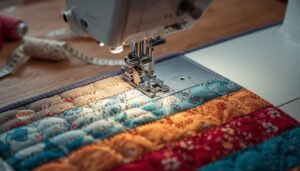
A walking foot is your quilt sandwich’s best friend. It adds a second set of feed dogs on top, moving all fabric layers together at the same pace. That means no shifting, no puckering, and solid Layer Alignment from edge to edge.
Foot Compatibility matters — walking feet are brand-specific, so match yours carefully.
Look for Pressure Adjustment options for better Fabric Weight Handling across different batting thicknesses.
Quilting Bars for Straight-line Stitching
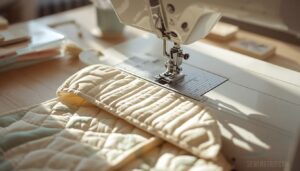
A quilting bar turns your sewing machine into a precision grid-maker. These simple attachments mount to your presser foot ankle using standard Bar Attachment Methods — no tools needed on most models.
Bar Length Options generally run 6 to 12 inches, and Bar Spacing Techniques let you dial in lines from ¼ to 1 inch apart.
Pair one with a large extension table and generous throat space for best results.
Clean the bar connection after each project — that’s your key Bar Maintenance tip.
Bar Material Choice matters too; rigid rods resist bending on long straight-stitch runs.
Presser Foot Choices for Different Techniques
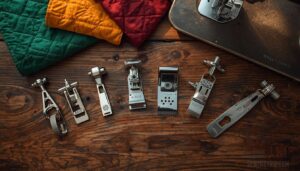
Your presser foot collection is really the toolkit inside your toolkit.
A walking foot manages thick quilt sandwiches evenly, while a free motion quilting foot — especially spring-action versions — lets you stitch in any direction.
Need tight detail work? A quarter-inch foot keeps seams consistent.
Specialty feet like the Nonstick Foot, Rolled Hem Foot, Pintuck Foot, Couching Foot, and Zipper Foot expand what your machine can do.
How Feed Dogs Affect Stitch Control
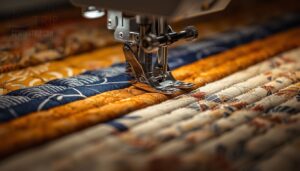
Feed dogs do for fabric what traction does for tires — they grip and guide every layer forward with each stitch.
Here’s what controls that precision:
- Dog Height Adjustment sets how far fabric advances per cycle
- Tooth Spacing Impact determines stitch length consistency across layers
- Feed Dog Timing prevents irregular spacing and puckering
- Layer Alignment Precision improves when dual feed systems synchronize thick stacks
When feed dogs that drop fully disengage, you reclaim total directional freedom for free-motion work — just remember to recheck fabric tension adjustment before re-engaging stitch regulation.
Budget and Skill Levels
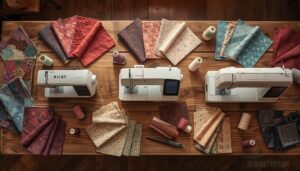
Your budget shapes your options more than almost anything else when picking a quilting machine. Whether just starting out or ready to upgrade, there’s a machine built for where you’re right now.
Here’s a look at what each price range actually gets you.
Best Entry-level Quilting Machines
Starting out doesn’t mean settling.
The Brother CS6000i and Singer 7469Q are solid beginner quilting machines priced between $260–$300, giving you 60–100 built-in stitches and a Simple UI that won’t overwhelm you. Both include an automatic threader for Threading Simplicity, a generous Accessory Ecosystem, and Noise Reduction that keeps weekend sessions peaceful.
They’re genuinely affordable entry-level quilting machines built for learning.
Mid-range Machines for Growing Hobbyists
Once you’ve outgrown your starter machine, mid-range models like the Juki TL-2000Qi and Brother PQ1500SL open up real possibilities.
They run at 1,000–1,500 stitches per minute, offer 8–9 inch throats, Thread Cutter Automation, Memory Stitch Programs, and a Digital Display Interface — all wrapped in a Noise Reduction Design.
budget-friendly quilting machines are built for hobbyists ready to take on bigger projects.
Premium Features Worth Paying For
Stepping up to a premium machine means you’re buying fewer frustrations, not just more features.
A metal frame construction cuts vibration for cleaner stitches at full speed. The dual-feed system keeps thick quilt layers moving evenly.
An automatic thread cutter saves real time across long sessions.
Add a touchscreen interface, LED needle light, built-in stitches, LCD screen, and wireless foot pedal — it all adds up.
Beginner-friendly Controls and Setup
If you’re just getting started, the right machine practically teaches you as you go. Look for these beginner essentials:
- Quick Start Buttons and a clearly labeled Presser Foot Lever
- Color-coded Threading Guides with an automatic needle threader
- An LCD screen with built-in LCD Tutorials for setup
- Memory Stitch Settings and simple speed control
Automatic thread cutting takes care of the fiddly bits so you can focus on quilting.
Picking Features Based on Project Size
Your project size quietly decides which features actually matter. Small throws under 20 inches need basic throat space and simple controls. Larger quilts demand extension tables and wider workspace.
| Project Size | Key Feature Needs |
|---|---|
| Under 20" | Standard throat space, basic speed |
| Twin size | 6"+ throat, drop feed |
| Full/Queen | Extension tables, walking foot |
| Large quilts | 8–9" throat, 1000+ spm |
| Multi-layer | Layer capacity planning, knee lifter |
Comfort, Durability, and Support
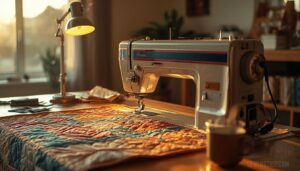
A great quilting machine isn’t just about stitches — it’s also about how it feels to use one for hours at a stretch. The right combination of weight, lighting, and build quality can make a real difference in your weekend sessions.
Here’s what to look for regarding comfort, durability, and support.
Weight and Stability During Quilting
A machine that wobbles is a machine that fights you. Machine Base Weight directly affects how steady your stitches land — heavier metal frame construction keeps vibration low, while Vibration Dampening Pads and Non-slip Table Mats reduce fabric shift by up to 25 percent.
Five stability features worth prioritizing:
- Heavy-duty machine frame — reduces chassis flex during dense quilting
- Center of Gravity — lower builds feel more planted on the table
- Metal frame construction — outlasts plastic on long weekend sessions
- Balanced Foot Pedal — smoother acceleration, fewer jerky starts
- Knee lifter — hands-free control without disturbing your grip on the quilt
LED Lighting for Better Visibility
Good lighting isn’t a luxury — it’s what keeps your seams honest. Modern LED lights with High CRI above 80 render fabric colors and thread shades accurately, so you’re not guessing under yellowish bulbs. Glare-Free Diffusers soften hotspots on shiny fabric, while Dimmable Brightness lets you dial in comfort for long sessions.
| Feature | Benefit | Best For |
|---|---|---|
| High CRI LEDs | True-to-life color rendering | Thread matching |
| Glare-Free Diffusers | Reduces eye fatigue | Shiny or metallic fabrics |
| Dimmable Brightness | Adjustable comfort | Long weekend sessions |
| Adjustable Arm Placement | Targets needle zone precisely | Free-motion quilting |
Energy-Saving LEDs run cool and last 25,000+ hours — no bulb swaps mid-project.
Knee Lifters and Hands-free Control
A knee lifter keeps both hands guiding your quilt while your knee does the lifting — no fumbling, no stopping.
Knee Lift Installation attaches to the front lower right, with Ergonomic Foot Positioning reducing shoulder fatigue fast.
Adjustable Lever Tension suits different knee heights, and Retrofit Compatibility means older machines aren’t left out.
Keep your Maintenance Routine simple: oil the linkage, check screws, and you’re set.
Build Quality and Long-term Durability
A sturdy build is the backbone of any machine you’ll rely on weekend after weekend. Die-cast frames and hardened steel gears resist wear far longer than stamped alternatives.
Ball bearing needle bars reduce wobble, while sealed gear housings and self-lubricating bushings cut down on maintenance.
Heavy-duty metal frame also dampens vibration noticeably, keeping your stitches consistent through long quilting sessions.
Warranty, Accessories, and Customer Support
Beyond build quality, a solid warranty gives you real peace of mind. Register your machine promptly — Warranty Registration activates your coverage and simplifies any future claims. Look for:
- Extended Coverage options that stretch protection beyond the standard one-to-three years
- Multiple Customer Service Channels — phone, chat, and email
- Clear Repair Turnaround timelines with prepaid return shipping
- Confirmed Accessory Compatibility for extension tables and presser feet
Brand reputation in quilting matters just as much as specs.
Frequently Asked Questions (FAQs)
What kind of sewing machines does Hobby Lobby sell?
Hobby Lobby carries budget-friendly sewing machines from Brother and Singer, both in-store stock and through their online catalog.
You’ll find computerized models with built-in stitches, automatic needle threaders, and accessory bundles included.
How often should quilting machines be professionally serviced?
Most manufacturers recommend professional checkups every 12 to 18 months. For heavier use, service intervals shorten to every 6 to 9 months. Watch for skipped stitches or unusual sounds — those are clear wear indicators.
Which thread types work best for quilt layers?
Funny how the right thread can make or break your whole quilt sandwich. Cotton thread in 50-weight keeps layers feeding smoothly with minimal lint and balanced tension throughout.
Can quilting machines handle specialty or batik fabrics?
Yes, most quilting machines handle batik and specialty fabrics well.
Prewash first for bleed prevention, use size 11–14 needles, adjust tension carefully, and apply a light stabilizer on stretchy areas for clean, even stitches.
How do I store a quilting machine between weekend sessions?
Ironically, your machine needs more care sitting idle than it does running.
Store it in its case with silica gel, raise the presser foot, oil metal parts, and keep it in a climate-controlled spot.
Conclusion
The right machine can make your weekend feel twice as long—suddenly, a Saturday afternoon stretches into a finished quilt top instead of a half-pinned pile. Choosing among quilting machines for weekend hobbyists comes down to knowing your workspace, your pace, and where you want to grow.
Match those three things honestly, and every machine on this list has something real to offer. Your next finished quilt is closer than you think.