This site is supported by our readers. We may earn a commission, at no cost to you, if you purchase through links.
Quilters still argue about which block to learn first. Some swear by the four-patch. Others won’t touch anything but log cabin.
What they agree on: the block you start with shapes how you think about quilting for years. That first seam, that first pressed corner—it either builds confidence or quietly convinces you that this isn’t for you.
Beginner traditional quilt blocks have survived centuries because they teach real skills without overwhelming you. Five classic blocks, a sharp rotary cutter, and a quarter-inch seam are all you need to start building something that lasts.
Table Of Contents
Key Takeaways
- Your first block shapes how you think about quilting for years, so choose one that builds confidence fast — like the four-patch or nine-patch.
- Quarter-inch seam allowance isn’t a suggestion; it’s what keeps every piece lining up cleanly across your whole quilt.
- Fabric value — how light or dark a color reads — matters more than color choice when it comes to making your blocks pop.
- Once your blocks are sewn, the layout you choose (straight set, on-point, barn raising) transforms the same pieces into completely different quilts.
Choose Beginner Traditional Quilt Blocks
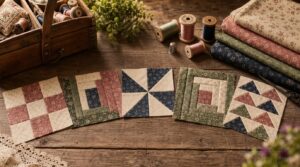
The good news is you don’t need to start with anything complicated. A handful of classic blocks have been teaching beginners for generations — and they still work beautifully today. Here are five traditional blocks worth learning first.
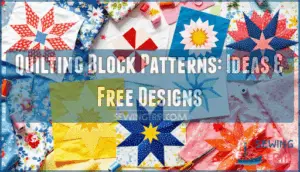
If you’re looking for inspiration, this collection of beginner quilting block patterns and ideas walks you through the classics with clear visuals and practical tips.
Four-Patch Block
The four-patch block is the perfect starting point. You sew just four equal squares into a 2×2 grid. That’s it.
Use light and dark fabrics to create contrast — it makes the center seam pop. Chain piecing speeds things up.
Press seams to one side to reduce bulk and keep everything flat. For precise joining, follow the center alignment technique.
Nine-Patch Block
The nine-patch block is a natural next step. You arrange nine equal squares in a 3×3 grid — simple, but endlessly adaptable. Cut 3½-inch squares for a finished 9-inch block.
Alternate light and dark fabrics for that classic checkerboard layout. Press seams toward the darker fabric. Rotate your color placement, and the same block can look completely different.
Log Cabin Block
The log cabin block is where quilting starts to feel like storytelling. Everything builds from one small center square — usually 2.5 to 3.5 inches.
The log cabin block is quilting as storytelling — every strip a sentence, built outward from one small square
From there, you add strips (called logs) in a clockwise sequence. Alternate light and dark fabrics as you go. That contrast is the whole point.
Fabric value placement matters more than color choice here.
Pinwheel Block
Where the log cabin tells a story in strips, the pinwheel block creates movement — pure and simple.
It’s built from four half-square triangles arranged so they spin from a center point. Two contrasting fabrics do all the work. The sharper your color contrast, the stronger the motion illusion feels.
Here’s what shapes a great pinwheel:
- Blade orientation controls which way the block appears to spin.
- Color reversal across blocks creates alternating visual rhythm.
- Rotating motifs can form larger secondary patterns when blocks are grouped.
- Border accents use partial pinwheels to frame an entire quilt top.
- Consistent value difference between blade and background keeps points crisp.
Pinwheels are genuinely beginner-friendly — honest results with simple cuts.
Rail Fence Block
Unlike the pinwheel’s spinning drama, the Rail Fence Block keeps things refreshingly straightforward — and that’s exactly why it works so well for beginners.
Its simple design means you’ll spend less time second-guessing yourself and more time actually sewing — just line up your fabric right sides together and stitch.
You sew parallel fabric strips together, then cut them into squares. Rotate every other square 90°, and suddenly a zigzag pattern emerges. Simple geometry. Real visual payoff.
| Feature | Option | Beginner Tip |
|---|---|---|
| Block Sizing | 6 in or 9 in | Start with 9 in for easier handling |
| Color Contrast | Light and dark pairing | High contrast sharpens the zigzag |
| Rail Layout | Straight or Diagonal Orientation | Straight rails build confidence first |
Strip cutting keeps your rails uniform. Asymmetric layouts add a modern twist without extra complexity.
Prepare Fabric, Tools, and Sizes
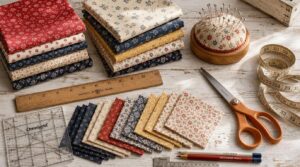
Before you sew a single stitch, getting your fabric and tools ready makes everything easier. A few smart choices upfront — like block size, seam allowance, and pre-cut fabrics — set you up for clean, confident results. Here’s what to sort out before you begin.
Best Beginner Block Sizes
Block size shapes your whole experience. For beginners, 10- to 12-inch blocks hit the sweet spot — big enough to handle comfortably, detailed enough to look impressive.
A Four-Patch Block or Nine-Patch Block at 12 inches gives you room to work without wrestling tiny pieces.
Going smaller increases seams; going larger reduces your block count for a full quilt.
-inch Seam Allowance
One small number makes a big difference: ¼ inch seam allowance is the standard in traditional quilt blocks, and sticking to it keeps every piece lining up cleanly.
- Use a ¼ inch piecing foot on your machine for built-in consistency
- Check thread tension — too tight causes puckering and widens seams
- Use a seam gauge to verify finished seams match the intended width
Pre-cuts for Easy Quilting
Pre-cuts take the measuring out of your hands before you even sit down.
Jelly roll strips (2½ inches wide, 42 inches long) are perfect for Rail Fence and strip-piecing projects. Charm packs give you coordinated 5-inch squares ready to sew. Layer Cakes offer 10-inch squares — ideal for bigger beginner-friendly quilt blocks. Fat quarters handle surrounding blocks beautifully.
Starching for Sharp Points
Starch is a quiet secret most beginners overlook. A light spray before pressing makes your fabric stiffer, so those pointy triangle tips actually hold their shape.
Spray from the center outward, let it dry fully, then press with a moderately hot steam iron. Cotton quilting weight responds best.
Test on a scrap first — every fabric behaves a little differently.
Cutting Accuracy Tips
A dull blade is the enemy of clean cuts. Swap your rotary cutter blade every four to six quilts — you’ll feel the difference immediately.
- Ruler alignment: line up selvage edges with ruler marks before every cut
- Fabric squaring: trim edges straight before main cuts begin
- Marking techniques: use a fine mechanical pencil for visible, erasable lines
- Cutting practice: test blade pressure on scraps first
Sew Your First Quilt Blocks
Now it’s time to put your hands to work. Each block below comes with a simple method you can follow from your first cut to your final seam. Start with whichever one calls to you.
Four-Patch Step-by-step
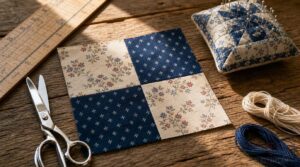
Just four squares. That’s all a Four-Patch Block needs.
Start by cutting squares to size — say, 2½ inches each, which yields a 4-inch finished block after seams.
Sew two opposite-fabric squares into pairs. Then join the two pairs together, nest your seams, and press toward the darker fabric.
Trim edges square, and you’re done.
Nine-Patch Step-by-step
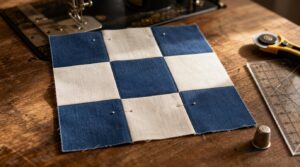
Step up from four squares to nine, and you’ll feel the difference right away.
Cut nine equal squares — try 3½ inches each for a finished 9-inch block. Arrange them in a 3×3 grid, alternating light and dark fabrics for contrast.
- Sew the top row first, aligning corner seams precisely
- Join the middle row, matching vertical seams cleanly
- Attach the bottom row, keeping all grid lines square
- Press seams flat after each row to reduce bulk
- Trim the finished block to confirm your target size
Match seams carefully where rows meet. That intersection is where beginners struggle most.
Log Cabin Strip Piecing
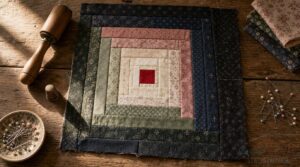
The Log Cabin block builds outward from one small square — the center hearth. Traditionally cut in red or warm fabric, it anchors the whole design.
From there, you add strips around it in a light-to-dark color progression, pressing each seam toward the darker fabric. Once finished, trim the block square for clean edges.
Rail Fence Assembly
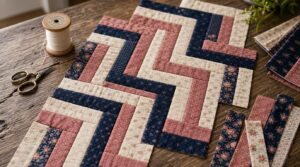
The Rail Fence block is refreshingly simple.
Start with strip preparation: cut three to five fabric strips to equal length and width. Sew them together along their long edges, then press seams toward the darker rail. Cut the sewn unit into squares. Rotate every other square 90°.
That rotation creates the zigzag seams that give this block its signature stepped look.
Pinwheel HST Method
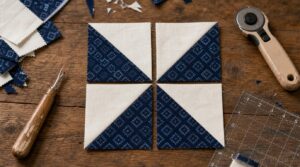
The Pinwheel block spins to life through four half-square triangles — each one a simple diagonal seam between two fabrics.
Pair a light and dark fabric, place them right sides together, and sew along the diagonal. Cut, press seams toward the darker side, then trim each HST to exact size. Rotate all four units 90° and you’ve got your pinwheel.
Arrange Blocks Into Quilt Layouts
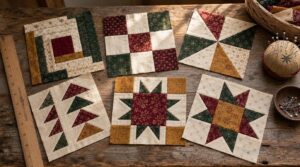
Once your blocks are sewn, the real fun begins — deciding how to arrange them. The layout you choose shapes the entire look and feel of your quilt. Here are five classic arrangements worth knowing.
Straight Set Layout
The straight set layout is the most beginner-friendly arrangement you can choose.
Blocks line up in clean horizontal and vertical rows — no rotation, no guesswork. Each block touches its neighbor along full edges, creating uninterrupted lines across the quilt.
Press your seams carefully and keep a consistent ¼-inch seam allowance so every grid intersection stays crisp and flat.
On-point Block Layout
Rotate your blocks 45 degrees and everything changes. This is the on-point layout — blocks become diamonds, and the whole quilt takes on a livelier feel.
To fill the gaps along the edges, you’ll need setting triangles. These stabilize the diamond grid and keep your borders straight. Sew them in small batches, pressing seams toward the sashing for clean corner alignment.
Alternating Plain Squares
Simple alternation is powerful. The Checkerboard Layout places your patterned blocks between plain squares, letting each design breathe. This Color Rhythm draws the eye across the quilt naturally.
Focus on Value Balance — light against dark keeps the grid crisp. Square Alignment matters most here. Even slight skewing breaks the pattern.
Press every seam flat before joining the next row.
Barn Raising Log Cabin
The Barn Raising layout turns simple Log Cabin blocks into something dramatic. Arrange your blocks so light and dark logs radiate outward from the center, creating a barn silhouette design across the whole quilt.
Keep your roofline alignment symmetrical.
A red or rust border integration finishes the shape cleanly, anchoring the central square layout like a frame around a painting.
Secondary Pattern Ideas
Every block you’ve sewn so far holds hidden potential. Arrange them thoughtfully, and secondary patterns emerge like magic between the seams.
Try a checkerboard tile layout by alternating light and dark blocks. Add echo line patterns along borders for depth. Even simple curved meander lines between blocks can soften the grid beautifully.
Improve Color, Accuracy, and Finish
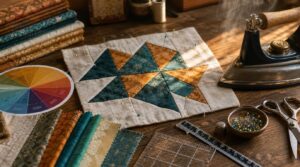
Getting your blocks sewn is a win — but the finishing touches are what separate a good quilt from a great one. A few smart habits around color choices, seam pressing, and accuracy will make everything click into place. Here’s what to focus on as you bring your quilt together.
Choosing Light and Dark Fabrics
Fabric value — how light or dark a color reads — shapes your entire quilt’s look. Start by choosing one strong light and one strong dark as your anchors.
Then add two or three midtones to bridge them. Test swatches under natural light before cutting.
Avoid mixing matte darks with shiny lights; the sheen difference creates uneven contrast that distracts the eye.
Pressing Seams Correctly
Good fabric choices mean nothing if your seams aren’t pressed well. Pressing seams correctly shapes every block’s accuracy from the start.
Press each seam before joining the next piece. Lift the iron — don’t slide it. Press to one side for sturdy joins, or press seam open to reduce bulk at thick intersections. Always use a pressing cloth on delicate fabrics.
Chain Piecing Blocks
Once your seams are pressed, you’re ready to speed things up. Chain piecing lets you feed pieces through your machine in one continuous run — no stopping, no cutting between each seam. It saves time and reduces thread waste.
Feed each pair of pieces back-to-back. Keep sewing. Then clip the chain apart and press.
Fixing Mismatched Points
Mismatched points happen to everyone. Don’t let them discourage you.
Mark seam intersections with washable fabric chalk before sewing — it guides your needle exactly where it needs to land. After each seam, press and verify alignment right away.
Trim any slight excess with a rotary cutter on a rotating mat. Small corrections early prevent bigger problems later.
Planning The Final Quilt
Before you sew a single block, take time to plan the full picture.
- Decide your quilt size and use — lap, twin, or baby.
- Sketch a block layout plan on grid paper to visualize spacing.
- Build a three-value color palette — light, medium, and dark — for depth.
Then calculate your fabric yardage accordingly. A clear plan saves real time.
Frequently Asked Questions (FAQs)
How do I choose batting for my quilt?
It all comes down to batting fiber and loft. Cotton drapes softly. Polyester resists shrinking. Wool adds warmth. Bamboo suits lightweight, eco-friendly quilts. Match your batting to the season and how the quilt will be used.
What thread type works best for quilting?
For most quilters, 50-weight cotton thread is the go-to choice. It performs well, blends naturally with cotton fabric, and keeps your seams clean and consistent across every block you sew.
How do I bind and finish quilt edges?
Fold a 5-inch binding strip in half, align raw edges to the quilt front, and stitch with a ¼-inch seam. Fold to the back and hand stitch. Miter corners for a neat finish.
Can I wash my quilt after its done?
Yes — and it’s actually the best way to soften the fabric. Use cold water and mild detergent on a gentle cycle. Air dry flat to prevent distortion. Check seams once dry.
How do I quilt the layers together?
Start with a quilt sandwich: backing face-down, batting centered on top, then your quilt top face-up. Baste every 4–6 inches. Stitch at 6–8 stitches per inch. Trim edges, then bind.
Conclusion
Every quilt begins the same way a garden does—one seed, one square, one choice to begin.
Your first beginner traditional quilt blocks aren’t just practice.
They’re the roots of a skill that grows stronger with every seam you press flat.
You now have the blocks, the layout, and the confidence to finish what you started.
The fabric is cut.
The needle is threaded.
What comes next is entirely yours to make.
- https://madamsew.com/blogs/sewing-blog/10-most-common-quilt-blocks-madam-sew
- https://sewcanshe.com/45-free-easy-quilt-patterns-you-can-sew-by-monday
- https://www.seasonedhomemaker.com/easy-quilt-block-tutorials-for-beginners
- https://suzyquilts.com/the-best-beginner-quilt-patterns-for-new-quilters
- https://apps.apple.com/us/app/quiltler-3-quilt-design/id6755831082