This site is supported by our readers. We may earn a commission, at no cost to you, if you purchase through links.
Most sewers own both a hand kit and a machine setup without realizing how differently those two collections of tools actually work. The needles alone tell the story—hand needles run on a sizing scale from 1 to 28, while machine needles come in types like ballpoint, microtex, and denim, each engineered for specific fabrics and tensions.
That’s not a cosmetic difference; it’s a completely different philosophy about how thread meets fabric. Understanding the real difference between hand sewing and machine sewing kits helps you stop reaching for the wrong tool, spend smarter, and get results that actually hold up—whether you’re tucking a silk hem or stitching through 12-oz denim.
Table Of Contents
Key Takeaways
- Hand needles and machine needles aren’t interchangeable — they’re built on completely different systems, so grabbing the wrong one can wreck your fabric before you’ve finished a single seam.
- Machine sewing wins on speed and consistency, but hand sewing gives you the control that delicate fabrics like silk and lace actually need to survive the process.
- Your budget and living space matter just as much as your skill level — a hand kit costs next to nothing and fits in a purse, while a machine demands real money, a dedicated table, and a power outlet.
- The smartest sewers don’t pick one kit over the other — they use both together, letting the machine muscle through heavy seams while their hands finish the details that actually show.
Hand Sewing Kit Basics
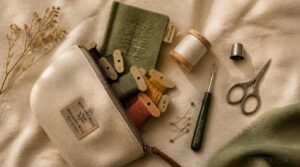
A hand sewing kit doesn’t need much to be genuinely useful — that’s kind of the whole point. Everything fits in a small pouch, and each tool has a clear job to do. Here’s what a solid hand sewing kit actually contains.
If you want to make sure you’re not missing anything, this complete list of essential hand sewing tools covers every item worth keeping in your kit.
Hand Needles and Sizes
Think of hand needles like a toolbox — you wouldn’t use a hammer to hang fine art. Needle sizes run 1 to 28: larger numbers mean finer needles for delicate fabrics like silk, while sizes 1–3 tackle denim and canvas. Note that machine needle sizing follows a direct convention where higher numbers indicate thicker needles.
- Sharps handle everyday woven fabrics
- Crewel needles fit embroidery floss through a longer eye
- Tapestry needles protect knit fibers with a blunt tip
Thimbles for Finger Protection
You just picked your needle — now your fingertip needs backup.
A thimble protects your finger when pushing a hand needle through stubborn layers. Leather thimbles conform softly to your fingertip; metal ones take serious punishment on dense fabric. Silicone options offer flexible grip for lighter hand stitching tasks.
| Thimble Type | Best For |
|---|---|
| Leather | Long stitching sessions |
| Metal | Thick or heavy fabric |
| Silicone | Light to medium tasks |
| Brass/Nickel | Dense, slippery fabrics |
| Open Nail Design | Better ventilation and airflow |
Fit matters more than you’d think — a loose thimble slips mid-stitch and throws off your placement. Look for textured interiors or adjustable bands. Clean leather ones with a damp cloth; polish metal versions occasionally to keep needle passage smooth.
Needle Threaders and Beeswax
Your fingers are protected — now let’s make sure the thread actually gets into the needle.
A needle threader uses a small wire loop to guide thread through even the tiniest eye without squinting. Metal threaders outlast plastic ones easily, and some even feature a small wedge to straighten frayed ends first.
- Reduces eye strain on fine embroidery needles
- Cuts down on frustrating multi-attempt threading
- Fits neatly inside any compact sewing kit
- Some designs come in fun bee or flower shapes for easy spotting
Once threaded, beeswax conditioning is your next move. Run your thread along the wax block and it stiffens slightly, glides smoothly, and tangles far less — especially helpful with slippery silk or metallic threads. Portable beeswax holders clip right into your kit.
Small Scissors and Thread
Now that your thread’s waxed and ready, you need something sharp to cut it cleanly. Small embroidery scissors — usually 4 to 5.5 cm long — are the go-to for hand sewing. Their pointed blades let you snip right at the stitch without catching surrounding fabric.
For thread, stick with all-purpose polyester or cotton — reliable, strong, and kit-friendly.
Portable Repair Essentials
A great hand sewing kit doubles as your portable repair station. Tuck in a button replacement kit with mixed sizes, snaps, and a needle threader for quick closures. Add quick fix adhesives — fabric glue or repair tape — for no-sew moments. Mobile seam repair gets easier with a seam ripper and compact cutting tools.
Machine sewing can’t match that kind of grab-and-go freedom.
Machine Sewing Kit Basics
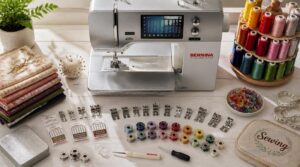
Machine sewing kits are a different beast altogether — more parts, more power, and more to keep track of. Once you understand what’s inside, though, it all starts to make sense pretty quickly. Here’s what a solid machine sewing kit actually includes.
Machine Needles by Type
Not all machine needles are created equal — and picking the wrong one can wreck your fabric fast. Your machine sewing kit needs the right needle for the job:
- Universal needles handle most woven fabrics with ease
- Ballpoint needles glide through knits without snagging fibers
- Microtex needles deliver clean, precise seams on silk and cotton
- Denim needles power through heavy layers without skipping stitches
Bobbins and Presser Feet
Two little components run the whole show underneath your machine: the bobbin and the presser foot. The bobbin holds your lower thread, and size actually matters here — using a mismatched class size causes skipped stitches and tension nightmares.
For delicate fabrics like silk or lace, skip the bobbin setup entirely and rely on hand stitching fabric repair methods that give you far more control over tension.
Swap in a concealed zipper foot or a walking foot for specialty tasks, and suddenly your machine manages quilts, zippers, and vinyl like a pro.
Seam Guides and Screwdrivers
Seam guides are the quiet heroes of consistent stitching. Snap on a magnetic seam guide and your fabric edge stays true every time — no measuring, no drift.
- Adjustable guides lock your seam allowance with a simple screw
- Transparent acrylic versions let you watch the stitch line
- Steel guides resist bending under heavy fabric pressure
Keep a precision screwdriver handy for tightening set screws mid-session.
Extra Thread and Notions
Think of extra thread as your safety net. Always leave a 1 to 2 inch tail when finishing seams — it’s the difference between a stitch that holds and one that unravels after the first wash.
| Thread Type | Best Use |
|---|---|
| 50 weight cotton | General seams |
| 40 weight polyester | Topstitching |
| Basting thread | Temporary holds |
| Bonded polyester | High-speed stitching |
Notion color coordination keeps your finish looking polished.
Maintenance Tools Included
Your machine deserves a little TLC too.
A good kit includes a Cleaning Brush to sweep out lint, an Oil Bottle for smooth mechanical movement, and a compact Screwdriver Set for adjusting feet and tension. Toss in a Thread Snip and a Bobbin Winder, and you’ve got everything needed to keep your sewing equipment running quietly and reliably.
Key Tool Differences
Once you start comparing the two kits side by side, the differences become pretty obvious pretty fast. It’s not just about needles and thread — the tools themselves are built for completely different jobs. Here’s a breakdown of what sets them apart.
Hand Needles Versus Machine Needles
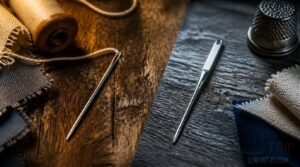
Here’s a detail that surprises a lot of people: hand needles and machine needles aren’t interchangeable at all. Hand needles have a round or elongated eye near the tip, letting you guide thread by hand. Machine needles flip that — the eye sits near the flat-topped shank, which locks into your machine.
Different tools, different jobs, same fabric.
Bobbins Versus Thread Spools
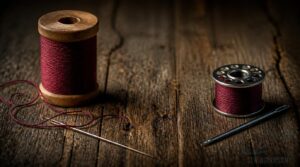
Now here’s where machine sewing gets its own language. A thread spool sits on top — it feeds your upper thread down through the guides and needle. A bobbin lives underneath, tucked into the machine, supplying thread from below. Together, they create your stitch.
Bobbin tension balance matters more than most beginners expect — if it’s off, your seams pucker or loop.
Awls Versus Presser Feet
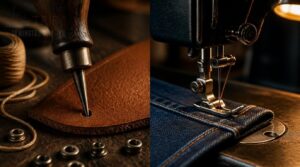
Awls and presser feet couldn’t be more different. An awl is a hand sewing tool — you press its sharp point into leather or heavy canvas to create precision hole placement before threading or lacing. No machine needed.
A presser foot, on the other hand, clips onto your sewing machine and holds fabric flat while stitches form beneath it.
Manual Versus Powered Tools
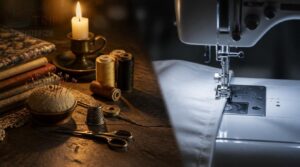
So we’ve established what individual tools do — but what about the bigger picture?
Hand sewing runs entirely on you: no plug, no power, just patience and feel. A sewing machine flips that equation completely.
Here’s what that gap actually means in practice:
- Speed vs. control — machines hit 1,500 stitches per minute; hands max around 30
- Portability — your hand kit fits in a bag; a sewing machine needs a dedicated bench and outlet
- Upkeep — manual tools need almost nothing; machines need motor care, needle swaps, and lubrication
Fatigue never slows a machine down. It will absolutely slow you down.
Simple Versus Technical Parts
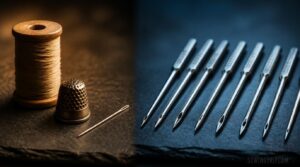
Think of it this way: a standard hand needle is a simple part — grab any brand, thread it, go.
Machine needles are technical parts, built to match specific models, fabrics, and stitch types. They require precise compatibility standards and swap out every six to eight hours. More precision means more maintenance, but also far better results on demanding work.
Stitching Speed and Precision
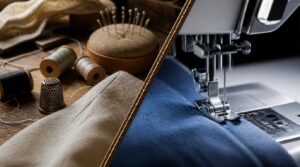
Speed and precision tell you a lot about which method fits your life. Whether you love the slow, meditative rhythm of hand stitching or need a machine to power through a project fast, both approaches come with real trade-offs worth knowing. Here’s how they actually compare.
Slow Detailed Hand Stitching
Hand sewing isn’t slow — it’s intentional. When you’re working with delicate fabrics, that deliberate stitch rhythm is exactly what protects them.
Stitches spaced just 0.5 to 1.0 millimeters apart, guided by careful needle angle technique, keep seams flat and clean. A running stitch, backstitch, or slip stitch, done right, gives you a handcrafted seam finish machines simply can’t replicate.
Fast Machine Construction
Machine sewing is basically speed with a brain. While hand stitching tops out around 30 stitches per minute, a sewing machine can punch out up to 1,500 stitches every single minute. That’s not just fast — that’s impactful for big projects.
Here’s what makes that speed reliable:
- Spindle balance keeps the machine running smooth without disruptive vibration
- Chip evacuation clears debris so nothing interrupts your stitch flow
- Coolant systems manage heat buildup during long sewing sessions
- Toolpath optimization reduces wasted motion between seams
Add predictive wear monitoring into the mix, and your machine practically tells you when it needs attention — before something goes wrong. That’s efficiency and precision working together, giving you consistency stitch after stitch.
Stitch Uniformity Differences
Uniformity is where the two methods really part ways.
Micro variation patterns are just part of hand sewing — your fingers naturally shift pressure, so stitch length drifts slightly along the seam. That’s not a flaw; it’s human.
In hand sewing, drifting stitch length isn’t imperfection — it’s the human touch
Machines, though, use SPI measurement standards and tension discs to lock in stitch density uniformity automatically, delivering consistent spacing every single time.
Tension Control Comparison
Tension is where you really feel the difference between the two methods.
With hand stitching, Manual Tension Adjustment is all in your fingertips — you tighten or loosen each pass as you go, reacting to the fabric in real time. Tightly woven fabrics hold tension well; stretchy ones need a looser touch to avoid tearing.
Machines handle this differently. Automatic Tension Settings balance the upper thread against the bobbin through calibrated dials, creating Thread Tension Balance automatically. Here’s what that controls:
- Upper thread pull — adjusted via the tension dial
- Bobbin resistance — set by the bobbin case seating
- Presser foot pressure — affects how fabric feeds under the needle
- Needle size interaction — Needle Tension Interaction shifts with fabric thickness
- Fabric Tension Influence — delicate fabrics need lower settings to prevent distortion
The trade-off? precision and control versus convenience. Hand stitching gives you feel; machine stitching gives you consistency.
Accuracy for Visible Seams
Visible seams don’t lie. With a machine, stitch length consistency lands within 0.2 mm of your target — that’s nearly invisible variation. Hand stitching can drift up to 2 mm between stitches, which shows on light fabrics.
Needle size impact matters too: a finer needle with matching thread keeps seam lines subtle and clean where it counts.
Best Projects for Each Kit
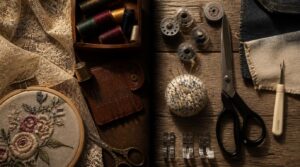
Knowing which kit to grab comes down to what you’re actually making. Some projects beg for the patience of hand sewing, while others need a machine to get the job done right. Here’s a breakdown of which kit fits which task best.
Small Repairs and Hems
When a hem drops or a seam splits, your hand sewing kit is often the quickest fix. A slip stitch hem hides the thread beautifully on casual trousers, while a blind hem stitch keeps things neat on skirts. Here’s what small repairs actually call for:
- Match thread weight to your fabric
- Use a thimble for long hemming sessions
- Apply hem reinforcement techniques at stress points
- Iron-on tape works for quick, temporary drops
- A quick fabric patch saves length on damaged hems
Thread weight matching matters more than people think — wrong weight creates visible bulk. Hand sewing wins here for control.
Delicate Fabrics and Details
Slipping from small repairs into delicate work is where hand sewing really shines. Silk, lace, and sheer fabrics genuinely need that slower, controlled touch.
With silk, a fine needle and gentle hand prevent snags. Lace calls for a size 60–70 needle to avoid pulls. Sheers need narrow seam allowances — too much fabric and you’ll get puckering fast.
Quilts and Large Projects
Now, quilts are a whole different story. A hand-sewn quilt takes around 40 hours of labor — machine sewing cuts that closer to 15.
For large projects, long arm quilting machines cover wide widths with consistent stitch density. Smart quilt back width choices (108 inches or wider) skip piecing seams entirely. A design wall helps you plan block placement before committing.
Denim, Bags, and Curtains
From big quilts, we shift to something equally demanding — denim, bags, and curtains.
Machine sewing wins here, no contest. Denim runs 8–14 oz per square yard, and your machine manages that weight without breaking a sweat. Bag reinforcement techniques like double stitching and cross-stitched panels keep totes standing up to daily wear.
- Denim dye transfer can stain lighter fabrics during construction
- Heavy-duty stitching prevents seam failure in loaded tote bags
- Curtain lining options improve drape and cut glare beautifully
- Sustainable denim upcycling turns old jeans into new bags or curtain panels
- Pre-washing denim prevents in-seam shrinkage after your project is finished
Hand sewing struggles with thick denim — needles bend, fingers ache. Machine sewing powers through it cleanly every time.
Invisible Finishing Stitches
Now here’s where hand sewing quietly earns its reputation. Invisible finishing stitches — blind hems, slip stitching, edge binding — demand the kind of patience and control that a machine can’t always match.
Slip stitch seam work catches only the fabric fold, leaving nothing visible outside. For delicate pieces, that’s not just useful. That’s the whole point.
Cost, Space, and Portability
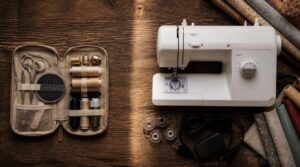
Beyond the stitches themselves, your wallet, your living space, and your lifestyle all play a role in which kit makes sense for you. Hand sewing and machine sewing sit at very different ends of the cost and convenience spectrum. Here’s how they actually stack up.
Lower Hand Sewing Costs
One of the quiet wins of hand sewing? It’s genuinely easy on your wallet.
Budget thread options come in small, single-use spools that cut down on waste, and affordable needle supplies cover dozens of projects without breaking the bank. Your minimal tool investment stays low from day one, and replacing small consumables costs next to nothing over time.
Machine Investment Needs
Machines cost real money upfront. A basic mechanical sewing machine starts around $100 to $200, while electronic sewing machines sit between $300 and $800. Step up to computerized sewing machines, and you’re looking at even more.
Factor in annual maintenance costs of $50 to $150, plus parts and consumables adding up to 25% of your purchase price yearly — it’s a genuine budget commitment.
Travel-friendly Hand Kits
Forget the budget stress for a second — hand sewing kits are basically the backpacker’s best friend.
A compact travel kit fits easily into a purse or small backpack, measuring just 6 to 8 inches long. You get stainless steel needles, a portable thimble, beeswax for smooth threading, and tiny scissors — everything neatly zipped inside a water-resistant pouch, ready for quick repairs anywhere.
Dedicated Machine Workspace
Machine sewing demands a proper home base. Unlike hand sewing, your dedicated machine workspace shapes every session. Set it up right, and you’ll wonder how you ever managed without it:
- Fixed table height keeps your needle position consistent
- LED task lamp eliminates shadows on fabric
- Built-in storage puts bobbins and presser feet within arm’s reach
- Surge-protected outlets safeguard your machine and foot pedal
An ergonomic chair and anti-fatigue mat complete the setup.
Electricity and Noise Factors
Your sewing machine doesn’t just need a table — it needs clean power. Voltage fluctuations in workshop outlets can throw off thread tension and dim your LED lamp mid-seam. Electrical noise from motors and adapters quietly disrupts sensitive electronics, while harmonics from multiple devices on one circuit build heat inside power supplies.
Hand sewing? Just grab your kit and go.
Choosing The Right Sewing Kit
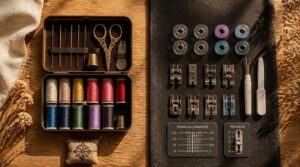
Picking the right sewing kit doesn’t have to feel like a guessing game. It really comes down to a few honest questions about what you sew, how often, and where you’re headed. Here’s what to think through before you decide.
Match Tools to Projects
Think of your tools as a team — each one has a job, and putting the right player in the right position matters.
Fabric needle pairing is your starting point: delicate fabrics like silk call for hand sewing, while denim and bags need machine needles with sturdy thread weight selection to hold heavy seams together. Presser foot matching keeps machine work precise and efficient.
Consider Your Skill Level
Your skill level shapes every kit decision you’ll make. Beginners do well starting with hand sewing basics — short 15–30 minute practice sessions build coordination without overwhelm.
As your confidence grows, machine sewing opens up. Don’t rush that jump. Matching tools to where you actually are, not where you want to be, keeps frustration low and progress steady.
Balance Speed and Control
Once you’ve matched your tools to your level, the next piece of the puzzle is knowing when speed helps and when it actually hurts.
- Hand sewing pace: 10–20 stitches per minute — slow, but you catch every tension slip before it becomes a problem.
- Machine sewing speed: up to 1,500 stitches per minute — great for long seams, not for fiddly details.
- Balanced workflow: delicate hems by hand, straight seams by machine.
Pace vs. precision aren’t opposites — they’re just different tools in your kit.
Plan for Future Sewing
Planning ahead turns good habits into lasting progress. Set a 12-month upgrade timeline for tools, and define skill milestones — like mastering a decorative stitch by month three.
Dedicate a 2m × 1.5m workspace for quarterly projects, cap your monthly fabric budget at 25% of sewing funds, and aim to cut fabric waste by 15% yearly through smarter material choices.
Combine Both Kit Types
Why choose one when both work better together? A unified toolset — hand needles, machine needles, bobbins, and thread spools — covers everything from delicate hems to heavy denim seams.
Toss in a portable mini machine, and your kit travels without losing power. Switch between hand finishing and machine construction fluidly, and your sewing efficiency genuinely doubles without the clutter of managing two separate cases.
Frequently Asked Questions (FAQs)
What thread types work best for both methods?
Polyester thread accommodates both hand sewing and machine sewing well — strong, low-stretch, reliable. For delicate fabric, silk thread glides smoothly through your needle. Cotton suits natural fibers, while nylon adds durability for heavy-duty repairs.
How often should machine needles be replaced?
Replace your machine needle every 6–8 hours of sewing. A dull needle causes skipped stitches and snags. It’s a tiny cost that saves your fabric.
Can beeswax improve machine sewing thread performance?
Yes — beeswax genuinely works wonders for machine sewing thread performance. It reduces friction, stabilizes tension, and improves needle penetration, giving your thread better durability and smoother, more consistent stitches with far less frustration.
What fabrics are unsuitable for machine sewing?
Some fabrics just fight the machine. Slippery satin shifts and puckers, stretch knits skip stitches, and napped fabrics like velvet dull needles fast. Delicate materials — silk, chiffon, organza, lace — need a gentler hand.
How do seam rippers work for both kits?
Ironically, the humble seam ripper does the opposite of sewing — yet it is necessary for both kits. The blade insertion method slides under threads cleanly, while the fabric protection ball prevents snags.
Conclusion
Funny how the difference between hand sewing and machine sewing kits seems like a simple supply question—until you’re fighting a silk hem with a denim needle. Your tools don’t just shape what you make; they shape how well it actually holds up.
Know when to slow down and stitch by hand, and when to let the machine run. Master both, and you stop settling for close enough—you start making things built to last.
- https://winslets.com/blogs/sewing-basics/100-sewing-tools-and-equipment-for-beginner-and-advanced-sewists
- https://blog.siysewityourself.com/2022/06/10/15-must-have-notionf-for-your-sewing-kit
- https://www.instructables.com/Tools-and-Materials-for-Hand-Sewing
- https://meissnersewing.com/blogs/inspiration/understanding-sewing-tools
- https://movingthreadla.com/blogs/journal/what-should-be-in-every-starter-sewing-kit-and-what-you-can-skip