This site is supported by our readers. We may earn a commission, at no cost to you, if you purchase through links.
bent needle costs you more than a skipped stitch. It can snap mid-seam, jam your machine’s timing belt, or shred fabric you’ve spent hours cutting.
Hand needles and machine needles wear out differently, and treating them the same shortens their life fast. One dulls from friction against dense weaves; the other collects lint and residue from high‑speed passes.
Master hand needle vs machine needle care, and you’ll catch problems before they ruin a project. The right inspection habits, cleaning routine, and replacement schedule protect your stitches, your fabric, and your equipment.
Table Of Contents
- Key Takeaways
- Hand Needles Vs Machine Needles
- Needle Sizing and Selection
- Point Styles and Fabric Care
- Caring for Hand Needles
- Caring for Machine Needles
- Top 10 Needles and Accessories
- 1. Schmetz Universal 130/705 Needle
- 2. Schmetz Jersey Ballpoint Needle
- 3. Schmetz Chrome Microtex Needle 80 12
- 4. Schmetz Quilting Needle Assortment
- 5. Schmetz Embroidery Needle Size 75/11
- 6. Schmetz Heavy Duty Leather Needle
- 7. Schmetz Denim Sewing Needles
- 8. Automatic Plastic Needle Threader
- 9. Schmetz Chrome Topstitch Needle
- 10. Schmetz Double Stretch Needle
- Needle Problems and Safe Use
- Frequently Asked Questions (FAQs)
- Conclusion
Key Takeaways
- Hand needles and machine needles wear differently and need separate care routines, so treating them the same shortens their lifespan.
- Match needle’s point style to your fabric—sharp for wovens, ballpoint for knits, chisel for leather—to avoid permanent damage and skipped stitches.
- Replace hand needles every 6–8 hours of use and machine needles every 8 hours, sooner for dense fabrics like denim or canvas.
- Hand needle sizing runs backward (smaller numbers mean thicker needles) while machine needle sizing is direct in millimeters, so always check a size chart to avoid costly mismatches.
Hand Needles Vs Machine Needles
Hand needles and machine needles look similar at a glance, but they’re built for completely different jobs. Understanding what sets them apart helps you choose the right tool and avoid costly mistakes. Here’s what you need to know across five key differences.
Getting familiar with the key differences between hand and machine sewing needles can save you from broken threads, skipped stitches, and a lot of unnecessary frustration.
Eye Placement Differences
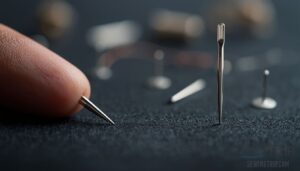
One small detail separates these two needles more than most sewers realize: where the eye sits.
On a hand sewing needle, the eye is at the blunt end — opposite the point. That placement enhances your natural finger grip and lets you push the needle cleanly through fabric.
| Feature | Hand Sewing Needle | Machine Needle |
|---|---|---|
| Eye location | Blunt (top) end | Just above the tip |
| Eye size | Larger, oval | Smaller, polished groove |
| Threading direction | Top-down by hand | Front-to-back mechanically |
A machine needle moves the eye just above the tip. This design keeps thread tension consistent at high speed, reducing drag through the polished groove. Your binocular overlap and depth perception matter here — threading that tiny eye demands stereoscopic cues your forward-facing eyes naturally provide. Peripheral awareness helps guide fabric edges simultaneously.
Needle eye size directly affects stitch consistency. The wrong needle in the wrong application — say, using a machine needle by hand — creates friction, fraying, and fatigue fast.
Shank Versus Smooth Shaft
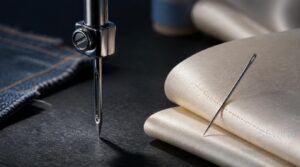
The eye placement sets the stage, but the shaft is where the real structural difference lives.
Machine needles have a shank — the upper portion that locks into the needle bar. Most home machines use a flat-sided shank, while industrial machines often use a round shank requiring a set screw. Hand needles have no shank at all: just a smooth, uniform shaft from eye to point.
| Feature | Machine Needle | Hand Needle |
|---|---|---|
| Upper section | Flat or round shank | No shank |
| Surface texture | Shank + smooth blade | Fully smooth shaft |
| Fabric perforation | Larger, more defined | Cleaner, finer hole |
That smooth hand needle shaft reduces resistance on delicate fabrics, producing minimal perforation marks. The machine needle’s shank, by contrast, creates a stable grip inside the needle bar, preventing wobble at high speeds. Shank thickness also absorbs driving force — that’s why machine needles can handle canvas or denim without bending, while hand needle shafts stay fine and flexible for controlled hand pressure.
Stitch Formation Impact
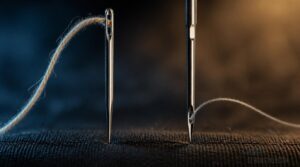
Shaft smoothness sets up the next factor: how that needle actually builds a stitch.
Loop formation geometry depends on point angle and eye position, controlling thread tension alignment and stitch direction.
| Factor | Hand Needles | Machine Needles |
|---|---|---|
| Point angle | Lower density | Higher density |
| Tension control | Manual feel | Automatic timing |
| Stitch consistency | Variable | Uniform |
This geometry shapes stitch quality across both needle types.
Threading Method Differences
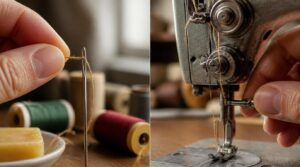
Threading a hand needle means guiding thread manually through a relatively large eye — a small frustration that waxed thread solves immediately. Wax stiffens the thread tip, preventing fraying and making entry clean. An automatic needle threader removes the guesswork entirely.
Machine sewing needles work differently. Tension discs, guides, and a needle clamp handle the thread path automatically, but precise needle insertion is non-negotiable — a misaligned machine needle causes bird nesting fast.
| Method | Key Technique |
|---|---|
| Hand threading | Manual eye alignment, waxed thread |
| Thread tail | Leave 6–8 cm to secure knot starts |
| Machine threading | Follow guide sequence exactly |
| Needle insertion | Flat shank side faces back |
Best Use Cases
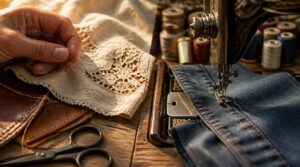
When should you reach for hand sewing needles instead of machine sewing needles? Hand needles win for heirloom embroidery techniques, decorative openwork, leather edge stitching, tailoring irregular shapes, and quick seam repairs.
| Task | Best Needle Type | Why |
|---|---|---|
| Heirloom embroidery | Hand | Precise control |
| Tight-space repairs | Hand | No machine access |
| High-volume seams | Machine | Speed, consistency |
Match needle point types to fabric compatibility for clean, reliable stitching every time.
Needle Sizing and Selection
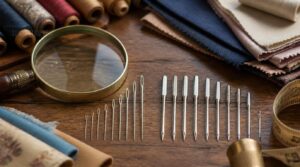
Picking the right needle size isn’t guesswork—it’s math you can rely on. Hand needles and machine needles each use their own numbering system, and mixing them up costs you stitches. Here’s how to read those numbers and match them to your fabric and thread.
Hand Needle Size Numbers
Hand needle numbers run backward from what you’d expect. Smaller numbers mean thicker needles; size 1 suits canvas, while size 12 suits silk. This inverse sizing confuses beginners constantly. Brand scale variations make cross-referencing essential — always check a needle size chart first. This is due to the inverse sizing system used for hand sewing needles.
- Size 1: ~1.0mm, heavy fabrics
- Size 5-7: medium-weight cottons
- Size 8-10: lightweight wovens
- Size 12: fine embroidery gauges
- Length correlates with thickness
Machine Needle Metric Sizing
Unlike hand needles, machine needle sizing runs forward and logically. This is direct mm sizing: NM 80 means 0.80mm diameter, NM 110 means 1.10mm.
The EU needle sizing system pairs with US numbers (80/12), but NM alone covers the diameter calculation.
Industrial NM ranges climb past 130, while home machines stick to 60–120 for sizing consistency standards.
Fabric Weight Matching
Fabric weight, measured in GSM, decides whether a needle glides through or fights the cloth. Light fabrics under 150 GSM need fine needles; heavy denim above 350 GSM demands sturdy ones.
Match the lining weight within one to two categories to protect drape.
Consider the season, too: heavier winter wovens need larger needle sizing for clean fabric compatibility.
Thread Weight Matching
Thread and needle sizing go hand in hand. Linear density explained simply: a 40 wt thread means 40 kilometers weigh one kilogram — thicker than 60 wt.
Pair heavier threads with larger needle eyes to prevent fraying. Balancing bobbin tension keeps stitches even.
For mid-weight cotton, 40–5 wt with a size 80/12 needle reliably avoids puckering.
Delicate Versus Heavy Fabrics
Delicate fabrics like chiffon and voile need a size 70/10 needle — anything larger punctures fibers and causes visible puckering. Their fluid drape demands precision.
Heavy fabrics like denim or canvas require a size 100/16 needle to penetrate dense weaves cleanly.
- Delicate: fine weave, smaller needle, finer thread
- Heavy: tight weave, larger needle, thicker thread
- Mismatching either damages fabric permanently
Point Styles and Fabric Care
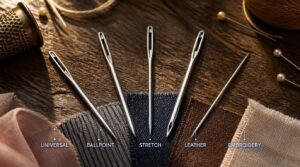
The point of your needle does more than pierce fabric — it determines whether your material survives the process. Matching the right tip to your fabric type is one of the simplest ways to prevent damage, skipped stitches, and frustrating do-overs. Here are the five key point styles you need to know.
Your needle’s point doesn’t just pierce fabric — it determines whether your material survives
Sharp Points for Wovens
A blade, not a bullet — that’s the real difference. Sharp points cut woven fibers cleanly, using precise entry angles that reduce weave resistance instead of forcing through it.
This tapered point efficiency matters whether you’re working hand vs machine needles. Universal sewing needles with sharp tips handle poplin, percale, and cotton well, minimizing fabric fraying during proper needle selection for tightly woven fabrics.
Ballpoints for Knits
Knits need a different approach entirely. Ballpoint needles push fibers apart instead of cutting them, protecting Jersey Loop Integrity and Preventing Knit Runs.
- Check Needle Tip Roundness before each project
- Size up for Stitching Fleece Weight
- Loosen Tension Adjustment Tips for stretch
- Match needle types to fabric weight
- Replace ballpoints every 6–8 hours
Blunt Tapestry Points
Tapestry needles take a completely different approach. Their blunt point geometry lets the tip slide between woven intersections rather than piercing fibers, protecting canvas weave integrity with every pass. The elongated eye accommodates thick wool and multiple floss strands without fraying. Use these for needlepoint and cross-stitch — anywhere needlepoint tension control and yarn thickness compatibility matter most.
| Feature | Tapestry Needle | Sharp Needle |
|---|---|---|
| Tip action | Glides between fibers | Pierces fibers |
| Eye size | Enlarged for thick yarn | Standard |
| Best fabric | Canvas, evenweave | Woven cotton |
Chisel Points for Leather
Leather needs an entirely different tool. A chisel point doesn’t pierce — it punches, guided by diamond tooth geometry for clean leather perforation alignment.
Four-point chisels give 8-10 stitches per inch; two-point chisels handle tight curves. Correct chisel tooth spacing plus steady mallet impact techniques ensure saddle stitch uniformity across these leatherworking needles, unlike standard needle types.
Preventing Fabric Damage
Choosing the wrong point doesn’t just slow you down — it damages your fabric permanently.
- Match point to fiber type: sharp for wovens, ballpoint for knits, chisel for leather
- Replace worn needles before burrs cause puckering or fiber runs
- Align thread weight to needle gauge to prevent pilling and tearing
Ideal point selection is your first line of defense.
Caring for Hand Needles
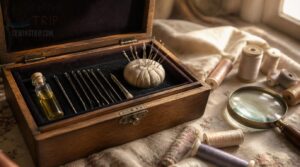
Hand needles are simple tools, but they still need regular attention to stay sharp, rust-free, and ready to work. A little routine care goes a long way toward protecting both your needles and your fabric. Here’s what to keep in mind.
Cleaning Wax and Lint
Wax and lint are quiet saboteurs — they build up slowly, then suddenly your thread snags on every stitch.
After each large project, wipe the shaft and eye with a non‑abrasive cloth. For stubborn wax, apply a small drop of mineral oil, then wipe clean. Use compressed air to clear lint from the eye. Always dry completely to prevent rust.
Checking Dull Points
A dull needle does more damage than you’d think. Hold yours under a bright LED lamp with a magnifying loupe and compare it against a new needle.
Look for a flattened or rounded tip — that’s your first red flag. Oblique lighting reveals micro-dents invisible in flat light.
Then test on scrap fabric: a sharp needle leaves a clean, tight hole; a dull one tears a wider, ragged opening.
Preventing Rust and Bending
Rust and bending are the two fastest ways to ruin a good hand needle. Stainless steel needles resist corrosion best — their chromium content forms a protective oxide layer that plain steel can’t match. After each session, wipe your needle with a lint-free cloth to remove moisture and fabric residue. A light coat of protective wax adds another barrier against humidity.
Silica gel packets inside your needle case keep ambient humidity below 40 percent, dramatically slowing oxidation. Choose high-carbon stainless steel when stitch control matters most — its added rigidity resists bending under repeated hand pressure.
Safe Needle Storage
Where you store your needles matters as much as how you use them. Keep them in a labeled magnetic holder or sealed felt case — both prevent bending and loss.
Tuck a silica gel packet nearby for humidity control.
Store your sewing kit away from children, in a cool, dry drawer that’s easy for you to audit regularly.
When to Replace
A hand needle doesn’t announce its retirement — but your stitches will.
Replace hand needles after 6–8 hours on dense fabrics, or every one to two projects.
If you hear friction or feel increased resistance, swap it out. Visible rust, a bent shaft, or a loose eye mean immediate replacement — never risk staining your fabric or snapping mid-stitch.
Caring for Machine Needles
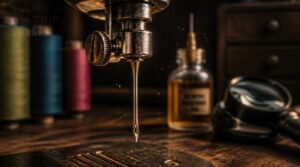
Machine needles take more abuse than most sewists realize — high speeds, constant friction, and repeated flex all add up fast. Treating them well directly protects your stitches, your fabric, and your machine. Here’s what to keep on top of.
Inspecting Burrs and Bends
Catching a bent or burred needle early prevents skipped stitches and fabric snags.
Hold the needle against a bright, oblique light source — a raised, shiny edge signals a burr. Run a gloved fingertip slowly along the tip; roughness confirms damage, your eyes might miss. A 2x–5x magnification lens reveals micro burrs invisible to the naked eye.
Inspect before every project.
Replacing After Sewing Hours
Once you’ve cleared your needle of visible damage, the next question is timing. Replace every 8 hours of sewing — sooner if you’re working dense denim or canvas.
- Log each session’s fabric, needle size, and hours
- Replace at every project switch
- Use titanium-coated needles to double replacement intervals
- Start fresh rather than guessing remaining life
Cleaning Thread Residue
Thread residue builds up faster than most sewers expect.
After each project, wipe your machine needle with a microfiber cloth dampened with mild soap to dissolve oily buildup. For stubborn debris lodged near the eye, isopropyl alcohol evaporates quickly and lifts sticky thread oils cleanly. An ultrasonic cleaner loosens embedded fragments from narrow grooves without bending the needle.
Always test-stitch on scrap fabric afterward.
Correct Insertion Habits
A clean needle still fails if you seat it wrong. Needle clamp alignment matters: push the needle up until it stops, with the flat side facing the correct direction for your machine.
Skipping this step creates depth accuracy risks, causing thread nests and skipped stitches. Maintain eye surface parallelism and seat flat sides fully to protect both hand sewing needle and machine needle performance, supporting needle safety, storage, and timely replacement.
Protecting Stitch Quality
Every care habit you’ve built leads to this: stitch quality protection. Needle geometry directly controls consistent penetration — a deflected blade skews the thread path and loosens loops.
Minimizing deflection keeps your machine needle tracking straight. Maintaining tension relies on a clean, undamaged eye.
Unlike hand sewing needles, worn machine needles need timely needle replacement to prevent fabric damage before it starts.
Top 10 Needles and Accessories
The right needle makes a bigger difference than most sewists expect. Whether you’re working with delicate silk, thick denim, or stretchy jersey, having the right tool in your machine — or hand — changes everything about your results. Here are ten needles and accessories worth keeping in your kit.
1. Schmetz Universal 130/705 Needle
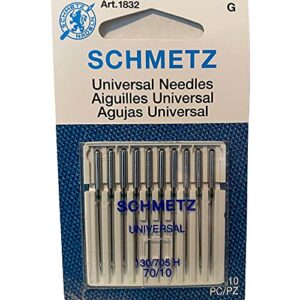
The Schmetz Universal 130/705 is the needle most home sewists reach for first — and for good reason. Its slightly rounded tip works with both woven and knit fabrics without switching needles mid-project.
At size 70/10, it’s suited for lightweight materials like cotton and polyester blends.
Each pack includes 10 needles with a flat shank that fits virtually all household machines.
It won’t tackle leather or heavy canvas, but for everyday sewing, it’s a reliable starting point.
| Best For | Home sewists who work with a variety of lightweight woven and knit fabrics and want a dependable, universal needle that fits most household machines. |
|---|---|
| Unit Count | 10 needles |
| Primary Use | General sewing |
| Machine Compatibility | All major home machines |
| Fabric Weight | Light to medium |
| Project Type | Woven & knit garments |
| Key Design | Rounded universal point |
| Additional Features |
|
- Works with both woven and knit fabrics, so you don’t need to swap needles between projects
- Compatible with virtually all major household sewing machine brands
- Comes in a pack of 10, making it an affordable option for everyday sewing
- Not suitable for heavy-duty materials like leather, canvas, or upholstery
- Only available in size 70/10 — other sizes require a separate purchase
- The rounded tip may struggle with very tightly woven fabrics that need a sharper point
2. Schmetz Jersey Ballpoint Needle
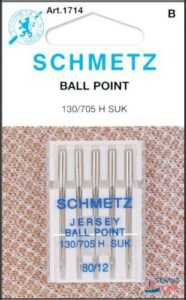
When sewing knits, the wrong needle doesn’t just skip stitches — it ruins fabric. The Schmetz Jersey Ballpoint (size 80/12) solves this with a medium rounded tip that slides between fibers rather than piercing them.
That design prevents runs, puckering, and snags on jersey, spandex, and cotton knits.
Each card includes five needles, compatible with all major home machines. It won’t suit tightly woven fabrics, but for stretch projects like activewear or t-shirts, it’s exactly what you need.
| Best For | Home sewers working with stretch fabrics like jersey, spandex, or activewear who want clean seams without snags, skipped stitches, or fabric damage. |
|---|---|
| Unit Count | 5 needles |
| Primary Use | Knit fabric sewing |
| Machine Compatibility | All major home machines |
| Fabric Weight | Light to heavy knits |
| Project Type | Jersey & activewear |
| Key Design | Medium ball-point tip |
| Additional Features |
|
- Rounded tip glides between fibers instead of piercing them, preventing runs and holes in knit fabrics
- Works with all major home sewing machine brands, so no compatibility headaches
- High-quality build means a longer needle life and fewer mid-project interruptions
- Not effective on tightly woven or non-stretch fabrics, so you’ll need a different needle for those
- Only five needles per card, which can go fast if you sew frequently or in high volume
- Not suitable for industrial machines or heavy-duty materials like thick leather
3. Schmetz Chrome Microtex Needle 80 12
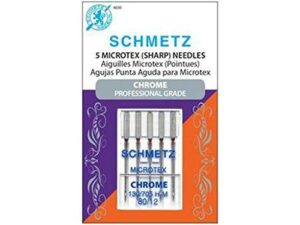
Precision sewing demands a needle that keeps pace with your standards. The Schmetz Chrome Microtex 80/12 features an acute, slim point built for microfibers, silk blends, and tightly woven cotton — fabrics that punish a blunt or ill-matched needle instantly.
Its chrome coating reduces friction and heat, letting you sew at speed without damaging delicate threads. At 0.80 mm diameter, it produces near-invisible seams. Replace it after signs of fraying or skipped stitches appear.
| Best For | Quilters, embroiderers, and sewists working with microfibers, silk, or tightly woven fabrics who need clean, precise stitching at speed. |
|---|---|
| Unit Count | 5 needles |
| Primary Use | Topstitching |
| Machine Compatibility | Standard home machines |
| Fabric Weight | Medium to heavy |
| Project Type | Quilts & embroidery |
| Key Design | Sharp chrome-coated tip |
| Additional Features |
|
- Chrome coating cuts friction and heat, protecting delicate threads during fast, extended sewing sessions
- Ultra-fine 0.80 mm shaft creates near-invisible seams on lightweight and densely woven fabrics
- Sharply pointed tip glides through tight weaves without snagging or distorting the fabric
- Small 5-needle pack means frequent reorders for anyone sewing in high volume
- Thin shaft isn’t ideal for heavy multi-layer projects where a sturdier needle would hold up better
- Only fits machines compatible with size 80/12 needles, limiting versatility across different setups
4. Schmetz Quilting Needle Assortment
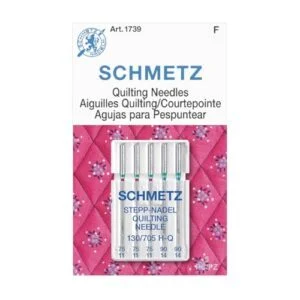
Quilting through multiple fabric layers is where needle choice makes or breaks your project. The Schmetz Quilting Needle Assortment includes sizes 75/11 and 90/14, covering lightweight cottons through thicker quilt sandwiches.
Its tapered, slightly rounded point glides between batting and fabric layers without snagging fibers or distorting seams. Compatible with Singer, Brother, Janome, and most major machines, it manages both piecing and free-motion quilting reliably.
Replace needles every 6–10 sewing hours to maintain clean, skip-free stitch formation.
| Best For | Home quilters who work with multiple fabric layers and want reliable, skip-free stitching for both piecing and free-motion quilting on major machine brands. |
|---|---|
| Unit Count | 25 needles |
| Primary Use | Quilting |
| Machine Compatibility | All major home machines |
| Fabric Weight | Light to heavy layered |
| Project Type | Layered quilts & piecing |
| Key Design | Tapered rounded point |
| Additional Features |
|
- Tapered, slightly rounded point glides smoothly through batting and layered fabrics without snagging or distorting seams
- Compatible with all major home sewing machine brands, making them a versatile pick for most quilters
- Premium steel construction holds up well over high-volume projects, meaning fewer mid-project needle changes
- Packaging may show five packs but the actual product contains three, which can be misleading at purchase
- Limited needle count per size means heavy users may need to order multiple sets to keep enough on hand
- Not suited for leather or heavy upholstery — the tip dulls quickly on those materials
5. Schmetz Embroidery Needle Size 75/11
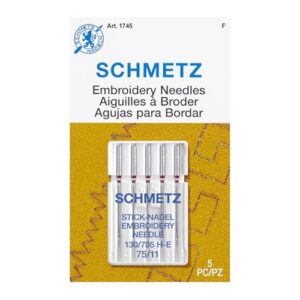
Embroidery thread is unforgiving — use the wrong needle and you’ll spend more time re-threading than stitching. The Schmetz Embroidery Needle Size 75/11 solves that problem directly. Its enlarged eye and widened groove reduce friction against rayon and polyester threads, cutting down on shredding and skipped stitches during complex decorative work.
The 75/11 diameter suits lightweight to medium fabrics used in appliqué, quilting, and machine embroidery. Each card includes five needles — enough to stay ahead of wear during longer sessions.
| Best For | Home sewers and embroidery enthusiasts who work with delicate rayon or polyester threads and want cleaner, skip-free results on quilting, appliqué, or decorative machine embroidery projects. |
|---|---|
| Unit Count | 5 needles |
| Primary Use | Machine embroidery |
| Machine Compatibility | Home sewing & embroidery |
| Fabric Weight | Light to medium |
| Project Type | Appliqué & embroidery |
| Key Design | Widened groove & eye |
| Additional Features |
|
- The enlarged eye and widened groove significantly reduce thread friction, meaning less shredding and fewer frustrating skipped stitches
- Works with a wide range of home sewing and embroidery machines, so compatibility is rarely an issue
- The 75/11 size hits a sweet spot for lightweight to medium fabrics commonly used in detailed decorative work
- The pack of five needles can run out quickly if you’re doing high-volume or back-to-back embroidery sessions
- Only available in one needle size, so you’ll need a separate pack if your project calls for a different gauge
- Not recommended for industrial machines, limiting their use to home sewing setups
6. Schmetz Heavy Duty Leather Needle
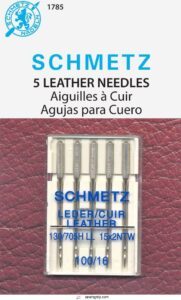
Leather doesn’t forgive a soft needle. The Schmetz Heavy Duty Leather Needle uses an LL left-twist cutting point that slices through genuine leather, stiff faux leather, and suede without tearing or shredding.
Sized 100/16, it’s built for handbags, belts, wallets, and saddle-making projects. The reinforced blade resists breakage across thick, multi-layered hides. Pair it with thick thread and longer stitch lengths to show off those signature angled stitches — and skip it entirely on knits, where that cutting point causes real damage.
| Best For | Leatherworkers and crafters who sew handbags, belts, wallets, upholstery, or saddle projects on a home sewing machine and need a needle that cuts cleanly through thick, stiff hides. |
|---|---|
| Unit Count | 5 needles |
| Primary Use | Leather crafting |
| Machine Compatibility | All major home machines |
| Fabric Weight | Heavy (leather & suede) |
| Project Type | Bags & upholstery |
| Key Design | LL left-twist cutting point |
| Additional Features |
|
- The LL left-twist cutting point slices through genuine leather, suede, and stiff faux leather cleanly — no tearing or shredding
- Creates strong, decorative angled stitches that look professional on heavy-duty leather projects
- Fits all major home sewing machine brands, so there’s no compatibility guesswork
- Completely off-limits for knit or woven fabrics — the cutting point will damage the fibers
- Can distort very soft faux leather, which calls for a microtex needle instead
- Requires longer stitch lengths and thick thread to work properly, so it’s not a drop-in swap for everyday sewing
7. Schmetz Denim Sewing Needles
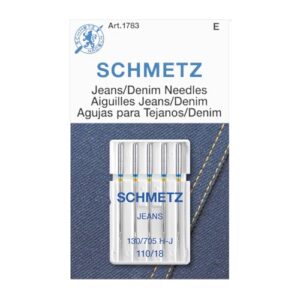
Where leather demands a cutting edge, denim needs sheer muscle. The Schmetz Denim Needle features a reinforced blade and sharp point that drives through thick twill, layered jeans seams, and heavy canvas without deflecting or snapping.
Size 110/18 tackles the toughest projects — multiple denim layers, canvas boat tops, rugged upholstery. Its chrome-plated finish resists corrosion during long sessions. Pair it with heavy polyester thread and replace it every few sewing hours to keep stitches clean and consistent.
| Best For | Home sewists who regularly work with heavy fabrics like denim, canvas, twill, or layered quilts and need a needle that won’t bend or break mid-project. |
|---|---|
| Unit Count | 1 needle |
| Primary Use | Heavy fabric sewing |
| Machine Compatibility | Standard home machines |
| Fabric Weight | Heavy (denim & canvas) |
| Project Type | Jeans & canvas goods |
| Key Design | Reinforced ball-point blade |
| Additional Features |
|
- Medium ball-point tip glides through thick, tightly woven fabrics smoothly, reducing skipped stitches and fabric deflection
- Reinforced blade holds up during long sewing sessions, meaning fewer needle breaks and less frustration
- Fits all standard home sewing machines, so there’s no compatibility guesswork
- Comes as a single needle, which can get inconvenient fast on bigger projects that eat through needles quickly
- Not a good fit for delicate or fine fabrics — the medium ball point is built for muscle, not finesse
- Designed strictly for home machines, so it won’t work for industrial or specialty setups
8. Automatic Plastic Needle Threader
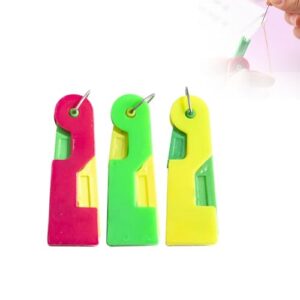
Strength and sharpness solve fabric problems, but small eyes still trip up many sewers. That’s where an automatic plastic needle threader earns its place in your kit.
A push-button mechanism creates a quick loop, pulling thread through the eye in seconds. At roughly 6.8 × 2 cm and 5 grams, it’s pocket-sized and easy to grip.
It works best with standard thread, not thick yarn, and helps anyone with limited dexterity thread needles fast.
| Best For | Seniors, visually impaired individuals, and anyone with limited hand dexterity who wants a faster, easier way to thread needles for sewing, embroidery, or crafts. |
|---|---|
| Unit Count | 1 threader |
| Primary Use | Needle threading aid |
| Machine Compatibility | Hand & machine sewing |
| Fabric Weight | All weights |
| Project Type | All sewing projects |
| Key Design | Push-button hook mechanism |
| Additional Features |
|
- Push-button mechanism threads a needle in seconds, saving time and frustration
- Tiny and lightweight (6.8 × 2 cm, 5 g) — easy to toss in a sewing kit or carry anywhere
- Great for teaching kids or gifting to crafters of all skill levels
- Too small for thick yarn or multiple thread strands — best with standard sewing thread only
- Comes in random colors, so you can’t choose a specific one
- No printed instructions included, and plastic quality can be inconsistent
9. Schmetz Chrome Topstitch Needle
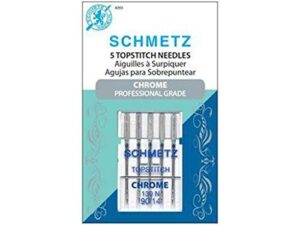
Threading metallic or heavy decorative thread through a standard needle is a quick way to end up with shredded thread and frayed patience. The Schmetz Chrome Topstitch Needle fixes that.
Its extra-long eye and deep groove let thick or multi-thread combinations feed smoothly at speed. The chrome-plated shaft runs cooler, cutting friction and stitch distortion. At size 90/14, it suits most home machines and works with wovens, quilts, and decorative edging with consistent, clean results.
| Best For | Home sewers and quilters who regularly work with metallic, decorative, or multi-strand threads and want clean, precise topstitching without constant thread breakage. |
|---|---|
| Unit Count | 1 needle |
| Primary Use | Decorative stitching |
| Machine Compatibility | Size 90/14 machines only |
| Fabric Weight | Light to medium |
| Project Type | Decorative topstitching |
| Key Design | Extra-large eye & groove |
| Additional Features |
|
- The extra-large eye and deep groove make threading easier and let thick or delicate threads feed smoothly, even at speed
- Chrome-plated shaft reduces friction and heat, which means fewer skipped stitches and less thread distortion
- Size 90/14 fits most home machines and handles a wide range of fabrics, from quilts to wovens to decorative edging
- Sold one needle per package, so stocking up means multiple purchases — a bit inconvenient and potentially pricey
- Only compatible with machines that accept size 90/14 needles, so it won’t work for everyone
- Not built for heavy-weight fabrics or industrial use, so it has a fairly specific sweet spot
10. Schmetz Double Stretch Needle
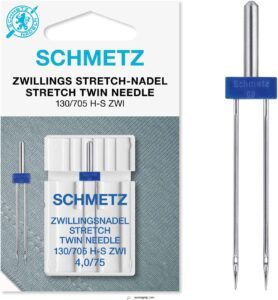
Hemming a stretchy knit skirt with a standard needle often leaves you with skipped stitches and puckered seams. The Schmetz Double Stretch Needle solves that problem by running two threads simultaneously through ballpoint tips, creating professional-looking coverstitch rows on your regular zig-zag machine.
Available in 2.5 mm × 75 mm and 4.0 mm × 75 mm, it suits elastic waistbands, jersey hems, and knit repairs. Match needle size to thread weight — mismatches cause skipped stitches fast.
| Best For | Home sewists who work with stretch fabrics like jersey, knits, or elastic waistbands and want professional coverstitch results without buying a dedicated machine. |
|---|---|
| Unit Count | 1 card (2 sizes) |
| Primary Use | Twin-needle stitching |
| Machine Compatibility | Zig-zag machines only |
| Fabric Weight | Light to medium knit |
| Project Type | Knit hems & waistbands |
| Key Design | Dual-needle single shaft |
| Additional Features |
|
- Creates two parallel rows of stitching in one pass, giving your knit hems a clean, store-bought look
- Ballpoint tips glide between fabric fibers instead of piercing them, so no snagging or holes on delicate knits
- Works on any standard zig-zag machine — no extra equipment needed
- Only compatible with zig-zag machines, so straight-stitch-only machines are out of luck
- The needles are quite fine and can snap under pressure if the fabric is pulled or fed too fast
- Getting the size-to-thread match wrong leads to skipped stitches, which means extra troubleshooting before you find the right combo
Needle Problems and Safe Use
Even experienced sewers run into needle trouble — and most of the time, the fix is simpler than you’d think. Knowing what to look for puts you back in control before a small problem damages your project or your machine. Here are the most common needle issues and how to handle them safely.
Skipped Stitches
Skipped stitches are one of the most frustrating problems you’ll face. They usually come down to a few fixable causes:
- Incorrect thread path causes the hook to miss the loop entirely
- Tension misadjustment creates uneven loop formation
- Needle bluntness reduces piercing efficiency
Check your machine needle first. Replace blunt or bent needles immediately, and re-thread carefully.
Thread Fraying or Breaking
When thread frays or breaks mid-seam, the needle is usually the first suspect. Needle scarf friction cuts into thread fibers at high speed, especially if the needle is dull or worn. Lint buildup in tension discs worsens the problem fast.
Check your threading path, balance bobbin tension, and replace the needle after every 6–10 sewing hours.
Fabric Puckering
Puckering is a stitch-quality warning sign, not just a cosmetic flaw. It usually points to one of these culprits:
- Wrong needle size for fabric weight
- Tension calibration set too high or too low
- Stitch density too tight on lightweight cloth
- Skipping shrinkage prevention by not pre-washing fabric
- Dense fabric weave resisting needle penetration
Press seams with steam to recover flat, clean results.
Using Needles Interchangeably
Can a needle really be "wrong" if it still fits? Yes. Hand sewing needles lack the scarf and shank that machine needles use for proper thread path alignment, so forcing one into a machine invites Manual Stitching Risks and thread breakage.
| Swap Attempted | Likely Result |
|---|---|
| Hand needle in machine | Misfeed, snapped thread |
| Wrong point for fabric | Fabric integrity concerns |
Always run swatch testing and recheck Machine Tension Adjustments before committing to fabric.
Safety Risks and Fixes
A snapped needle isn’t an inconvenience — it’s a hazard. Needle breakage hazards rise sharply with bent shafts or forced threading, so check every needle before use.
For finger puncture prevention, slow down during threading and keep fingertips clear of the point. Identifying needle burrs early, managing needle fatigue, and following a strict needle replacement schedule keeps stitching safe and mitigates fabric tearing.
Frequently Asked Questions (FAQs)
What needles are good for nickel allergies?
Itchy fingers aren’t a sewing superpower. Look for gold plated or nickel free coated needles, titanium coated or titanium-nitrided steel, or plastic alternatives. Always verify metal composition before buying, and replace worn needles once coating erodes.
How often should I rotate between multiple needle types?
Rotate needle types with every new project or fabric switch. Different textures dull points at different rates, so swapping regularly helps you catch wear early and keep stitches clean.
Can humidity affect needle rust or storage life?
Yes. Above 60% relative humidity, steel needles corrode faster, even with coatings. Keep storage near 40–50% humidity, use desiccant packets, and inspect regularly — early rust spots signal it’s time for needle replacement.
What causes a needle to bend during stitching?
Like David facing Goliath, your sewing machine needle takes on serious force with every stitch.
Fabric resistance forces, improper insertion angles, machine timing issues, and tight thread tension stress all combine, causing needle bending, wear, and eventual breakage.
Are titanium needles worth the extra cost?
For heavy denim or leather, titanium coated needles are worth it. They last 5 to 8 times longer, resist wear, and lower your needle replacement frequency, cutting cost per stitched hour despite higher upfront price.
How do I match needle brand to my machine model?
Check your manual for the system number (often 130/705 H) and confirm shank shape. Cross-reference the brand’s site, ask a dealer for compatibility checks, and contact specialists for vintage machine sourcing before buying any sewing machine needle.
Conclusion
A needle is a small tool carrying a heavy job: one weak point, and the whole seam unravels.
That’s why hand needle vs machine needle care isn’t optional housekeeping—it’s the difference between confident sewing and constant repair.
Wipe wax from your hand needles, swap machine needles every 8 hours of stitching, and check points before every project.
Small habits, repeated consistently, protect your fabric, your machine, and your time.
Master this routine, and your stitches will hold.
- https://www.eobquiltdesign.com/blog2/e2s6px8yjr8jsczaewgf33g46zp4r5
- https://scissortailquilting.com/tutorials-instruction/clean-maintain-sewing-machine-maintenance
- https://www.jacksew.com/blog/best-practices-on-maintaining-your-sewing-machine
- https://thesewinggallery.net/blogs/the-sewing-gallery/how-often-should-you-change-your-sewing-machine-needle
- https://toolly.de/pages/care-guide-for-pins-and-needles