This site is supported by our readers. We may earn a commission, at no cost to you, if you purchase through links.
Most sewists own fewer than five presser feet—and use maybe two of them regularly. That’s a lot of untapped potential sitting in a little plastic box. The foot you snap on before hitting the pedal controls far more than you’d think: seam accuracy, stitch quality, how your fabric feeds, even whether your needle survives a pass through heavy denim.
The wrong foot for the job doesn’t just slow you down. It can snap threads, skip stitches, or leave visible drag marks on silk you spent good money on. Knowing how to choose the right presser foot—by project, fabric weight, and machine type—turns guesswork into confidence, one swap at a time.
Table Of Contents
Key Takeaways
- Matching your presser foot to your fabric weight, project type, and machine shank is the single most reliable way to avoid skipped stitches, puckering, and thread breakage before you sew a single seam.
- A handful of key feet — zigzag, straight stitch, walking, rolled hem, and zipper — handle the vast majority of sewing tasks, so you don’t need a full collection to work with confidence.
- Your machine’s shank height (low, high, or slant) determines which feet actually fit, so confirm compatibility before buying anything — the wrong shank shifts your needle off course and causes real damage.
- Testing on scrap fabric and cleaning your feet after every use aren’t optional habits — they’re what separates clean, consistent results from a mid-project troubleshooting spiral.
Choose by Project, Fabric, and Machine
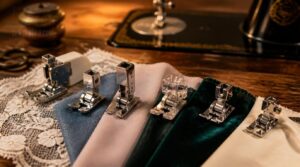
Picking the right presser foot comes down to three things: what you’re making, what fabric you’re working with, and what your machine can actually handle. Get those three lined up, and the right foot becomes obvious. Here’s how to think through each one before you start sewing.
If you’re ever unsure where to start, this guide on choosing the right presser foot for your fabric and sewing style can help you match all three factors quickly.
Identify The Sewing Task
Before you touch a single presser foot, ask yourself: what exactly does this project need to accomplish?
Define your project goal clearly — are you inserting a zipper, finishing a hem, or topstitching a seam? Each operation points you toward a different foot.
Consider what matters most:
- Seam allowance precision for structured garments
- Edge finishing method for durability
- Whether gathering, pleating, or invisible stitching is required
Understanding basic machine functions is essential for selecting the appropriate foot.
Match Fabric Weight First
Once you know your task, fabric weight becomes your first real filter.
Light fabrics — chiffon, silk — need a narrow foot and lower presser pressure to avoid puckering and shredded edges. Heavy fabrics like denim demand wider feet and higher pressure for even feeding.
Getting this match right prevents thread breakage before you’ve sewn a single seam.
Check Stitch Type Needed
Fabric weight narrows your options — but stitch type seals the deal. Straight stitches lock woven seams cleanly. A zigzag foot manages stretch and prevents fraying on raw edges.
Need invisible hems? Reach for a blind hem setting.
Reinforced buttonholes demand a dedicated buttonhole foot. Match your stitch first, and the right foot usually follows naturally.
Confirm Machine Compatibility
Once you’ve settled on your stitch type, check your machine’s shank type before buying any foot.
Shank height determines what fits — low shanks measure roughly 0.5 inches, while high shanks run about an inch tall.
Most modern home machines use a universal low-shank system, but older or specialty brands may need specific adapters to stay compatible.
Test Before Final Sewing
Running a quick test on scrap fabric before touching your actual project is the smartest move you can make. Stitch a short line, then check for even tension, smooth feeding, and clean edges.
If something looks off — puckering, skipped stitches, shifting layers — adjust now.
Your real fabric deserves a confident first pass, not a troubleshooting session midway through.
Know Your Presser Foot Options
Once you understand what your project needs, the next step is getting familiar with the feet that handle the heavy lifting. Each one is designed with a specific job in mind — and knowing which does what puts you firmly in control. Here are the five you’ll reach for most often.
Standard Zigzag Foot
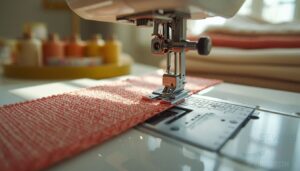
Think of the standard zigzag foot as your sewing machine’s all-purpose workhorse. It manages everything from edge finishing techniques to satin stitch applications with ease. The wide opening lets the needle swing side to side — anywhere from 0.5 mm to several millimeters — giving you real decorative stitch versatility.
Here’s what it does well:
- Finishes raw edges cleanly on woven fabrics
- Accommodates satin stitches for appliqué work
- Maintains consistent fabric feeding on medium-weight materials
- Prevents fabric snagging with its smooth sole
- Fits most low-shank machines without adapters
Adjust your zigzag stitch width narrower on delicate fabrics, wider for stretch.
Straight Stitch Foot
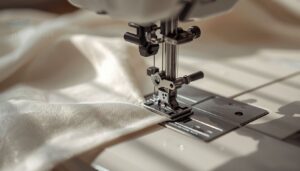
The straight stitch foot is a specialist — built for one job and genuinely radiant at it. Its single center needle hole eliminates lateral movement, keeping every stitch locked in a precise, unwavering line. That narrow opening also stops delicate fabrics from getting pulled into the feed dogs — a common frustration with chiffon or silk.
| Feature | Benefit |
|---|---|
| Smooth underside | Fabric glides without snagging |
| Narrow toe with markers | Guides parallel stitching lines |
| Fixed needle hole | Prevents skipped stitches on fine material |
Use it whenever stitch accuracy matters most — topstitching, fine seams, lightweight layers. It won’t handle zigzag or decorative stitches, but for a clean, straight line? Nothing beats it.
Zipper and Invisible Zipper Feet
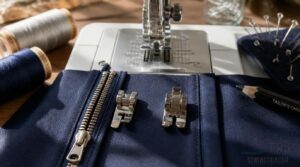
Two feet, two very different jobs. The zipper foot stitches as close as 2.5 mm to zipper teeth — ideal for standard and piping installations.
The invisible zipper foot uses grooved channels underneath to guide the coil flush against the seam, so once closed, the zip practically vanishes.
Test both on scrap fabric first to nail your seam allowance.
Buttonhole and Button Feet
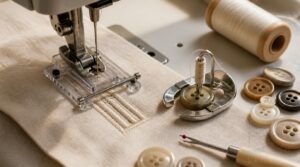
Few feet pull double duty quite like these two. The buttonhole foot manages buttonhole creation automatically — either in a one-step continuous sequence or a four-step manual process that gives you control at each stage. A built-in stabilizer plate keeps fabric flat, while a stop bar signals the machine when to finish each side, improving stitch uniformity by roughly 68%.
- One-step: completes the hole in one uninterrupted run
- Four-step: lets you manually control each stage
- Slot-style: sizes the hole to match your actual button
- Decorative variants: reinforce edges with specialty stitching
The button sewing foot works differently — its horseshoe-shaped grip holds buttons steady while you stitch, keeping spacing consistent. For shank button attachment, the foot feeds thread around a raised guide to secure the shank cleanly. Together, these two feet eliminate hand-sewing entirely.
Rolled Hem Foot
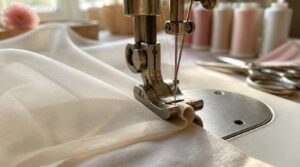
Hemming sheer fabrics is where most sewists lose patience — and the rolled hem foot wins it back. Its small scroll channel folds the raw edge twice as you sew, producing a 1–3 mm finished hem without hand‑pressing.
Use a fine needle, feed steadily, and clear the curling channel regularly.
Tissue paper underneath helps delicate fabric glide smoothly.
Match Feet to Fabric Types
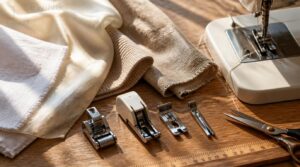
The right presser foot isn’t just about technique — it starts with knowing your fabric. Different materials pull, stretch, and slide in their own ways, so what works beautifully on cotton can be a disaster on silk. Here’s how to match your foot to whatever’s on your cutting table.
The right presser foot begins with your fabric — because what glides on cotton can destroy silk
Lightweight Chiffon and Silk
Silk chiffon and similar sheers are the fabrics that’ll test your patience — unless you have the right foot. A narrow rolled-hem or 7–9-groove foot keeps those feather-light fibers feeding smoothly without puckering.
Better yet, swap in a Teflon (non-stick) foot to reduce friction on slippery silk surfaces. It glides rather than grips, protecting delicate yarns from snags.
Medium Cotton and Linen
Move from slippery sheers to cotton-linen blends and things get noticeably easier — but don’t get too comfortable. This fabric has quirks worth knowing.
Prewash before cutting. Cotton-linen blends (commonly 60% cotton, 40% linen) shrink, and stabilizing the fabric first saves you from seams that pucker after the first wash.
Here’s what sets you up for success:
- Use an all-purpose foot — it manages the medium weight (180–260 gsm) without special adjustments.
- Set a mid-to-long stitch length to preserve seam strength and reduce fabric layering.
- Manage linen slubs by sewing slowly past raised texture spots to keep stitch quality even.
- Overlock or zigzag your edges — linen fibers fray over time, especially along cut edges.
- Press seams flat immediately after stitching for clean, lasting results.
A straight-stitch foot works well for structured seams on shirts or trousers, where precision matters most. The tighter needle opening keeps your stitch line honest — no wandering.
Denim and Heavy Layers
Denim doesn’t forgive shortcuts. When you’re stacking multiple layers — waistbands, pocket bags, side seams — you need tools that match the muscle.
Start with a walking foot. It grips both layers simultaneously, reducing fabric creep and cutting needle breakage on denim by around 67%. Pair it with a size 90–110 needle and slightly increased thread tension for clean, skip-free topstitching every time.
Knits and Stretch Fabrics
Where denim demands muscle, stretch fabrics demand finesse. Knits are built on interlocking loops — that structure gives them their signature give, but it also makes them slip, pucker, and distort under the wrong foot.
Your best ally here is the knit/tricot foot. It glides over stretch materials without gripping too aggressively, cutting puckering by over 30%. Pair it with a ballpoint needle and reduced presser foot pressure to protect the fabric’s knit recovery — the ability to spring back after stretching.
Here’s what to keep in mind:
- Fabric tension control matters most on two-way stretch; ease your pressure slightly to prevent distortion
- High elastane content enhances better elasticity — but elasticity degrades faster with heat and heavy tension
- Lighter stretch jerseys offer breathable thermal insulation and natural fabric drape — handle them gently
- Moisture wicking performance depends on fiber porosity, which tight stitching can compress and reduce
Watch for fabric slippage as you sew. If layers shift mid-seam, pin generously or use clips instead of pins to keep the loops intact.
Leather, Vinyl, and Pleather
Few materials humble a sewing machine faster than leather, vinyl, or pleather. Every slip, drag, or skipped stitch traces back to one fix: a Teflon non-stick foot. It glides over slick surfaces without gripping — no fabric slippage, no scratched grain.
| Material | Best Foot | Key Tip |
|---|---|---|
| Leather | Teflon foot | Use clips, not pins |
| Vinyl | Teflon foot | Wipe clean after use |
| Pleather/PU | Teflon foot | Gentle speed reduces cracking |
Check Attachment and Shank Fit
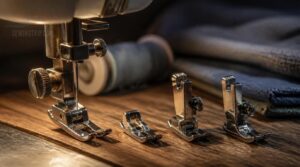
Before you buy a single foot, you need to know how it actually connects to your machine — because not every foot fits every sewing machine. The attachment style and shank height are what determine compatibility, and getting this wrong means the foot simply won’t work. Here’s what to check before anything else.
Snap-on Versus Screw-on Feet
There are two ways a presser foot attaches to your machine — snap-on or screw-on — and the difference matters more than you’d think.
Snap-on feet click into place in seconds, no tools needed.
Screw-on feet require a small screwdriver but offer a more secure hold during heavy stitching, making them the steadier choice for denim or thick layers.
Low Shank Machines
If your machine is a standard home sewing machine, it’s almost certainly a low shank — the most common setup in domestic sewing. The shank sits roughly ½ inch tall, and most modern feet snap right on without adapters.
That near‑universal compatibility means you can pick up feet from almost any brand and trust they’ll fit.
High Shank Machines
High shank machines — usually industrial or quilting-focused setups — sit about one inch taller than low shank models. That extra clearance isn’t accidental; it’s built for heavy fabric handling: denim, canvas, multiple thick layers.
Feet here are almost always screw‑on, locking firmly for long, demanding seams. You’ll also find specialized quilting and edge‑joining feet designed specifically for this taller geometry.
Slant Shank Compatibility
Slant shank feet sit at a forward angle — a quirk of older and some mid-range machines that changes how the foot meets the fabric. Before buying any foot, identify your shank type by checking your manual or measuring the shank height.
A mismatched foot shifts the needle off its drop point, causing skipped stitches or worse.
Using Presser Foot Adapters
Think of adapters as universal translators for your presser foot collection. A snap-on adapter lets you click generic or cross-brand feet onto your machine’s ankle in seconds — no tools needed.
Just confirm the adapter width matches your shank exactly; a loose fit causes wobble and uneven pressure. Also check clearance beneath the needle plate, since adapters add a touch of height.
Install, Test, and Maintain Feet
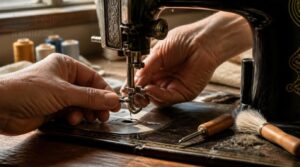
Getting the foot on correctly is half the battle — the other half is making sure it stays that way and keeps working well over time. A few simple habits around installation, pressure adjustment, and cleaning can save you from frustrating stitching problems down the road.
Here’s what you need to know to get it right every time.
Raise Needle Before Changing
Before anything else, raise the needle to its highest point. This single step engages your machine’s needle bar lock — making foot removal smoother and protecting your fingers from an accidental strike.
In lockstitch mode, especially, a raised needle prevents sudden movement if you brush the foot pedal.
Good habit. Every time, no exceptions.
Secure The Foot Properly
With the needle raised, it’s time to lock your foot in place. Snap-on feet should click firmly — if you don’t hear or feel that click, it isn’t seated. Screw-on feet need a clockwise turn until snug, not just finger‑tight.
Then lower the foot, visually confirm the edge aligns with your needle centerline, and run a quick test stitch.
Adjust Presser Foot Pressure
Once your foot is locked in, pressure becomes the next dial worth understanding. Presser foot pressure is simply how hard the foot pushes down on your fabric — and getting it wrong is a quiet saboteur.
Here’s where fabric weight drives every decision:
- Lightweight fabrics like chiffon or silk need low pressure to prevent seam puckering.
- Medium-weight cottons and linens work well with moderate, stable pressure.
- Heavy denim or layers need higher pressure to feed evenly without skipped stitches.
- Stretch knits benefit from reduced pressure to avoid distortion along the seam.
On computerized machines, digital pressure settings let you dial in a number precisely. Mechanical machines use a numbered dial or screw — either way, always test on scrap fabric first before touching your real project. That quick test run is your safety net against unwanted fabric tension issues.
Troubleshoot Skipped Stitches
Skipped stitches often follow a pressure adjustment — your fabric shifts, your settings change, and suddenly the stitching looks broken.
Start with your needle: replace it every 8–12 hours of sewing, or immediately if it’s bent. A dull tip can’t form a proper thread loop.
Next, check bobbin winding and orientation — uneven fill or wrong placement disrupts tension instantly. Clean your tension discs regularly; debris causes inconsistent thread pull.
If skips persist across every stitch, suspect machine timing drift — that needs a technician.
Clean and Store Feet
Caring for your presser feet takes minutes but pays off in years of clean stitching.
- Remove lint after every use with a nylon brush or soft toothbrush
- Wipe metal surfaces dry immediately to prevent rust
- Include a silica gel pack in your storage container
- Inspect for burrs or nicks and smooth them with a fine emery board
Frequently Asked Questions (FAQs)
How long do presser feet typically last?
Like a trusty compass, a presser foot endures hundreds to thousands of uses. Metal feet outlast plastic, especially on denim. With regular cleaning and damage checks, most last six to twelve months of steady sewing.
Can snap-on feet convert to screw-on systems?
Yes — with an ankle adapter, snap-on feet can work on screw-on systems. The adapter mounts onto your machine’s shank, giving snap-on feet a stable screw-on connection. Always verify shank height compatibility first.
Which foot works best for gathering fabric ruffles?
For ruffles, the gathering foot is your go-to — it creates even fullness automatically as you sew. Need structured pleats? Reach for the ruffler foot instead. Lightweight fabrics love gathering feet; heavy ones need the ruffler.
Do walking feet reduce needle breakage on denim?
Walking feet do reduce needle breakage on denim. They distribute pressure evenly across heavy layers, preventing needle deflection. Consistent fabric feeding means the needle meets each fiber cleanly — no sudden resistance, fewer snapped needles.
How should presser feet be stored long-term?
Store feet in a labeled, lidded box with individual compartments — metal-on-metal contact causes scratches and rust. Tuck in silica gel packets to control moisture, replacing them every 6–12 months.
Conclusion
You don’t need a drawer full of specialty feet to sew well—you need the right few, chosen with intention. That’s really the heart of how to choose the right presser foot: match it to your fabric, your task, and your machine, then let it do the work.
Every foot you snap on is a quiet decision that shapes the finished piece. Make it deliberately, and the results will show up exactly where it counts—in the seam.