This site is supported by our readers. We may earn a commission, at no cost to you, if you purchase through links.
Flip last night’s seam over and find a mess of loose loops staring back at you, and you’ve met the most common complaint in sewing: tension that’s fighting itself, thread against thread.
Two threads, top and bottom, are supposed to meet exactly at the fabric’s midpoint, locked together like two hands shaking firmly in the middle. When one pulls harder than the other, that handshake falls apart, and your seam shows it. Learning to balance top and bottom tension isn’t guesswork — it’s a handful of clear signals and small, deliberate dial turns that put both threads back on equal footing.
Table Of Contents
Key Takeaways
- two-color thread test — contrasting top and bobbin colors — instantly reveals which side is pulling harder, so you’re adjusting with evidence, not guesswork.
- Top tension fixes most imbalances, but when underside loops persist after dial changes, the bobbin case tension screw needs quarter‑turn adjustments to finish the job.
- Needle size, thread weight, and fabric type all silently shift your tension before you touch a dial, so matching these three factors first prevents most problems from starting.
- Logging successful tension settings — thread brand, dial number, needle size, fabric type — turns every solved problem into a reusable solution you won’t have to chase down twice.
What Balanced Tension Looks Like
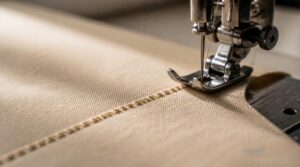
Before you can fix a tension problem, you need to know what "right" actually looks like. Balanced tension has a few specific, visible signs — and once you know them, bad stitches become easy to diagnose. Here’s what to look for.
Skipped stitches or shredding thread can mimic tension trouble, and this guide on skipped stitches and thread shredding causes and solutions explains why.
Locked Stitches at Fabric Center
When both threads are pulling with equal force, they meet and lock exactly at the fabric’s midpoint — neither tugging the other to the surface. Think of it like two cables in a suspension bridge, each carrying its share of the load.
Balanced thread tension is like a suspension bridge: two cables sharing the load equally, meeting at the center
That interlock creates a compact, durable stitch center that holds without fraying, even under stress.
Top Thread Visibility
On a well-balanced stitch, the top thread lies flat on the fabric face — no loops, no pulling, just a clean, consistent line. Needle friction can disrupt this; a dull needle drags the thread unevenly, making the line appear wavy or raised.
Silk and high-sheen threads reflect light more sharply, so even slight tension shifts show immediately. Fabric coatings and shorter stitch lengths increase that prominence fast.
Bobbin Thread Visibility
When tension is balanced, the bobbin thread stays invisible from the top — locked at the fabric’s midpoint. If it creeps up, your top tension is likely too tight.
Tighter fabric weaves hide it better; loosely woven or thin materials expose it faster.
Poor bobbin winding creates uneven feeding, pulling the bottom thread upward unpredictably.
Ensuring balanced upper and lower tensions prevents the bobbin thread from surfacing.
Two-color Thread Test
Load a bright color on top and a contrasting shade in the bobbin, then sew a straight stitch across scrap fabric.
Flip the sample over. If each side shows only its own color, tension is balanced.
If the top thread bleeds underneath — or vice versa — one side is dominating. That color imbalance tells you exactly which dial to adjust.
Zigzag Tension Test
Switch to a zigzag stitch after the two-color test — the directional pull across each swing exaggerates any imbalance straight stitches might hide. Watch for loops, puckering, or uneven zigzag width: these signal tension is off.
If both thread colors stay buried inside the fabric across the full zigzag path, your top and bobbin tension are genuinely balanced.
Diagnose Top and Bottom Imbalance
Before you start turning dials, you need to know exactly what your machine is telling you. Tension problems show up as specific, readable clues — loops, puckering, or stray thread on the wrong side of your fabric. Here are the five symptoms to look for and what each one means.
Loops on Fabric Top
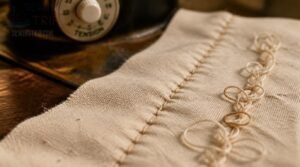
Loops on the fabric’s top surface are a clear sign your top tension is too loose, or the bobbin tension is gripping too hard. The thread can’t lock at the fabric’s midpoint, so it gets pulled upward instead.
Run a two-color test. If loops bunch on top, increase the top dial by half a step at a time, then stitch a scrap piece to confirm.
Loops Underneath Fabric
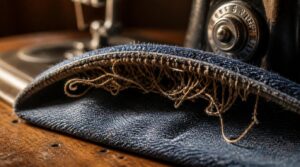
Flip your fabric over — underneath loops tell the opposite story from the top. When you spot them bunching on the underside, your top tension is too tight, pulling the needle thread down through the fabric instead of locking at center.
Drop the top dial by half a step. Tighter underside loops also reduce moisture-wicking paths and increase abrasion on that layer, wearing seams faster.
Bobbin Thread Showing
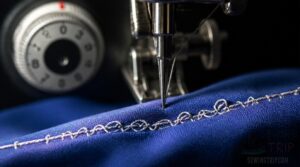
When bobbin thread crawls up and shows on your fabric’s top surface, top tension is too tight — it’s yanking the bobbin thread upward instead of locking both threads at center. Check for dirty tension discs or an improperly seated bobbin case first; either can mimic a tension problem.
Satin stitches expose this imbalance fastest. Reduce top tension by half a step and retest.
Needle Thread Showing
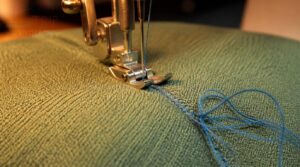
Needle thread showing on the right side means top tension is too low — the thread isn’t pulling tight enough to lock at center, so it spills onto the surface.
Knits worsen this fast; fabric stretch exposes the stitch’s inner part.
Increase top tension by half a step, shorten your stitch length slightly, and use thread that matches your fabric color closely.
Fabric Puckering Clues

Puckering means the tension is fighting the fabric — pulling harder than the fibers can absorb.
Five fast clues that excessive thread pull is your culprit:
- Seam ridges appear on lightweight cotton or chiffon
- Fabric distortion tightens the seam allowance inward
- Stitching ripples run parallel to the stitch line
- Both threads feel locked too shallow, not at center
- Stitch puckering worsens after washing
Drop top tension by half a step first.
Adjust The Top Tension Dial

Once you’ve spotted the imbalance, the top tension dial is your first and most powerful fix. It controls how tightly the upper thread feeds through the machine, and small turns in either direction can shift your stitches from a tangled mess to clean and even. Here’s how to work through the dial adjustments step by step.
Start at Default Setting
Before touching any dial, set your machine to its factory preset tension — usually 4 or 4.5 on most domestic machines. That number isn’t random; it’s calibrated for general-purpose cotton on medium-weight fabric, giving you a clean baseline to work from.
Think of it as your zero point. If something goes wrong after adjustments, returning to default tension settings instantly tells you whether the problem is user-created or mechanical.
Increase Top Thread Pull
Once your baseline is set, turning the dial clockwise — even half a number — increases top thread pull, drawing the needle thread more firmly through the fabric layers. This helps with dense fabric pull on denim or canvas, preventing underside loops and improving seam overlap.
For metallic threads, a controlled increase also grips slipperiness without risking needle deflection.
Decrease Top Thread Pull
Going the other direction works the same way — turn the dial counter-clockwise in half-number steps to reduce top-thread pull on lightweight or stretchy fabrics.
Four quick checks before adjusting:
- Clean the tension discs of any lint buildup
- Confirm the spool pin feeds smoothly without side friction
- Verify the take-up lever moves freely
- Align thread through every thread guide in a straight line
Drop the setting to 2–3 for chiffon or knits to prevent puckering.
Test After Small Changes
Once you’ve nudged the dial, sew a test seam on scrap fabric immediately. Change only one variable — top tension or stitch length, never both. Check both fabric sides within five minutes for loops, puckering, or thread dominance.
| Adjustment | Pass Criteria | Action If Failing |
|---|---|---|
| +0.5 tension | No top loops | Revert, retest |
| −0.5 tension | No puckering | Decrease further |
| Stitch length | Even needle spacing | Isolate and retry |
Log every result before proceeding.
Auto-tension Fine-tuning
Auto-tension fine-tuning uses sensor feedback mechanisms for real-time tension monitoring, dynamically adjusting needle and bobbin balance without touching the machine tension dial.
Watch for these key behaviors:
- Tension error codes flag your mechanical limits
- Automatic calibration routines reset after needle changes
- Digital profile management saves your settings
- Sensors maintain stitch tension balance mid-seam
- Manual override corrects what auto can’t reach
Adjust Bobbin Tension Carefully

Most sewists adjust the top tension dial and call it done — but sometimes the fix lives deeper, in the bobbin case itself. Knowing when and how to touch that tiny tension screw makes the difference between chasing your tail and actually solving the problem. Here’s what you need to work through, step by step.
When Bobbin Adjustment Matters
Most tension problems actually live at the top dial — but when underfabric loops persist after top adjustments, that’s your signal to check the bobbin.
Metallic or elastic threads distort normal balance and almost always need a bobbin case adjustment. Shifting to heavier fabric density does so too.
Persistent thread breakage at seam starts often points to a tension mismatch requiring a bobbin tension adjustment.
Locate The Tension Screw
Flipping open the bobbin case reveals a small slotted screw on the flat arm of the spring — that’s your bobbin tension screw. It’s usually recessed slightly, so a thin flathead screwdriver fits best. Some cases use a Phillips head; match your tool exactly to avoid stripping the screw head.
Always power the machine off before touching it.
Tighten in Quarter-turns
Once you’ve located the tension screw, turn it clockwise in quarter-turns only — that’s a precise 90-degree rotation per step. Each increment adds consistent clamping force without risking overtightening.
Watch for these signs after each quarter-turn:
- Thread sits flatter against the bobbin case
- The bobbin drop test shows the spring catching sooner
- Top tension imbalance visibly reduces on a scrap test seam
Loosen in Quarter-turns
Going counter-clockwise reduces spring preload on the bobbin case, which lowers frictional resistance and lets thread flow more freely. This matters most for delicate fabrics, stretchy knits, or lightweight threads that overtight tension will snap or distort.
Turn counter-clockwise in quarter-turns only — one full turn shifts tension dramatically. Each 90-degree step gives you a repeatable, micro-level adjustment without losing control of the balance.
Use The Bobbin Drop Test
The bobbin drop test gives you a gravity-based read on spring pressure.
- Machine off, needle up, presser foot raised
- Hold thread taut and release the case
- A 1–2 inch drop means tension is balanced
- No movement signals the bobbin is too tight
- A fast drop to the floor means too loose
Retest after each quarter-turn. Thread weight always shifts results.
Keep Tension Balanced Longer

Getting your tension dialed in is only half the job — keeping it there is what actually saves your projects. A few consistent habits make the difference between re-threading every session and sewing with confidence every time. Here’s what to build into your routine.
Match Needle to Fabric
Needle choice quietly controls tension before you ever touch the dial.
A 75/11 needle controls medium wovens cleanly, while a 100/16 powers through denim without deflecting.
For knits, a ballpoint point pushes between fibers instead of cutting them, preventing runs.
Microtex needles suit fine synthetics precisely.
When the needle fits the fabric, thread tracks evenly and tension stays honest.
Choose Compatible Thread Weight
Thread weight follows needle logic: thread weight matching keeps each stitch honest.
- 50-weight cotton for medium wovens
- 30-weight for denim topstitching
- 60-weight silk for delicate seams
Fabric weight matching and thread weight compatibility guide fiber type selection, thread strength needs, and decorative thread uses for any thread type. That thread weight math prevents skipped stitches when picking thread type selection.
Retest After Thread Changes
Once you’ve matched your thread weight, don’t assume your tension settings carried over. Swap thread types, and the balance shifts — sometimes subtly, sometimes not.
Run a test seam on scrap fabric using the same stitch length, needle, and presser foot pressure as your project. Check both sides. Photograph top and bottom for comparison. Log the thread type and dial settings if it passes.
Clean Tension Discs Regularly
Even perfect thread settings drift when lint silently builds up between the discs. That residue changes how firmly the discs grip, throwing off the balance you just dialed in.
Power off and unplug before cleaning. Wipe disc surfaces with a lint-free cloth dampened with a mild, appliance-safe cleaner — never spray directly. Use a soft brush to dislodge stubborn particles, then confirm alignment by running scrap fabric through.
Record Successful Tension Settings
Writing down what worked saves you from solving the same puzzle twice. Once you’ve dialed in tension settings that produce locked stitches at fabric center, log them immediately in a tension logbook.
Tension Log Essentials: thread brand, weight, fabric type, needle size, dial number, and bobbin screw position. Tracking environmental factors like humidity matters too — it affects thread behavior. This reproducibility through records turns a centralized tension ledger into your fastest path to consistent stitch quality control.
Frequently Asked Questions (FAQs)
What does bad bobbin tension look like?
Bad bobbin tension shows up two ways: tight tension creates crushed, ropey seams that sink into fabric, while loose tension causes underside loops, airy gaps, and bird nesting—messy nests of thread tangling beneath the needle plate.
Does fabric stretch change the ideal tension setting?
Yes — stretch fabrics pull threads outward as you sew, shifting the ideal tension lower. Reduce top tension incrementally and use a ballpoint needle to prevent puckering and keep stitches stable through elastic sections.
What bobbin tension works for monofilament nylon thread?
Like a whisper in a loud room, monofilament nylon needs just enough bobbin pressure to hold — not dominate. Set bobbin tension near 0, keep it light, and Wonder Invisible Thread performs cleanly without puckering or show-through.
How does mixing thread types affect both tensions?
Mixed fiber friction throws both tensions off balance. Polyester on top with cotton below often needs a looser top tension, while metallic or rayon threads demand even more manual fine-tuning — auto-tension won’t catch the difference.
Conclusion
Tension, it turns out, is really just a matter of give and take. When you balance top and bottom tension correctly, both threads stop competing and start cooperating — and your seam holds exactly where it should.
Small dial turns, quarter-turn bobbin adjustments, and a simple two-color test give you full control.
Keep notes on what works. Clean your tension discs.
The machine doesn’t fight you when you understand its language.
- https://www.superiorthreads.com/education/tension-guide
- https://www.maggieframes.com/blogs/embroidery-blogs/fix-bobbin-tension-too-loose-ultimate-troubleshooting-guide
- https://paigehandmade.com/sewing-machine-basics/tension
- https://www.karenbolan.com/blog/20220918
- https://www.magnetichoop.com/blogs/news/how-to-thread-a-bobbin-master-tension-direction-and-troubleshooting