This site is supported by our readers. We may earn a commission, at no cost to you, if you purchase through links.
Somewhere between a math proof and a painting, quilting lives. The most striking quilts you’ll ever see—the ones that stop you mid-stride at a craft fair—aren’t random arrangements of fabric. They’re geometry made tactile, where a half-square triangle repeated 200 times across cotton transforms into something that breathes and moves.
That precision is what separates a quilt that hangs crooked from one that lands perfectly flat, corners kissing the floor. This geometric quilting pattern guide walks you through every decision, from choosing your first block design to cutting accurate pieces, matching points, and finishing with clean binding.
Table Of Contents
Key Takeaways
- Picking the right geometric block—whether half-square triangles, flying geese, or hexagons—sets the tone for your entire quilt, so choose a shape that matches both your skill level and the visual energy you want.
- Sharp tools and accurate cuts matter more than most beginners expect, because even a tiny drift in your rotary cutter or ruler can throw off every seam and point across hundreds of pieces.
- Color contrast and intentional fabric placement—not just pretty prints—are what make geometric shapes readable from across a room, so plan your layout before you cut a single piece.
- Finishing details like consistent quarter-inch seams, pressed seam allowances, and mitered binding corners are what separate a quilt that looks homemade from one that looks handcrafted.
Choose Your Geometric Quilt Design
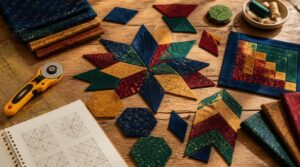
Every great quilt starts with a shape that speaks to you. Before you touch your rotary cutter, take a minute to picture the finished look you want. Here are five geometric patterns to get those creative wheels turning.
If you want to go beyond geometry, machine embroidery ideas for quilts can add a whole new layer of texture and personality to your finished design.
Half-square Triangle Patterns
A great starting point: Half Square Triangles are just squares cut diagonally, then sewn together for bold contrast. Use light and dark fabrics for HST Color Contrast, and master Diagonal Seam Precision with quarter-inch seams.
- Try Paper Piecing HST for exact sizing
- Calculate sizes carefully (HST Size Calculations)
- Plan layouts before cutting (HST Layout Planning)
You can also explore various traditional styles such as the Virginia Star or Pinwheel.
Grab your rotary cutter and get trimming!
Flying Geese Layouts
Once those triangles are trimmed, try Flying Geese for movement. Each unit pairs one goose triangle with two sky triangles, with Goose Triangle Alignment keeping points crisp.
Arrange geese for a Chevron Geese Arrangement, or flip pieces for Reversible Layout Options. Use Directional Color Placement and Negative Space Geese to guide the eye across your quilt layout.
Keep that rotary cutter handy before binding day arrives.
Hexagon Quilt Designs
Hexagons take quilting in a completely different direction. Unlike triangles, these six-sided shapes tessellate without gaps, creating an organic honeycomb feel across your quilt top.
Try Color Gradient Hexagons by arranging quilting cotton fabric from light to dark, or use Negative Space Hexagons to let background fabric breathe. A Staggered Row Layout adds diagonal energy, while Half-Hexagon Borders square off edges cleanly before binding.
Log Cabin Variations
Where hexagons bring organic flow, the Log Cabin block brings structure and warmth. It’s built from strips sewn around a center square, creating alternating light and dark halves — much like dovetail corners interlocking for a tight, purposeful fit.
Try these five popular variations:
- Traditional Log Cabin — classic alternating strips
- Courthouse Steps — strips added to opposite sides
- Asymmetrical Log Cabin — uneven strip widths for modern energy
- Pineapple Log Cabin — diagonal strips for a spinning effect
- Thick-and-Thin Logs — varying strip widths for visual depth
Precision cutting with rotary cutters keeps every strip clean and consistent.
Chevron and Zigzag Styles
Few geometric patterns deliver energy quite like chevron and zigzag styles.
| Feature | Chevron vs. Zigzag |
|---|---|
| Point alignment | Chevrons need precise V-point joins |
| Color direction | Zigzags suit gradient or rainbow palettes |
| Scale variation | Both shift mood at wider or narrower scales |
Use your cutting mat and clear ruler to keep angles consistent, and press every seam flat before joining rows.
Gather Tools and Materials
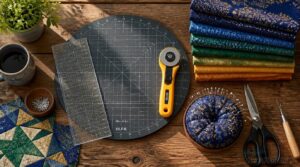
Before you cut a single piece of fabric, make sure you’ve got the right tools within reach. Having everything ready saves you from stopping mid-project to hunt something down. Here’s what you’ll need to get started.
A good cutting mat, sharp rotary cutter, and ruler are must-haves — and if you’re tackling patchwork, these easy traditional block patterns will show you exactly what sizes to cut for.
Rotary Cutter and Mat
A sharp rotary cutter is your best friend for clean, accurate cuts. Choose a 28mm to 60mm blade depending on your fabric type, and always engage the blade guard when you’re not cutting.
Pair it with a self-healing cutting mat — it reseals after every pass and protects both your table and your blade, giving you thousands of precise cuts before needing replacement.
Clear Quilting Rulers
A good quilting ruler is what separates guesswork from precision. Look for transparent acrylic construction — you can see your fabric clearly beneath it, so aligning pattern pieces is straightforward.
| Feature | Why It Matters | Best Use |
|---|---|---|
| Non-slip surface | Prevents shifting mid-cut | Multi-layer fabric cutting |
| 1/8-inch grid | Grid marking accuracy | Seam allowances |
| 6×24-inch size | Covers wide strips | Borders and binding |
Marking Pens and Templates
The right marking pen or template can make or break your cutting accuracy. For light fabrics, water-erasable markers wash out with warm water. On dark fabrics, metallic or alcohol-based pens give you visible, smudge-resistant lines. Use light card template material to trace geometric shapes cleanly and repeatedly.
Five marking essentials to keep handy:
- Water-erasable marker for light cotton
- Metallic pen for dark fabric visibility
- Fiber-tip pen for fine, precise lines
- Light card templates for repeatable shapes
- Test swatch before marking your final quilt
Quarter-inch Presser Foot
One tiny foot does a big job. The quarter-inch presser foot keeps your seam allowance consistent on every single pass — no guessing, no drifting. Its built-in guide edge aligns with your needle center, so fabric feeds straight.
Look for a snap-on shank for fast swaps between feet. Most fit Brother, Janome, and Singer machines without adapters.
Quilting Cotton and Batting
Your fabric choice is the foundation of everything. Stick with 100% quilting cotton — it’s stable, easy to cut, and holds a crisp edge. For batting, low loft cotton keeps geometric seams flat and shows your stitching clearly. Prewash both to prevent shrinkage later.
Pair a neutral piecing thread with high-contrast quilting thread to make your geometric pattern really pop.
Plan Colors and Fabric Placement
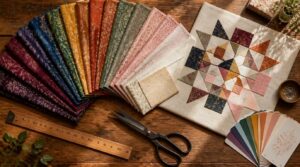
Color is where your quilt starts to come alive. Before you cut a single piece, it’s worth thinking through how your fabrics will work together — and where each one will land on the layout. Here are the key decisions that’ll shape everything from your first block to your last seam.
Complementary Color Palettes
Choosing a complementary color palette starts with the color wheel. Colors directly opposite each other — like blue and orange or yellow and purple — create instant visual energy in a geometric quilt.
- Use warm colors as dominant hues
- Add cool accents in smaller amounts
- Anchor bold pairs with white or gray neutrals
Test fabric swatches in natural light before committing.
High-contrast Fabric Choices
High contrast is what makes geometric shapes pop. Think stark black against white, or deep navy next to clean cream — your seams become sharp lines that you can read from across the room.
Aim for at least a 60 percent brightness difference between paired fabrics. Neutral whites and blacks anchor everything, keeping bolder color placements vivid without muddying the pattern.
Solids Versus Prints
Once you’ve nailed your contrast levels, the next choice is whether to use solids, prints, or both.
- Solids show seams clearly, making geometric accuracy visible
- Prints can hide small misalignments behind busy patterns
- Mix two or three solids with one or two prints for balance
- Directional prints need careful alignment to maintain visual flow
Negative Space Placement
Prints can hide a lot, but negative space does something different — it gives your eye a place to rest.
Negative space placement means deciding where your plain or low-key fabric goes, not just your focal blocks. Think of it as breathing room built right into the grid.
| Placement Strategy | Effect on Design |
|---|---|
| Centered negative zone | Isolates a focal block, drawing the eye inward |
| Border margin ratio | Frames the quilt, balancing busy geometric blocks |
| Grid-aligned gaps | Keeps tessellations crisp and accurate piecing easier |
| Color contrast balance | Light neutrals brighten; dark negatives anchor the pattern |
| Varied negative zones | Scattered open areas create subtle movement across the quilt |
Even a simple neutral strip between rows can shift the whole mood.
Modern Asymmetrical Layouts
Breaking symmetry is one of the boldest moves in modern geometric quilts. Instead of mirroring blocks, try off-center focal placement — a large triangle cluster on one side, balanced by smaller shapes opposite. Let negative space carry the visual weight.
This asymmetrical push-pull creates movement without chaos, and your finished quilt feels alive rather than predictable.
Asymmetry creates movement without chaos, making your finished quilt feel alive rather than predictable
Cut Accurate Geometric Pieces
Cutting is where your design either comes together or falls apart — so getting it right matters more than most people think. A few good habits here will save you from headaches later when you’re trying to match points and line up seams. Here’s what to keep in mind before you make a single cut.
Measure Before Cutting
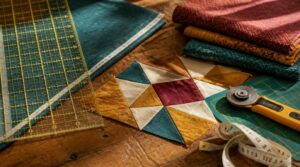
Before you cut a single piece, check your fabric grain alignment. Run your quilting ruler along the warp or weft thread, not on the bias. A bias cut causes stretching that throws off your entire quilt block.
- Double check measurements before every cut
- Inspect ruler edges for nicks that skew lines
- Record micro adjustments to keep seam allowances consistent
Cut Triangles and Strips
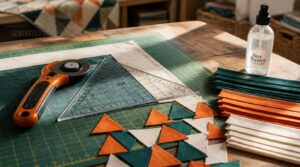
Grab your rotary cutter and cutting mat before anything else.
For triangles, use a 60-degree triangle ruler and always align it with the fabric grain — never on the bias. Bias edges stretch and distort fast.
For strips, stabilize with spray starch first, then cut consistent widths. Flying geese units especially need strip-width precision to match up cleanly.
Trim Units Square
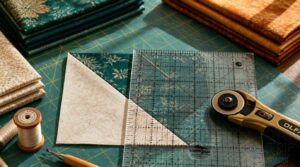
Trimming units square is where precision becomes visible. After sewing your diagonal seams and pressing them flat, align your ruler’s diagonal line exactly with the seam — even a small shift causes misalignment across your whole block.
Keep these trimming essentials in mind:
- Press seams first before trimming to guarantee flat, stable edges
- Align the ruler’s center mark with the unit’s seam intersection
- Use smooth, steady rotary strokes — no sawing or repositioning mid-cut
- Re-trim if off by more than 1/16 inch to restore squareness
Your goal is consistent 10.5-inch trimmed squares, with a quarter-inch seam allowance built in for clean, nested corners across every row.
Use Specialty Rulers
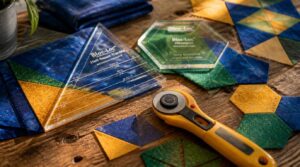
Specialty rulers are the quiet secret behind perfectly matched geometric blocks. A Bloc-Loc or triangle ruler lets you trim half-square triangles cleanly in one pass, hitting both the hypotenuse and legs without repositioning. For hexagons, a dedicated hexagon template locks each side to equal angles, eliminating drift across your honeycomb layout.
Keep rulers flat and clean — clouded acrylic costs you accuracy fast.
Label Each Fabric Piece
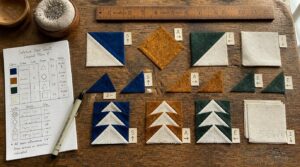
Once your pieces are cut, label everything before a single block moves. Write each piece’s row letter and column number on a small fabric-safe tag and place it near the seam allowance on the wrong side. Add an orientation mark so geometric angles stay true.
Log every code, fabric name, and color value on your master reference sheet.
Sew Blocks With Precision
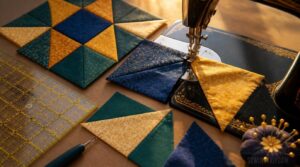
Cutting is done—now the real magic begins at the sewing machine. Getting your blocks precise here makes everything else fall into place, from matching points to straight rows. Here’s what to focus on as you sew.
Use Quarter-inch Seams
A quarter inch is everything in geometric quilting. That tiny measurement — exactly 0.25 inches — is what keeps your blocks square and your points sharp.
Use a quarter-inch presser foot to guide every seam consistently. Backstitch at the start and end of each seam to lock it in place. Check your seam width on scrap fabric before sewing your actual pieces.
Press Seams Carefully
Seams sewn, now press them — and don’t rush this step.
Press from the wrong side first, using a medium heat setting for cotton. Press each seam once in a consistent direction rather than ironing back and forth.
- Use steam to reduce bulk at dense intersections
- Apply a seam roller for tight spots
- Finger-press curves before applying heat
Assemble Matching Points
Now that your seams are pressed flat, it’s time to bring your blocks together — and matching points is where precision really counts.
Place pins perpendicular to the seam line at each intersection, spacing them every one to two inches. Start stitching slightly before the match point, then sew straight through using a consistent quarter-inch seam allowance.
Trim Blocks Evenly
Once your points match up, trimming brings each block to its true finished size.
Place your block on the cutting mat and align the ruler at exactly 10.5 inches on all sides. Check each corner hits ninety degrees, then trim any edges showing distortion. Press lightly after trimming to set the shape before moving forward.
Join Rows Accurately
Now that your blocks are trimmed and pressed, it’s time to bring your rows together cleanly.
- Match center and end points before pinning each row
- Press seams in alternating directions so they nest snugly at intersections
- Use a walking foot to feed layers evenly and prevent shifting
Sew from one end to the other, checking that each row edge stays flush as you go.
Quilt and Finish The Pattern
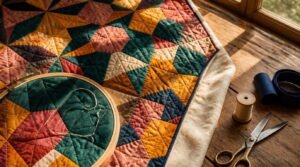
You’ve pieced your blocks together, and now comes the part that really brings everything to life. Quilting and finishing aren’t just final steps — they’re where your pattern gets its texture, structure, and personality. Here’s how to work through each stage with confidence.
Straight Line Quilting
Straight line quilting is one of the most satisfying ways to finish a geometric quilt — clean, confident, and endlessly adaptable.
Set your stitch length to between 2.0 and 3.0 millimeters for crisp, even lines. Attach your walking foot to feed all layers smoothly without shifting.
Space lines roughly 2.5 inches apart, pressing from the center outward after each pass to keep everything flat.
Diagonal Quilting Lines
Diagonal lines bring a whole new energy to geometric quilt patterns — they add movement where straight lines stay calm.
- 45-degree angle cuts classic chevrons
- Crosshatch patterns layer two directions
- Echo quilting traces parallel depth
- Sunburst effect radiates from center
- Spacing variations shift tone dramatically
Use your walking foot and a quilting guide to keep every diagonal true.
Sashiko-inspired Stitching
Sashiko-inspired stitching brings a meditative, hand-crafted quality to your geometric quilt patterns. Using thick sashiko thread and a large-eyed needle, stitch uniform running stitches along marked grid lines — no knots needed, just a few anchor backstitches. Try hemp leaf or interlocking wave motifs, both deeply symbolic and visually stunning against indigo fabric.
| Motif | Meaning | Placement |
|---|---|---|
| Hemp Leaf | Growth | Block centers |
| Wave | Protection | Border rows |
| Mountain | Longevity | Sashing strips |
Trim Quilt Edges
Think of trimming as giving your quilt its final shape — clean, crisp, and ready for the next step.
After all your quilting is done, place the quilt flat on a large cutting mat. Align your ruler to the quilt top edges, then use a sharp rotary cutter to slice cleanly along each side. Always trim before binding.
Attach Binding Strips
Binding is the finishing handshake your quilt gives the world.
Cut five strips at 3 inches wide, then join them end to end using diagonal seams. Fold the strip in half lengthwise and press flat.
Attach to the front edge, stop ¼ inch from each corner, fold at 45 degrees for a mitered corner, then hand-stitch the back.
Frequently Asked Questions (FAQs)
Can I mix geometric patterns in one quilt?
Yes, you can. Pair similar angles like triangles and chevrons, anchor busy patterns with a solid, and keep a unified color palette so your mix feels intentional rather than chaotic.
How do I fix puckering in quilted seams?
Puckering usually means your thread tension is off. Tighten or loosen slightly, then test on scrap fabric. Switch to a walking foot and press each seam flat with steam.
What backing fabrics work best for geometric quilts?
The right backing fabric can make or break your quilt’s finish. Cotton backing breathes well and washes easily. Need warmth? Try flannel weight options. For softness, Minky plush shines.
How do I quilt curves alongside geometric blocks?
Sew curves slowly, using curved seam alignment to match center points first. Press toward the curved side, then block the unit flat before joining it to your geometric blocks.
Can beginners attempt paper-piecing geometric designs?
Beginners can absolutely tackle paper-piecing geometric designs. Start small — 4 to 6 inch blocks build confidence fast. Print templates at 100 percent scale, trim seam allowances after each unit, and you’ll nail clean, precise shapes every time.
Conclusion
Every stitch you’ve placed is a quiet conversation between math and memory. This geometric quilting pattern guide didn’t just show you how to cut and bind—it handed you a living language. Now your fabric speaks in triangles, sharp angles, and intentional color.
The quilt that once existed only in your imagination is finally taking shape beneath your own hands. Trust the process, trust your seams, and let the pattern say what only cloth can.
- https://modernquiltco.com/blogs/the-modern-thread/geometric-quilting-patterns-floral-projects
- https://www.thimblesquilts.com/blogs/news/7-quilting-trends-that-will-dominate-2025
- https://www.countrysidequilts.com/blogs/countryside-stitches/top-quilting-trends-for-2025-new-techniques-and-projects-every-crafter-should-try
- https://www.missouriquiltco.com/blogs/missouri-star-blog/geometric-fabrics-guide
- https://geometriquilt.com/category/quilt-pattern