This site is supported by our readers. We may earn a commission, at no cost to you, if you purchase through links.
Scrunchies ruled the ’80s, quietly disappeared, and somehow came back harder than ever. What started as a simple fix for hair breakage has turned into a full-blown accessory obsession—and the best part? You can make one in under an hour with fabric scraps you already own.
Sewing your own scrunchie means you control the color, the texture, the vibe. Silk for a night out, cozy velvet for the weekend, bold cotton to match that one dress. Once you learn how to sew a scrunchie, a $3 hair tie from the drugstore will never feel the same.
Table Of Contents
Key Takeaways
- Fabric choice makes or breaks your scrunchie — silk reduces hair friction, velvet grips thick hair, and cotton works great for everyday wear.
- You only need an 18×4-inch fabric strip and 7 inches of elastic to make a standard scrunchie in under an hour.
- Knit elastic is better than braided for scrunchies because it keeps its full width when stretched, giving you a fluffier, more comfortable result.
- Once your tube is sewn, a safety pin or tube turner threaded through the casing is the fastest way to flip it right side out and get your elastic in.
Essential Tools and Materials for Scrunchies
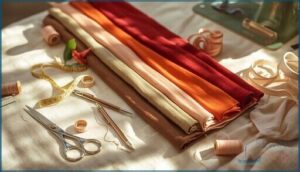
Before you sew a single stitch, you need the right stuff in your corner.
From choosing the right needle to dialing in your tension, sewing knit fabrics successfully comes down to knowing your machine and your materials before you begin.
Scrunchies are simple, but your fabric, elastic, and tools make all the difference.
Here’s what you’ll want to have ready before you start.
Choosing The Right Fabric
Your fabric choice sets the whole scrunchie up for success. Here’s a quick guide to get it right:
- Silk or satin – Perfect for fine or damaged hair; reduces friction beautifully.
- Cotton or linen fabric – Breathable, hypoallergenic, great for active days.
- Velvet – Grips thick or curly hair with serious hold.
- Polyester blends – Easy care, vibrant prints, wrinkle‑resistant.
Cut strips 4 inches wide for classic sizing.
Mulberry silk benefits reduce friction and help prevent hair breakage.
Selecting Elastic Types and Sizes
Once your fabric is sorted, elastic is next — and the type matters more than you’d think.
For knit vs braided choices, knit elastic stays at full width during stretch, making it ideal for fluffy scrunchies. Braided grips are better.
Match width selection to your scrunchie size: 3/8 inch for everyday, 1/2 inch for jumbo styles. Hair thickness matching keeps everything comfortable and secure.
For added stability, consider that knitted elastic retains width when stretched.
Must-Have Sewing Tools
Now that elastic is sorted, let’s talk tools. A basic sewing kit gets you far, but a few specifics make scrunchies easier.
Use Universal 80/12 needles for cotton, or ballpoint for knits — they prevent skipped stitches. Glass-head pins hold slippery fabric without melting under iron heat. A 45mm rotary cutter slices clean strips fast. Don’t forget a safety pin threader — it’s your best friend for pulling elastic through.
Cutting and Preparing Fabric Strips
Getting your fabric cut right is honestly half the battle with scrunchies. A little prep work here saves you from crooked seams and frustration later.
Here’s what you need to work through before you touch the sewing machine.
Measuring and Marking Fabric
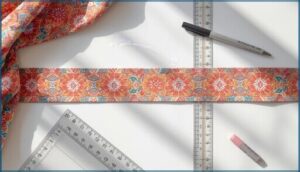
Getting your measurements right is half the battle. For a regular scrunchie, mark a strip 4 inches wide and 18 to 30 inches long, keeping grain alignment in mind — run the length along the stretch direction. Use a seam gauge or ruler for measuring accuracy.
If you’re just starting out, browsing beginner sewing machine craft ideas can help you choose the right fabric weight before you cut your first strip.
Mark your seam allowance at ¼ inch, and don’t forget turn gap placement: two small dashes about 1 to 2 inches apart. Tailor’s chalk and heat‑erasable pens are the best marking tools here.
Cutting Accurate Strips
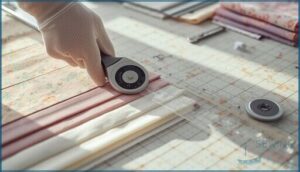
Cutting accurate strips is where your scrunchie really takes shape. Grab your rotary cutter and let it do the heavy lifting — one smooth roll beats scissors every time.
- Stack two to four layers using the Layer Stacking Method to cut identical strips fast.
- Use Ruler Alignment Techniques with grip tape underneath so nothing slides.
- Run Straight Edge Checks every five strips to catch drift early.
- Follow Mat Selection Tips — an 18×24 gridded mat keeps your fabric cutting clean and consistent.
Keep your Rotary Blade Maintenance in check too. A dull blade drags and frays edges, so test on fabric scraps before touching your good material.
Prepping Fabric Edges
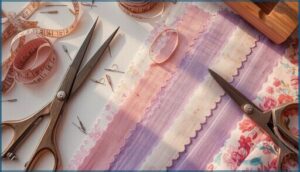
Prepping your edges now saves a headache later. Pick the method that fits your fabric and skill level.
| Method | Best For |
|---|---|
| Zigzag Finishing | Stretchy or woven fabrics |
| Pinking Shears | Light cottons under 0.5mm |
| Raw Edge Overlap | Hiding joins invisibly |
Use Short End Matching with a 1/4-inch seam allowance, then secure with a backstitch. Ladder Stitch closes any gaps softly.
Sewing The Scrunchie Tube
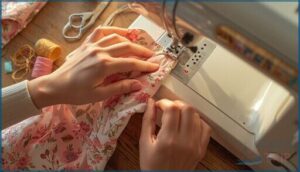
Now comes the fun part — actually turning your fabric into a scrunchie tube.
This is where everything starts to take shape, and it’s easier than it looks.
Here’s what you’ll work through to get it done right.
Folding and Pinning Fabric
Fold your fabric strip lengthwise, right sides together, matching those long raw edges perfectly — think of it like closing a book. Edge alignment here sets up everything that follows.
- Follow grainline orientation before folding to prevent twisting
- Maintain consistent seam allowance (about 1 cm) for bulk management
- Use pin spacing every 3–5 cm, perpendicular to the edge
Leave a small gap unpinned for turning later.
Stitching The Long Edge
Now comes the satisfying part — stitching that long edge. Set your stitch length to 2.5 mm and sew straight down the folded fabric.
Use backstitch reinforcement at both ends to lock your seam. Maintain a consistent seam allowance of about 1 cm.
Remember gap placement: leave a 1-inch opening near one short end. You’ll thank yourself when threading elastic through later.
Tips for Even Seams
Even seams come down to three things: tension, pressure, and length. Set your tension around 4 to 4.5 and stitch length to 2.5 mm — that’s your sweet spot for cotton.
Keep presser foot pressure light so fabric feeds smoothly. Use fabric marking and a consistent seam allowance to stay on track. Press seams flat with low heat before turning.
Turning and Assembling The Scrunchie
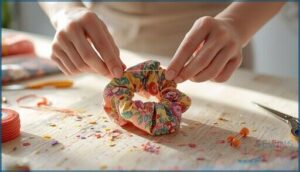
The tube is sewn — now the real magic happens.
This next part is where your scrunchie actually starts to look like, well, a scrunchie.
Here’s how to turn, thread, and secure everything into place.
Turning The Tube Right Side Out
Turning your tube right side out is honestly the most satisfying part of sewing scrunchies. You’ve got five solid options: the Safety Pin Method, Quick Turn Tools, Loop Turner Technique, Straw Tube Hack, or Thread Needle Trick.
Turning your fabric tube right side out is the most satisfying scrunchie step, with five clever methods to choose from
Each works great with fabric scraps and DIY hair accessories. A tube turner makes the job fastest, but a safety pin gets it done just as well.
Threading Elastic Through The Tube
Now that your tube is right side out, it’s time to thread the elastic. The Safety Pin Method is your best friend here — clip a closed pin to one end and inch it through, scrunching the fabric forward as you go.
- Bodkin Comparison: bodkins glide smoother, safety pins work fine
- Elastic Length Calculation: cut 7.5 inches for a snug adult fit
- Twist Prevention Techniques: mark quarter points before threading
- Circular Casing Tips: bunch fabric generously before each pull
Securing and Knotting Elastic
Once the elastic is through, pull both ends out and overlap them by about 1 to 1.5 inches — that’s your sweet spot for overlap length.
Knot types matter here: a tight square knot beats a sloppy granny knot every time.
For stitch reinforcement, sew a quick X‑pattern across the join.
Trim tails close for bulk reduction, then stretch the scrunchie a few times for tension testing.
Finishing and Customizing Your Scrunchie
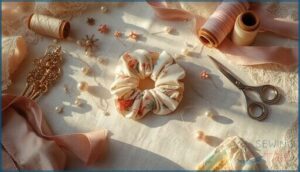
Your scrunchie is basically done — now comes the fun part.
This is where you get to make it actually yours.
Here are a few simple ways to add personality and finish it off right.
Adding Decorative Ties or Bows
Adding a bow is one of the easiest ways to take your DIY scrunchies from simple to statement-making. Bow Fabric Choices matter — lightweight cotton stays crisp, while satin gives dressy vibes. Bow Size Variations, a 3‑inch finished bow works great as a subtle accent.
- Tie it around the seam, then hand‑stitch the knot so it holds
- Mix prints and solids for bold Bow Styling Ideas
- For kids’ handmade scrunchies, always stitch bows securely — loose knots are a safety concern
Tips for Personalizing Designs
Bows set the tone, but the real fun starts when you make the whole scrunchie yours. Try color blocking two fabric scraps for bold contrast, or use fabric prints like florals and novelty patterns for instant personality.
Embroidery monograms add a handmade touch that feels intentional.
Surface texture — velvet, satin, crinkled cotton — changes everything.
Even small sewn-in label lifts your DIY fabric crafts into something giftable.
Top Tools and Accessories for Sewing Scrunchies
Having the right tools makes scrunchie sewing so much easier — and more fun.
A few key picks can help you work faster and get cleaner results every time. Here are the ones worth keeping in your kit.
1. Jeatonge Men’s Pocket Squares Set
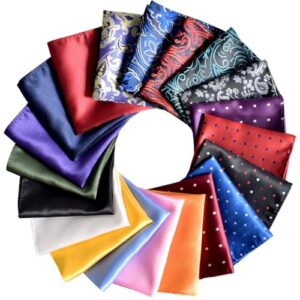
Here’s a fun surprise — pocket squares make great scrunchie fabric. The Jeatonge 20-piece set gives you a ready-made variety of 10-inch squares in solids, polka dots, and paisley patterns.
That’s basically a scrunchie collection waiting to happen.
The polyester-silk blend holds folds well and has a nice, smooth feel against your hair. Colors like navy, burgundy, and white work for any style.
It’s genuinely great value, and the boxed set makes gifting easy, too.
| Best For | Guys who want to elevate their formal look without spending a fortune — great for weddings, proms, or business events, and makes an easy gift for the men in your life. |
|---|---|
| Material Quality | Polyester and silk blend |
| Primary Use | Formal accessories |
| Product Weight | 9.14 ounces |
| Craft Suitability | Fashion accessory styling |
| Package Size | 12.28 x 10.39 x 0.75 in |
| Value Concerns | Cheap feel on solids |
| Additional Features |
|
- 20 squares in one set means you’ve got a pattern and color for every occasion without hunting around
- The polyester-silk blend feels smooth and holds its fold nicely
- Comes in a storage box, so it stays organized and gift-ready right out of the box
- Some solid-color squares feel a bit cheap compared to what the price suggests
- Stitching on the back can be inconsistent — not the most polished finish up close
- Mostly synthetic material, so it won’t feel like true silk if that’s what you’re after
2. Dritz Knit Elastic White
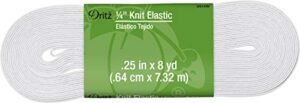
Good elastic is the secret to a scrunchie that actually holds. Dritz Knit Elastic White is a solid pick — it’s soft, curl-resistant, and won’t bunch up inside your fabric tube.
The 1/4-inch width is just right for scrunchies, and you get 8 yards per roll, so you can make a bunch at once. It’s machine washable up to 200°F, which means it survives real wear. The 67% polyester, 33% rubber blend keeps its stretch after each wash.
| Best For | Sewers and crafters who want a reliable, everyday elastic for scrunchies, waistbands, and light garment work. |
|---|---|
| Material Quality | Soft elastic fabric |
| Primary Use | Scrunchie making |
| Product Weight | 1.12 ounces |
| Craft Suitability | Sewing and crafts |
| Package Size | 6.9 x 2.2 x 2.1 in |
| Value Concerns | Batch quality variance |
| Additional Features |
|
- Soft and curl-resistant, so it lays flat inside your fabric without bunching
- 8 yards per roll gives you plenty to work through multiple projects in one go
- Machine washable up to 200°F, meaning it holds up through regular wear and washing
- No info on latex content, so it’s a question mark for anyone with sensitivities
- Quality can vary batch to batch, which makes consistency a bit of a gamble
- Not suited for anything that needs to handle heat above 200°F
3. Dritz Quick Turn Fabric Tube Turner
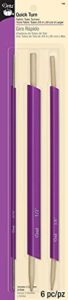
Turning a narrow fabric tube right‑side out used to mean a lot of frustrated muttering. The Dritz Quick Turn Fabric Tube Turner fixes that fast.
It comes with three plastic cylinders — 3/16, 3/8, and 1/2 inch — so you can match the right size to your scrunchie tube. Insert the cylinder, push the fabric over it with the rod, and it slides through cleanly.
For scrunchies, the 3/8‑inch cylinder works perfectly. No more poking around with a safety pin for ten minutes.
| Best For | Sewers who regularly make ties, straps, scrunchies, or stuffed animals and want to stop wrestling with narrow fabric tubes. |
|---|---|
| Material Quality | Plastic and wood |
| Primary Use | Fabric tube turning |
| Product Weight | 0.32 ounces |
| Craft Suitability | Sewing projects |
| Package Size | 12.75 x 2.88 x 0.63 in |
| Value Concerns | Pricey for function |
| Additional Features |
|
- Comes in three sizes so it works with different tube widths — no one-size-fits-all guessing
- Speeds up a tedious step dramatically, especially compared to the safety pin method
- Great for people with arthritis or hand strain since it takes the muscle out of it
- Feels pricey for a simple tool, especially if you only sew tubes occasionally
- Only does one thing — turning fabric tubes — so it won’t pull double duty on other tasks
- Results can depend on technique, so there’s a small learning curve for first-timers
Frequently Asked Questions (FAQs)
Are scrunchies healthier for your hair than hair ties?
Yes, scrunchies are much gentler on your hair. They spread tension across a wider surface, reducing stress on each strand by up to 70 percent compared to tight elastic hair ties.
How to sew a scrunchie for beginners?
Once you get the hang of it, sewing a scrunchie takes about 20 minutes.
Cut fabric, stitch a tube, thread elastic through, and close the seam. That’s really all there is to it.
What are the measurements for a scrunchie?
A standard scrunchie needs an 18-inch by 4-inch fabric strip and 7 inches of elastic. Simple as that. Adjust the length for more puff, or trim it down for something sleeker.
How much fabric do you need for a scrunchie?
Most scrunchies need about 18 inches by 4 inches of fabric. Jumbo styles go up to 40 by 6 inches. Mini versions only need 18 by 3 inches. Size and hair thickness decide the rest.
How to sew the ends of a scrunchie together?
Fold both raw edges inward about 5 cm, overlap them, and sew straight across. For the cleanest finish, use a ladder stitch — it’s practically invisible and holds surprisingly well.
How long do homemade scrunchies last?
With good fabric and quality elastic, homemade scrunchies can last anywhere from 3 months to over a year. Rotate a few regularly, wash them gently, and they’ll hold up beautifully.
Can scrunchies damage different hair types?
Yes, they can — but fabric choice matters.
Silk and satin scrunchies glide over hair with less friction than cotton, reducing breakage.
Your hair type and how tight you wrap it make the biggest difference.
Whats the best way to wash scrunchies?
Hand wash silk scrunchies in cool water with a drop of gentle detergent — a two-minute swish and twenty-minute soak does the trick.
Cotton ones can handle a gentle machine cycle just fine.
How many scrunchies can one yard make?
One yard goes further than you’d think. With standard cotton, expect 30 to 40 scrunchies. Stretch fabric like jersey? Up to Mini scrunchies push that number even higher.
Why do scrunchies lose their stretch?
Scrunchies lose their stretch from heat, sweat, and repeated pulling. Dryer heat breaks down spandex fast. Chlorine and oils weaken elastic too. Even sunlight does damage over time.
Conclusion
Every great craft begins like a single stitch—small, intentional, and part of something bigger.
Learning how to sew a scrunchie is exactly that kind of beginning.
You started with a fabric scrap and ended with something you’ll actually wear.
That’s not small.
Your hands made a choice today: to create instead of consume.
Keep that thread going.
The next scrunchie will be faster, bolder, and even more yours.
- https://www.fabrichouse.com.au/6-best-fabric-for-scrunchies/
- https://mellysews.com/how-to-make-scrunchies/
- https://sustainmycrafthabit.com/how-to-make-a-scrunchie-3-different-ways/
- https://www.bethanylynnemakes.com/how-to-sew-a-scrunchie/
- https://www.secretlifeofaseamstress.co.uk/blog/2020/04/14/beginner-sewing-project-hair-scrunchie-tutorial-easy-make-in-an-hour-project/