This site is supported by our readers. We may earn a commission, at no cost to you, if you purchase through links.
Most sewers own at least one pin that’s bent, slightly rusty, or mysteriously dull—yet somehow still rattling around in the tin. It seems harmless until it snags a silk blouse or leaves a permanent hole in chiffon.
The right pinning tools in sewing make a real difference, not just in how tidy your seams look, but in how much you fight the fabric to get there.
Straight pins, glass-head pins, ballpoint pins, T-pins—each one does a specific job.
Knowing which to grab, and when, is what separates frustrating projects from ones that actually behave.
Table Of Contents
Key Takeaways
- Match your pin type to your fabric—ballpoint for knits, fine, sharp pins for silk, and heavy-duty T-pins or quilting pins for thick layers—or you’ll fight your fabric the whole way through.
- Pin placement matters as much as pin choice: keep pins inside the seam allowance, insert them perpendicular to the seam, and add extras on curves and corners where fabric loves to shift.
- Retire bent, dull, or rusty pins immediately—they’re quiet saboteurs that snag delicate fabric and leave permanent damage before you even notice.
- When pins aren’t the right tool, reach for clips on slippery fabrics, pattern weights for cutting layouts, or stay tape on knit edges to get the same control without the puncture holes.
Common Pinning Tools for Sewing
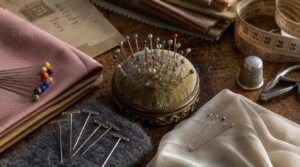
Not all sewing pins are created equal, and the type you reach for can make or break your project. Each pin has a job it does better than the rest.
Knowing which sewing pins work best for each fabric type saves you from snags, distortion, and a lot of frustration down the line.
Here are the most common ones you’ll want to know.
Straight Pins for Everyday Construction
workhorse of your sewing kit — simple, reliable, and endlessly useful. high-carbon or stainless steel, making rust resistant pins easy to find.
what to know:
standard cotter pin variants[https://richconn.com/27-types-of-pins-the-ultimate-guide/).
- Pin length generally runs 1.75–2 inches
- Diameter ranges from 0.4–0.6mm
- Pin head shapes vary for different grips
- Metal content affects durability, and rust prevention tips matter
- Pin reuse practices save money — store them dry in ergonomic pin holders
Glass-head Pins for Visibility and Ironing
Glass-head pins are a natural upgrade from standard options. Their Color-Coded Visibility makes them easy to spot on any fabric — light, dark, or patterned.
The Heat-Resistant Heads handle direct iron contact up to 450°F, so Iron-Safe Handling isn’t just a claim. Stainless Steel Shafts glide cleanly, and Glass Head Durability holds up project after project.
| Feature | Detail | Benefit |
|---|---|---|
| Pin Head Visibility | Bright, reflective glass | Easy to spot on any fabric |
| Iron-Safe Handling | Withstands up to 450°F | Press seams without removing pins |
| Pin Material | Stainless steel shaft | Rust-free, smooth penetration |
Ballpoint Pins for Knit Fabrics
Knit fabrics need a different approach entirely. Unlike wovens, knits have interlocking loops — and a sharp pin will snag them, causing laddering or pulls. That’s where ballpoint pins earn their keep.
Their rounded tip manages Snag Prevention naturally, sliding between fibers instead of piercing them. Combined with Nickel Coating for smooth insertion and Color Coding for quick identification, they’re built for knit work.
- Rounded tips support Loop Preservation without distorting the fabric structure
- Nickel-coated shafts glide through jersey, rib, and fleece cleanly
- Color Coding helps sort pins for easy pin selection for knitting fabrics
- Perpendicular placement improves Edge Stretch Control along seams
- Match pin thickness and fabric compatibility — lightweight knits prefer finer pin point shapes
Quilting Pins for Thick Layers
Quilting is a different beast. You’re pinning through batting, backing, and a quilt top all at once — so regular pins just bend.
Quilt pins run 1¾ to 2¼ inches long, which matters a lot as your pin length guide for layers of fabric. Their nickel plated heads resist heat, and corrosion resistant coatings handle batting dust.
Use center-outward pinning and a consistent pinning interval strategy to keep everything flat.
T-pins for Upholstery and Canvas
T-pins are built for the heavy lifting. When you’re anchoring upholstery fabric to foam, or pinning canvas flat for painting, you need Tempered Steel Strength and T-Head Pressure Distribution — not a dainty straight pin that folds under pressure.
Just as T-pins match the job, knowing how to choose the right pin size for different fabric thicknesses keeps your work clean and your materials damage-free.
The Nickel-Plated Finish resists rust in damp workshops.
At 1.5–2 inches long, they handle Upholstery Layer Stabilization across thick assemblies. Just expect slightly larger holes.
How to Choose Sewing Pins
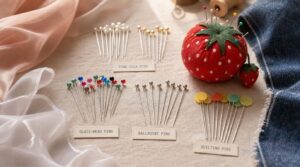
Picking the right pin isn’t complicated, but the wrong choice can snag your fabric or leave visible holes — neither of which you want. A few simple factors make all the difference: point style, thickness, length, and whether your pins are still actually doing their job.
Here’s what to look for before you reach into that pin cushion.
Match Pin Point Style to Fabric Type
The point style on your pin matters more than you’d think. A ballpoint tip slides between yarn loops on knits without breaking them. A sharp point cuts cleanly through woven fabrics like linen or wool.
Here’s a quick cheat sheet:
- Knits: ballpoint pins
- Delicate fabrics (satin, silk, rayon): flat-head or extra-fine sharp pins
- Wovens (linen, wool): tapered or medium sharp pins
Choose Pin Thickness for Light or Heavy Fabric
Pin thickness and fabric compatibility go hand in hand.
For light fabric pinning — silk, chiffon, lawn — stick to 0.4–0.5 mm pins. These leave almost no trace.
Medium fabrics? A 0.6 mm pin is your workhorse.
Heavy fabric pinning means going up to 0.7–0.8 mm for denim or canvas.
Following this pin thickness guide protects your fabric and keeps seams clean.
Select Pin Length for Layered Projects
Layer thickness guidelines make all the difference when you’re pinning multiple layers.
For light stacks, 1–1.25 inch pins handle baste stitching without distorting fabric.
Quilting and batting depth calls for 1.25–1.5 inch pins — anything shorter and your layers creep.
Upholstery pin sizing jumps to 1.5 inches or longer for foam and canvas.
This pin length guide keeps your fabric weight correlation and curved seam length under control.
Use Specialty Pins for Specific Tasks
Not all pins are created equal — and using the wrong one is like showing up to a potluck with a spoon and no dish. Specialty pins for specific sewing tasks make a real difference.
Ballpoint pins handle pin selection for knitting fabrics without snagging. Glass-head pins simplify fine silk pinning and pattern piece alignment. Quilting pins manage multiple layer basting with ease, while T-pins tackle curved seam reinforcement on upholstery.
Replace Bent, Dull, or Rusted Pins
A bent or rusted pin is basically a tiny saboteur in your sewing kit. Don’t let damaged pins wreck a good seam. Build a simple replacement routine:
A bent or rusted pin is a tiny saboteur quietly wrecking your seams
- Inspection routine – Check points weekly; retire anything bent, dull, or rusty immediately.
- Material selection – Stainless steel wins for pin durability and rust prevention in pin storage.
- Safety disposal – Wrap old pins in tape before tossing; store new ones somewhere dry for storage humidity control.
Pin Placement for Better Seams
Where you place your pins matters just as much as which pins you use. A few small adjustments to your pinning habits can mean the difference between seams that line up perfectly and fabric that shifts the moment you touch the presser foot.
Here’s what to keep in mind.
Keep Pins Within Seam Allowances
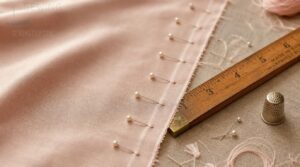
Here’s a rule worth tattooing on your cutting mat: always keep your pins inside the seam allowance.
Aim for 3–6 mm from the raw edge—that’s your seam edge buffer sweet spot.
Following solid edge distance guidelines means any pin holes stay hidden once the seam is sewn.
Good pin placement tolerance here directly protects your seam accuracy and keeps finished work looking seam accuracy.
Insert Pins Perpendicular for Secure Stitching
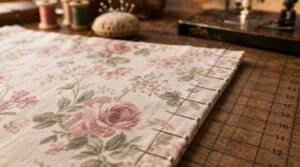
Once your pins are inside the seam allowance, angle matters more than you’d think.
Insert straight pins perpendicular to the seam line—crosswise, not parallel. This pinning technique for fabric alignment keeps seam line visibility clear, so you can sew right past and pull each pin safely before the needle hits.
On curves, bump up your perpendicular pin density to hold that curved edge alignment steady.
Use Lengthwise Pins for Alignment
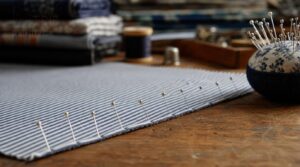
Perpendicular pins keep you stitching straight, but lengthwise pinning performs a different job: alignment. Run pins parallel to the seam edge, spaced one to two inches apart, and you lock in Grain Line Consistency before a single stitch drops.
This is your go-to for Pattern Matching Precision on stripes or plaids, Edge Puckering Prevention on plain weaves, and Layered Fabric Stability across long panel joins.
Add More Pins on Curves and Corners
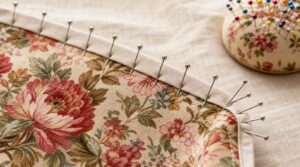
Straight seams are forgiving.
Curves and corners? Not so much.
That’s where pinning techniques for fabric alignment really matter.
For pinning curved edges technique and Corner Pin Density, follow this:
- Staggered Curve Pinning every ½ inch on Tight Curve Spacing areas
- Apply an Angle Pin Strategy—45 degrees near corners—to prevent shifting
- Start Curved Edge Pinning at the midpoint, working outward
curved pins as you sew.
Space Pins Evenly on Long Seams
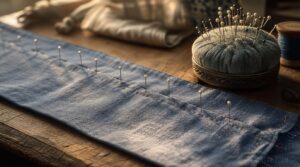
Long seams have a sneaky way of drifting on you. That’s why even pin intervals matter more than most beginners expect. For medium-weight fabrics, aim for 2–3‑inch spacing. Use a mid-seam anchor pin first, then work outward—it keeps everything honest.
| Fabric Type | Pin Density Guidelines | Slippery Fabric Spacing |
|---|---|---|
| Lightweight | Every 1–1.5 inches | Every 1 inch |
| Medium-weight | Every 2–3 inches | Every 2 inches |
| Heavyweight | Every 2.5–3 inches | Every 2.5 inches |
Interval calibration is your secret weapon here.
Pin Alternatives for Delicate Fabrics
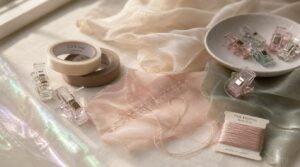
Sometimes pins just aren’t the right tool for the job — especially when you’re working with silk, chiffon, or anything that marks easily. The good news is there are solid alternatives that hold fabric just as well without leaving a trace.
Here’s what actually works.
Sewing Clips for Slippery or Fragile Fabric
Slippery satin or fragile organza? Skip the pins entirely. Sewing clips are one of the best alternatives to traditional pinning — no holes, no snags.
Silicone Padded Jaws grip without marking delicate fibers, while Wide Jaw Comfort clips handle multiple layers cleanly. Magnetic Alignment Clips lock onto rulers for precise placement, and Mini Silicone Snaps keep bias cuts from drifting. Edge Clip Strips cover long hems fast. Wonder Clips work great too.
Pattern Weights for Cutting and Layout
Pattern weights are the quietest tool in your kit — no holes, no fuss. Flat, weighted discs in various weight shapes and sizes hold your pattern pieces steady while you cut.
Material choices matter: felt-backed metal weights grip without slipping.
For placement strategies, keep them inside the pattern outline, away from edges.
Quick maintenance tips: wipe them down and store upright. Simple storage solutions keep them ready.
Hand Basting for Temporary Holding
Hand basting is your best friend when sewing pins would damage delicate fabric. With basting stitches, stitch length control matters — keep them ¼ to ½ inch long.
Contrast thread visibility makes removal easy later.
Try diagonal basting benefits for curved seams or bulky layers. Slip basting techniques and tailor’s tacking uses help with precise alignment without leaving holes behind.
Spray Adhesive for Light Stabilization
Spray adhesive is a surprisingly handy alternative to traditional pinning, especially on fabrics that hate being poked. water-based carrier formula dries fast, stays clear, and won’t stiffen your fabric.
You get temporary fabric bond strength control without leaving residue.
Look for a UV protective formulation if you work near windows.
Always follow application safety tips — test on scraps first, spray in short bursts, and ventilate well.
Stay Tape for Stretch or Knit Edges
Stay tape is your secret weapon for knit edges that just won’t behave. It’s a narrow strip — fusible or non-fusible — that keeps stretch fabric from growing or rippling as you sew. Think of it as alternatives to traditional pinning, minus the puncture holes.
- Fusible Edge Stabilization: press ½-inch tape along necklines or armholes, then heat-set with steam
- Curved Edge Application: choose a knit tape that bends smoothly without wrinkling
- Non-fusible Tape Options: stitch these down by hand or machine when heat isn’t an option
Tape Width Selection matters — match it to your seam. Test on scraps first.
Top 3 Pinning Aid Products
Having the right pins matters, but the right supporting tools can make a real difference too. These three products work well alongside your pins to give you better control, cleaner seams, and less frustration.
Here’s what’s worth keeping in your sewing kit.
1. Clover Silk Glass Head Pins
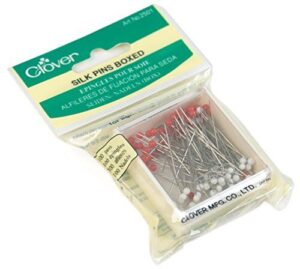
These are the pins serious sewists keep going back to. Clover’s Silk Glass Head Pins have 0.5 mm alloy-steel shafts and 36 mm length — fine enough to slide through silk, chiffon, and organza without leaving a mark.
The glass heads won’t melt under your iron, which matters more than you’d think mid-project. Red ball tips make them easy to spot and grab fast. Each box holds 100 pins, plenty to keep your whole project under control.
| Best For | Sewists working with delicate fabrics like silk, chiffon, and organza who need pins that glide in cleanly and won’t melt under an iron. |
|---|---|
| Material | Polyester elastic yarn |
| Primary Use | Stretch fabric stitching |
| Fabric Compatibility | Lightweight to medium knits |
| Color | Black |
| Package Quantity | 1 spool (142 yds) |
| Heavy Fabric Suitability | Not recommended |
| Additional Features |
|
- Glass heads hold up to heat, so you can iron right over them without worry
- Ultra-fine shafts slide through delicate fabric without snagging or leaving holes
- Red ball tips are easy to spot and grab, which speeds up your whole workflow
- Thin shafts can bend or break on heavier fabrics like quilting cotton
- Not great for thick or multi-layered projects where you need more structural strength
- Once a shaft bends, the pin’s done — no straightening it back out
2. Mettler Seraflex Black Elastic Thread
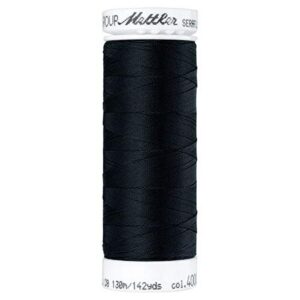
Once your pins are sorted, thread matters just as much — especially on knit fabrics.
Mettler Seraflex Black Elastic Thread is built for stretch. It’s made from 100% PTT fiber and can stretch up to 65% before snapping back without distorting your seam.
Use it in both the needle and bobbin for best results, and keep your tension loose.
At 130 meters per spool, it’s great for leggings, bike shorts, and any project where your seams need to move with you.
| Best For | Sewers working with stretchy fabrics like leggings or bike shorts who want to skip the serger and still get clean, flexible seams. |
|---|---|
| Material | Alloy steel & glass |
| Primary Use | Fabric pinning |
| Fabric Compatibility | Lightweight to medium wovens |
| Color | Red tip |
| Package Quantity | 100 pins per box |
| Heavy Fabric Suitability | Not recommended |
| Additional Features |
|
- Works in both the needle and bobbin, so you get good stretch coverage without special equipment
- Black color blends right into dark fabrics — no awkward thread showing through
- Handy for hand-sewing repairs too, not just machine work
- Some users find it less stretchy than expected, so it might not cut it for high-intensity activewear seams
- A bit pricey compared to your standard polyester thread
- Not great for heavy fabrics or anything that needs serious stretch
3. Fields Fabrics White Fusible Knit Stay Tape
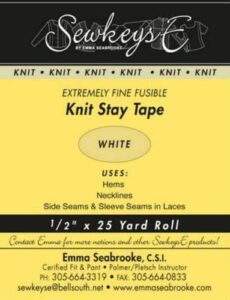
Not everything needs a pin. For knit edges — necklines, shoulders, armholes — Fields Fabrics White Fusible Knit Stay Tape does the stabilizing without any puncture holes.
It’s half an inch wide, knit so it moves with your fabric, and fuses in place with a hot iron. One 25-yard roll covers a lot of projects.
It’s especially handy for lightweight knits that stretch out of shape before you even reach the machine. At $9.99, it’s an easy yes.
| Best For | Sewers working with lightweight knits who want to stabilize seams, hems, and necklines without a cover-stitch machine. |
|---|---|
| Material | Knit fabric & adhesive |
| Primary Use | Seam stabilization |
| Fabric Compatibility | Lightweight to medium knits |
| Color | White |
| Package Quantity | 1 roll (25 yds) |
| Heavy Fabric Suitability | Not recommended |
| Additional Features |
|
- Nearly invisible once fused — no bulk, no visible reinforcement on finished pieces
- Stretches with your fabric, so it won’t fight the knit while you sew
- Layer it for extra width or stability, making one roll surprisingly versatile
- Too thin for heavyweight knits like hoodies unless you double up
- Adhesive can weaken over repeated washes and may need reapplication
- Needs a hot iron with firm pressure — skimp on either and it won’t bond properly
Frequently Asked Questions (FAQs)
What is pinning in sewing?
Think of pinning as the scaffolding before the build. It’s how you hold fabric pieces together temporarily — using pins — so everything stays aligned while you sew your seams.
Do you remove pins while sewing?
Yes — remove pins just before your needle reaches them. Sewing over a pin can bend or break your needle.
Pull each one out as you go, and drop it in a magnetic pin bowl nearby.
What types of pins are suitable for holding bias binding?
For bias binding, straight pins, glass-head pins, and ballpoint pins all work well. Glass heads handle pressing heat, ballpoint tips protect knit bindings, and fine straight pins suit woven fabrics.
How can I prevent fabric damage when pinning?
An ounce of prevention goes a long way here.
Pin within the seam allowance, use fine or silk pins on delicate fabrics, and swap out any bent or rusty pins before they snag your work.
What are the benefits of using glass-headed pins?
Glass-head pins are easy to spot on any fabric, won’t melt under a hot iron, and give you a comfortable grip.
They’re reliable, reusable, and work well across most fabric weights.
Can I use pins for appliqué projects?
Absolutely — pins work great for appliqué.
Use short, fine appliqué pins or glass-head pins to hold small pieces flat without distorting them. Remove each pin just before your needle reaches it.
How do I choose the right pins for my sewing project?
Match your pin to your fabric. Use fine pins (4–5 mm) for silk or chiffon, ballpoint pins for knits, and thicker quilting pins for heavy layers.
Always replace bent or rusty ones.
How do I remove pin marks from delicate fabric?
Funny how the tiniest pin can leave the biggest evidence. Steam the area gently, use a pressing cloth, then lift the fibers with a fine needle. Most marks disappear fast.
Can I sew over pins with any machine?
No, and this isn’t really a machine issue — it’s a safety one.
Hitting a pin can snap your needle, jam the machine, or send a metal fragment flying. Remove pins before you reach them.
How many pins does a beginner need?
A starter set of 100 pins covers most beginner projects comfortably. You won’t need more than that right away.
Fifty pins can work for simple seams, but 100 gives you room to breathe.
Conclusion
Pinning it all together comes down to one simple truth: the right pinning tools in sewing aren’t just accessories—they’re the difference between a project that fights you and one that practically sews itself. Match your pin to your fabric, place them with intention, and swap out anything bent or dull without guilt.
Your seams will be straighter, your fabric happier, and honestly, so will you. Good tools don’t just hold fabric. They hold your work to a higher standard.