This site is supported by our readers. We may earn a commission, at no cost to you, if you purchase through links.
That first seam you sew on a machine feels like a small miracle—fabric feeding through on its own, a clean line of stitches appearing where there was nothing. Then the thread bunches underneath, the needle snaps, and suddenly it feels less miraculous.
Every beginner hits that wall, usually within the first ten minutes.
The good news? Every single problem has a straightforward fix, and the skills that seem mysterious now become second nature faster than you’d expect.
These basic sewing machine tutorials for beginners will take you from tangled threads to finished projects, one confident stitch at a time.
Table Of Contents
- Key Takeaways
- Setting Up Your Sewing Machine
- Mastering Basic Sewing Techniques
- Choosing The Right Fabric and Thread
- Avoiding Common Sewing Mistakes
- Basic Sewing Projects for Beginners
- Troubleshooting Common Sewing Issues
- Essential Sewing Tools and Accessories
- Practicing and Improving Your Sewing Skills
- Advanced Sewing Techniques for Beginners
- Taking Your Sewing to The Next Level
- Frequently Asked Questions (FAQs)
- Conclusion
Key Takeaways
- Matching your needle and thread to your fabric type is the single most important setup decision you’ll make before sewing a single stitch.
- Almost every beginner problem — tangled thread, broken needles, skipped stitches — traces back to incorrect threading or the wrong tension setting, not a broken machine.
- Starting with small, low-stakes projects like a pincushion or pillowcase builds real muscle memory faster than studying technique ever will.
- The iron is just as important as the machine — pressing seams flat at every stage is what separates polished results from amateur-looking ones.
Setting Up Your Sewing Machine
Before you sew a single stitch, you need to get comfortable with your machine. Setting it up the right way makes everything else so much easier.
This beginner’s guide to sewing with a machine walks you through setup step by step, so nothing catches you off guard.
Here’s what to tackle first.
Locating and Understanding Machine Parts
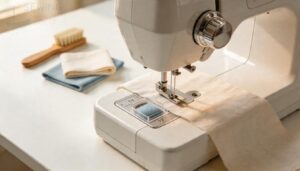
Before you sew a single stitch, get familiar with your machine’s key parts — it makes everything easier.
- Power Switch Location — Usually on the right side or back; always switch it off before threading or cleaning.
- Presser Foot Pressure — This foot holds your fabric against the feed dog mechanism below.
- Needle Plate Guides — Those measurement marks help you sew straight seams every time.
- Bobbin Case Maintenance — Lint collects here fast, so check it often.
- Handwheel — Moves the needle manually for precise control.
Know these, and you’re already ahead! Understanding the drop‑in bobbin system helps prevent thread jams.
Choosing The Right Needle and Thread
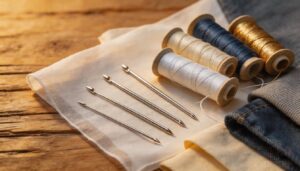
Now that you know your machine’s parts, let’s talk about your right needle and thread — because choosing the right needle and thread is where the magic really begins.
Think of it like picking the right shoes for the weather. Lightweight fabrics like cotton or chiffon? Go with a fine 70/10 needle and thin thread. Heavy denim? Grab a sturdy 90/14.
Match your needle to your fabric like shoes to the weather — fine for delicate, sturdy for tough
Here’s a quick Fabric Needle Compatibility and Thread Weight Matching guide:
| Fabric | Needle Size | Thread Weight |
|---|---|---|
| Silk/Chiffon | 65/9 or 70/10 | Light (Tex 30) |
| Cotton | 80/12 | Medium (Tex 40) |
| Denim/Canvas | 90/14 | Heavy (Tex 70–90) |
| Knits/Stretch | Ballpoint Needle | Polyester stretch |
| Metallic fabrics | Metallic Thread Needle | Metallic thread |
Ballpoint Needle Benefits are real — they glide between fabric fibers instead of piercing them, protecting your stretchy fabrics. A Needle Type Overview tip: universal needles handle everyday projects, but specialty needles truly level up your results. Your manual has the full Thread and Thread Types Overview — check it!
Threading The Machine Correctly
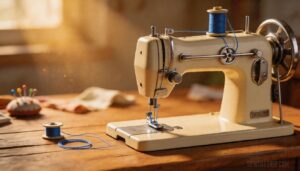
With your needle and thread chosen, it’s time to thread your machine — and yes, it’s easier than it looks!
Start with presser foot positioning: raise it first. This opens the tension discs so your upper thread path seats properly inside them.
Follow these machine threading steps:
- Guide the thread through each thread guide from spool to take-up lever
- Complete tension disc alignment by lowering the presser foot after threading
- Finish bobbin insertion steps with thread trailing counter-clockwise
- Use the needle threader if your machine has one — total real advantage!
Turn the handwheel toward you, and you’re ready to sew!
Mastering Basic Sewing Techniques
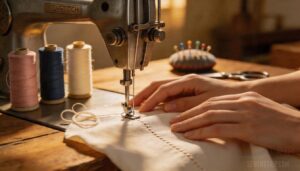
Once your machine is threaded and ready, it’s time to actually sew something.
Every strong project starts with a few core moves you’ll use over and over again.
Here’s what you need to know first.
Straight Stitch and Backstitch
Two stitches will carry you through almost every beginner project: the straight stitch and the backstitch.
The straight stitch is your everyday workhorse. Set your stitch length to around 2.5 mm and let the machine feed fabric forward in a clean, steady line. That’s basic sewing techniques in action — simple and reliable.
The backstitch is where stitch overlap and backstitch reinforcement come in. Hit the reverse lever technique at the start and end of every seam — just 2 to 3 stitches back. That locks everything tight so your work doesn’t unravel.
Together, these two moves cover most beginner sewing projects. Master them, and you’ve got a real foundation.
Sewing in a Straight Line
Getting a perfectly straight line feels like magic the first time it clicks — and it’s easier than you think!
- Use Your Needle Plate Guides: Line your fabric edge up with the etched marks, not the needle itself.
- Master Fabric Control Techniques: Guide the fabric gently — no pushing or pulling. Let the machine do the work.
- Check Stitch Length Adjustment and Thread Tension: Start at 2.5 mm and test on scrap fabric first.
Stay focused on the guide, not the needle. Straight seams, every time!
Turning Corners and Sewing Curves
Corners and curves are where your sewing really levels up!
For sharp turns, mark your pivot point first, then stop with the needle down, lift the presser foot, and rotate. Always do a diagonal corner trim before turning pieces right-side out — it makes sharp point finishing so much cleaner.
Once you’ve nailed these techniques, advanced sewing pattern making lets you adapt any design so your pivots and corners land exactly where you intend them to.
On curves, shorten your curve stitch length and clip concave curves so seams lie flat.
Practice on scrap fabric, and those mitered corners and scalloped edges will soon feel totally natural!
Choosing The Right Fabric and Thread
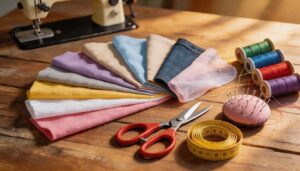
Picking the right fabric and thread makes everything easier — trust me on this one. The good news is that once you know a few basics, it all clicks pretty fast.
Here’s what you need to know to get started on the right foot.
Solid and Elastic Fabrics
Not all fabrics play by the same rules — and that’s what makes sewing so exciting!
Solid fabrics like cotton and linen are your best starting point. They hold their shape, respond well to stitch length adjustments, and make grain direction cutting straightforward. Fabric selection really does set you up for success.
Elastic fabrics are a different story. Stretch needle choice matters here — a ballpoint needle slips between loops instead of tearing them. You’ll also need seam allowance adjustments and thread tension adjustments to keep seams from popping.
Here’s what to remember for each fabric type:
- Cotton — stable, beginner-friendly, forgiving
- Jersey knits — needs stretch stitches and careful handling
- Linen — crisp but wrinkle-prone
- Canvas — heavy, structured, fiber blend effects vary widely
Fabric stretch recovery determines how garments hold their shape after wear. Master this, and you’re unstoppable!
Choosing The Right Thread for Your Project
Think of thread as the backbone of your whole project — get it right, and everything holds together beautifully.
Start with Thread Weight Matching: light fabrics like chiffon love fine 40wt or 50wt thread, while denim needs something beefier. Fiber Compatibility matters too. Cotton thread pairs naturally with quilting cotton, while polyester manages stretchy knits without snapping under pressure.
Check your thread spool before you start — old, brittle thread breaks constantly and messes with your thread tension adjustment. For Color Coordination, match closely for invisible seams or go bold for decorative top‑stitching. Consider Thread Finish Types as well: matte blends in quietly, shiny thread stands out.
Right thread, right project — that combo makes every stitch count!
Pre-washing and Ironing Fabrics
Skipping the pre-wash is like skipping the warm-up — you’ll pay for it later. Fabric shrinkage prevention starts before you even touch your scissors. Wash your fabric the same way you’ll care for the finished item. Water temperature selection matters: cotton and linen handle warm or hot water well, while silk and rayon need cool, gentle cycles. Smart detergent choice means reaching for mild soap — harsh chemicals mess with fabric behavior. Drying method impact is real too; air drying beats high heat every time for delicate cloth.
Here’s your fabric preparation and cutting basics checklist:
- Pre-wash to avoid shrinkage surprises later
- Match wash temperature to your fabric type
- Use mild detergent every time
- Air dry delicate fabrics to preserve shape
- Iron fully dry fabric before cutting
press everything smooth using an iron and ironing board. Use a press cloth on delicate surfaces — it protects against scorching. These fabric care tips turn raw yardage into a perfectly prepped canvas, ready to sew beautifully.
Avoiding Common Sewing Mistakes
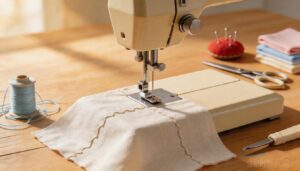
Even experienced sewers mess up sometimes — so don’t stress if your first few attempts aren’t perfect. Most beginner mistakes come down to just a handful of bad habits that are easy to fix once you know what to look for.
Here are the three most common ones to watch out for.
Incorrect Threading and Tension
Bad stitches?
Nine times out of ten, it’s a threading problem.
Upper Thread Errors happen when you miss a guide or skip the take-up lever — loops appear on the back fast.
Bobbin Direction Mistake flips that, showing lower thread on top.
Tension Dial Misadjustment too; start around 4 or 5, then test on scrap fabric.
Fix these first, and watch your stitches snap right back into shape!
Sewing Over Pins and Not Backstitching
Threading sorted? Great — now let’s talk about two habits that make or break your seams.
Pin collision avoidance is simpler than it sounds. Don’t sew over them — ever. That snap you hear? It’s your needle hitting metal, and broken shards can fly. Instead, try these:
- Practice hand‑wheel pin control near tricky spots — turn it slowly to guide the needle safely.
- Keep a magnet pin collection dish on your machine bed for quick removal.
- Use stitch length finish and seam lock alternatives like a lockstitch for clean, secure ends.
Pinning fabric and backstitching to secure seams are your two best sewing basics — don’t skip either!
Not Using The Correct Needle Size
Now, pins aside — let’s talk needles. A needle-fabric mismatch quietly wrecks your work.
Too large, and stitch hole size damages delicate fibers, hurting seam durability. Too small, and thread friction causes breaks and uneven stitches.
Use a needle size chart to match needle and thread to your fabric. A good needle assortment covers everything — choosing the correct needle for fabric is that simple!
Basic Sewing Projects for Beginners
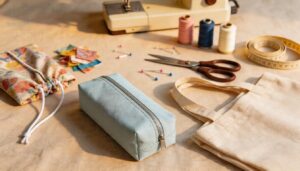
Now that you’ve got the basics down, it’s time to put those skills to work on something real.
Starting with small, useful projects is the fastest way to build confidence with the machine.
Here are three beginner-friendly projects to get you going.
Simple Pincushion
A pincushion is the perfect first DIY sewing project — small, fast, and actually useful! Cut two Pattern Shapes from cotton scraps, stitch around the edge using basic stitch types, and leave a gap for stuffing. Polyfill works great as a Stuffing Material, but crushed walnut shells add satisfying weight. Then close it up tight.
- Add Trim Details like ribbon or buttons for personality
- Try Size Scaling from 3 cm up to 4×6 inches
- Sew a Button Placement through the center for a classic dimple
Machine sewing basics have never felt so rewarding!
Reusable Produce Bags
Now that your pincushion is done, let’s make something you’ll use every single week! Reusable produce bags are one of the best beginner-friendly projects out there.
Grab lightweight organic cotton or mesh for breathable design — both support material sustainability beautifully.
Sew basic stitch types and their uses into drawstring or toggle bag closure types, then follow simple cleaning guidelines: cold water, air dry.
Size organization is everything — make a few!
Easy Zipper Pouch
Ready to sew a zipper pouch? This is one of those beginner sewing projects that feels like a big win the moment you pull it right-side out.
- Pick a 9-inch zipper and adjust the length to match your fabric width
- Add interfacing for structure so your pouch holds its shape
- Stitch close with careful topstitching distance — about 1/8 inch from the zipper
- Finish with boxed corner design for a pouch that stands on its own
Use your sewing machine setup from earlier, match thread color coordination to your fabric, and enjoy the process!
Troubleshooting Common Sewing Issues
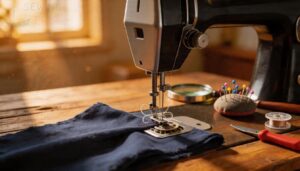
Even the best sewists hit a snag sometimes — that’s just part of the process.
The good news is that most common machine problems have simple, quick fixes once you know what to look for.
Here are the three issues beginners run into most often, and exactly what to do about them.
Thread Breakage and Tangles
Thread breaking mid-seam is one of sewing’s most frustrating surprises — but it’s almost always fixable! Most breaks trace back to Thread Path Obstructions, Bobbin Insertion Errors, or Thread Quality Issues.
Check these five things first:
- Recheck your threading techniques and confirm the thread hits every thread guide
- Adjust your tension dial — tight tension snaps thread fast
- Inspect your needle for bends (Needle Condition Maintenance saves seams!)
- Re-insert bobbin cases with thread running the correct direction
- Slow down — High Speed Tangles happen when you rush
Clean thread tension changes everything.
Machine Jamming and Not Moving
When your machine suddenly stops cold, don’t panic — most jams have a simple fix.
Needle Jam Causes usually start with a bent needle or the wrong size. Bobbin Shuttle Blockage happens when your bobbin case isn’t seated right. Feed Dog Clog from built-up lint is sneaky but common.
Check for Drive Belt Slip or Motor Torque Failure if the motor hums but nothing moves. Clean, rethread, and you’re back in business!
Incorrect Stitch Length and Width
Getting your stitch length and width wrong can turn a clean seam into a crinkled mess. Fabric puckering, zigzag width errors, and seam density issues all trace back to one thing — settings that don’t match your fabric.
Here’s how to fix it fast:
- stitch length to 2.5–3.5 mm for most fabrics
- stitch width only when using zigzag or stretch stitches
- stitch width distortion by testing on scrap fabric first
- Fine-tune adjusting stitch length and tension together for smooth results
Master these basic stitch types and your sewing machine troubleshooting days get a whole lot easier!
Essential Sewing Tools and Accessories
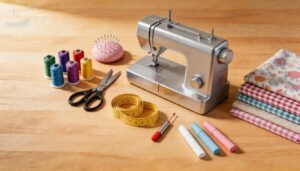
The right tools can make or break your sewing experience — and yes, it really is that simple. Beyond the machine itself, a few key accessories will save you time, frustration, and more than a few crooked seams.
Here’s you’ll want to have on hand.
Rotary Cutters and Mat
A rotary cutter and self-healing mat might just be the upgrade your fabric cutting has been waiting for!
Think of the rotary cutter like a pizza wheel built for fabric — smooth, fast, and incredibly precise.
Blade Size Selection matters more than you’d think. A 45 mm blade manages most everyday projects beautifully, while smaller blades steer tight curves like a champ.
Your cutting mat’s Mat Self-Healing surface closes up after each cut, protecting both your table and your blade.
| Feature | Why It Helps You |
|---|---|
| Safety Blade Guard | Prevents accidental cuts |
| Angle Guide Usage | Keeps cuts perfectly square |
| Layer Cutting Technique | Cuts multiple fabric layers at once |
| Grid Markings | Guides accurate measurement |
| Mat Self-Healing Surface | Extends mat life considerably |
push the cutter forward — never pull back and forth.
Close the blade guard every single time you set it down.
Your future self will thank you!
Sewing Machine Accessories
Your sewing machine accessories are what take you from "just getting by" to genuinely loving every project!
Think of them as your crew — each one has a job, and together they make everything click. Here are five must-haves:
- Presser foot options like a zipper foot or walking foot help you handle tricky fabrics and hardware with ease.
- Bobbin case keeps your lower thread under steady tension so stitches look clean.
- Bobbin winder fills bobbins quickly and stops automatically — no guessing.
- Thread stand feeds large spools smoothly into your thread guide without tangling.
- Needle threader saves your eyes and your patience on tiny needle eyes.
Each accessory solves a real problem. Build your collection one piece at a time, and watch your confidence soar!
Iron and Ironing Board
Now meet the tool that finishes every seam like a pro — your iron and ironing board!
Pick a board with adjustable board height so you’re not hunching over your work. Heat resistant padding underneath keeps everything stable.
Use iron temperature controls to match your fabric, and the stainless steel soleplate with smart steam hole design releases even vapor for smooth fabric preparation.
Press seams flat, and every stitch shines.
Practicing and Improving Your Sewing Skills
Getting better at sewing is really just about putting in the reps — and knowing where to look for help along the way. The good news is you’ve got more resources than ever to keep you moving forward.
Here are a few of the best ways to sharpen your skills and stay inspired.
Online Tutorials and Classes
Learning to sew online has never been easier — and the resources are genuinely great. Whether you prefer live Q&A sessions where you can ask questions in real time, or self-paced video lessons you can pause and replay, there’s something for every learning style.
Here’s what most online sewing classes offer:
- Interactive Quizzes to check your understanding after each lesson
- Downloadable Worksheets for practicing away from the screen
- Community Feedback Forums to share progress and get encouragement
- Progress Tracking Badges so you always know what’s next
Tutorial blogs and web classes round it all out perfectly!
Simple Projects for Beginners
Got some fabric scraps lying around? Put them to work! A Scrap Fabric Pouch or simple pincushion is perfect first win — small, fast, and totally satisfying.
From there, try a Mini Tote Bag, Fabric Bookmark, Simple Headband, or even a Button Cuff. These beginner-friendly projects teach basic stitch types naturally, so you’re actually building real skills while making useful, cute stuff.
Joining a Sewing Community
Once you’ve nailed those beginner projects, the next big move is finding your people. A sewing community turns solo practice into something way more fun. Here’s what to look for:
- Local Meetups at fabric shops or quilt guilds
- Online Forums where you swap tips and show finished work
- Sew‑Along Challenges to stay accountable and motivated
- Fabric Swaps and Mentor Pairing for real skill growth
You’ll learn faster than any online tutorials alone can teach you.
Advanced Sewing Techniques for Beginners
You’ve nailed the basics — now it’s time to level up. These next techniques might sound fancy, but they’re totally within your reach. Here’s what you’ll tackle next:
Buttonholes and Zippers
Closures can make or break a finished piece — and you’ve totally got this! Different buttonhole types exist for a reason: keyhole styles for thick fabrics, rounded ones for delicate silk. Always focus on buttonhole placement and stabilizing buttonholes with interfacing first.
- Test your zipper foot technique on scrap fabric before touching your project.
- Try invisible zipper installation techniques for a clean, polished look.
- Always choose your button before stitching — size matters!
Gathering and Ruffles
Ruffles are one of those details that make people ask, "Did you make that?" Yes, you did! Start by gathering fabric using two parallel basting rows, then pull the bobbin threads to scrunch. Use quarter mark alignment to spread fullness evenly — no lumpy spots!
| Ruffle Type | Best Method |
|---|---|
| Bias-cut ruffles | Zigzag cord gathering |
| Double-layer gathers | Ruffle attachment methods |
| Basic stitches | Standard basting rows |
Check thread tension before you sew!
Free Arm and Blind Hemming
Slipping a pant leg or cuff under the needle used to feel impossible — until you discover the free arm.
Remove the accessory tray, slide your tubular fabric handling around the narrow arm, and suddenly tight spots aren’t scary anymore.
For blind hemming, attach your blind hem foot, press the fold crisp, and use a stitch width adjustment so the needle just barely catches the edge.
Your seam finishing looks clean and nearly invisible!
- Keep fold alignment technique consistent before stitching
- Match thread color for invisible results
- Test basic stitch types on scrap first
- Check your beginner sewing tutorials for free arm setup tips
Taking Your Sewing to The Next Level
You’ve built a solid foundation — now it’s time to stretch your wings. Real creative freedom comes when you start making the machine work for your ideas, not just the instructions.
things get exciting.
Creating Your Own Patterns
Ready to design something totally yours? Start by taking accurate Body Measurements — bust, waist, hip, and length.
From those numbers, you’ll build Drafting Blocks, your personal pattern foundation. Add Seam Allowance around each edge, and you’ve got a real working pattern!
Pattern Drafting sounds fancy, but it’s just drawing shapes from your measurements. Your dream outfit starts right here, on paper.
Altering and Customizing Patterns
Now your patterns work for you. Altering sewing patterns is where pattern drafting gets personal — and powerful.
- Master Seam Allowance Control so edges stay accurate after every change
- Length Adjustments to match your actual torso, legs, or arms
- Dart Modifications to flatter your unique shape
- Pattern Truing and Size Grading to keep pieces lining up perfectly
Your custom fit starts now!
Exploring Different Sewing Styles and Techniques
You’ve built the foundation — now let’s make it sing. Exploring new sewing techniques is where basic sewing skills transform into something truly personal.
| Technique | What It Does |
|---|---|
| Quilting Patterns | Layers fabric and batting into cozy, textured designs |
| Appliqué Design | Adds shaped fabric pieces onto a base for bold detail |
| Smocking Techniques | Gathers fabric into elastic-looking rows for a classic look |
| Embroidery Stitching | Creates surface patterns using basic stitch types and thread |
Try a Patchwork Layout next — it’s a great beginner sewing tutorial hiding inside scrap fabric. Every technique you explore deepens your Fundamentals of Sewing for Beginners journey.
Frequently Asked Questions (FAQs)
How do I start a sewing machine?
Plug in your machine, flip the power switch, and check the machine light indicators — they’ll confirm it’s on.
Load your bobbin, thread the upper path, lower the presser foot, then press the foot pedal gently.
How do I learn to use a sewing machine?
Start with your manual, then practice threading, bobbin winding, and test stitches on scrap fabric.
Watch online tutorials, take a beginner class, and jump in with simple projects to build real confidence fast.
How to choose a sewing machine for beginners?
Choosing a sewing machine starts with ease of use. Look for simple controls, a compact size, and a good motor power.
Beginner sewing guide basics: Straight stitch, zigzag, and a top drop-in bobbin cover almost everything.
How can I make machine sewing easier?
Slow down, use your Speed Slider Control, and let Automatic Needle Down do the heavy lifting.
Good threading techniques, Seam Guide Tape, and a simple Machine Maintenance Routine make every seam feel smooth.
How to start a sewing project for a beginner?
Pick a beginner-friendly project like a pillowcase, gather your materials, and set up your sewing machine.
Read the pattern, match your thread color, and perform a quick stitch test before diving in.
What do you need to make a sewing machine?
You’ll need a sewing machine with a solid motor housing, gear train, and needle bar assembly —
plus thread, bobbins, needles, a presser foot, and a reliable thread guide system to get stitching confidently.
What is the first thing a beginner should sew?
Your first stitch doesn’t need to be a masterpiece. A pillowcase starter project is perfect — straight seams, cotton scraps, and done fast.
It builds real confidence before you tackle drawstring bags or mini totes.
Can I teach myself to use a sewing machine?
Absolutely yes — you can teach yourself! With online tutorials, mindful practice, and beginner-friendly projects, your self-paced learning journey is fully within reach. Mistakes aren’t setbacks; they’re your best teacher.
How to use a sewing machine step by step for beginners?
Starting a sewing machine journey feels like unlocking a superpower you never knew you’d have.
Unbox your machine, read the manual, then focus on threading techniques, bobbin winding steps, stitch length adjustment, and foot pedal control before your first stitch.
What is the easiest thing to sew with a sewing machine?
A pillowcase is the easiest thing to sew. It uses only straight seams, minimal fabric, and basic stitches — perfect for building real confidence fast.
Conclusion
Sewing is a journey, not a destination. With these basic sewing machine tutorials for beginners, you’ll master the basics and access a world of creativity.
As you sew, remember that every stitch is a step forward, and with practice, you’ll become a skilled sewer, using basic sewing machine tutorials for beginners to create something truly special, one confident stitch at a time, every time.
- https://crazylittleprojects.com/how-to-use-sewing-machine/
- https://moonlanka.com/top-5-sewing-machine-features-for-beginners/
- https://www.instructables.com/How-to-Sew-using-a-sewing-machine/
- http://www.treasurie.com/
- https://uark.pressbooks.pub/teachingappareldesign/chapter/sewing-machine-parts-and-safety-teaching-apparel-production/