This site is supported by our readers. We may earn a commission, at no cost to you, if you purchase through links.
Pick the wrong embroidery thread and your design fails before the needle hits the fabric. gorgeous rayon finish on a kid’s jersey won’t survive three wash cycles. Metallic thread snapping every few inches on a rushed machine setting wastes hours.
Thread choice drives everything—sheen, strength, how colors hold after laundering, how the stitch feels against different fabrics. Polyester, rayon, cotton, and metallic each behave differently under tension, heat, and wear.
Choosing between embroidery thread types isn’t guesswork—it’s matching material properties to project demands, and the right call separates work that lasts from work that disappoints.
Table Of Contents
Key Takeaways
- Polyester is your most reliable everyday thread — it survives repeated washing, resists UV, and won’t snap under machine tension.
- Rayon delivers unmatched shine on delicate fabrics, but it fades faster and breaks under high tension or hot washes.
- Cotton suits natural, matte designs on linen and cotton fabrics, though it sheds lint and breaks sooner than polyester.
- Matching thread weight to needle size — and testing tension on scrap fabric first — prevents most embroidery failures before they start.
Embroidery Thread Types Compared
Not all embroidery thread is created equal, and the type you pick changes everything. Each material has its own strengths, weaknesses, and sweet spots where it truly shines.
Knowing which material suits your project gets a lot easier when you browse a breakdown of the best threads for embroidery by type and use case.
Here’s how the four main thread types stack up.
Polyester Vs. Rayon Vs. Cotton Vs. Metallic
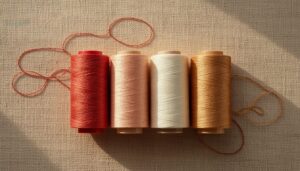
Four threads. Four personalities.
Polyester embroidery thread wins on durability, machine compatibility, and cost efficiency — it’s the workhorse. Rayon embroidery thread delivers that silk-like shine, but sacrifices toughness. Cotton embroidery thread keeps things natural and matte, though it’s the weakest of the group. Metallic embroidery thread grabs attention but demands patience.
This comparison of polyester, rayon, metallic, and cotton threads comes down to one question: what does your project actually need? For projects prioritizing comfort, consider the high breathability cotton option.
Best Uses for Each Thread Material
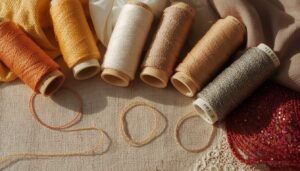
Each thread has its lane.
Polyester embroidery thread covers outdoor gear projects, athletic wear, and kids sleepwear embroidery — anything washed repeatedly.
Rayon embroidery thread belongs on heirloom wedding details and formal pieces where silk-like gloss matters.
Cotton embroidery thread suits eco friendly threads advocates working on linen quilts.
Metallic embroidery thread and silk thread boost festive or couture work.
For denim heavy stitching, go polyester — always.
Durability, Sheen, and Colorfastness Differences
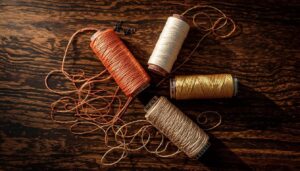
Polyester wins on embroidery thread durability — period. It holds strength retention through dozens of washes, and its colorfastness stability is unparalleled.
Rayon offers gorgeous gloss longevity and sheen consistency, but fades faster.
Cotton? Matte charm, weaker fade resistance.
In any comparison of polyester, rayon, metallic, and cotton threads, metallic dulls quickest. Thread quality shows up in the long run.
Which Thread Type Suits Beginners Best
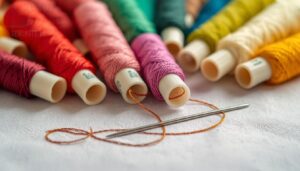
Start with polyester. It ticks every beginner box — low Thread Cost, high Thread Quality, and near-zero Learning Curve.
Machine Compatibility is a non-issue; it runs smoothly on most setups with standard 40 wt Thread Weight and a 75/11 needle, making Thread and Needle Matching simple.
Stitch Visibility stays crisp wash after wash.
Follow basic Beginner Guidelines for selecting embroidery thread: keep it simple, keep it polyester.
Polyester Thread for Everyday Embroidery

Polyester thread is the workhorse of the embroidery world — and for good reason.
It endures more punishment than any other common thread type, from heavy washing to daily wear.
Here’s what makes it the go-to choice for everyday projects.
Why Polyester is The Strongest Common Option
Regarding raw performance, polyester thread simply holds its ground better than the rest. In any comparison of polyester, rayon, metallic, and cotton threads, polyester wins on tensile strength metrics, stitch integrity, and long-term thread quality.
Here’s why it leads:
- Heat resistance — manages high-temp stitching without weakening
- Moisture repellency — dries fast, resists mildew
- Chemical resilience — survives bleach and household cleaners
- Low thread breakage — performs under dense fill and backstitching
- Consistent thread weight — stays uniform across the whole spool
Best Projects for Frequent Washing
Frequent washing destroys weak thread fast. Polyester thread endures it without flinching.
Canvas tote durability holds up past 25 wash cycles. Baby garment longevity stays intact through 80.
Kitchen towel resilience and home décor washability both benefit from polyester’s colorfastness of thread — colors don’t bleed or fade.
Need accessory stitch strength that lasts? Washable embroidery items and fabric compatibility make polyester your go-to every time.
Stretch, Abrasion, and UV Resistance
Thread durability goes beyond wash cycles. Elastomeric thread construction lets polyester stretch 20–40% without permanent deformation — perfect for stretchy fabrics that move with the body.
Abrasion resistant ply endures repeated friction zones without breaking down. UV inhibitor coatings protect color after 1,000+ hours of sun exposure, preventing UV degradation of thread.
Use stretch stabilizer pairing and weatherproof thread testing for outdoor or high-wear projects.
When Polyester Outperforms Rayon and Cotton
Polyester thread wins where it counts most. Here’s when to choose it over rayon or cotton:
- Moisture Management — Dries 20–40% faster, resisting mildew and pilling.
- Shrinkage Prevention — Holds shape after repeated washing.
- UV Resistance — Colors stay bright through heavy sun exposure.
- Cost Efficiency — Lower cost per spool, easier bulk sourcing.
- Stitch Quality — Less breakage on dense designs than rayon or cotton thread.
Rayon Thread for High-Gloss Designs
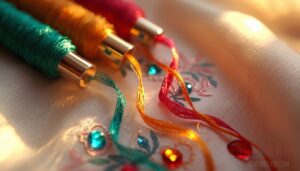
Rayon thread is the go-to when shine matters more than anything else. It catches light the way few other threads can, and the colors hit differently on smooth, delicate fabrics.
what you need to know before you spool it up.
Silk-like Shine and Vivid Color Payoff
Rayon’s thread sheen is hard to beat. Light interaction with the fiber creates an even, glass-like glow — especially on satin stitches.
Dye saturation runs deep, so color vibrancy stays rich after washing.
Shorter stitch lengths boost gloss retention substantially.
Choose the right stabilizer choice, and your thread luster really pops.
It’s the closest thing to silk thread without the price tag.
Best Fabrics for Rayon Embroidery Thread
Smooth surfaces are where rayon thread truly shines. Silk Satin Pairings deliver that mirror-like finish — light catches every stitch. Linen Lightness gives crisp, clean results with soft luster.
Voile Delicacy and Chiffon Glow work beautifully for intricate lettering or decorative motifs. Denim Stabilization works when you back it properly.
Thread Weight and Fabric Compatibility matter — match your weight, control your result.
When Rayon Looks Better Than Polyester
Sometimes the finish matters more than the fiber. On light fabrics, Rayon Thread delivers Light Fabric Glow and Fluid Thread Fall that Polyester Thread simply can’t match.
rayon wins:
- Vivid Color Hold on silk and satin
- Delicate Stitch Detail in fine lettering
- Thread Sheen vs Luster — Rayon reads richer
- Gentle Care Advantage on couture pieces
Durability Tradeoffs to Watch For
That shine comes at a cost. Rayon Thread has lower tensile strength than Polyester Thread, meaning high needle tension triggers thread breakage quickly.
Its abrasion resistance is weak — textured fabrics wear it down quickly.
Watch for heat sensitivity too; hot washes cause fabric shrinkage and color bleed.
Stitch density impact is real: dense fills stress rayon beyond its limits.
Cotton Thread for Natural Texture
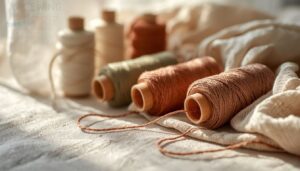
Cotton thread brings something different to the table — a quiet, matte look that polyester and rayon simply can’t fake. It’s the go-to choice when your project calls for texture that feels as natural as it looks.
what you need to know before threading up.
Matte Finish and Soft Visual Effect
Cotton thread doesn’t chase the spotlight — and that’s the point. Its natural light diffusion creates a glare reduction effect that makes designs feel grounded, almost tactile. You get real color depth without the flashiness of thread sheen vs. luster debates.
Cotton thread skips the shine and delivers something richer: color depth that feels grounded, honest, and real
- Surface texture reads warm and handcrafted
- Thread texture stays consistent under UV protection coatings
- Sheen level stays flat, letting the design speak quietly
Best Uses on Cotton and Linen Fabrics
That quiet, matte look pairs naturally with cotton and linen. For Towel Embroidery and Tea Towel Highlights, cotton thread holds up without overpowering the weave.
On Canvas Outline Strength projects, it anchors bold stitches cleanly. Heirloom Linen Accents stay understated.
Thread Weight and Fabric Compatibility matter here — Choosing the Right Embroidery Thread means matching Fabric type selection to texture.
Poplin Gloss designs? Skip cotton. Stick to what fits.
Lint, Strength, and Breakage Considerations
Lint buildup in machine parts is cotton’s biggest headache. It sheds more than polyester — that’s just the nature of the fiber.
Tensile testing shows cotton threads handle less tensile force before breaking, so thread breakage happens faster under stress.
Watch your needle compatibility and tension optimization settings closely. Poor fabric interaction with rough weaves speed wear. Thread quality and lint management aren’t optional here.
When Cotton is The Right Aesthetic Choice
When the goal is warmth over flash, cotton thread wins. It delivers a warm vintage look that polyester simply can’t fake — matte, honest, and lived‑in.
Pair it with linen or natural weaves for subtle texture contrast and organic color depth.
Thread durability matters less here than feel.
Cotton’s breathable comfort and natural fiber story make it the right call for artisanal, heirloom‑style work.
Metallic and Specialty Threads
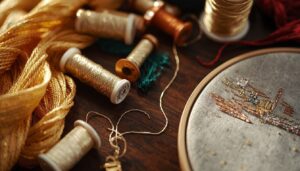
Metallic and specialty threads are where embroidery gets interesting — and a little tricky. They can make a design look stunning, but only if you know how to handle them.
Here’s what you need to know to use them without the frustration.
Metallic Thread Pros and Breakage Risks
Metallic thread earns its place on dark fabric sheen projects — the reflective pop is hard to replicate any other way. But it demands respect. Foil cracking happens fast under high tension, and needle compatibility matters more than you’d think.
Watch for these breakage causes:
- Wrong needle size gouges the thread.
- Speed reduction ignored — machine running too fast.
- Poor stabilizer selection strains every stitch.
Glow-in-the-dark and Variegated Thread Uses
Glow-in-the-dark thread charges under UV or room light, then emits for hours — perfect for Halloween design strategies and nighttime safety accents on kids’ gear and bags.
Variegated and multicolor thread shifts color along the length, creating variegated color gradients without rethreading.
Both are specialty embroidery threads with real uses. Dark fabrics increase glow visibility. Follow glow thread care basics: wash gently, dry at moderate heat.
When Specialty Threads Add Value
Specialty threads earn their place when your design needs more than color.
Metallic thread adds reflective highlights that catch the eye on logos. Variegated thread delivers gradient shifts without rethreading. Glow-in-the-dark thread builds functional durability into safety and novelty pieces.
Together, these specialty embroidery threads create tactile depth and a premium aesthetic — driving real market differentiation, especially when limited colorways make your work exclusive.
Handling Tips for Fragile Decorative Threads
Fragile threads break fast. Handle them right, or lose the design.
- Thread Path Maintenance: Rethread often. Check for sharp bends that fray metallic thread.
- Spool Winding Technique: Unwind without twisting. Kinks cause instant breakage.
- Thread Conditioner Use: Apply lightly to variegated thread and glow-in-the-dark thread for smoother passes.
- Temperature Management + Surface Preparation: Slow your machine. Cool, smooth surfaces protect every fragile fiber.
Match Thread to Project Needs
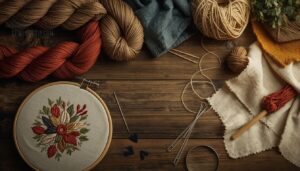
Getting the right thread isn’t just about material — it’s about matching every choice to your specific project. Fabric type, wash frequency, design style, and machine settings all pull the decision in different directions.
Here’s how to line them up so everything works together.
Choose by Fabric Type and Wash Frequency
Your fabric decides the thread. Polyester wins on knits and athletic wear — thread elasticity matching stretch fabric prevents puckering after washing.
For cotton or linen, matte cotton thread suits the texture naturally.
Wash temperature compatibility matters too: polyester tolerates heat up to 140°F; rayon can’t.
Frequent washing demands colorfast, durable threads. Always check care labels first.
Choose by Design Style and Stitch Detail
Your design style drives thread choice just as much as fabric does.
- Geometric stitching needs polyester — crisp, stable, no stretch
- Satin fill strategies shine with rayon’s high-gloss finish
- Fluid motif detailing suits rayon or silk for smooth shading
- Chain edge definition benefits from cotton’s matte, textured grip
- Stitch length variation works best when thread weight matches density
Bold design? Match thread to intention.
Match Thread Weight to Needle Size
Thread weight and needle size work as a pair. Get it wrong and you’ll fight breakage all day.
Use Needle Size Charts to match correctly: 40 wt thread needs an 80/12 needle, 30 wt needs a 100/16, and fine 60 wt calls for a 65/9.
Thread Diameter Impact is real — the Ideal Needle Eye must fit your thread without friction. That’s Fabric Needle Compatibility in practice.
Check Tension, Stabilizer, and Machine Settings
Needle size locked in? dial in your machine.
Upper Tension Adjustment and Bobbin Tension Calibration work together — one off, and both suffer. Start at factory defaults, then move in half-step increments.
Three checks before every project:
- Set Machine Needle Height and verify thread path
- Match Stabilizer Type Selection to fabric weight
- Test Stitch Density Optimization on scrap first
Fix tension before touching your final piece.
Frequently Asked Questions (FAQs)
What is the difference between 40 wt and 60 wt embroidery thread?
40wt thread is thicker, delivering bold stitch visibility and rich color saturation. 60wt is finer, built for design precision with less bulk.
Your thread weight explained simply: lower number, heavier stitch.
Can you embroider on viscose?
Yes, you can embroider on viscose. Use a tearaway stabilizer, sharp needle, and shorter stitch length. Prewash first to prevent shrinkage. Polyester thread holds best through washing.
How does thread color affect embroidery design visibility?
Color is everything — pun intended. High contrast between thread and fabric background boosts visibility up to 12 feet.
Saturation levels, light reflection, and thread sheen vs luster all shape how clearly your design reads.
Can you mix thread types in one project?
Absolutely. Mixing thread types works well when you plan it.
Use polyester for structure, rayon for shine, and metallic for accents.
Test compatibility first. Balance stitch density so no single thread overpowers the rest.
How do I fix thread tension on my machine?
Re-thread with the presser foot up. Clean your Tension Disc Cleaning area. Check Thread Path Inspection from spool to needle. Run a test stitch on scrap fabric.
How should I store leftover embroidery thread properly?
Store leftover embroidery thread like a pro: use airtight containers, add silica gel for humidity control, and shield spools from UV light.
Label everything.
Good thread storage longevity starts with consistent, simple habits.
Conclusion
Every project you start from here carries a decision inside it.
Choosing between embroidery thread types isn’t just a supply question—it’s the difference between work that holds and work that unravels.
Polyester endures.
Rayon shines.
Cotton breathes.
Metallic catches light.
Match the thread to the demand, and the fabric does the rest.
Get it wrong, and the stitches will tell you.
Get it right, and the finished piece speaks for itself.