This site is supported by our readers. We may earn a commission, at no cost to you, if you purchase through links.
Knit fabric has a way of exposing every weakness in your machine—and your patience. A standard sewing machine will pucker jersey, stretch out seams on activewear, and leave raw edges that curl and fray within a few washes.
The fix isn’t better technique; it’s the right tool.
Serger machines for knit fabrics handle what regular machines can’t: trimming, encasing, and stitching in one fluid pass while maintaining the stretch your fabric demands.
Features like differential feed, four-thread overlock, and air threading separate machines that perform from ones that frustrate. The ten options ahead cover every skill level, fabric weight, and budget worth considering.
Table Of Contents
- Key Takeaways
- Top 10 Sergers for Knit Fabrics
- 1. Singer Professional S0700 Air Threading Serger
- 2. Brother 1034D Heavy Duty Serger
- 3. Singer S14-78 Serger Overlock Machine
- 4. KPCB Metal Frame Serger Sewing Machine
- 5. Lumina Heavy Duty Serger Overlock Machine
- 6. Brother AIR1800 Air Serger Jet Air Threading
- 7. Brother 2340CV Coverstitch Serger
- 8. Juki Serger Overlock Machine
- 9. Singer Heavy Duty Serger Overlock Machine
- 10. Lumina Moda Serger Overlock Machine
- Key Features for Sewing Knits
- Stitch Options for Knit Garments
- Threading and Fabric Control
- Choosing The Right Knit Serger
- Frequently Asked Questions (FAQs)
- Conclusion
Key Takeaways
- Differential feed is the single most critical feature for knit sewing — without it, your seams stretch, wave, and pucker no matter how good your technique is.
- A 4-thread overlock outperforms 3-thread setups on knit fabrics because the extra needle thread adds real seam strength and lets the stitch flex with the fabric instead of fighting it.
- Air-threading systems like those on the Brother AIR1800 and Singer S0700 cut setup time dramatically, but they’re not foolproof — always know how to thread manually as a backup.
- Your serger can’t fully replace a regular sewing machine — buttonholes, zippers, and topstitching still need a standard setup, so think of the two as a team, not a swap.
Top 10 Sergers for Knit Fabrics
Finding the right serger for knit fabrics can feel overwhelming with so many options out there. The machines below have been selected based on how well they handle stretch, seam strength, and ease of use for knit projects.
If you’re wondering when to reach for each tool, this guide on whether a serger can replace your regular sewing machine breaks down the differences clearly.
Here are the 10 best sergers worth your attention in 2026.
1. Singer Professional S0700 Air Threading Serger
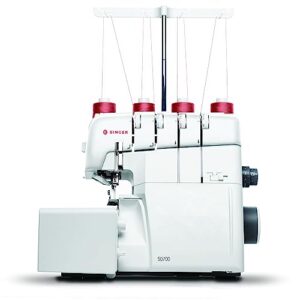
The Singer S0700 takes the hassle out of threading with its one-touch air system — pull a lever, and both loopers are done. That’s a genuine time-saver when you’re mid-project.
It processes knits confidently, offering 15 stitch options, 4/3/2-thread flexibility, and differential feed to keep stretch fabrics from puckering.
Electronic speed control tops out at 1,300 spm, giving you real command over your pace.
The included accessory kit means you’re ready to sew from day one.
| Best For | Home sewers and small-business owners who want faster setup and clean, professional seam finishes across a range of fabric types. |
|---|---|
| Max Speed | 1300 spm |
| Thread Options | 2/3/4-thread |
| Differential Feed | Yes |
| Frame Material | Metal/Plastic |
| Weight | 13.9 lb |
| Color-Coded Threading | Yes |
| Additional Features |
|
- Air threading system threads both loopers in seconds — huge time-saver, especially if you have arthritis or limited dexterity.
- 15 stitch options with 4/3/2-thread flexibility handles everything from heavy denim to lightweight chiffon.
- Differential feed keeps knits and stretch fabrics smooth without puckering or distortion.
- Air threading needs a decent thread tail to work reliably — short tails can cause mis-feeds.
- The needle threader feels clunky and requires switching into a separate threading mode, which adds extra steps.
- Only a universal presser foot is included — you’ll need to buy specialized feet separately for rolled hems or flatlocking.
2. Brother 1034D Heavy Duty Serger
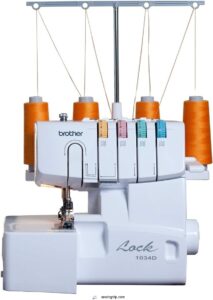
If air threading isn’t your priority, the Brother 1034D delivers where it counts: raw durability.
Its heavy-duty metal frame keeps things stable even when you’re pushing through multiple layers of jersey or thick knit.
You get 3- or 4-thread overlock capability, differential feed from 0.7 to 2.0, and speeds up to 1,300 spm — solid specs for demanding projects.
Color-coded threading paths make setup approachable, and the convertible free arm manages cuffs without wrestling the fabric into place.
| Best For | Sewers who work with heavy fabrics and multiple layers and want a durable, no-frills serger without paying extra for auto-threading. |
|---|---|
| Max Speed | 1300 spm |
| Thread Options | 3/4-thread |
| Differential Feed | Yes |
| Frame Material | Heavy-duty Metal |
| Weight | 17.7 lb |
| Color-Coded Threading | Yes |
| Additional Features |
|
- Metal frame handles tough materials like denim and thick knits without wobbling or stalling
- Color-coded threading makes setup manageable, even if you’re new to sergers
- Differential feed keeps stretchy and delicate fabrics from puckering or distorting
- Manual threading can still feel intimidating if you’ve never touched a serger before
- Blind hem, pin tuck, and flat-lock stitches need extra feet that don’t come in the box
- At 17.7 lbs, it’s not something you’ll want to lug around often
3. Singer S14-78 Serger Overlock Machine
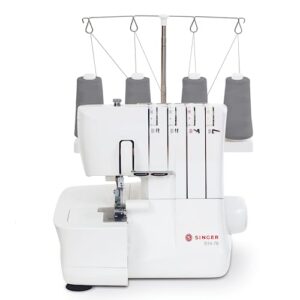
Where the Brother leans heavy-duty, the Singer S14-78 finds its strength in versatility. It accommodates 2-, 3-, and 4-thread configurations, so you can move between finishing woven edges and sewing stretchy knit seams without swapping machines.
Differential feed keeps jersey and interlock lying flat, while the free arm gives you clean access to cuffs and sleeves.
At 1,200 stitches per minute, it keeps pace with most home projects — and the color-coded threading paths mean you won’t lose an hour just getting started.
| Best For | Home sewers who work with a mix of fabrics — from lightweight knits to woven garments — and want one machine that handles finishing, hemming, and seam work without a lot of fuss. |
|---|---|
| Max Speed | 1200 spm |
| Thread Options | 2/3/4-thread |
| Differential Feed | Yes |
| Frame Material | Metal/Plastic |
| Weight | 13.89 lb |
| Color-Coded Threading | Yes |
| Additional Features |
|
- Handles 2-, 3-, and 4-thread setups, so you can switch between stitch types as your project demands
- Differential feed does a great job keeping stretchy fabrics like jersey from puckering or distorting
- Free arm makes it easy to sew tight spots like cuffs and sleeves without fighting the fabric
- No printed manual included, so beginners will need to hunt down videos or PDFs just to get started
- A few users reported motor issues within the first few months, which raises questions about long-term reliability
- Warranty repairs mean shipping the machine to Michigan on your own dime, which isn’t ideal
4. KPCB Metal Frame Serger Sewing Machine
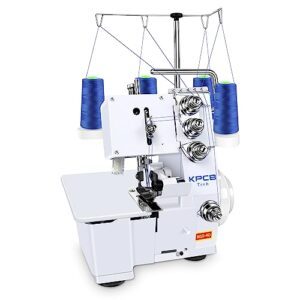
If the Singer S14-78 wins on flexibility, the KPCB Metal Frame Serger earns its place through solid, dependable construction.
The steel chassis keeps vibration low at its 1,200-stitch-per-minute ceiling — a real advantage when you’re running through layers of jersey or ribbed knit.
Differential feed and adjustable presser-foot pressure give you real control over stretch, and the color-coded threading guides make setup straightforward.
It’s compact enough for a small studio, yet sturdy enough to handle your more demanding knit projects.
| Best For | Home sewers and hobbyists who work with medium to heavy fabrics and want a durable, portable serger for finishing seams quickly. |
|---|---|
| Max Speed | 1200 spm |
| Thread Options | 3/4-thread |
| Differential Feed | Yes |
| Frame Material | Heavy-duty Metal |
| Weight | 17.9 lb |
| Color-Coded Threading | Yes |
| Additional Features |
|
- Heavy-duty metal frame keeps the machine stable even at top speed, so you can power through denim or canvas without it rattling around
- Built-in cutting blade trims and finishes seams in one pass, which seriously speeds up garment projects
- Compact size and carry handle make it easy to store or take along to a class or sewing event
- Threading is a real headache — no numbered tension markings means a lot of trial and error before you get it right
- Some units have loose blade and needle fittings, which can lead to broken needles or uneven cuts mid-project
- The LED light is hit or miss — it can be too bright, and it may switch off on its own during longer sewing sessions
5. Lumina Heavy Duty Serger Overlock Machine
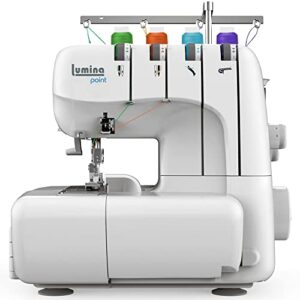
The Heavy Duty Serger punches above its price point with a rigid metal frame that keeps things stable at 1,250 stitches per minute.
Pair it with fabric scissors built for professional seamstresses to keep your entire workspace performing at the same high standard.
You get 2/3/4-thread overlock, rolled hem, flatlock, and cover hem options — real versatility for knit projects ranging from activewear to light jackets.
Differential feed and adjustable stitch length give you control over stretch, while color-coded threading keeps setup frustration‑free.
Just know, going in: it runs loudly, and the manual could use a rewrite.
| Best For | Home sewists and hobbyists who work regularly with knits, activewear, or layered fabrics and want professional-looking seams without spending premium serger money. |
|---|---|
| Max Speed | 1250 spm |
| Thread Options | 2/3/4-thread |
| Differential Feed | Yes |
| Frame Material | Metal |
| Weight | 19.8 lb |
| Color-Coded Threading | Yes |
| Additional Features |
|
- Metal frame keeps the machine steady at full speed — no wobbling or drifting mid-seam
- Color-coded threading makes switching threads fast and pretty painless
- Differential feed handles stretchy and layered fabrics well, so knits come out clean instead of puckered
- It’s loud — not ideal if you’re sewing while others are nearby or sleeping
- The manual is poorly translated, so beginners may need YouTube to fill in the gaps
- Some parts (cutter, tension bar) show early wear, which raises questions about long-term durability
6. Brother AIR1800 Air Serger Jet Air Threading
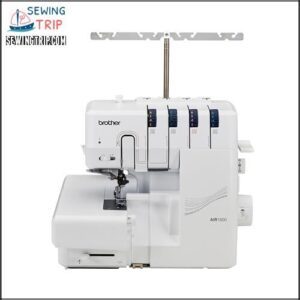
Threading a serger used to mean 20 minutes of squinting and cursing. The AIR1800 fixes that — one button press sends a jet of air through the loopers, and you’re ready to sew.
It accommodates 2, 3, or 4-thread configurations with color-coded guides, runs at 1,300 spm, and includes differential feed (0.7–2.0 mm) for clean results on stretch knits.
LED lighting, safety error indicators, and a quick rolled-hem lever round it out. At $899.99, it’s built for sewists who value speed over everything.
| Best For | Sewists who work with stretch fabrics and want to spend less time threading and more time actually sewing. |
|---|---|
| Max Speed | 1300 spm |
| Thread Options | 2/3/4-thread |
| Differential Feed | Yes, 0.7–2.0mm |
| Frame Material | Plastic |
| Weight | 21.5 lb |
| Color-Coded Threading | Yes |
| Additional Features |
|
- Air-jet threading makes setup almost instant — no more fishing thread through tiny loopers by hand
- Differential feed (0.7–2.0 mm) handles knits, jerseys, and activewear without puckering
- LED lighting and color-coded guides make the whole process easier, especially on dark fabrics
- The air-threading system has known failure reports, so you’ll want a backup manual threading tool handy
- Only one speed (1,300 spm) — no way to slow it down for really delicate work
- No built-in thread catcher, and at $899.99, that feels like an oversight at this price point
7. Brother 2340CV Coverstitch Serger
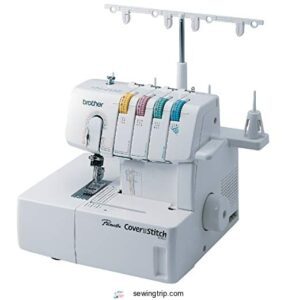
Cover stitching is where the 2340CV earns its place. It’s a dedicated coverstitch machine — not a hybrid — so every feature points toward one goal: clean, professional hems on stretch fabrics.
You get three stitch options (wide, narrow, and tri-cover), adjustable differential feed from 0.7 to 2.0 mm, and a sturdy metal frame that won’t wobble mid-seam.
At 1,100 spm, it’s quick enough for production runs. If your focus is knit hems, neckbands, or activewear edges, this machine doesn’t waste your time.
-only — not ideal if you’re outside the States.
| Best For | Sewists and small-batch garment makers who work regularly with knits, activewear, or stretch fabrics and want a dedicated coverstitch machine that delivers clean, professional results every time. |
|---|---|
| Max Speed | 1100 spm |
| Thread Options | 2/3/4-thread |
| Differential Feed | Yes, 0.7–2.0mm |
| Frame Material | All-Metal |
| Weight | 13 lb |
| Color-Coded Threading | Yes |
| Additional Features |
|
- All-metal frame feels solid and built to last — this isn’t a machine that rattles around when you push the speed up.
- Color-coded threading and lay-in guides make setup fast, even if you’re not a coverstitch veteran.
- Differential feed (0.7–2.0 mm) handles everything from swimwear to heavy jerseys without puckering.
- Thread breakage on the left needle is a known frustration — getting the tension dialed in takes some trial and error.
- It only does coverstitch. No serging, no overlocking, so you’ll still need a separate machine for other tasks.
- Only works on 120V U.S. power, and the warranty is U.S.
8. Juki Serger Overlock Machine
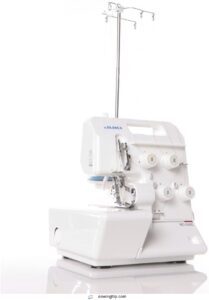
The JUKI MO-644D processes knit fabrics with quiet confidence. It runs at 1,500 spm, accommodates 2/3/4-thread configurations, and includes differential feed to keep jersey and rib knits from stretching out of shape.
The automatic rolled hem is a real time-saver for finishing necklines and cuffs cleanly.
Color-coded threading paths mean you’re not squinting at a manual every time you rethread.
At 19 lb, it’s sturdy without being immovable — a solid everyday workhorse for home studios and teaching spaces alike.
| Best For | Home sewers, apparel makers, and sewing instructors who work regularly with knit and stretch fabrics and want a reliable, easy-to-thread serger for everyday use. |
|---|---|
| Max Speed | 1500 spm |
| Thread Options | 2/3/4-thread |
| Differential Feed | Yes |
| Frame Material | Metal |
| Weight | 19 lb |
| Color-Coded Threading | Yes |
| Additional Features |
|
- Runs at 1,500 spm with differential feed, so stretchy fabrics like jersey and rib knit stay smooth and pucker-free
- Color-coded threading system makes setup fast and far less frustrating, even if you’re new to sergers
- Automatic rolled hem saves real time when finishing necklines, cuffs, and raw edges on delicate or stretchy materials
- Not self-threading — you’ll need to follow the sequence carefully and may want a tutorial video handy at first
- At 19 lb, it’s on the heavier side, which can be a bit much if you’re working in a tight space or moving it often
- Needs a voltage transformer for 220–240 V regions, which adds around $160 to the cost upfront
9. Singer Heavy Duty Serger Overlock Machine
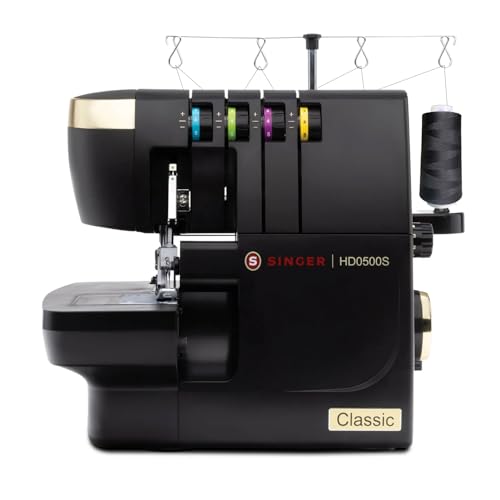
The Singer Heavy Duty Serger processes knit fabrics without fuss. Its 1,300 spm motor gives you consistent speed through denim, jersey, and sheer layers alike.
You get 2-, 3-, and 4-thread capability across six built-in stitch types, including overlock and rolled hem.
The differential feed keeps stretchy knits flat and smooth, while the free arm makes cuffs and sleeves easy.
Built-in suction cups lock it to your table — no shifting mid-seam.
solid pick for beginners ready to sew heavy-duty.
| Best For | Sewists who work with a mix of heavy fabrics and delicate knits and want a reliable, fast serger that’s approachable enough for beginners but capable enough for small-scale production. |
|---|---|
| Max Speed | 1300 spm |
| Thread Options | 2/3/4-thread |
| Differential Feed | Yes |
| Frame Material | All-Metal |
| Weight | 15.9 lb |
| Color-Coded Threading | Yes |
| Additional Features |
|
- Screams through fabric at 1,300 stitches per minute — denim, jersey, sheers, you name it
- The color-coded threading and lower-looper LED make setup way less intimidating than most sergers
- Suction-cup base and metal frame keep it rock-solid on the table, even at full speed
- No air-threading means you’re still doing it by hand, LED or not
- The printed manual is gone — you’ll need your phone or a computer just to get started
- The included waste tray fills up fast, and most users end up rigging their own solution pretty quickly
10. Lumina Moda Serger Overlock Machine
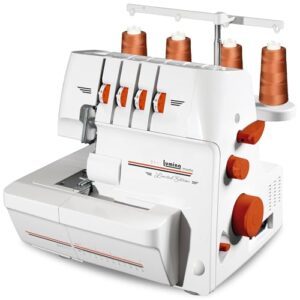
The Lumina Moda punches above its $259.99 price tag. You get a heavy-duty metal frame, built-in LED lighting, and a free arm — features you’d normally pay more for.
It runs at 1,250 spm on a 90 W motor, handling knits, jersey, and light wovens without drama.
The differential feed prevents puckering, and the trim trap keeps your workspace clean.
Threading is color-coded, so setup doesn’t slow you down.
One caveat: no warranty, and the rolled-hem instructions need work.
| Best For | Home sewists and garment makers who want professional-quality overlocking without spending a fortune. |
|---|---|
| Max Speed | 1250 spm |
| Thread Options | 2/3/4-thread |
| Differential Feed | Yes |
| Frame Material | Heavy-duty Metal |
| Weight | 16.5 lb |
| Color-Coded Threading | Yes |
| Additional Features |
|
- Heavy-duty metal frame with a free arm and LED light — solid build for the price
- Color-coded threading and differential feed make it beginner-friendly and fast to use
- Handles knits, jersey, and wovens at 1,250 spm without puckering or fuss
- No warranty, and some users have reported motor failures within months
- Rolled-hem setup instructions are vague — expect some trial and error
- At 16.5 lb, it’s not something you’ll want to haul around
Key Features for Sewing Knits

Not all sergers handle knit fabrics equally well, and the right features make a real difference in your finished seams. Before you commit to a machine, it’s worth knowing which specs actually matter for stretchy, delicate, or heavy knit projects.
Here are the key features to look for.
Differential Feed for Preventing Stretched Seams
Differential feed is your secret weapon against wavy, stretched-out seams. Using the neutral ratio setting provides a baseline for accurate adjustments.
By tuning the Feed Ratio Tuning dial — usually between 0.7 and 2.0 — you control Front-Back Feed Balance so knit fabric compatibility stays consistent across weights.
Run a Swatch Test Protocol first, adjusting in 0.1 increments.
Combine Knit Edge Stabilization with Stitch Tension Sync, and your stretch fabrics will lie perfectly flat every time.
4. thread Overlock for Stronger Knit Construction
Once your differential feed is dialed in, the next layer of control comes from your thread count.
A 4-thread overlock machine adds a second needle thread — that’s Thread Duplication working in your favor. It boosts Seam Reinforcement and Fabric Stretch Retention while keeping Edge Trim Control tight.
For knit fabric compatibility and real Durability Testing results, this setup simply outperforms three-thread alternatives.
Adjustable Stitch Length and Width
Thread count handled; now let’s talk precision.
Stitch Length Calibration and Width Ratio Tuning directly shape how knit fabric stitching behaves under tension.
Start mid-range — length 2.5 mm, width 4.5 mm — then tune in 0.5 mm steps.
Precision Dial Settings lock your choices in place.
Match those numbers to Fabric Weight Matching guidelines, and your seams won’t curl, pucker, or pull.
Presser-foot Pressure Control for Delicate Knits
Stitch dimensions locked in — now it’s time to talk about grip.
Your Foot Pressure Dial controls how hard the presser foot holds fabric during sewing. Get it wrong, and even perfect stitch settings won’t save a wavy seam. A solid Pressure Calibration Routine keeps knit fabric stitching smooth:
- Start at pressure 1–3 for delicate knits
- Run a Pressure Testing Swatch before cutting into your garment
- Dial in Pressure Tension Balance by adjusting thread tension alongside pressure
Your Pressure Settings Chart paired with presser foot options gives you full fabric handling capability across any knit weight.
Free Arm for Cuffs, Sleeves, and Neckbands
For cuffs, neckbands, and sleeves, free arm ergonomics completely change how you handle tubular sewing. Drop the cover plate, expose the arm, and you can guide stretch fabrics around that narrow surface without bunching or pulling.
Arm access mechanisms vary by model — some detach, some drop away — but the result is the same: seam distortion prevention on small circumferences that flat beds simply can’t manage.
Built-in Rolled Hem for Lightweight Knit Edges
A built-in rolled hem gives lightweight knit edges a finish that looks store-bought without bulk. Activate it via stitch selector, and the Fold Precision Mechanism folds fabric twice into a 1–3 mm edge:
- Edge Softness Retention keeps stretch alive
- Minimal Bulk Edge suits sheer and jersey
- Hem Visibility Reduction hides raw seams
- Smooth Edge Finish on tanks and tees
- Consistent width on lightweight knit edges
Stitch Options for Knit Garments
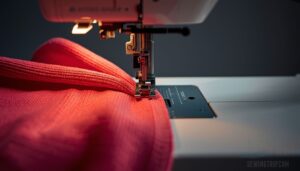
Not all stitches are created equal — and when you’re working with knit fabrics, the right one can make or break your finished garment. Your serger likely does more than you think, offering several stitch types built specifically for stretch, structure, and a clean professional look.
Here’s what each one does and when to reach for it.
Overlock Stitches for Stretchy Seams
Overlock stitches are your best ally when working with knit fabrics. A 4-thread overlock delivers serious seam elasticity testing results — it stretches with the fabric instead of snapping under pressure.
Dial in your differential feed and thread tension to nail fabric feed synchronization, and you’ll eliminate edge curl control problems fast.
Stitch density and loop interlock ratio determine how well your stretchy fabrics actually perform.
Rolled Hems for Lightweight Knit Finishes
A rolled hem transforms a raw knit edge into something clean and barely‑there. For lightweight jersey, modal, or fine knits, the built‑in rolled hem plate folds fabric twice before stitching — delivering edge seam consistency without bulk.
- Use steam press preparation first: light steam stabilizes the edge before rolling
- Dial differential feed to prevent waves or gathering along delicate knit fabrics
- Match thread weight matching to fabric weight for a tidy, flat roll
- Control fold depth control, by trimming excess before guiding through the foot
- Apply fabric edge stabilization tape on stretchy fabrics to prevent distortion mid‑stitch
Flatlock Seams for Activewear and Decoration
Flatlock stitches sit flush against knit fabrics, eliminating the ridge that causes chafing during workouts. That’s what makes them the go-to seam for activewear — pure Seam Smoothness with zero bulk.
Flatlock stitches lie flush against skin, eliminating bulk and chafing for seamless activewear performance
Differential feed keeps Fabric Stretch consistent while interlocking threads preserves Knit Flexibility through repeated wear.
| Feature | Benefit | Best For |
|---|---|---|
| Edge Visibility | Discreet seam line | Color Matching panels |
| Flat profile | No skin irritation | Compression activewear |
| Decorative stitches | Design detail | Color-block leggings |
Cover Hem Stitches for Professional Hems
Cover hem stitches give knit fabrics a clean, store-bought look you can’t fake with a regular machine.
You’ll see two or three parallel topstitches on the right side — that’s your Hem Seam Consistency doing its job.
Pair your coverstitch with differential feed, use a Fabric Edge Guide, and dial tension carefully.
The result? Professional Finish Tips made visible: flat, resilient hems with real Edge Reinforcement.
Chain Stitching for Durable Garment Construction
Chain stitching builds Seam Elasticity that flat stitches simply can’t match — the Stitch Loop Length flexes with every stretch and recovery cycle, making it ideal for knit fabrics under real movement stress. Pair it with Backstitch Integration at stress points, and your seams won’t budge after dozens of wash cycles.
Multi-Thread Chain with differential feed adds Chain Reinforcement where it counts most.
Choosing Thread Count by Fabric Weight
Thread count matters more than most sewers realize. lightweight knits, stay in the 150–250 TC range to keep seams soft and flexible.
Medium Knit TC sits around 200–300, while Heavy Knit TC tops out near 350.
Fiber Type Matching shifts things too — cotton tolerates higher counts than synthetics.
Always run Swatch TC Testing first. Your serger’s thread capacity and stitch options do the rest.
Threading and Fabric Control
Threading a serger doesn’t have to feel like solving a puzzle, and controlling how knit fabric feeds through the machine is easier than most people think.
A few key settings make the difference between puckered seams and smooth, professional results.
Here’s what you need to know to get it right.
Color-coded Threading Paths for Beginners
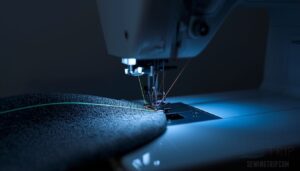
Color Mapping Guide makes serger threading far less intimidating for beginners. Each thread path uses a distinct hue — green for the lower looper, blue for the right needle, yellow for the left needle, pink for the upper looper — so Thread Path Visualization becomes almost instinctive.
Beginner Thread Sequencing in that exact order every time.
If guides wear off, Color Guide Maintenance is simple: replace the front panel insert.
Troubleshooting Thread Colors? Recheck misplaced needle paths first.
Air Threading for Faster Setup
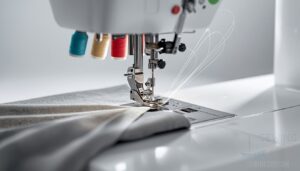
Beyond color guides, setup speed matters just as much.
Jet Air Threading — like what you get with the Brother AIR1800 Air Serger Jet Threading — uses Automatic Looper Activation to push thread through in under 60 seconds. That’s a Threading Time Reduction of up to 70%.
One Push Threading manages all loopers in sequence, so you spend less time setting up and more time sewing knit fabrics.
Tension Adjustment for Smooth Knit Seams
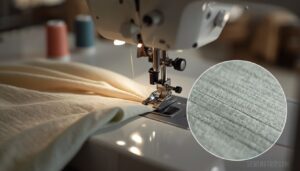
Getting tension right is what separates a clean knit seam from a puckered mess. Start with tension test swatches on matching fabric weight — upper tension tuning and lower tension calibration work together, so adjust one at a time.
Thread tension matching across all loopers ensures stitches lock evenly inside the seam. lightweight jersey needs gentler, looser settings than heavy rib knits.
Knife Adjustment for Clean Seam Allowances
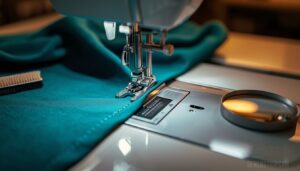
Dialing in your knife adjustment is what keeps seam allowances consistent and edges clean. Start with Knife Angle Setting between 15–25 degrees for knits — this prevents curling without snagging. Blade Height Alignment should mirror the needle line.
For Cutting Width Calibration, 3/8 inch works well for most jersey.
A solid Knife Care Routine — daily lint wipe, Burr Prevention checks — protects seam strength and edge finish.
Ball-point Needles for Knit Fabric Protection
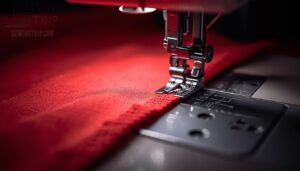
Switch to ball-point needles and your knit fabrics will thank you. Their rounded tips slide between loops rather than piercing them, ensuring Loop Preservation and Stretch Retention across every seam.
For Needle Size Guidance, use 70/10 for lightweight jersey and 90/14 for heavier knits. Combined with thread tension adjustment and differential feed importance, Seam Elasticity stays consistent — wash after wash.
Stabilizing Tape for Shoulder and Side Seams
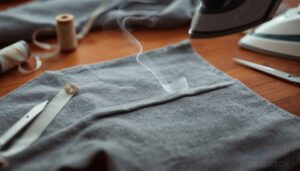
Shoulder seams are quietly the most stressed seams in any knit garment. A half-inch fusible stay tape sewn directly into the seam line keeps them from sagging over time.
For Fusible Tape Types, press with a hot iron to activate the bond; for Nonfusible Stabilization, serge it in place.
Follow Tape Width Guidelines — narrower for lightweight jerseys, wider for thick sweater knits. Always Trim Excess Tape to reduce bulk, and adjust your thread tension to keep the seam flat.
Choosing The Right Knit Serger
Not every serger works the same way for every knit project, and that gap matters more than most people realize. The right match depends on what you’re making, how you work, and what you’re willing to spend.
Here’s what to look for across the most important categories.
Best Serger Type for Beginners
If you’re just starting out, the right serger makes all the difference. Look for a beginner-friendly model with an easy interface, simple stitch selection, and color-coded threading paths.
Differential feed importance can’t be overstated — it’s what keeps knit fabric handling smooth and seam-free. A compact machine size, low-cost model around $300–$400, and beginner safety features round out smart beginner serger recommendations.
Best Features for Activewear Sewing
Activewear demands a lot from your serger — think compression leggings pulling at every seam during a squat.
You need differential feed to keep stretch panels smooth, adjustable tension for spandex blends, and high speed stitching backed by solid Motor Power Efficiency.
Frame Vibration Dampening, Seam Recovery Technology, LED Lighting Visibility, Portable Frame Weight, and knit fabric handling round out winning activewear and stretch fabric sewing performance.
Best Options for Lightweight Jersey
Lightweight jersey — think 100–150 gsm cotton tees — needs a gentler touch than activewear. Fabric Tension Tuning and differential feed keep those airy seams from rippling.
Dial in Seam Allowance Settings around 5 mm, use Needle Size Guidance for size 10–70 ball‑points, and lean on Stitch Density Control with adjustable stitch length and width.
Thread Weight Choice and thread tension do the rest.
Best Options for Thick Sweater Knits
Thick sweater knits demand more muscle than jersey ever will.
You’ll want a heavy-duty metal frame serger with differential feed, Heavy Duty Blades in a smart Blade Material Choice like stainless steel, and a Large Presser Foot to clear bulky layers.
Thread Weight Matching and Stitch Width Control keep seams balanced, while high stitching speeds up to 1300 SPM push through dense sweater knit without stalling.
Portability Versus Heavy-duty Construction
Sweater knits pushed you toward durability—now ask yourself how often you move your machine.
- Weight Comparison: Portable sergers under 15 lbs win on Transport Convenience; heavy-duty metal frame units trade mobility for stability.
- Frame Material: Steel supports dense knit fabrics and high stitch speed without flex.
- Setup Time: Portables unfold fast; heavy-duty models need recalibration after moving.
- Maintenance Frequency: Compact units need less upkeep; differential feed mechanisms on heavier machines require scheduled checks.
Price, Accessories, and Long-term Value
Once you’ve settled on your build needs, price does the final sorting.
Entry-level models run $299–$499 and cover the basics well. Mid-range options ($500–$799) add air threading and better accessory bundles. Premium machines top out near $1,299 with longer warranty length and lower total cost ownership over time.
Budget-friendly picks hold resale value best when frames prioritize durability and construction, and maintenance costs stay manageable with regular oiling.
Frequently Asked Questions (FAQs)
Can you serge knit fabric?
Yes, you can serge knit fabric.
Use a 4-thread overlock, ballpoint needles for needle compatibility, activate differential feed, and choose polyester thread for thread elasticity to keep seams smooth and stretchy.
Is there a difference between a serger and an overlock machine?
Not really. "Serger" is the American term; "overlocker" is used in the UK and Australia. Same machine, different regional naming. Both trim edges and enclose them with thread simultaneously.
How do I care for my serger long-term?
Think of your serger like a car — skip the oil changes, and it’ll let you down mid-project.
Clean lint weekly, oil every 8–10 hours, swap needles regularly, and control humidity to extend longevity.
Can a serger replace a regular sewing machine?
A serger manages Fabric Stretch Management and seam finishing beautifully, but it can’t do everything.
Buttonhole Capability, Zipper Installation, and Topstitching Limitations mean you’ll still need a regular machine alongside it.
What fabrics should beginners avoid when starting out?
Skip silk satin, chiffon organza, velvet nap, leather faux, and heavy denim when starting out. These cause fabric distortion, feeding issues, and inconsistent seams — stick to beginner-friendly stable knits first.
How often should serger blades be replaced?
How often should you replace serger blades? Blade lifespan depends on usage frequency — casual sewers can follow a 12–24 month replacement schedule, while daily use demands changes every 3–6 months.
Can sergers handle multiple fabric layers at once?
Yes, most sergers handle 2–4 layers at once.
Use differential feed, ball-point needles, and test swatch layers first to confirm blade clearance adjustment and stitch quality before committing to your full project.
Conclusion
Knit fabric doesn’t forgive the wrong tool—it reveals every shortcut you take. The right serger machines for knit fabrics don’t just finish seams; they give you control over stretch, weight, and construction that a standard machine simply can’t match.
Whether you’re hemming lightweight jersey or building structured activewear, your choice here shapes every garment that follows.
Pick the machine that fits your work, and the fabric will finally cooperate.
- https://www.mh-chine.com/blog/products/how-to-sew-knits-with-serger
- https://www.oreateai.com/blog/understanding-overlocking-stitch-the-key-to-seamless-sewing/d494561bb1b37854187aaa221e08698a
- https://siemachtsewingblog.com/2022/05/serger-hems-for-thin-knit-fabrics/
- https://northshorecrafts.com/overlock-stitch-on-sewing-machine/
- https://www.thesewingdirectory.co.uk/simple-garment-techniques-with-an-overlocker/