This site is supported by our readers. We may earn a commission, at no cost to you, if you purchase through links.
Most sewing machines beg for your patience. The Juki DDL-5550 doesn’t—it runs at 5,500 stitches per minute and treats that number like a starting point, not a ceiling. That kind of speed belongs on a factory floor, which is exactly where this machine earned its reputation.
But here’s the thing: it’s landing in home studios and small shops at a rate that’s hard to ignore. Sewers who’ve outgrown hobby machines want something that won’t flinch at heavy canvas or a full day of straight stitching. The DDL-5550 keeps showing up as the answer.
Whether it actually delivers—or just looks impressive on paper—is worth a hard look.
Table Of Contents
Key Takeaways
- The Juki DDL-5550 hits 5,500 stitches per minute with a cast iron build that handles everything from silk to heavy canvas without breaking a sweat.
- It’s a straight-stitch-only machine, so if you need zigzag or decorative stitches, you’ll need a second machine alongside it.
- The servo motor and knee lifter give you real hands-free speed control, making it surprisingly approachable despite its industrial DNA.
- It’s a serious long-term commitment — the footprint is massive, maintenance is non-negotiable, and the value only makes sense if you sew hard and often.
Juki DDL 5550 Overview and Key Specs
The Juki DDL-5550 isn’t trying to be everything — it’s built to do one thing exceptionally well.
Its singular focus on straight-stitch excellence is what makes it such a reliable workhorse — much like the approachable simplicity praised in this Singer Start 1304 review for beginner sewists.
Before you decide if it’s the right machine for your setup, the specs tell a pretty clear story. Here’s what you’re actually working with.
Industrial Design and Build Quality
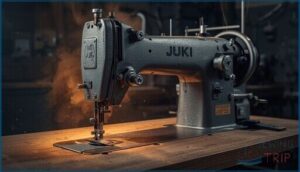
The Juki DDL5550 isn’t messing around with frame construction. You’ve got a cast iron head, K-shaped steel legs, and metal components throughout — built to outlast years of daily production runs.
Vibration control comes standard through rubber-dampened mounts and cross-braced legs, so this industrial sewing machine stays planted.
Pair that with ergonomic design and a servo motor, and you’ve got serious machine efficiency baked into every bolt.
For further technical specifics, see the industrial single needle lockstitch features.
Stitch Speed and Performance Metrics
Speed is where this machine flexes. You’re looking at 5,500 stitches per minute—genuine production-level sewing speed that crushes domestic machines.
Stitch accuracy stays locked in whether you’re crawling through a collar or opening the throttle on a long seam run. The performance metrics back it up: consistent sewing efficiency, tight stitch quality, and production output that keeps pace with serious demand.
For those needing consistent results with industrial lockstitch reliability, this machine stands out in its class.
Machine Dimensions and Weight
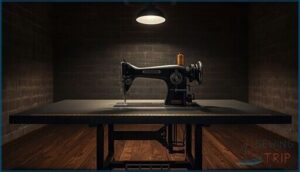
The Juki DDL 5550N demands real estate. Its unit footprint runs 48 by 20 to 36 inches, with the full setup standing 48 inches tall.
The head bed measures 517 by 178 millimeters, giving a workspace area of roughly 10.25 inches to the right of the needle. Handling weight tops 100 pounds assembled — plan accordingly.
Needle System and Stitch Length
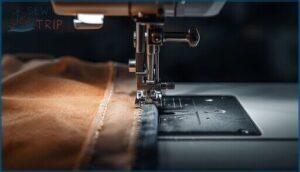
The DDL-5550 runs on DB x 1 needles — sizes 9 through 18 — covering serious ground for fabric compatibility:
- Sizes 9–10: silk, chiffon, delicate sheers
- Sizes 11–12: quilting cotton, spandex
- Sizes 13–14: linen, fleece, uniforms
- Sizes 15–16: canvas, denim, leather
- Sizes 17–18: heavy upholstery, stacked layers
Max stitch length hits 5mm. Most sewists land between 2–3mm for everyday straight stitch work on this JUKI DDL5550.
Core Features of The Juki DDL 5550
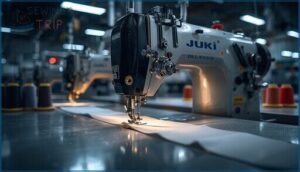
The Juki DDL-5550 doesn’t mess around regarding key features that actually matter on the floor. Every detail is built to keep you moving fast and sewing clean, whether you’re running one seam or five hundred.
Here’s what’s doing the heavy lifting.
Servo Motor and Speed Control
The servo motor is where this industrial sewing machine stops being intimidating. Instead of a clutch system that slams you into motion, you get true variable speed control — pedal sensitivity that lets you creep through a single stitch or blast through long seams.
Motor efficiency stays strong at every setting, torque control holds firm on medium fabrics, and power consumption drops to near zero at idle.
High Presser Foot Lift
The Juki DDL 5550‘s presser foot lift is a genuine breakthrough for fabric clearance. By hand, you get 5.5mm of lift.
If you’re working with bulkier materials, pairing this machine with the right setup — like an embroidery machine with a large hoop — makes that extra clearance even more practical.
Hit the knee lifter mechanism and that jumps to 10mm standard — or up to 13mm with a quick presser foot adjustment.
For an industrial sewing machine handling layered seams, that lift height setting means serious sewing efficiency without wrestling your material into position.
Thread Trimming Mechanism
Thread trimming on the Juki DDL 5550 is where sewing efficiency stops being theoretical.
The automatic cutter — a standard feature on the DDL-5550N-7 — slices both needle and bobbin thread the moment you rock your heel back. No scissors, no wasted motion. The knife adjustment keeps cuts clean, while regular trimmer maintenance prevents missed cuts.
For an industrial sewing machine, that’s serious throughput, not a luxury.
Adjustable Presser Foot Pressure
Pressure adjustment on this industrial sewing machine is your secret weapon for fabric control. Turn the regulator clockwise to boost fabric grip on denim or multiple layers — counterclockwise for preventing puckering on delicate weaves.
Fine tuning by quarter turns keeps stitch consistency locked in across fabric types. The Juki DDL 5550’s fabric compatibility and versatility improve dramatically when sewing performance and quality start with getting this dial right.
Sewing Performance and Fabric Compatibility
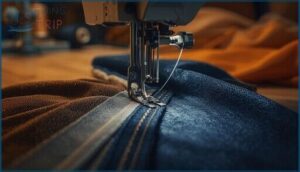
This is where the DDL 5550 either earns its price tag or doesn’t. How a machine actually performs on real fabric tells you more than any spec sheet ever could.
Here’s what you need to know about its stitch quality, fabric range, and how it holds up when the work gets demanding.
Straight Stitch Quality and Consistency
The straight stitch on this industrial sewing machine doesn’t mess around. Stitch formation stays locked and even from your first inch to your last — no wandering, no skipping.
Thread tension holds steady at any speed, and seam repeatability across long production runs is genuinely impressive. The Juki DDL 5550 delivers stitch quality and stitch consistency that define serious sewing performance.
Handling Light to Medium Fabrics
Light fabrics don’t have to be a fight. The Juki DDL 5550 works with light to medium weight fabrics like cotton, polyester, and ripstop nylon with a drop-feed system that keeps fabric feed smooth and steady.
Fabric tension stays dialed in at any sewing speed, so your straight stitch holds clean whether you’re sewing delicates or medium weight twills. This industrial sewing machine owns its lane.
Multi-Layer and Heavy Fabric Capabilities
Now push past medium weights. The Juki DDL 5550 processes fabric thickness surprisingly well for its class.
With the knee lifter raising the presser foot to 13mm, you can feed 4 to 6 denim layers clean. Smart sewing techniques and the right needle size facilitate serious heavy duty material handling — no walking foot machine required.
Stitch Strength and Reliability
Thick layers handled — now let’s talk about whether those seams actually hold.
The DDL 5550’s lockstitch quality is genuinely impressive. At 2–3mm stitch length, you get seam security that distributes stress evenly and resists unraveling under real wear.
What drives that stitch integrity:
- Balanced thread tension keeps knots centered in fabric
- Straight stitch formation localizes any damage — one failed stitch won’t cascade
- Consistent fabric durability across light and medium weights
- Industrial sewing machine timing holds at full 5,500 SPM
User Experience and Ease of Use
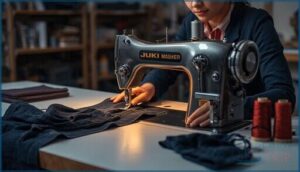
Getting comfortable with the DDL-5550 doesn’t take long once it’s in front of you. The controls are straightforward, and daily operation quickly starts to feel natural.
Here’s what you can expect from setup to the moment you actually start sewing.
Setup and Assembly Process
Setting up the Juki DDL 5550 isn’t exactly plug-and-play — but it’s more manageable than it looks.
Machine placement comes first: the head drops into the table cutout and rests on four rubber cushions.
Oil circulation kicks in after about ten minutes at 3,000–3,500 stitches per minute. Belt tensioning and thread routing follow, and you’re ready to sew.
Control Layout and Adjustability
Once you’re past setup, the Juki DDL 5550’s control layout feels surprisingly logical.
Thread tension adjusts with a front-mounted knob — small turns, immediate results.
The presser adjustment screw gives you real control over fabric grip.
Variable speed control through the foot pedal is smooth, and the knee lifter keeps both hands free.
You’re in charge, not chasing the machine.
Noise Level and Operation Smoothness
The Juki DDL 5550 industrial sewing machine genuinely surprises people with its quiet performance. Swap in a servo motor, and you get smooth operation and serious vibration reduction — the room stays calm between seams.
Motor efficiency means no constant humming at idle. Stitch quality stays rock-solid at speed, and noise cancellation-level quiet makes sewing performance feel almost seamless. This machine runs the room on its terms.
Limitations for Hobbyists and Professionals
Freedom has a price tag — and with the Juki DDL 5550, that price includes space constraints, portability issues, and real stitch limitations. You’re locked to straight stitch only, which means a second machine for zigzag or stretch work.
The Juki DDL 5550 demands full commitment — straight stitch only, serious footprint, no compromises
Cost efficiency only kicks in if you sew constantly. For occasional hobbyists, this industrial sewing machine demands more commitment than most casual setups can handle.
Maintenance and Longevity
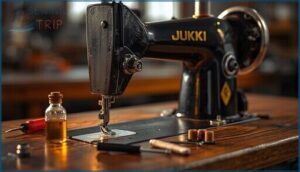
This machine is built to last — but only if you treat it right. Like any workhorse, the DDL-5550 rewards a little regular attention with years of reliable performance.
Here’s what keeping it in top shape actually looks like.
Cleaning and Lubrication Requirements
Keep this machine running like it owns the shop — because it can. The Juki DDL 5550’s self-oiling system does the heavy lifting, but you still need to stay on top of basics.
- Fill the oil pan with Juki New Defrix Oil No. 1 to the HIGH mark
- Never run it below the LOW oil level mark
- Brush lint from feed dogs and hook race daily
- Run at 3,000–3,500 SPM for 10 minutes after long storage
- Change oil every 6–12 months depending on use
Included Accessories and Parts
What ships with the Juki DDL 5550 is genuinely impressive for an industrial sewing machine. You get the essentials ready to roll.
| Accessory | What’s Included |
|---|---|
| Sewing Notions | Needles, bobbins, bobbin cases |
| Thread Guides & Knee Lifters | Pre-installed on the Juki DDL 5550N |
| Machine Oil | Juki New Defrix lubricant |
No scrambling for parts — you’re set from day one.
Recommended Maintenance Schedule
Treat your Juki DDL 5550 like a pro machine, and it’ll run like one. For sewing machine maintenance on this industrial sewing machine, stick to a simple rhythm: brush out lint daily, check oil flow weekly, top off oil monthly.
Heavy-duty sewing machines reward consistency. Following this schedule keeps your sewing machine reviews-worthy performance locked in for years.
Professional Servicing Needs
Even the toughest industrial machines need a professional to step in sometimes. For your Juki DDL-5550, annual servicing isn’t optional — it’s how you protect your investment.
- Servicing costs run $150–$250 for a clean-oil-adjust
- Warranty coverage excludes tension and skipped-stitch fixes
- Technician training ensures precise hook timing you can’t DIY
- Repair techniques restore stitch quality after heavy use
- Maintenance schedules prevent costly bearing and hook damage
Top Juki Industrial Sewing Machines
Juki makes more than just the DDL-5550, and some of their other machines might actually suit your needs better.
Whether you want something portable, computerized, or built for a specific stitch type, there’s likely a Juki model that fits the bill.
Here are a few worth knowing about.
1. Juki Industrial Straight Stitch Sewing Machine
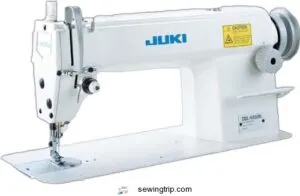
The Juki DDL-5550N is the workhorse of Juki’s industrial straight stitch lineup. It hits 5,500 stitches per minute, processes light to medium fabrics with ease, and delivers tight, consistent lockstitches across long production runs.
The cast metal build keeps vibration low even at top speed. You’re getting a machine that doesn’t flinch at multi-layer seams or daily high-volume use. If straight stitch performance is your priority, this is the standard everything else gets measured against.
| Best For | Quilters, hobby sewers, and production professionals who need fast, reliable straight stitching on light to medium fabrics. |
|---|---|
| Stitch Type | Straight stitch only |
| Auto Threader | No |
| Thread Cutter | Built-in bobbin winder |
| Material | Metal |
| Brand | JUKI |
| Ideal Use | Light to medium fabrics |
| Additional Features |
|
- Screams through 5,500 stitches per minute while staying smooth—great for long runs without the machine wearing you down
- Handles thick, multi-layer fabric without struggling, so you’re not fighting the machine on heavy seams
- The adjustable speed motor makes it approachable for beginners while still holding up to professional daily use
- Straight stitch only—if you need zigzag or decorative stitches, this isn’t your machine
- It’s loud and heavy (250 lbs), so it’s not exactly apartment-friendly or easy to move around
- Comes with some assembly required and possible minor cosmetic blemishes on the table, so don’t expect it straight out of the box looking perfect
2. Juki Portable Sewing Machine
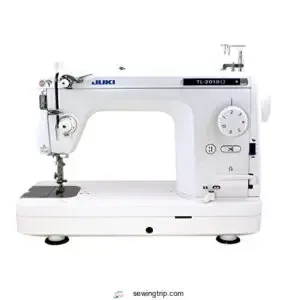
Not everyone needs a machine bolted to a production table. The Juki TL-2010Q is built for the sewist who wants industrial-level power without the industrial footprint.
At just 25 pounds, it moves easily between your home studio and weekend retreats. You still get 1,500 stitches per minute and a 6mm stitch length — faster than most domestic machines.
The aluminum frame keeps it rigid under pressure. Real performance, no anchor attached.
| Best For | Quilters, tailors, and home sewists who want serious machine performance without being tied to a permanent workspace. |
|---|---|
| Stitch Type | Straight stitch only |
| Auto Threader | Yes |
| Thread Cutter | Automatic thread trimmer |
| Material | Aluminum |
| Brand | JUKI |
| Ideal Use | Quilting and apparel |
| Additional Features |
|
- Automatic thread trimmer and needle threader save time and reduce frustration between cuts and color changes
- Knee lifter lever keeps your hands free to guide fabric — a game-changer for quilting bulky layers
- Aluminum frame holds up under heavy use while still being portable enough to pack for a retreat
- No scant 1/4″ foot included, so quilters may need to buy one separately or fiddle with adjustments
- The built-in lighting is on the dim side, especially for detailed work in low-light spaces
- The needle threader has a bit of a learning curve and can feel finicky until you get the hang of it
3. Juki Computerized Sewing Machine
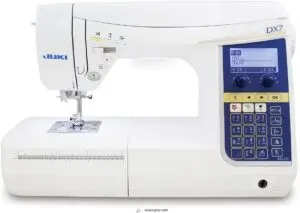
When portability still isn’t enough, the HZL-DX7 steps in with serious control. This computerized machine packs 277 built-in stitches, an automatic needle threader, and a box feed system that keeps your fabric moving straight — no wrestling required.
You get a built-in straight stitch plate, lockstitch, and thread cutter all in one package. It tops out around 1,050 stitches per minute. For garment makers who want precision without sacrificing versatility, this machine hands you the keys.
| Best For | Garment makers and quilters who want precise control, a wide stitch variety, and the ability to handle everything from delicate silk to thick, heavy fabrics. |
|---|---|
| Stitch Type | 277 built-in stitches |
| Auto Threader | Yes |
| Thread Cutter | Automatic thread cutter |
| Material | Metal |
| Brand | JUKI |
| Ideal Use | Garments and quilting |
| Additional Features |
|
- 277 built-in stitches plus 4 alphabet fonts give you serious creative range without needing a second machine.
- The box feed system and straight stitch plate work together to keep fabric feeding smooth and even, even through thick layers.
- Built-in auto threader, lockstitch, and thread cutter make the whole sewing process faster and less fiddly.
- The needle threader has given some users trouble, so don’t count on it working perfectly every time.
- Winding the bobbin can be a bit finicky and may take some trial and error before you get it right.
- The foot pedal cord is on the thin side, which could become a durability issue with heavy daily use.
4. Juki Straight Stitch Sewing Machine
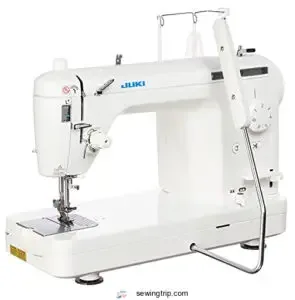
Want straight stitching done right? The TL2000Qi is built around that single purpose — and it does it well. At 1,500 stitches per minute, it tackles quilting, apparel, and home décor without breaking a sweat.
You get an automatic needle threader, knee lifter, and built-in thread cutter, all packed into a 25-pound frame. That’s light enough to move, sturdy enough to mean business. It’s the machine you grab when precision matters and you don’t want distractions.
| Best For | Quilters and sewists who want a fast, no-fuss straight stitch machine for apparel, quilting, and home décor projects. |
|---|---|
| Stitch Type | Straight stitch only |
| Auto Threader | Yes |
| Thread Cutter | Automatic thread cutter |
| Material | Aluminum die cast |
| Brand | JUKI |
| Ideal Use | Quilting and home decor |
| Additional Features |
|
- Blazing 1,500 SPM speed makes short work of thick layers and long quilting runs
- Hands-free features like the knee lifter and auto thread cutter keep your workflow smooth
- Solid aluminum build keeps vibration low, so your stitches stay clean and consistent
- Straight stitch only — if you ever need a zigzag or decorative stitch, you’re out of luck
- Needs oiling after every use, which adds a small but real maintenance commitment
- The heel thread cutter on the foot pedal is easy to trigger by accident, which can get frustrating mid-project
Frequently Asked Questions (FAQs)
Is the Juki DDL 5550 a walking foot machine?
Let’s cut to the chase — no, it’s not. The Juki DDL-5550 is a drop feed, straight stitch machine.
Its presser foot stays fixed while only the feed dog moves fabric forward.
What is the difference between Juki DDL 5550 and 5530?
The 5550 targets light to medium apparel at 5,500 spm, while the 5530 processes heavier materials like leather and canvas with more automation options and direct drive motor integration.
Which Juki sewing machine is best?
The best Juki depends on your work. For factory-speed garment sewing, the DDL 5550 wins. For quilting or home use, the TL 2010Q is your best bet.
What is the Warranty and Service Policy for the Juki DDL-5550?
Juki backs the DDL-5550 with a limited warranty on mechanical parts and 2 years on electrical components.
Consumables like needles and bobbins aren’t covered.
Always buy from an authorized dealer to keep that coverage intact.
What Accessories and Feet Are Compatible With the Juki DDL-5550?
You’ve got solid options here. Standard industrial straight stitch feet, zipper feet, rolled hem, and compensating feet all fit without adapters.
Bobbins, needles, and even a heavy duty kit are readily available too.
What is the Maximum Fabric Thickness the Juki DDL-5550 Can Handle?
The DDL-5550 accommodates about 6mm of compressed fabric comfortably. Push past that and you’ll feel the motor strain.
For thick seams, use a size 18 needle and shorten your stitch length slightly.
How Noisy is the Juki DDL-5550 During Operation?
Honestly, it’s quieter than expected. The servo motor barely hums at idle, and even at full speed, most of the sound comes from the needle punching fabric — not mechanical racket.
What Maintenance is Required for the Juki DDL-5550 and How Often?
This machine demands a little TLC to keep performing. Daily lint brushing, weekly oil checks, and needle swaps every 8–10 hours keep it humming. Budget a full service every 6–12 months.
How fast is a Juki ddl-5550 industrial sewing machine?
The Juki DDL-5550 tops out at 5,500 stitches per minute. That’s blazing fast. Most operators cruise comfortably at 3,000–4,000 SPM for better control, especially on detailed seams.
Does the Juki ddl-5550 have a servo motor?
It depends on the version you get. The standard DDL-5550 usually ships with a clutch motor, but many new complete sets now include a servo motor, and it’s fully compatible with aftermarket servo upgrades.
Conclusion
They say, “fortune favors the bold. If you’re tired of babying hobby machines and your ceilings need raising, the Juki DDL-5550 pulls no punches.
It’s built to run hard—day after day—without apology. Yes, speed kills hesitation, but precision wins the game. Regarding reviews Juki DDL 5550, the machine’s reputation isn’t hype.
If you’re ready to commit, this industrial beast will stand beside you long after others tap out.
- https://www.scribd.com/doc/88133503/Juki-DDL
- https://sewingfromhome.com/reviews/juki-ddl-5550/
- https://www.jacksew.com/juki-ddl-5550n-high-speed-single-needle-lockstitch-industrial-sewing-machine-with-table-and-servo-motor/
- https://zamirsew.net/juki-ddl-5550n-single-needle-table/
- https://www.odbproject.org/items/Juki-DDL-5550-Industrial-Sewing-Machine-With-Table-Servo-Motor/530735