This site is supported by our readers. We may earn a commission, at no cost to you, if you purchase through links.
A plain seam holds a garment together, but a well-placed trim makes someone stop and ask, "Wait, did you make that?" That’s the magic of sewing project’s creative embellishments—they turn something functional into something memorable.
A strip of crochet along a collar, a little fringe swinging from a hem, a tassel catching the light.
Small moves, big personality. The trick isn’t piling on more; it’s knowing which details belong where, how to secure them so they last, and which materials play nicely with your fabric.
That’s exactly what you’ll find here.
Table Of Contents
Key Takeaways
- Match your embellishment to your fabric weight—delicate lace for chiffon, heavy fringe for denim—so nothing sags, pulls, or looks out of place.
- Always test trim placement on a scrap first, because what looks good in your head doesn’t always land the same way on actual fabric.
- Secure heavy trims with bar tacks or box stitches, and stabilize the fabric underneath before you add any weight, or it won’t hold up past the first wash.
- The goal isn’t more embellishment—it’s the right one, placed with intention, so your finished piece feels like you made it, not just assembled it.
Choosing The Right Embellishments
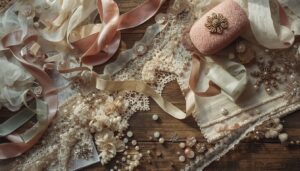
The right embellishment can make or break a project, so it’s worth thinking through a few things before you start sewing anything on. From fabric weight to washability, small decisions upfront save you a lot of frustration later.
Getting your stitching technique right from the start matters just as much as the embellishment itself.
Here’s what to keep in mind as you choose.
Match Embellishments to Fabric Weight
Think of your fabric as the foundation — the embellishment has to match its strength. For delicate fabrics, consider lightweight hand embroidery to add subtle texture. Lightweight fabrics like chiffon love delicate lace trim or tiny seed beads. Heavier fabrics like denim handle fringe or velvet ribbon without sagging.
Follow these density guidelines:
- Light fabric embellishment: narrow bias binding, fine lace trim
- Medium fabrics: flat braid, moderate fringe
- Heavy fabrics: heavy trim backing keeps appliqués secure
- Always use a stabilizer selection that matches your fabric weight
Coordinate Color, Texture, and Pattern
Color does a lot of the heavy lifting here. Analogous color pairing keeps your fabric trim usage feeling calm and cohesive, while complementary trim contrast adds that pop that makes a detail sing.
Layer your textures thoughtfully — smooth satin against embroidery is a classic texture layering strategy. For pattern customization, use scale harmony: big prints up top, smaller motifs near edges.
Pattern direction alignment along seams ties everything together beautifully.
Balance Statement Details With Clean Design
Once you’ve sorted your colors and textures, pull back and look at the whole picture.
Too much fabric trim usage, decorative stitching, or handcrafted garment detailing can crowd your design fast.
Good garment customization means knowing when to stop.
Use white space — breathing room between elements — to let your visual texture shine.
Think of font hierarchy and column alignment like your design’s quiet backbone: bold totals highlighting the hero details, with note placement keeping everything honest and clean.
Test Placement on a Fabric Swatch
Before you commit to any trim application, grab a scrap and test first. Swatch Positioning lets you check Symmetry Checks, Color Interaction, and visual texture all at once.
Pin your embellishment at the center, edge, and corner, then do a gentle stress test tug.
Snap a photo under good lighting. You’ll see exactly how adding visual texture to apparel will actually look.
Pick Washable Materials for Everyday Wear
Everyday pieces take a beating, so pick embellishments that can keep up.
Cotton jersey and polyester blend fabrics handle repeated washing without losing shape.
Tencel lyocell blends wick moisture and stay colorfast, wash after wash.
For trims, grosgrain ribbon, satin ribbon, and bias tape all hold up beautifully.
Machine embroidery and nylon abrasion-resistant details add style that lasts, perfect for moisture-wicking fabrics you actually live in.
Trims That Add Texture
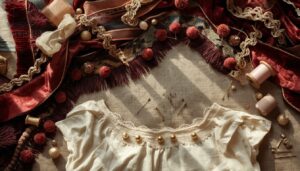
Texture is one of the easiest ways to make a garment feel truly yours. The right trim can turn a plain collar or simple hem into something people actually notice.
The right trim transforms an ordinary hem or collar into something people actually stop to notice
Here are a few favorites worth adding to your sewing toolkit.
Crochet Trim for Collars and Pockets
Crochet trim is one of those details that instantly makes a garment feel handmade in the best way. Whether you’re edging a collar or framing a patch pocket, the key is getting four things right:
- Stitch Pattern Selection — shells and picots for delicate looks, clusters for bold texture
- Yarn Weight Matching — light cotton for fine fabrics, heavier yarn for structured pieces
- Motif Sizing — keep motifs between 2–4 inches so they don’t overpower the design
- Edge Blocking Techniques — always block finished trim so it lays flat, before seam integration methods lock it in place
Pom-pom Trim for Playful Edges
Few trims bring instant joy like pompom trim. It’s light enough for cotton and linen, so it won’t drag down your edges.
Pom-pom Trim Length Adjustment is simple — just cut along the tape to fit.
Use a walking foot to feed it evenly, and keep your Edge Seam Allowance Tips in mind: a narrow seam keeps things clean and neat.
Fringe for Hems, Sleeves, and Jackets
Fringe is one of those trims that moves with you — and that’s the whole point.
For hems, aim for a Fringe Length of three to five inches. On Sleeves, start a quarter inch above the cuff. For Jacket edges, Bar Tack Spacing every inch keeps things secure.
Choose a Fiber Material Choice that washes well, and always use Seam Integration for a clean finish.
Follow basic Maintenance Tips to keep strands tangle-free.
Tassels for Swishy Decorative Accents
Tassels are basically fringe’s more dramatic cousin — and they’re worth the upgrade. The right tassel shapes, material choices, length proportion, attachment methods, and color finishing all work together to make your garment feel intentional, not accidental. Here’s what to think about:
- Tassel Shapes — Ball and bell styles give the best swish on kimonos.
- Material Choices — Silk or rayon tassels drape beautifully alongside satin ribbon or velvet ribbon edges.
- Length Proportion — Keep tassels one-quarter to one-third the garment’s hem length.
- Attachment Methods — Hidden stitching inside hems keeps the look clean.
- Color Finishing — Ombre or high-contrast tassels add movement even when standing still.
Eyelash Trim for Bold Contrast
Eyelash trim is the secret weapon your neckline’s been missing. It adds sharp, tactile texture right where the eye travels first. Dark synthetic fiber types appear boldest against light fabrics, while trim length extension of 1–2mm creates that crisp bold edge definition. It’s a simple fabric embellishment technique with serious impact.
| Eye Shape Alignment | Fiber Type | Bold Edge Definition |
|---|---|---|
| Almond | Matte black | Soft but defined |
| Round | Glossy dark | High contrast |
| Hooded | Multicolor | Subtle dimension |
Reusable trim care: store strips flat and clean with oil‑free remover.
Embroidery and Appliqué Details
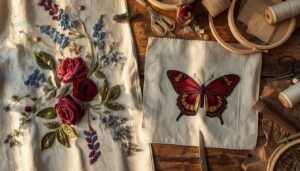
Embroidery and appliqué take your sewing from "nicely made" to "how did you do that?" They let you add personality, color, and texture in ways that no trim or ribbon can quite match.
Here are some of the best techniques to try.
Hand Embroidery for Floral Accents
Few things make a garment feel truly yours, like a little hand stitching.
Flower embroidery lets you paint with thread — use satin stitches for smooth petals, French knots for centers, and back stitch for stem outlining.
Stitch layering and thread blending add real petal shading, while color gradient shifts make petals glow.
These fabric embellishment techniques are creative sewing embellishment techniques at their most personal.
Machine Embroidery for Monograms and Motifs
Machine embroidery takes personalization up a notch. With digitizing precision, your design translates cleanly onto fabric — balanced underlay strategies stabilize the cloth before a single decorative stitch runs.
Thread tension control and stitch density optimization keep monograms crisp, not puckered. Color gradient techniques handle smooth shade shifts between motifs.
Whether you’re adding custom monograms or bold embroidery motifs, they’re creative embellishment ideas for sewing, made effortlessly repeatable.
Appliqué for Shapes, Flowers, and Animals
Appliqué opens up a whole creative playground.
Cut a geometric shape appliqué from cotton scraps, align it with the fabric grain, and stitch it down for instant art.
Layer petals for 3D floral layers, or build textured animal features with satin-stitched eyes.
Just follow scale proportion guidelines — keep motifs sized right for your garment — and your fabric appliqué will look intentional, not thrown on.
Couching for Corded Decorative Lines
Couching is like drawing with thread — you lay a cord right on the fabric surface and stitch it down with tiny anchoring stitches.
Here’s what to keep in mind:
- Needle Choice matters: use a sharp appliqué needle sized to your cord
- Cord Material Options range from metallic to silk to wool
- Stitch Spacing Techniques control how raised or flat the line sits
- Cord Tension Control keeps your line smooth, not puckered
Always do Cord Colorfastness Testing before committing.
Echo Quilting for Layered Texture
Echo quilting turns a single motif into something that feels alive. Stitch lines ripple outward, following the shape’s silhouette, adding visual texture that draws the eye inward.
Use free motion quilting for curved shapes, or ruler spacing for clean, straight edges.
Satin stitch echoes catch light beautifully. Stitch density control lets you dial up drama or keep things soft — your call.
Ribbons, Bows, and Edge Finishes
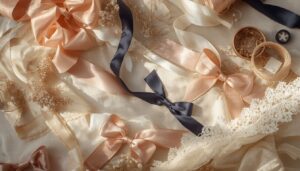
Ribbons and bows might seem simple, but they can completely change the feel of a garment. A well-placed strip of satin or a grosgrain trim can add polish, structure, or a little personality — all without a lot of effort.
Here are some of the best ways to use ribbons, bows, and edge finishes in your sewing projects.
Satin Ribbon for Glossy Accents
Satin ribbon is one of those ribbons and trims that just makes everything look more finished. Its Double-Faced Shine means both sides catch the light, so you can twist or loop it freely.
A Calendered Surface keeps it crisp and smooth. Width Variations from 1/8 to 2 inches cover everything from delicate hems to bold sashes. Colorfast Dyes prevent bleeding, and Wired Edge Support holds bows beautifully in place — a real win for DIY embellishments.
Grosgrain and Jacquard Ribbon for Structure
Grosgrain and jacquard ribbon do something satin simply can’t — they hold your garment in shape. That’s the ribbon weight impact you feel right away.
Grosgrain’s ribbed surface resists curling, while jacquard’s woven patterns add stiffness and shape exactly where you need it.
Fiber choice effects matter too — polyester lasts longer, cotton breathes better.
Use reinforced stitching techniques to anchor both, and always check colorfastness and longevity before committing.
Bias Tape as a Decorative Border
Bias tape might just be the most underrated trim in your sewing kit. It wraps curved edge application like a dream, hugging necklines and armholes without a single pucker. Choose single double fold, depending on how much border you want to show. Want a little glam? Metallic satin tape catches the light beautifully. For knits, stretchable bias tape keeps everything moving with you.
- Stitch right sides together, then fold over and press topstitch technique for a clean finish
- Use edge binding on hems, necklines, and armholes
- Single fold works for narrow, delicate borders
- Double fold gives a bolder, more visible edge
- Prewash your tape before applying — it prevents misalignment later
Edge finishing methods for sewing projects don’t get much easier than this. Bias tape and fabric trims like this one do double duty — they protect the edge and add style. As sewing embellishments go, weaving them seamlessly into your design takes almost no extra effort.
Bow Accents for Sleeves and Collars
A small bow can completely change a garment’s personality.
For sleeves, a 1.5 to 2.5 inch width hits the sweet spot — any bigger and it overwhelms lightweight fabrics. Layer your bow construction layers with lightweight interfacing to hold the shape. Use stitch reinforcement techniques underneath so nothing shifts.
Want flexibility? Removable bow fasteners like tiny snaps keep things clean and washable.
Use Ribbon on Belts, Ties, and Sashes
Ribbon turns a plain belt into something worth noticing. The trick is proportion — a 12 to 25 mm width works for most silhouettes, while wider options create bold sashes.
- Use Adjustable Ribbon Loops to keep belts centered
- Try Contrast Ribbon Pairing with solid fabrics
- Practice Smooth Ribbon Integration using ribbon carriers
- Explore Proportional Ribbon Widths for ties and sashes
Secure, Washable Embellishment Methods
Adding beautiful trims is only half the job — making sure they actually last is the other half. You want your embellishments to survive real wear, real washing, and real life.
Here are a few methods that keep everything in place long after the project is done.
Reinforce Heavy Trims With Sturdy Stitching
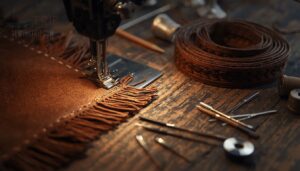
Heavy trims pull hard on fabric — so your stitching has to pull back harder. Bar Tack Techniques create dense, reinforced blocks at stress points, while Box Stitch Strategies spread the load across a wider area. For leather trim, piping, or foldover elastic, Topstitching Reinforcement adds a visible second layer of strength.
| Technique | Best For | Thread Choice |
|---|---|---|
| Bar Tack | Fringe, tassels, leather trim | Polyester, nylon |
| Box Stitch | Thick woven tapes, piping | Heavy-duty polyester |
| Topstitching | Bias binding, edge finishing | UV-resistant nylon |
Stitch Density Optimization — around 8–12 stitches per centimeter — keeps seams from migrating. Thread Needle Selection matters too: match needle size to trim weight to avoid skipped stitches.
Stabilize Fabric Before Adding Weight
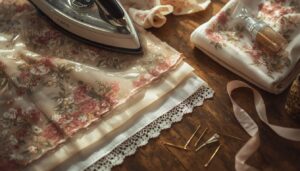
Sturdy stitching gets you halfway there — but the fabric underneath needs backup too. Before you layer on anything heavy, press light fusible interfacing onto the wrong side.
For softer pieces, a breathable underlining distributes weight evenly. A quick spritz of temporary stabilizing spray also helps during placement.
- Strategic basting holds layers steady before final stitching
- Seam allowance planning keeps bulk under control at edges
- Test everything on a swatch first
Use Bead Backing or Tiny Seed Stitches
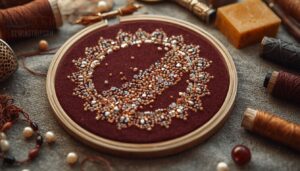
Once your fabric is stable, handstitched beads and sequins need a firm foundation — that’s where Backing Material Selection matters. Ultrasuede or leather hides your knots and keeps beads from sinking.
| Technique | Best For | Key Benefit |
|---|---|---|
| Bead Backing | Heavy embroidery, trim | Prevents sagging |
| Seed Stitch Density | Ribbon and trim edges | Continuous coverage |
| Edge Reinforcement Techniques | Curves, cabochons | Clean margins |
| Lightweight Bead Foundations | Everyday wear | Reduces fabric stress |
| Thread Color Matching | All beadwork | Invisible stitching |
Match your thread, keep stitches short, and reinforce curves with extra passes.
Choose Adhesives Only for Low-stress Details

Not everything needs needle and thread. For lightweight, low‑stress details — think a small ribbon accent or a decorative appliqué patch — adhesives do the job beautifully.
Silicone Adhesive Flexibility keeps trims soft and drapey, while Acrylic Craft Tack grabs porous fabric fast.
Love nose‑w or quick‑sew options? A Water‑Based Adhesive won’t stiffen your fabric, and Pressure‑Sensitive Repositioning lets you adjust placement before committing.
Heat‑Free Bonding is perfect for delicate silks.
Finish Edges to Prevent Fraying and Wear
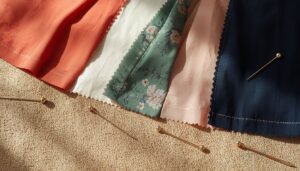
Once your embellishments are on, raw edges still need protecting.
Here are five edge finishing methods for sewing projects that keep things looking sharp, wash after wash:
- Overlock Edge – wraps fibers cleanly, no fraying
- Zigzag Stitch – quick, reliable, works on any home machine
- Bias Binding – encases edges and adds a decorative touch
- Pinked Edge – fast cut, great for light fabrics
- French Seam – tucks everything inside, neat and polished
Frequently Asked Questions (FAQs)
Are embellishments a good idea for a sewing project?
Yes — and here’s the thing: the right embellishment can completely transform a plain garment.
From DIY embellishments to fashion embellishments, small details add personality, design cohesion, and style when matched to your skill level and project suitability.
What are the different types of embellishments?
There are so many to explore — ribbon and trim, beaded trim, sequins & rhinestones, lace trim, fringe, tassels, metallic piping, lace appliqué, and even patchwork upcycling.
Beads and sequins bring sparkle too.
What are some easy embellishment ideas?
Start small. A ribbon here, a button there — that’s all it takes. Try iron-on patches, glitter glue, or stenciled motifs for quick wins that feel totally you.
What embellishment ideas can spice up a garment?
Try beaded trim along a neckline, metallic piping in a seam, or glass crystals for sparkle.
Even simple ribbons and trims can transform a plain piece into something worth showing off.
What are embellishments & why do you need them?
Embellishments are decorative touches — think ribbons and trims, beads, or embroidery — that add texture depth and visual interest to fabric.
They’re your stylistic signature, turning a plain piece into personal expression.
Can you use bias tape as a decorative embellishment?
Yes, you can! Bias tape isn’t just for finishing edges — it’s a surprisingly adaptable embellishment.
Twist it into bias tape flowers, layer it into spiral bias tape designs, or stitch layered bias strips for bold, eye-catching detail.
How do embellishments affect garment draping and fit?
They change everything. Heavy beads shift drape dynamics downward, while dense stitching affects fabric flex impact.
Smart weight distribution keeps your silhouette alteration intentional, not accidental. Placement matters more than people think.
Can embellishments be safely removed and reused?
Most embellishments can be removed and reused. A seam ripper works well along stitch lines, and adhesive residue cleaning keeps fabric fresh. Colorfastness testing before reattaching ensures nothing bleeds.
Whats the cost difference between embellishment types?
Costs vary a lot. Iron-on patches run just $50–$00, while hand-beaded work can hit $50-plus per piece. Your budget and patience decide which direction makes sense.
How do you store embellishments to prevent damage?
Keep ribbons and trims in labeled, compartmentalized containers with silica gel packets.
Wrap delicate pieces in acid-free tissue, monitor temperature and humidity, and store everything cool, dry, and away from sunlight.
Conclusion
The best sewing project creative embellishments aren’t the most expensive or the most elaborate—they’re the ones that feel like you: a single strip of crochet trim, a tassel at the hem, a bow at the sleeve.
Each small choice adds up to something that’s unmistakably yours.
Trust your eye, test before you commit, and secure everything well.
When someone stops mid-conversation to ask, "Wait, did you make that?"—that’s your answer.