This site is supported by our readers. We may earn a commission, at no cost to you, if you purchase through links.
After testing dozens of sewing machines, I’ve learned one thing: most “heavy-duty” machines aren’t. They bog down on denim, struggle with multiple layers, and leave you wrestling with tension issues every third seam.
The Singer 4423 breaks that pattern—and it does it at a price that makes premium machines look ridiculous. With a metal frame, genuine 1100-stitch-per-minute speed, and over 18,000 Amazon reviews averaging 4.6 stars, this machine has earned its reputation among sewers who actually push their equipment hard.
I put it through canvas bags, quilted layers, and upholstery projects to see if it lives up to the hype—and whether those few vocal critics have legitimate complaints you need to know about.
Table Of Contents
- Key Takeaways
- Singer 4423 Overview and Key Features
- Design, Build Quality, and Durability
- Sewing Performance and Fabric Handling
- Ease of Use and User Experience
- Included Accessories and Expansion Options
- Maintenance, Reliability, and Warranty
- Value, Comparisons, and Recommendations
- Frequently Asked Questions (FAQs)
- Conclusion
Key Takeaways
- The Singer 4423 delivers genuine heavy-duty performance at around $200 with a metal frame, 1100-stitch-per-minute speed, and proven reliability across 18,000+ Amazon reviews averaging 4.6 stars—making premium machines look overpriced.
- This machine dominates thick fabrics like denim and leather with consistent stitch quality and rock-solid stability, though it requires a lighter touch and adjusted settings (lower foot pressure, finer needles) for delicate materials like silk.
- You’ll appreciate the straightforward setup with automatic needle threading, top drop-in bobbin, and simple dial controls that let you focus on sewing instead of fighting the machine, plus LED lighting that actually illuminates your workspace.
- The 4423 hits a rare sweet spot where beginner-friendly features meet serious performance that experienced sewers won’t outgrow, backed by affordable replacement parts and expandable presser foot options that grow with your skills.
Singer 4423 Overview and Key Features
The Singer 4423 isn’t your average home sewing machine—it’s built like a workhorse and priced like it wants you to actually use it. With a 4.6-star rating from over 18,000 Amazon reviews, this thing has earned its reputation in the sewing world.
Let’s break down what makes this heavy-duty machine tick and whether it’s worth the roughly $200 price tag.
Heavy-duty Motor and Construction
The Singer 4423 earns its heavy-duty reputation through serious engineering, not marketing fluff. This heavy-duty sewing machine delivers the power you need to dominate thick fabrics without apology.
What makes this Singer Heavy Duty beast different:
- High-torque motor delivers consistent power output through dense layers
- Metal construction and internal frame minimize vibration control issues
- Sturdy build resists heat buildup during marathon sewing sessions
- Durable bedplate ensures smooth feeding and even pressure distribution
The machine’s performance can be further optimized by considering methodological rigor in its design and testing.
Built-in Stitches and Stitch Selection
All that motor power means nothing if you can’t execute. The Singer 4423 arms you with 23 built-in stitches—your precision toolkit for total fabric compatibility and sewing precision.
Stitch variety delivers creative freedom and technical control.
| Stitch Category | What You Get |
|---|---|
| Utility Basics | Straight, zigzag, blind hem—foundational sewing techniques for everyday dominance |
| Stretch & Specialty | Buttonhole options, decorative patterns—thread tension mastery across knits and canvas |
| Selection System | Front-mounted dial with printed guide—zero confusion, maximum stitch customization |
Adjustable Stitch Length and Width
Real control lives in the details. You don’t just pick stitches—you calibrate them with adjustable stitch length (0–4mm) and width (0–5mm) dials right at your fingertips.
Why these adjustments matter for sewing precision:
- Stitch length controls seam density—shorter for delicate fabrics, longer for heavy canvas
- Width adjustment tailors zigzag spread and decorative pattern scale
- Locking detents prevent accidental dial shifts mid-project
- Calibrated markings guarantee repeatable results across different sewing techniques
Dial in fabric tension, thread management, and stitch quality with surgical accuracy.
Automatic Needle Threader and Top Drop-in Bobbin
Setting up your machine shouldn’t feel like defusing a bomb. The Singer 4423 automatic needle threader and top drop-in bobbin cut setup time in half—you’ll spend more moments creating, fewer fumbling with thread management. Here’s how these bobbin systems stack up against traditional nightmares:
| Feature | Singer 4423 Design | Traditional Manual Systems |
|---|---|---|
| Threading Speed | 5-10 seconds with lever mechanism | 30-60 seconds squinting at needle eye |
| Bobbin Access | Clear view, drop straight in | Hidden compartment, rotate and latch |
| Thread Path | Visible guide from needle to foot | Multi-step maze under tension discs |
| Setup Errors | Minimal—alignment guides prevent mistakes | Common threading issues with missed hooks |
| Sewing Efficiency | Start projects immediately | Frustration delays, especially for beginners |
Your automatic needle threader operates via a small lever near the needle bar. Push it down, hook your thread, release—done. *I’ve threaded this heavy-duty sewing machine in dim light without my reading glasses, which says something.
- Just make sure your needle alignment is perfect and the needle sits fully raised, or the mechanism won’t engage properly.
The top drop-in bobbin sits in a clear case right under the needle plate. You can see exactly how much thread remains and whether it’s winding evenly—no more surprise mid-seam bobbin depletion. Thread your bobbin following the simple diagram etched into the metal, snap the cover closed, and you’re ready to conquer denim or chiffon with equal confidence.
Design, Build Quality, and Durability
The Singer 4423 doesn’t mess around regarding construction—this machine was built to take a beating and keep stitching. You’re getting a solid metal frame that won’t wobble across your table when you’re pushing through thick denim, and the overall design screams ‘workhorse’ rather than ‘fragile toy.’
Let’s break down what makes this machine tough enough to handle your most ambitious projects.
Metal Frame and Overall Stability
When you’re pushing fabric at 1100 stitches per minute, you need rock-solid frame rigidity—and the Singer 4423 delivers.
This heavy-duty sewing machine uses metal construction throughout its chassis, not flimsy plastic, giving you vibration control that keeps seams straight even when you’re cranking through multiple denim layers. The stability features mean your needle stays exactly where you aim it, every single time.
Machine Dimensions and Portability
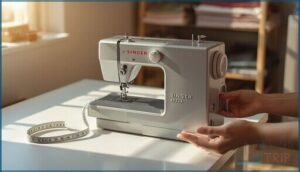
Compact Design meets heavy‑duty power in a package you can actually move. The Singer 4423 weighs around 12–14 pounds—solid enough for stability, light enough that you won’t throw your back out hauling it to a workshop.
- Footprint: Roughly 15 × 6 inches, fits standard tables without hogging space
- Workspace: 6–7 inches left of needle for Space Efficiency
- Free arm: Extends 6–7 inches for cuffs and sleeves
- Machine Weight: Manageable for two‑handed lifting between rooms
- Portable Storage: Accessory drawer keeps feet organized during transport
(I’ve moved mine three times—no drama, just unplug and go.)
Stainless Steel Bedplate and Sewing Area

Corrosion Resistance meets real-world abuse on the Singer 4423’s stainless steel bedplate—a sewing surface built to outlast painted alternatives. This heavy-duty sewing machine glides denim and canvas without snagging, thanks to a smooth platform that won’t warp under your needle.
- I’ve spilled coffee on mine; quick wipe, zero rust.
The Singer Heavy Duty’s steel durability means consistent seam allowances and minimal bedplate maintenance across thousands of stitches.
Sewing Performance and Fabric Handling
Here’s where the rubber meets the road—can this machine actually handle what Singer promises, or does it choke when you throw real projects at it? I put the 4423 through its paces with everything from slippery silk to thick leather, and the results might surprise you.
Let’s break down how this heavy-duty machine performs across different fabrics and sewing conditions.
Speed and Stitch Quality
This machine doesn’t mess around when you hit the pedal. The Singer 4423 cranks out 1100 stitches per minute, and here’s what matters: stitch consistency stays locked in even at high-speed stitching. Thread tension holds steady, fabric feed doesn’t skip, and sewing accuracy doesn’t fall apart when you’re racing through a project.
- Speed settings let you control the pace without sacrificing stitch quality
- Heavy duty construction keeps everything stable during aggressive sewing speed runs
- Adjusting stitch length maintains precision across different materials
*Finally, a sewing machine that keeps up with my impatience.
*
Handling Thick Fabrics and Multiple Layers
You’ll push through 5 layers of denim without drama—this heavy-duty sewing machine manages fabric thickness like it’s personally offended by lightweight competition. *Turns out layer management beats brute force every time.
*
Needle selection matters: grab a size 16/100 for leather and heavy-duty sewing projects. Adjust presser foot pressure and lower stitch tension to manage multiple layers without puckering.
The metal frame keeps everything stable during fabric and material sewing, though you’ll still need proper sewing machine maintenance to prevent thread breakage.
Performance With Lightweight Materials
Lightweight fabrics flip the script—your Singer 4423 needs gentler handling to prevent puckering and skipped stitches. Fabric tension drops, needle selection shifts to size 70/10, and sewing speed and efficiency take a backseat to control.
- Fine thread choice reduces stitch visibility on silk and chiffon
- Lower presser foot pressure prevents stretching during fabric and material sewing
- Stabilizers stop translucent fabrics from bunching at seams
- Seam reinforcement requires shorter stitch lengths on delicate weaves
- Test scraps first—this sewing machine rewards precision over power
Ease of Use and User Experience
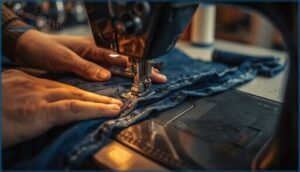
A machine can sew like a dream through five layers of denim, but if you can’t figure out how to thread it without throwing something, what’s the point? The Singer 4423 keeps things refreshingly straightforward with controls that don’t require an engineering degree.
Let’s break down what actually matters when you’re sitting at this machine trying to get work done.
Controls, Dials, and Navigation
Simple dials keep you focused on the work, not the machine. You’ll find stitch selection on a clear dial—no navigation menu to hunt through—and separate knobs for stitch length and width. The tension adjustment sits front and center, while LED lighting illuminates your workspace. Button functions are straightforward: start/stop, reverse, and needle position. *I barely glanced at the manual.
*
| Control | Function |
|---|---|
| Stitch Selection Dial | Choose from 23 stitches instantly |
| Length/Width Knobs | Adjust stitch dimensions precisely |
| Tension Disc | Balance thread for different fabrics |
| Speed Slider | Control sewing speed and efficiency |
Free Arm and Cuff Sewing
Pull off the detachable storage compartment and you’ve unlocked free arm techniques that transform cuff construction.
Slide sleeves right over the narrow platform for perfect hems on shirt cuffs and pant legs—no awkward bunching or hand-cranking the fabric around.
Your Singer 4423 heavyduty sewing machine manages tubular pieces like a champion, and switching presser foot accessories makes tight curves manageable.
Sewing cuffs becomes second nature.
LED Lighting and Workspace Visibility
That incredibly bright LED light isn’t just a bonus—it’s a breakthrough for sewing precision and fabric visibility. You’ll notice the workspace illumination cuts eye strain reduction during marathon quilting sessions, and the cool brightness reveals every stitch on dark denim or black silk.
- Finally, no more squinting at your needle like you’re defusing a bomb.
This Singer 4423 sewing machine feature alone justifies its spot in serious sewing machine reviews.
Presser Foot Pressure Adjustment
Pressure Control makes or breaks your stitch quality on the Singer 4423—and you’ve got the dial to prove it. Crank up presser foot tension for heavyduty sewing through denim layers, or dial it down so silk doesn’t pucker like a nervous first date.
This fabric feed adjustment technique separates competent sewing machine reviews from the fluff, giving you real foot calibration authority over every seam.
Included Accessories and Expansion Options
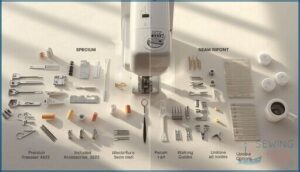
The Singer 4423 doesn’t just show up at your door ready to sew—it comes loaded with useful accessories that let you tackle different projects right out of the box. But here’s where it gets interesting: you can expand this machine’s capabilities way beyond what Singer includes.
Let’s break down what you get initially, what you can add later, and how easy it’s to find parts when you need them.
Presser Feet and Accessory Tray
You get four presser feet right out of the box with the 4423, and Singer doesn’t make you hunt for them—they snap into the accessory tray that clips onto your sewing machine. This tray design keeps your sewing accessories organized and dust-free, with room for 1–2 feet for quick swaps.
Here’s what makes this setup work:
- Snap-on compatibility with standard low-shank mechanisms means most presser foot options fit without drama
- Scratch-resistant tray material creates a stable surface during foot changes
- Integrated dust cover shields your presser foot storage from lint between projects
- Built-in slots for guide rulers reduce fabric misalignment during heavy-duty sewing
- Quick-access design lets you grab what you need without digging through drawers
The tray’s thoughtful presser foot storage makes this heavyweight sewing machine feel surprisingly easy to use.
Compatible Add-on Feet and Attachments
Beyond what’s included, you can access serious expansion potential with add-on presser foot accessories. The Singer 4423 accepts universal snap-on feet, so you’re not locked into brand-only sewing attachments. A walking foot transforms quilting tools performance on thick layers, while specialty foot accessories like non-stick Teflon or narrow hem feet expand your heavy-duty sewing techniques and tips repertoire.
| Attachment Type | Best For | Compatibility |
|---|---|---|
| Walking Foot | Multiple layers, slippery fabrics | Universal snap-on |
| Teflon Foot | Leather, vinyl, dense materials | Low-shank standard |
| Overcasting Foot | Edge finishing, preventing frays | Singer 4423 compatible |
Replacement Parts and Availability
Long-term ownership depends on sewing machine parts availability, and you won’t hit major roadblocks with the Singer 4423. OEM quality components ship from official Singer retailers, while aftermarket options fill gaps for common wear items.
- Part sources: Official Singer catalog and authorized service centers stock heavyduty components
- Regional distribution: US suppliers maintain consistent inventory; occasional backorders on specialty attachments
- Availability issues: Rare for standard needles and bobbins
- Sewing machine maintenance: Using original parts preserves warranty coverage
Maintenance, Reliability, and Warranty
You can’t just buy a machine and forget about it—keeping the Singer 4423 running smoothly takes a little upkeep, and knowing what might go wrong saves you headaches down the line.
The good news is that regular maintenance isn’t complicated, and Singer backs this machine with some coverage if things go sideways.
Here’s what you need to know about keeping your 4423 in fighting shape, handling common hiccups, and what the warranty actually covers.
Cleaning and Oiling Requirements
You can’t just sew and forget—your Singer 4423 needs regular love to keep crushing heavy-duty projects.
Clean lint from the feed dogs and bobbin area after fleece or knit sessions using a soft brush. For lubrication tips, apply sewing machine oil to the hook race every 8–10 hours of heavy use.
Proper thread management and maintenance costs stay minimal with this routine machine maintenance approach.
Common Issues and Troubleshooting
Thread breakage and stitch skipping plague even the Singer 4423—but you can fix them. Rethread the top and bobbin completely, then clean lint from the bobbin area to stop birds nesting.
Check your needle for damage by inserting it fully and switching to the correct type for thick fabrics.
Sticky feed dog issues? Remove the fabric, clean under the presser foot, and oil per your manual’s sewing machine maintenance schedule.
Warranty Coverage and Customer Support
Singer 4423 warranty claims start with 90 days of parts and labor coverage—short, but certain components get extended protection.
You’ll contact Singer customer support through phone or email, then ship your machine to authorized service centers for repair options.
Want peace of mind? Extended coverage plans exist, though most sewers skip them since replacement parts cost pocket change.
Value, Comparisons, and Recommendations
At around $200, the Singer 4423 sits in that sweet spot where you’re not gambling on a plastic toy, but you’re also not dropping serious cash on a machine you might outgrow.
You need to know how it stacks up against the competition and whether it’s actually worth your money. Let’s break down the value, see how it compares to similar heavy-duty machines, and figure out if this is the right machine for your skill level.
Price Point and Cost Efficiency
You’re looking at $150–$250 USD depending on sales and bundles—that’s solid mid-range territory. The Singer 4423 delivers serious value assessment for your dollar, especially when retailers slash prices during promotions. Your cost savings add up fast: replacement bobbins and needles run cheap, and that metal frame means expense reduction long-term since you won’t replace plastic-framed junkers every two years.
| Cost Factor | Singer 4423 Reality |
|---|---|
| Base Price Range | $150–$250 USD (varies by retailer) |
| Accessory Bundles | 32-piece presser foot set: $20 |
| Replacement Parts | Needles and bobbins: inexpensive, widely available |
| Warranty Coverage | 90-day parts/labor, extended for select components |
| Long-term Durability | Metal frame reduces replacement frequency vs. plastic models |
Price comparison across heavy-duty sewing machines shows the Singer Heavy Duty holding its ground. Sales knock it down to entry-level pricing while keeping intermediate performance—that’s your sweet spot. Add the 4.6-star rating from 18,000+ sewing machine reviews, and you’ve got proof this investment pays off. (Though honestly, I wish more retailers bundled a walking foot instead of making us hunt one down separately.)
Comparison to Similar Heavy-duty Machines
When you stack the Singer 4423 against rivals—Brother ST371HD, Janome HD3000—competitor analysis reveals tight races. Market trends show 600–800 SPM across the board, but durability tests prove metal frames win every time. Heavy-duty features overlap (solid construction, adjustable pressure), yet the 4423’s sewing speed hits 1100 SPM while costing less.
Here’s your heavy-duty sewing battlefield:
| Machine | Speed (SPM) | Frame Material |
|---|---|---|
| Singer 4423 | 1100 | All-metal |
| Brother ST371HD | 800 | Metal |
| Janome HD3000 | 860 | Cast aluminum |
Sewing machine comparison shows the Singer Heavy Duty delivering serious velocity without the premium price tag. You’re getting industrial-grade guts in a home package—that’s your edge. Sewing machine reviews confirm what durability tests reveal: fewer fancy stitches, more raw power, and longevity.
Pros and Cons Summary
Now that you’ve seen how the 4423 measures up, let’s cut through the noise. Sewing machine reliability meets raw heavy duty performance here—but nothing’s perfect. Your user experience depends on knowing what you’re getting before you hit the pedal.
| Pros | Cons |
|---|---|
| 1100 SPM speed tears through projects | Foot pedal sensitivity takes practice |
| Stitch quality stays consistent on thick fabrics | Buttonhole foot feels cheap |
| Metal frame = rock-solid stability | Needle threader only works at top position |
| Low maintenance costs with affordable parts | Noise level under heavy loads |
Singer 4423 delivers industrial guts without the price shock—that’s your competitive edge for heavy duty sewing. This sewing machine review confirms what matters: fewer decorative stitches, more muscle, and sewing performance that won’t quit when you’re layering denim.
Suitability for Beginners and Experienced Sewers
Whether you’re tackling your first hem or you’ve been stitching for years, this heavy-duty sewing machine caters to your sewing skill levels. User feedback from the sewing community confirms beginners nail basic projects fast—automatic threading and clear controls remove intimidation. Meanwhile, experienced sewers push the Singer 4423 hard on thick fabrics and complex garments without frustration.
| Sewer Profiles | Best For | Sewing Tips and Tricks |
|---|---|---|
| Total Beginners | Beginner projects, hemming, repairs | Start at low speed, practice threading |
| Intermediate | Garments, quilting, home décor | Experiment with presser foot pressure |
| Expert | Multiple denim layers, leather, canvas | Use heavy-duty needles, adjust tension |
| Hobbyists | Mixed fabric projects, gifts | Join online sewing for beginners groups |
| Small Business | Production sewing, repeat orders | Maintain regularly, stock replacement parts |
You’ll outgrow cheaper plastic machines fast, but the 4423’s metal frame keeps pace as your skills sharpen. That’s why repeat purchases dominate—it’s a rare sweet spot where beginner-friendly meets serious performance.
The Singer 4423’s metal frame grows with your skills—beginner-friendly power that serious sewers never outgrow
Frequently Asked Questions (FAQs)
Is the Singer 4423 worth it?
Yes, the Singer 4423 delivers serious value for around $ You’re getting a powerful heavy-duty sewing machine with metal construction, reliable performance, and cost efficiency that makes beginners and experienced sewers satisfied.
Is Singer 4452 better than 4423?
The 4452 edges ahead with more stitches, brighter LED lighting, and smoother feed on thick fabrics—but if you’re watching your budget, the 4423 delivers rock-solid Heavy Duty performance at lower cost.
What can the Singer 4423 do?
Think of it as your sewing Swiss Army knife—the Singer 4423 handles heavyweight fabrics like denim and leather, delivers 23 stitch options, and races through projects at 1100 stitches per minute.
Is the Singer 4423 loud?
You’ll notice the Singer Heavy Duty 4423’s motor hum sits around 60–70 dB at normal sewing speed—think quiet conversation.
Noise reduction improves with vibration control mats, and acoustic testing shows thicker fabrics briefly spike sound levels.
What troubleshooting tips are available for Singer 4423?
When your Heavy Duty sewing machine acts up, start with the basics: check needle threading, reseat the presser foot, and re-thread completely.
Most Thread Issues and Needle Problems vanish after cleaning lint from feed dogs.
How do I clean and maintain the Singer 4423?
Keep your Singer 4423 Heavy Duty sewing machine running smooth by clearing lint from the bobbin area, oiling moving parts per manual, and replacing needles after heavy projects—basic sewing hygiene prevents most headaches.
Where can I buy replacement parts for Singer 4423?
You’ll find genuine parts through Singer’s official parts shop, authorized dealers, and national sewing machine distributors.
Amazon and major online retailers stock Singer 4423 replacement components—needles, bobbins, feet—at killer prices.
Can Singer 4423 sew embroidery designs?
The Singer 4423 Heavy Duty sewing machine doesn’t do true embroidery—no built-in designs or hoops.
You can try free motion techniques with stabilizers, but for real design workarounds, upgrade to a dedicated embroidery machine.
How does the Singer 4423 handle delicate fabrics?
While this Heavy Duty sewing machine excels with thick fabric, you can master delicate settings using lower foot pressure, fine needles, and reduced fabric tension—just slow your speed and test thread choice first.
Can the Singer 4423 sew leather without a special foot?
You can sew light-to-medium leather on the Singer 4423 Heavy Duty sewing machine without a specialized presser foot, but you’ll need sharp leather needles, waxed thread, and careful stitch adjustments for reliable Leather Stitching results.
Conclusion
The Singer 4423 review results are clear: this machine delivers serious power without the premium price tag. It punches through thick fabrics, maintains consistent stitch quality, and backs it up with a metal frame that won’t shimmy across your table.
Sure, it’s loud and lacks fancy stitches—but if you need a workhorse that actually works hard, this is your machine. Stop overthinking it and start sewing.
- https://thequiltshow.com/quiltipedia/what-is-a-sewing-room
- https://www.instagram.com/sewingjulieblog/
- https://www.ai-literacy.se/research-prompts.html
- https://www.scribd.com/document/356795007/Research-Methods-Knowledge-Base
- https://pmc.ncbi.nlm.nih.gov/articles/instance/9553038/bin/pone.0275964.s005.docx